
23 February 2016

Denominations: When churches network.

DENOMINATION di.nɑm.ə'neɪ.ʃən noun. Organized network of affiliated churches.
2. Autonomous branch of a religion.
[Denominational də.nɑm.ə'neɪ.ʃən.əl adjective.]

When Jesus began his church, it had a really basic organization: The Twelve, the apostles whom he hand-picked to lead his followers… and his followers.

Over time this evolved. As it kinda had to, ’cause the church spread. The Twelve didn’t stay in Jerusalem: Simon Peter went to Rome, Andrew to Greece, John to Ephesus, Jude and Simon to Syria, Bartholemew to Armenia, Thomas to India, and so forth. The followers spread out to different cities in the Roman Empire, and to the barbarians outside the Empire. They founded new church groups.

All sorts of questions began to crop up about how connected these groups were with one another. Of course since power is always a stumbling-block for us humans, there was also concern about what authority various apostles and bishops in other groups had over the new congregations and their leadership.

The short version: The church remained one universal group for roughly a thousand years. I say “roughly” because it got mighty rough there near the end. Too many power struggles between bishops. Too many cultural and theological differences between Greek- and Latin- and Coptic- and barbarian-speaking churches. Too many hurt feelings. It all culminated in the Great Schism in 1054: The bishops of Rome and Constantinople declared each another heretic. From that point on there were two formal networks: The Orthodox Churches in eastern Europe, western Asia, and northern Africa, all of whom recognized one another as Christian; and the Roman Catholic Church in western Europe and the Americas, which only recognized itself as Christian.

The Orthodox and Catholics insist on calling themselves churches, not denominations. ’Cause their original attitude was they’re the real church, and any other “chuches” were heretic. (That’s largely still their attitude, though they’re a lot nicer nowadays towards the rest of us: They still figure they’re the real church, but the others are wayward. Not necessarily heretic. Though certainly some denominations are very much heretic.)

They’re not alone in shunning the word “denomination.” Two churches in my city insist on calling themselves “nondenominational”—yet both are heavily plugged into the “nondenominational” Bethel Church in Redding, Calif. Bethel hasn’t yet created a formal denomination, so the many churches affiliated with it, and no other group, figure they’re nondenominational. But they’re far from independent of all other churches. (Which is good. Go-it-alone churches are like go-it-alone Christians: They tend to get all weird and cultlike and heretic.)

Sometimes churches prefer another word, like fellowship or alliance or assembly or network. My denomination, the Assemblies of God, is kinda partial to “movement.” And—as is the case with episcopal groups like the Orthodox and Catholics—some consider themselves the one same single church with many, many campuses, no matter how big they are.

But despite what they call themselves, whenever we got a network of churches—loose or tight, doesn’t matter—I’m gonna refer to them as denominations. Sometimes “denom” for short. (Not to be confused with “demon.” I’ll leave that for the anti-denominational folks.)
19 February 2016

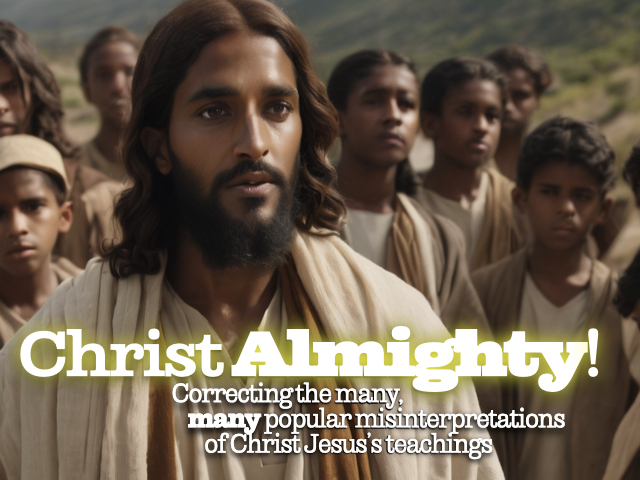
The baptism of Jesus. And adoption. And anointing.

Mark 1.9-11, Matthew 3.13-17, Luke 3.21-22.

Baptism, i.e. ritual washing, was usually for Jews who were ritually unclean: They’d touched an animal they weren’t allowed to eat, anything they found dead, an open wound; they’d expelled bodily fluids of one sort or another; in general they needed to wash themselves and their clothes before they went to temple. Pharisees co-opted the ritual and said you gotta do this before going to synagogue as well.

And John the baptist co-opted the ritual too, and used it on sinners who wanted to repent and get morally clean. Same practice, new idea.

Mark 1.9 KWL
It happens in these days Jesus comes from Nazareth of the Galilee,
and is baptized by John in the Jordan.
Matthew 3.13-15 KWL
13Then Jesus comes from the Galilee to the Jordan,
to John, to be baptized by him.
14John is preventing him, saying,
I need to be baptized by you¹!
And you¹ come to me?”
15In reply Jesus told him, “Just permit it.
It’s appropriate for us to fulfill everything that’s right.”
So John permitted him.

As you see, when Jesus came south from the Galilee, went to the Jordan, and wanted baptism, John rightly objected. I’ll write it again: Rightly objected. John’s baptism was for sinners. Was Jesus a sinner? Nope. Did Jesus need to repent? Nope; never sinned, so nothing to repent of. He 4.15 So what’d he think he was doing? If a man goes through a baptism of repentance, yet he isn’t repentant at all and feels there’s nothing for him to repent of… wouldn’t we call this hypocrisy?

Well we would, but we’d never call Jesus a hypocrite. So we usually look the other way at this, and give Jesus a free pass.

Yet at the same time, continue to teach that Jesus didn’t need repentance, and underwent baptism so he could be a good example for Christians who actually need to repent. In other words, we teach he was totally behaving like something he’s not—that he was acting like a hypocrite.

Should we be teaching such a thing in the first place? If Jesus is no hypocrite, should we be teaching anything at all which could, on closer inspection, easily make Jesus out to be a hypocrite?

I would say no; and also Jesus has a legitimate, non-hypocritical reason for wanting baptism. Let’s get to that.

14 February 2016

Love and romance.

I’m posting this article on St. Valentine’s Day, a feast day named for several ancient Christian martyrs named Valentine: Bishop Valentinus of Terni, Presbyter Valentinus of Rome, Valentinus of Raetia, Valentinus of Genoa, Valentinus the hermit, and Valentinus of North Africa. All their stories and myths got frapped together… and nobody cares about ’em anyway, ’cause Valentine’s Day is a commercial holiday. It’s meant to get people to buy stuff, or make various other expensive materialistic declarations of love, for the person they’re currently boning.

By “love” I mean one of the eight definitions of love. On Valentine’s Day, among Christians who know charity is the sort of love God is, the sort of love the scriptures point to… there might be some expressions of that: They love their partners with godly love. They want the best for their loved ones, even if that means sacrificing themselves. They expect nothing in return; it’s not a love which expects, even demands, reciprocity. They really do love like God does. Or strive to.

But Valentine’s Day isn’t at all about that sort of love. It’s about the romantic sort. It’s what the ancient Greeks meant by ἔρος/éros, the desire one has for the objects of their affection or infatuation, the desire lovers have for one another. (Éros is where we get our English word erotic.)

C.S. Lewis spent a quarter of his 1960 book The Four Loves on éros, and when Christians speak on love, a lot of times we likewise spend a chunk of time discussing éros. Although what we tend to do, incorrectly, is bash it.

  1. First we define it as romantic love, erotic love, or lust.
  2. Then we point out éros isn’t in the bible. (’Cause it’s not. Neither in the New Testament, nor the Septuagint.) It’s just a different Greek word for a concept we translate as “love”—which is all Lewis was writing about anyway. He was a classics scholar, after all; not a bible scholar.
  3. Then spend the rest of our sermon railing against éros for not being godly love, the ἀγάπη/agápi Paul defined in 1 Corinthians 13.

Expect all that to be part of nearly every Valentine’s Day sermon. Oh wait; let me throw in an extra bonus point:

  1. Some preachers will insist éros and romance aren’t any sort of “love.” Therefore we should only use the word “love” to mean agápi, to mean having patience and kindness and self-control and gentleness and all that other stuff Paul wrote. Romance isn’t love. Lust certainly isn’t love. So when people incorrectly use the word “love” to describe such things, correct ’em. “That’s romance. That’s lust. Not love. Real love is agápi.”

Sound about right?

But if you actually read The Four Loves you’ll notice Lewis didn’t define éros as romance or lust.

12 February 2016

John the baptist’s message for everyone else.

Mark 1.7-8, Matthew 3.11-12, Luke 3.10-20, John 1.26-28.

Previously I dealt with what John the baptist had to say to religious folks—people who already followed God, or at least were active in temple and synagogue. John didn’t come to preach to them; they already had prophets, and shouldn’t need to come to John and repent. He came to reach the people who had no relationship with God, who needed to get ready for their coming Messiah.

But you might notice Luke describes John’s message to the religious folks as being directed towards everyone. Religious and irreligious alike.

Luke 3.7-14 KWL
7John is saying this
to the crowds coming to be baptized by him:
“You² viper-spawn!
Who warned you² to escape the wrath of God?
8Fine then: Produce worthy fruits,
from repentant people.
Don’t start to tell yourselves²,
‘We have a father in Abraham’:
I tell you² God can raise up children for Abraham
from these rocks.
9The axe already lays at the root of the tree.
So every tree not producing good fruit
is cut down and thrown into fire.”
10The crowds are questioning John,
saying, “So what can we do?”
11 In reply John tells them,
You² who have two tunics:
Share with those who don’t.
You² who have food:
Do likewise.”
12Taxmen come to be baptized
and tell John, “Teacher, what can we do?”
13John tells them,
“Do nothing more than you were ordered.”
14 Soldiers are questioning John,
saying, “And we, what can we do?”
John tells them, “You² could stop shaking people down,
or stop accusing them falsely.
Be content with your paychecks.”

I explained the whole worthy fruits, making Abraham’s children from rocks, and axe at the foot of the tree stuff in the previous article. Here Luke includes John’s corrections to the people who came to him for baptism.

In general the problem is stinginess. The crowds needed to share their food and clothing with the needy. Yes, the Law had a sort of welfare system built in so farmers would leave gleanings for the needy, Lv 19.9-10 and so every third-year’s tithes would go to the needy. Dt 14.28 But then, same as now, people don’t bother to do any more than their obligations, and share food and clothing only with people we consider worthy—not so much needy. Loving our neighbor Lv 19.18 gets limited to thinking pleasant thoughts about them, not doing for them. It’s an attitude which always needs breaking.

The taxmen (KJV “publicans,” although Julius Cæsar abolished the publican rank in 30BC; NLT “corrupt tax collectors”) were customs agents. They sat in booths at ports and city gates, and charged everyone a fee to get in. Merchants especially: Usually 2 to 5 percent of whatever they were selling. (Which added up, especially when you transported goods from city to city.) Taxmen were usually already-wealthy men who bought their commissions from the city officials (usually Roman), because it was such a lucrative job. One of the perqs was the ability to set the rates above what the city required, and pocket the difference. Or cheat the merchants with faulty scales, and again pocket the difference. It’s why they were so hated. And why they knew they needed to repent. “Don’t steal” is one of the 10 commandments, y’know.

Lastly soldiers. Who were likely—and kinda surprisingly—Roman soldiers. This is the first time we see gentiles really getting involved in the gospel, but Luke wanted to make it clear in his gospels (both Luke and Acts) that God’s kingdom is likewise for gentiles. And interestingly, John initially responded to them with what they could do, not commands: They could be more fair and just in their duties, instead of hassling the locals and trying to rob them. As gentiles, they weren’t under the Law, so John couldn’t command them to follow it in quite the same way. But like the taxmen, they also knew they needed to repent.

05 February 2016

John the baptist’s message for the religious.

Didn’t sound too pleased with them.

Matthew 3.7-10 • Luke 3.7-9 • John 1.19-23

In Matthew and Luke’s parallel stories, John the baptist comes across a bit hostile towards the religious folks who come to check him out.

Matthew 3.7-10 KWL
7 Seeing many of the Pharisees and Sadducees coming to his baptism, John told them,
“You viper-spawn! Who warned you to escape the wrath of God?
8 Fine then: Produce worthy fruit, from repentant people.
9 Don’t presume to tell yourselves, ‘We have a father in Abraham’:
From these rocks, I tell you, God can raise up children for Abraham.
10 The axe lays at the root of the tree right now.
So every tree not producing good fruit is cut down and thrown into fire.”
Luke 3.7-9 KWL
7 John said this to the crowds coming to be baptized by him:
“You viper-spawn! Who warned you to escape the wrath of God?
8 Fine then: Produce worthy fruits, from repentant people.
Don’t start to tell yourselves, ‘We have a father in Abraham’:
From these rocks, I tell you, God can raise up children for Abraham.
9 Plus, the axe lays at the root of the tree right now.
So every tree not producing good fruit is cut down and thrown into fire.”

In John, not so much, but then again they’re not there to prejudge him, but find out just who he claims to be.

John 1.19-23 KWL
19 This is John’s testimony when the Judeans sent priests and Levites from Jerusalem
so they could ask him, “Who are you?”
20 He conferred with them, and didn’t refuse to answer: “I’m not Messiah.”
21 They questioned John: “Then what? Are you Elijah?” He said, “I’m not.”
“Are you the Prophet?” He answered, “No.”
22 So they told him, “Then what?—so we can give an answer to those who sent us.
What do you say about yourself?”
23 John said, “I’m the voice shouting in the wilderness, ‘Straighten the Master’s road!’ Is 40.3
like the prophet Isaiah said.”

These folks would be:

  • Pharisees, whom I dealt with elsewhere. These are the religious Jews, as opposed to the irreligious, secular Jews. Many were actually trying to follow God. And same as us Christians, many were hypocrites, faking it for social and political acceptance. Jesus sparred with the hypocrites a lot, but don’t get the wrong idea all Pharisees were that way.
  • Sadducees. Our present-day equivalent would be those pagans who call themselves “spiritual but not religious”—they believe in God, but not religion. Freakishly, these are the folks who ran the religion: The head priest, his family, and the leading families of Jerusalem, were in this camp. They believed in God and the Law, but not the supernatural: No angels, miracles, afterlife, End Times, resurrection, or prophets beyond Moses. Just God.
  • Levites. You may have heard Israel had 12 tribes. They actually had 13, and Levi was the weird 13th tribe which had no land, lived in cities, and took turns serving in temple. Only Levites could be priests, and John was a Levite himself. Some were Pharisees, some Sadducees, some in other denominations. But all were involved in temple.
  • “The crowds.” In Luke John is hostile to everybody, not just religious folks. Everybody gets slammed with his preaching. No exceptions. But it’s fair to say most of them were Pharisees, which I’ll explain in a bit.

John’s reaction to them was essentially, “What’re you doing here? Aren’t you saved already?”