
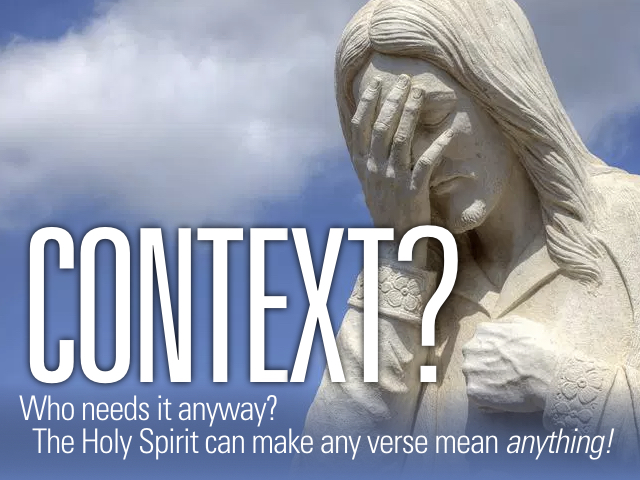
Years ago a pastor gave me a daily devotional, and this year I decided to actually use it. It consists of 366 really short, three-paragraph excerpts from E.M. Bounds’s writings. Edward McKendree Bounds (1835–1913) was a Methodist preacher and Confederate chaplain whose sermons on prayer were collected into a number of books, and once the books got into the public domain, Christian publishers have been cranking ’em out like he’s the best writer on prayer there ever was. Meh; he’s unnecessarily wordy (as was the popular style in public speaking in the 1800s), and he’s made too many problematic statements about
The devotional starts with a bible verse or two, gives the Bounds passage, and ends with a short written prayer. Made in China, printed in brown ink, bound in fake leather, with a built-in ribbon for a bookmark. The sort of devotional they sell in bible bookstores for $4.99 and stash by the checkout. It’s not very good, but you get what you pay for.
Anyway, I was flipping ahead a few pages and noticed a verse for the day came from Job, chapter 5. Who’s speaking in Job 5? It’s not Job; it’s his friend Eliphaz from Teymán,
Job 42.7-9 CSB 7 After the LORD had finished speaking to Job, he said to Eliphaz the Temanite, “I am angry with you and your two friends, for you have not spoken the truth about me, as my servant Job has.8 Now take seven bulls and seven rams, go to my servant Job, and offer a burnt offering for yourselves. Then my servant Job will pray for you. I will surely accept his prayer and not deal with you as your folly deserves. For you have not spoken the truth about me, as my servant Job has.”9 Then Eliphaz the Temanite, Bildad the Shuhite, and Zophar the Naamathite went and did as the LORD had told them, and the LORD accepted Job’s prayer.
Eliphaz’s advice is bad advice. Untrustworthy. Unreliable. Slanderous.
So what’s it even doing in the bible? It’s there to warn us how not to think about God. It’s there as a representative of the popular thinking, of what passed for
Here’s the problem: People don’t read. And of course they don’t read Job either. The few times they do, they read the beginning, when Satan destroys all Job’s stuff, and the end, when God gives it back, and largely skip the middle—the parts we were meant to read, and learn how not to think.
Or they read it when they’re gonna preach a sermon about a particular topic. (Like prayer, which makes sense for a prayer devotional.) So they get out their Nave’s Topical Bible and read all the bible verses,
That’s exactly what this devotional did. Quoted Elphaz like he knew what he was talking about. Doesn’t Eliphaz say he knew what he was talking about?
Job 5.27 CSB - “We have investigated this, and it is true!
- Hear it and understand it for yourself.”
Yeah, you “investigated” it like those people who “investigated” vaccines on the internet. It’s just as full of rubbish.
Not my first rodeo.
Decades ago I attended a Baptist church whose pastor was really fond of preaching about a different topic each week, and quoting dozens of verses from all over the bible to prove his points.
I had just graduated from seminary, where the faculty really discouraged us from preaching topical sermons. They preferred where you pick a single passage from the scriptures, analyze its pants off, then share everything you discovered. I took it to heart, and regular readers will notice I usually write that way. But regardless, I don’t actually have a problem with topical preaching and writing—if you’re gonna teach theology, often you have to jump all over the bible to show these ideas aren’t solely found in one place; they’re a consistent description of God. But of course you’d better quote
Well, this pastor didn’t always. No, he wasn’t trying to twist anything… but yep, he was preaching almost directly from Nave’s. And Nave’s doesn’t care about context. The editors expect us—probably naively—to do our homework and double-check the context of every verse we include. And lazy pastors presume Nave’s already did that for them, so they don’t bother. So yep, Pastor quoted one of Job’s friends. And I caught him.
To his credit, he gave a retraction the next Sunday: “I quoted one of Job’s friends, and I shouldn’t have done that. I apologize. I’m glad you caught me! Keeps me honest.” Well I never doubted his honesty—though I would have if he tried to sweep his error under the rug, as a prideful pastor might do. He was absolutely right to point out his listeners should pay attention to what he’s saying, and fact-check him. It reminds our pastors to take their bible study seriously.
The next time I caught someone quoting Job’s friends, he was not so humble. He insisted Job’s friends could be quoted—they’re in the bible, and the bible is always trustworthy. And yes it is—when we don’t misrepresent it! Job’s friends are in the bible to show us how people sound when they’re wrong about God. We quote ’em to say, “Here’s what some people believe about God, and it’s false and they’re wrong.” We don’t quote ’em to say, “Here’s what the bible says about God.” We could do that with Satan!—we could quote something it claimed and say, “Well it’s in the bible,” and ignore the fact
And some Christians regularly quote Satan in just that way. You might know the passage in which it offers Jesus the world:
Luke 4.6 CSB - The devil said to him, “I will give you their splendor and all this authority, because it has been given over to me, and I can give it to anyone I want.”
And on this basis, certain Christians claim the devil owns all the kingdoms of the world. It does not. Jesus conquered the world.
Yes the bible is trustworthy—but use your head. When the bible trustworthily indicates some passages and people aren’t to be believed, don’t believe ’em. Don’t quote them unless you first warn people, “This is not a trustworthy saying.” And when you get caught quoting ’em wrong, don’t try to bluster your way out of confessing wrongdoing. You messed up. Fix it. Then don’t do it again.
