21 July 2020

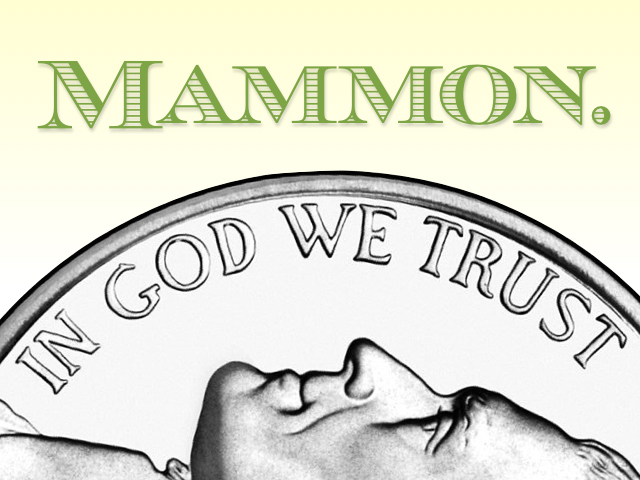
The “prosperity gospel”: Mammonism disguised as Christianity.

PROSPERITY GOSPEL prɑs'spɛr.ə.di 'gɑs.spəl noun. The good news that God doesn’t just want to save his people, but bless us materially.

That’s not an ironic definition, folks. That’s legitimately how the prosperity gospel is defined by those who proclaim it. God doesn’t just want us to come live in heaven’s kingdom with him. As we’re headed thataway, he wants us to be materially successful and comfortable.

For totally legitimate reasons, they claim. Remember when Moses was advising the Hebrews to follow the Law in Deuteronomy, and how he said part of the blessings they’d receive for doing so would be material? Oh you don’t remember that bit? Fine; I’ll quote it.

Deuteronomy 28.1-13 KWL
1 “If you happen to listen to your LORD God’s voice,
so as to observe and do every command I instruct you about today,
your LORD God will give you power over every country on earth:
2 All these blessings will come to you and overwhelm you, for you listened to your LORD God’s voice.
3 You’ll be blessed in city, field, 4 the fruit of your belly, the fruit of the ground,
and the fruit of your animals—what your cattle births, or your flocks produce.
5 You’ll be blessed in breadbasket, in yeast; 6 when you enter, when you leave.
7 The LORD will have your enemies which rise against you be struck down in front of you.
They’ll come at you from one direction, and run away from you in seven.
8 The LORD will teach you about blessing in your storehouses, in everything you undertake.
He’ll bless you in the land your LORD God gives you.
9 The LORD will raise you to himself: A holy people, as he swore you’d become.
So observe your LORD God’s commands. Walk in his ways.
10 All the earth’s peoples will see you call upon the LORD’s name, and fear you.
11 The LORD will give you a good surplus, fruit of your belly, beasts, and your ground,
in the land the LORD swore to give your ancestors.
12 The LORD will open his good, heavenly treasury for you:
He’ll give rain to your land in its season. He’ll hand over every deed.
Many nations will owe you, and you’ll never borrow.
13 The LORD makes you the head, not the tail. You’ll go upward, not downward.
So listen to your LORD God’s commands. Observe and do what I’m instructing you today.
Don’t dismiss any words I command you today. Don’t go right or left, to follow or serve other gods.

This passage was addressed to the ancient Hebrews, and applies to whether they as a nation followed the Law in the land he gave ’em. Does it apply to present-day gentiles, not as nations but individuals, who live in all sorts of other lands, Christian or not?

Well, the prosperity-gospel folks certainly believe so. This, they figure, is why God’s made the predominantly-Christian United States so profoundly rich. (Ignoring the fact we’re actually up to our eyeballs in debt, and only look rich. We borrowed our riches.) So if they individually follow God’s commands, refuse to turn right or left away from them, and serve no other gods but the LORD, they’re counting on God blessing them with growth and surplus.

Well… okay, they don’t always figure they gotta follow God’s commands necessarily. But if they follow God’s general principles, and believe really hard, they expect God’ll make ’em prosperous just the same.

Well… okay not all God’s general principles. Plenty of them have no problem with being as dishonest, covetous, and promiscuous as any pagan. They’re kinda focused on a few principles. Namely it’s these three:

  • ACT LIKE GOOD CHRISTIANS. In public, anyway. God wants to make his people rich so that pagans’ll get jealous and wanna become Christian. But it doesn’t work when his people don’t act Christian. So behave yourselves! Quit sinning. Get rid of the negative attitudes, and let everything which comes from your mouth be encouraging and confident.
  • GIVE, AND IT’LL BE GIVEN YOU. Loosely based on Jesus’s teaching about generosity Lk 6.38 but only applied to giving to one’s church. If you give sacrificially large amounts to your church, God’ll reward you tenfold. Or more, depending on the preacher. But giving to the needy isn’t so necessary. God doesn’t wanna give them wealth unless they practice these principles, so no going around him, okay?
  • NEVER EVER DOUBT. Unless you wanna lose your blessing, don’t ever, ever question prosperity beliefs. Not in your mind, not in public, not ever. You gotta believe, and keep believing, that God’s gonna enrich you. Even when he doesn’t. Even when he hasn’t for years or decades.

Stick to these three principles, and watch the riches come pouring in. Guaranteed.

After all, look at the preacher. He follows these principles, and as a result, his church is flush with cash, he has a seven-figure income, he has a Bentley and a Gulfstream and a really nice house, he wears expensive suits and gold jewelry—he’s been blessed! Follow his example, and you’ll be blessed too.

If this sounds like a giant scam to you, that’s because of course it’s a scam.

Stuck in the scam.

And it’s a very-well crafted scam too. It’s had about three centuries of development and fine-tuning, as Americans tried to figure out how to reconcile our riches, or our mad pursuit of riches, with Christ’s teachings.

Since a lot of Pentecostals have adopted it, a number of people think we came up with it. Nah; for a while it used to be called the health-and-wealth gospel, and that predates the Pentecostal movement by a century. But Pentecostals have been pioneers in multimedia, which is why a lot of Christian TV and radio shows are Pentecostal—and of course, all the health-and-wealth preachers who happen to have TV and radio shows, also happen to be Pentecostal.

Like most scams, it works great for the person on top. The pastors who preach prosperity are frequently gonna be prosperous once everybody starts giving to their ministries—and, they hope, giving a lot to their ministries. Way more than the traditional 10 percent; sometimes as much as 60 percent. I’m serious.

It’s intentionally designed to discourage questions and criticism. If you’re legitimately wondering how these “promises” of wealth work, considering their proof texts don’t apply to present circumstances at all, you’re gonna be condemned and rebuked by both the leaders of these churches, and by the people who are striving for prosperity, for your “negativity” and doubt. Even though it’s exactly the right kind of doubt. You’ll be told your doubts cancel out your blessings; you’ll never be prosperous so long that you question the system. And some of ’em are a little worried your negativity might affect them—that if God decides to smite you, he might accidentally hit them too. So quit doing that!

It’s unintentionally designed to encourage undisciplined financial behavior. People imagine their windfall from God is gonna arrive any day now, so they don’t plan ahead. There’s nothing in the savings account. The credit cards are maxed out. They’re already buying all the accoutrements of wealth. They got that ridiculous mortgage and that ridiculous second mortgage. America’s in debt to its eyeballs; their debt level would be up to the eyeballs of someone standing on their shoulders.

Undisciplined financial behavior also extends to their churches. They give loads of money, but pay no attention to how the church, its board, and its leadership handles the money. The pastor’s salary is wholly inappropriate for any person who runs a nonprofit. The pastor’s wholly unnecessary entourage is also well-paid… but most of the projects they’re working on were invented so they could have something to do, and justify their salaries. The church gives far too little to charity, benevolence, and missions. Large sums of money are regularly wasted on frills and perquisites.

The system is also designed to encourage hypocrisy. ’Cause you gotta look good! But you don’t necessarily gotta be good.

If you’re wondering how people can fall for this scam, you gotta remember things look very different from their point of view. Every Christian in their circle has likewise fallen for this scam. So its theology and practice appear to be, as far as they can tell, “normal.” Since they don’t know how to look at the scriptures in context, as far as they can tell the proof texts are totally solid: Isn’t this what every true Christian is supposed to believe? So those folks who claim prosperity teaching is bunk: They’re the ones who’ve been scammed. They’re doomed to live without victory, without prosperity, without success, because of their negative, pessimistic mindset. Of course they don’t believe in a gospel of wealth; at this rate they’re never gonna see wealth.

Yeah, it’s pretty cultlike. So much so, certain Christians claim the prosperity gospel is heresy. But technically they’re not heretics. Prosperity churches (unless they’re oneness churches; some of ’em are) don’t really teach anything contrary to the creeds.

Well, unless you count the fact they’re worshiping Mammon instead of Jesus.

Well they are.

Mammonism is of course the worship of wealth. We call wealth “Mammon” because it’s a convenient way of making it crystal clear we’re talking about idolatry. In the United States, where we’re taught every American has the potential of gaining great wealth, Mammon’s a popular god: Americans devote our lives to getting rich, by hook or by crook; by compromising every other thing we claim to believe in, because everything else takes a back seat to wealth acquisition: Friends, morals, family, even our own freedom. Even, ironically, our own wealth.

And if people identify themselves as Christian, that’s often gonna take a back seat to wealth acquisition too. We’re gonna join a stingy church, which doesn’t give, and doesn’t expect us to give either. Or we’re gonna join a prosperity church, which demands we give, but promises God’ll pay us back in bucketloads. As a reward for our trust and faithfulness (and our silence when we discover it has problems), we’re told God will give us full, unrestricted access to Mammon. All the Mammon we can eat, and rub all over our bodies.

In this way God gets turned into a means to an end. The end, the true object of worship, would therefore be Mammon. We’re supposed to follow God because we want God; we wanna be with him in his kingdom forever. Not because we want mansions, streets of gold, riches, health, and comfort. Not because we expect that stuff in the next age, nor because we’re told we can have that stuff in this age. If you’re following God because you want peace, you’re unintentionally worshiping peace; if you want heaven, you’re worshiping heaven; if it’s ultimately about wealth, you’ve embraced Mammon.

Whoops.

Prosperity-gospel folks are entirely sure this isn’t true: They don’t worship wealth; they worship God! Who’s promised them wealth. And if he never comes through for them with the wealth, they’ll be disappointed, but they’re still gonna worship God. But here’s the thing: They’re entirely sure he will come through for them with the wealth. Maybe, in their heart of hearts, they realize he won’t pony up the dough in this age. But after they’re resurrected, after they’re shown their new home in New Jerusalem, they’re expecting the nicest of mansions. It’ll come eventually. It’s just they figure it’ll come much sooner than that.

So to their minds, wealth and God are a package deal: You get God, you get prosperity. You get the LORD, you get Mammon. Six of one, a half-dozen of the other. Jesus said we can’t serve both God and Mammon, Mt 6.24, Lk 16.13 but prosperity gospel folks figure why serve it when God’ll just give it to us, free? And thus we sorta can serve both God and Mammon. In your face, Jesus!

Okay, that “in your face, Jesus” bit is a lot more blatant than prosperity-gospel folks are willing to be. Instead they’ll just quietly undermine the gospel of Christ Jesus by adopting various views which run contrary to his teachings, but which suit the prosperity gospel just fine.

Disrespecting the needy.

Animals fight for survival and supremacy. The animals which win get to pass down their genes, and the animals which lose, don’t. Charles Darwin figured this was how evolution works: The better genes and traits survive, and improve the species. Capitalists figure the marketplace and workforce works the same way, and call this social Darwinism.

Here’s the thing: In nature, the better genes and traits don’t always survive. Ec 9.11 Quite frequently dumb luck, not survival of the fittest, is how things work. And in the marketplace and workforce, people likewise beat the competition through dumb luck. Or by cheating; there’s nepotism, bribery, blackmail, lowballing the competition, insider trading, rules violation, various unfair advantages, various disadvantages like institutional racism, sexism, ageism, and prejudices against the disabled or the previously incarcerated.

The prosperity gospel claims the only reason you’re needy is because you don’t believe hard enough. The only reason you’re poor, sick, disadvantaged, or in any way not successful nor prosperous, is all your fault. Jesus claimed the good news is for the poor, Lk 4.18 and the prosperity gospel would agree—but with a very different spin on Jesus’s meaning. The good news is for the poor only when you believe really hard. Otherwise it’s really not.

So when people actually are needy, or become needy—a hurricane floods a city, or a tornado or earthquake knocks its buildings down, or a volcano burns ’em away—the prosperity gospel really has nothing to say to such people. According to them, bad stuff doesn’t happen to God’s people. When it does, they can’t really be God’s people, can they? Not anymore, at least; they must be sinning. They stopped believing. Somehow they’re deficient, so God took their stuff away. (Like he did Job—but they consider Job a special exception to teach a special lesson.)

This blame-the-needy-for-being-needy mentality is a very old one. The Pharisees had it, which is why they were so quick to dismiss the guy born blind whom Jesus cured. Jn 9.34 Jesus’s students had picked some of it up from the Pharisees, which is why they initially asked Jesus whether the guy was blind because he or his parents sinned. Jn 9.2 Jesus had to correct them, Jn 9.3 because while we create a lot of our own luck, some of it we don’t. Some of it is just plain meaningless.

But the true gospel is that God loves the needy. That he came to meet those needs.

Prosperity-gospel folks suck at being aid and comfort to the needy. Not that some of ’em don’t try; that despite what their churches and preachers claim, they do know enough of Jesus’s teachings to recognize they need to be generous to everyone, and love everyone regardless of merit, just like their Father. They may not realize the practice of this love violates every principle of the prosperity gospel—that you’re supposed to merit God’s riches by believing really hard!—but it’d seem they follow Jesus a lot more than their teachers do.

And this is the route we need to take when we’re correcting the people who believe in the prosperity gospel: Emphasize the needy. God cares about the needy. They care about the needy. So what’s the deal with a belief system which condemns the needy?

16 July 2020

Being a jerk: “It’s just who I am.”

Many a novelty T-shirt warns you they’re coming. “I speak fluent sarcasm,” or “If you can’t handle me at my worst, you don’t deserve me at my best,” or “Back up till I’ve had my Risperdal coffee,” or “I can go from zero to [awful] in 60 seconds.” There, that counts as their necessary legal notification that they’re gonna be a jerk.

That, and pitching a hissy fit when somebody asks ’em to put on a face mask. Yeah, those folks are just a ray of sunshine whenever their faces screw up… Sorry, I’m also kinda fluent in sarcasm. But I’ll stop now.

I used to be a jerk myself. It came out as sarcasm, which is how I got away with it for so long in Christian circles: It amused and entertained people. I still have pastor friends who enjoy the fact I can say the things they can’t. Not because I’m being a dick and they have to be better than that; plenty of pastors are dicks, and Christ Jesus expects better of both them and me. No; it’s because when the things I say bug people, it’s not gonna make ’em quit my church, or try to get me fired. But back in my a--hole days, my pastor friends were jerks like me, and appreciated how much better I was at ridiculing people than they. I had more practice, I guess.

In any event, I mocked people so often I became known as “the sarcastic guy.” Which is not a badge of honor… but I wore it like one. I thought it was a compliment: “Look how clever he is.” Wasn’t just me either: When people met my family members, they immediately noticed we were all that way. Looked like it was hereditary: Mom did it, Grandpa did it; it’s our thing. So that became my excuse: It’s in my genes.

It really wasn’t. Sarcastic people are angry, the anger gets turned into angry humor, and that’s where sarcasm comes from. Grandpa was angry that Grandma treated him like crap. Mom was angry that Dad treated her like crap. I was angry with Dad too; same reason. Sarcasm was my outlet, and since I didn’t know psychology I of course misdiagnosed the problem. And since I enjoyed making fun of others, I justified the problem: It was hereditary. I was born that way.

Humanity does the very same thing with all our favorite sins: We blame ’em on anything but ourselves. It’s because we’re the products of evolution, of our environment, of the culture, that our families messed us up, that it’s a birth defect… and of course that it is a product of our birth, but it’s not a defect; it’s like mutations in the X-Men movies, which might have their down sides but ultimately grant us superpowers. We take neither credit nor blame for them; we can’t help them either way. We have no control. It’s all predetermined.

And if it’s all predetermined, if it’s all part of the design and the plan for the universe, who’s ultimately responsible? God. He put it in us. Who else?

And God is good, and God doesn’t create evil, so if he made me this way, it can’t be evil. Doesn’t take long before determinists discover this logical argument, and immediately apply it to themselves: “I may be a rotten bastard first thing in the morning, but God didn’t make me a morning person; he made me this way. So back up. Touch not the Lord’s anointed.

So yeah, this is how jerks justify a whole lot of jerkishness. We pass the buck to God.

God’s not gonna accept it though.

I didn’t put it in you.”

Yes, in the beginning God created humanity, and called us good. Then humanity sinned, and now we’re not good. We sin; we’re self-centered. God didn’t put those traits in us, and it’s wrong to credit him with ’em. Even when we like some of those traits; if we think they’re badass. God doesn’t agree.

Imagine an automobile manufacturer who puts out a really good, reliable car, then sends ’em to the dealerships. The dealer thinks they’ll sell better if she repaints them, so she does. The dealer’s mechanic thinks he knows a trick to get better mileage out of the cars, so he tinkers with the engines. The customers don’t know any of this, and when they buy the cars they assume they’re getting ’em just as the manufacturer made ’em. Well, that’s kind of humanity’s deal. We’re not as God originally made us. Sin’s tweaked us a bunch. We need a factory reset.

The stuff God actually does put into us, is the fruit of the Spirit. We just have to cooperate with the manufacturer. But we don’t; we’re kinda fond of the “customizations”—which are actually flaws.

Jerks enjoy being jerks. They don’t care to change their character and become more like Jesus; they’d far rather be jerky than fruity. They like being known as the tough guy or the bad b----; they identify with these traits and consider them essential to who they are. They don’t want the Holy Spirit to mess with “perfection.”

But he will, ’cause he’s got an entirely different idea of perfection.

I had to get over my desire to remain “the sarcastic guy.” The Holy Spirit had to convince me I need to be better than that. ’Cause as far as I was concerned, there wasn’t better. Sarcastic Guy had fans, got laughs, was fun. I had a few arguments with the Spirit about it; I wasn’t gonna win, but I didn’t know any better. I insisted this was who I am, but he countered with, “But I didn’t put it in you.” And if it didn’t come from God, it’s gotta go. True of everything.

A lot of people are avoiding this particular conversation with the Holy Spirit… ’cause deep down, they know it’s coming. He really does want us to change, to become better people, to be more like Jesus, to produce fruit. And we’d really rather not. We’re comfortable where we are. We’re having fun; why’s the Spirit anti-fun? Well he’s not, but they don’t trust him enough to accept that he knows better, and has better things in mind for us.

He’s not content to leave us where we are. We shouldn’t be content where we are either. We should always strive for self-improvement. The path to that, is through Jesus. Follow him.

15 July 2020

Zeal’s a work of the flesh.

Frequently the excuse Christians make for being jerks is… they’re just so dedicated to God. He comes first. Orthodox truth and godly standards and biblical principles come first. Your feelings, your hangups, your boundaries, your convictions, most definitely do not—nothing comes before God. They’re never gonna compromise that. It’d be idolatry.

So while they’re defending God and his favorite things (which coincidentally happen to be their favorite things, ’cause projection they’re so tight with God), if they happen to set aside kindness, patience, gentleness, forgiveness, grace, love, or any other of the Spirit’s fruit… well, that’s just gonna be a casualty of the culture war. Fruit’s important and all that, but orthodoxy? Principles? Standards? Absolute truths? We can’t compromise those things; the whole universe will fall to pieces if we do. But we can totally compromise fruit, ’cause on God’s cosmic totem pole fruit’s probably not that important.

Which only goes to show how Christian jerks don’t really know God as well as they imagine. The Spirit’s fruit is God’s character. You think his character’s not important? Not so important, he deposited God himself in us so he can teach and grow this character in us, transform our very nature, and make us like Jesus? Seems fruit’s rather high on God’s list of priorities. But not theirs. They’d rather remain the same jerks they’ve always been, but slap Christian labels on all their works of the flesh instead of do the hard work of transforming into what God wants them to become. It’s way easier. It’s hypocrisy though.

And one of the things they slap Christian labels upon, is their impatience. Which they call zeal, and claim God wants ’em to be zealous. Wasn’t Jesus zealous when he flipped those tables in temple?

John 2.12-17 KWL
12 After this, Jesus went down to Capharnaum with his mother, his siblings, and his students.
They stayed there—not many days; 13 it was nearly the Judeans’ Passover.
Jesus went up to Jerusalem, 14 and in temple he found cattle-, sheep-, and pigeon-sellers,
and coin-changers taking up residence.
15 Making a whip out of ropes, Jesus threw everyone, plus sheep and cattle, out of temple.
He poured out the money-changers’ coins, and flipped over the tables.
16 He told the pigeon-sellers, “Get these things out of here!
Don’t make my Father’s house a market-house!”
17 His students were reminded it’s written,
“The zeal of your house will eat me up.” Ps 69.9

Look how zealous Jesus was for his Father’s house! Shouldn’t we be just as zealous for our Father’s house?—and for all the things in it, like orthodoxy and principles and standards? Shouldn’t we be willing to whip a few people if need be?

Here’s the problem: When Paul wrote about the Spirit’s fruit in Galatians, he first stated there are a few character traits we shouldn’t see among Christians, ’cause they indicate a person who’s not following the Holy Spirit. Instead they’re following their own selfish, fleshly impulses. And he provided a list—not a comprehensive one, but it gives us the general idea—of the behaviors we’ll find in such people.

Galatians 5.19-21 KWL
19 Fleshly works are obvious in anyone who practices the following:
Promiscuity. Uncleanness. Unethical behavior.
20 Idolatry. Addiction. Hatred. Rabble-rousing.
Too much zeal. Anger. Partisanship. Separatism. Heresy.
21 Envy. Intoxication. Constant partying. And other people like these.
I warn you of them just like I warned you before:
Those who do such things won’t inherit God’s kingdom.

Now check out that item in the second line of verse 20: “Too much zeal.”

Sometimes fleshly… and sometimes not.

What’s it say in the original Greek text of Galatians? Ζῆλος/zílos. Our word comes from their word. It’s not a different word. But it certainly gets translated as other words:

  • AMPLIFIED, CSB, ESV, GNT, ISV, MEV, NASB, NET, NIV, NLT, NRSV, TLV, VOICE: Jealousy.
  • CEB: Obsession.
  • GENEVA, KJV: Emulations.
  • WYCLIFFE: Indignations.

Jealousy, y’notice, is the most popular translation. Because people don’t wanna translate zílos as zeal.

In part because of that quote from John, which is a quote from Psalms, “The zeal of your house will eat me up.” Jn 2.17, Ps 69.9 If Jesus was zealous, and zeal is fleshly, we can’t say Jesus was being fleshly. The Spirit’s fruit is his character and nature; fleshly works are antithetical to Jesus’s very nature!

Likewise Paul wrote it’s okay to be zealous in certain situations—and in the very same letter to the Galatians; in just the chapter before.

Galatians 4.17-18 KWL
17 The legalists are zealous for you. Not for your good:
Instead they want to isolate you, so you can be zealous for them.
18 Being zealous is good—when it’s for every good thing,
and not only when I’m present with you.

He used the verb-form of zeal, ζηλόω/ziló. Means the same thing. And stated zealousness is good—when we’re zealous for good things. When we’re zealous for God, for trusting and following Jesus, for loving our neighbors, for the scriptures… and yes, even for orthodoxy, principles, and standards.

Yet Paul still called zeal a work of the flesh. Because, when misplaced or taken to extremes, it can go very, very wrong.

Same with jealousy. Y’notice those other bible translations turn zílos into “jealousy,” figuring zeal’s fine but jealousy’s not. Well, sometimes jealousy is fine. God is jealous. Straight-up calls himself jealous. Ex 20.5, 34.14 Which means he doesn’t want us worshiping anyone but him, and he’s right to feel that way; worshiping anything else will ruin us, and not because God does the ruining. And when humans get jealous, it’s likewise because we want someone’s exclusive devotion. Sometimes rightly so! You don’t want your spouse lusting after other people; you likewise don’t want our fellow Christians trying to borrow contradictory ideas from other religions, just because they prefer what the Buddha taught to what Jesus teaches.

Now. When I point this fact out to certain Christians, it freaks them out. Because they like their lists of dos and don’ts to be absolute: Always do this; never do that. Makes it simple. Means you don’t have to think too hard. Means you don’t have to practice wisdom—and there’s the real issue, right there. They’d rather not think! Or they’re a bit legalistic, and would prefer that other Christians not think; just act. They don’t want such things as situational truths, to exist. Some of ’em insist there are no such things; that everything’s a black-and-white issue; that this is how loopholes and relativism and sin happen.

But the reality is the bible was written for wise people. And if you lack wisdom, go get some; the Holy Spirit’s giving it out for free. Jm 1.5 He’ll tell you where and how to apply it. He’ll tell you whether you’re practicing proper zeal for God’s house… or improper zeal, which rightly alienates Christians and pagans alike.

Improper zeal.

And of course improper zeal demonstrates most of the other works of the flesh. It’s unethical. Hate-filled. Rabble-rousing. Angry. Partisan. Separatist. Heretic. Envious. And when it’s hopped up on caffeine, sugar, alcohol, adrenalin, or (less likely, but it happens!) liquor and cocaine, yep it’s intoxicated.

Improper zeal ditches the Spirit’s fruit because that stuff gets in its way. It doesn’t bother to be patient and kind. It claims it’s acting in tough love, or harsh love, or “love” modified by all sorts of adjectives which take all the actual love out of it. It’s not about winning people over, but about winning—we gotta defeat our opponents in the debate, or purge sinners instead of rehabilitate them. It’s not about growing closer to Jesus, but about achieving personal goals in knowledge, power, or prestige. It’s not about love of God; it loves his stuff or his perqs, like miraculous power or New Jerusalem—and God himself is secondary, and sometimes we can even take or leave him.

Proper zeal exhibits good fruit: More love, more patience, more grace. Those who demonstrate proper zeal are never gonna get called jerks by the people they interact with—or even the people who oppose them. Even their opponents will appreciate their zeal. They might totally think it’s misplaced—“Y’know, all that effort she puts into her ministry would make her far more money in the private sector”—but they’ll still appreciate it, and recognize she’s a good person regardless of their feelings about her ministry.

Improper zeal? Just the opposite. Their opponents don’t appreciate their enthusiasm; to them it just demonstrates how they’re dicks through-and-through. Any good which might’ve come from it, is wholly squandered.

So yeah, when the subject of zeal comes up, we gotta use our noggins. What kind of zeal are we talking about?—the good kind, or the evil kind? What kind of fruit is it producing? Pay attention. And be cautious, ’cause human nature means it’s more likely to go wrong than not.

14 July 2020

“But Jesus was a jerk sometimes.”

Probably the Christian jerk’s favorite excuse for their awful behavior is Jesus himself: He’s a bit of a jerk sometimes, they’ll argue. Therefore sometimes (although it’s way more often than sometimes) it’s all right if they get a little bit jerkish.

Since when is Jesus ever a jerk? Well, they got proof texts.

Let me preemptively say they really don’t. They’ve got Jesus stories where yes, he can be accused of rude, harsh, thoughtless, dickish behavior. But this interpretation is entirely based on the presumption Jesus had a bad attitude: People pissed him off, so he was clapping back at them. Despite having God’s very nature, he decided to act entirely unlike himself, and be fruitless instead of fruity.

Why do they presume Jesus had a bad attitude? ’Cause they have a bad attitude. ’Cause they’re projecting their own bad attitudes upon Jesus. The gospels don’t remind us of his motives and character in every single story; the authors figured we oughta know Jesus already, or at least we oughta hear the stories from someone who does. They didn’t take into account all the selfish people who spin Jesus wrong in order to justify their own fruitless behavior.

And that’s what we have in all the Jesus stories they use to defend themselves: Misinterpretations. Every last one of ’em.

If you truly follow Jesus, you know what he’s like. He’s loving, patient, kind, generous. He’s thoughtful, not reckless. He’s self-controlled, not impulsive; especially not angrily impulsive; he gets ahold of himself so that love, not anger, is his driving force. Really love’s his only driving force.

If your interpretation of Jesus has him acting with any other motives, you don’t know him. Get to know him.

“Woe to you, scribes and Pharisees, hypocrites!”

Every Christian jerk’s favorite proof text is Matthew 23, where according to popular interpretation, Jesus has absolutely had it with the Pharisee and their scribes, and tears ’em a new one. This is the “woe to you” chapter, and the way people like to imagine Jesus, he’s just livid with rage and bile. Here’s a few pull quotes.

Matthew 23.13 NIV
“Woe to you, teachers of the law and Pharisees, you hypocrites! You shut the door of the kingdom of heaven in people’s faces. You yourselves do not enter, nor will you let those enter who are trying to.”
 
Matthew 23.27-28 NIV
27 ““Woe to you, teachers of the law and Pharisees, you hypocrites! You are like whitewashed tombs, which look beautiful on the outside but on the inside are full of the bones of the dead and everything unclean. 28 In the same way, on the outside you appear to people as righteous but on the inside you are full of hypocrisy and wickedness.”
 
Matthew 23.33 NIV
“You snakes! You brood of vipers! How will you escape being condemned to hell?”

Pretty much every translation from the King James onward has thrown in a number of exclamation points, ’cause they wanna give you the idea Jesus was yelling his head off at them. That’s how popular Christian culture has chosen to interpret Matthew 23, and far be it from them to disagree. To most, Jesus is cursing the Pharisees, calling down woes upon them in condemnation of their hypocritical behavior.

That’s not accurate. The bit the NIV renders “Woe to you” is οὐαὶ ὑμῖν/ue ymín. The ue is actually a Greek transliteration of the Hebrew word אוֹי/oy. We have that word in English, ’cause Yiddish-speakers used it so often: “Oy vey,” meaning “woe to me.” No, those who say “oy vey” aren’t cursing themselves; they’re expressing their own misery. Life is rough, and they’re lamenting this.

The Good News Translation puts it a little better:

Matthew 23.33 GNT
25 “How terrible for you, teachers of the Law and Pharisees! You hypocrites! You clean the outside of your cup and plate, while the inside is full of what you have gotten by violence and selfishness. 26 Blind Pharisee! Clean what is inside the cup first, and then the outside will be clean too!”

I mean it is terrible for them that their hypocrisy blinds ’em to the fact they’re not as good as they imagine. But again, Christians have traditionally read our own bad attitudes into Jesus’s statements, and assume he’s lecturing them. In reality he’s diagnosing them. This is what’s wrong with too many Pharisees: They focus on looking outwardly devout, but they’re not any more fruitful than before. Christian jerks are exactly the same.

Those who claim Jesus is raging at Pharisees, really don’t understand what he’s doing. He’s lamenting too. He’s weeping in dismay and frustration. As is obvious from how he ends his rant:

Matthew 23.37 GNT
“Jerusalem, Jerusalem! You kill the prophets and stone the messengers God has sent you! How many times I wanted to put my arms around all your people, just as a hen gathers her chicks under her wings, but you would not let me!”

He’s a spurned father, not an angry crank. Anybody who thinks otherwise is projecting.

And anyone who knows what Jesus is actually doing, but doesn’t care because it doesn’t let ’em get away with being a Christian jerk, is just as much a hypocrite.

Flipping tables, cursing trees, rude names, dead pigs, and the poor.

Moving along, we got Jesus flipping tables in temple. This one’s real popular with jerks who like to pick fights: Jesus got to whip people, so why not they? But double-check that story: Jesus doesn’t appear to whip anyone. Nor does anyone arrest him, or object that he shouldn’t do as he just did. They wanna know who gave him authority to act, Jn 2.18 but they never object and say he did wrong. Because those who ran the concessions legitimately weren’t supposed to be where Jesus found ’em. Jesus simply did the temple cops’ job for them.

There’s where Jesus was annoyed, so he killed a fig tree. Mk 11.12-14 Which strikes me as a little strange when people comment, “Aww, the poor tree.” Jesus used to be a carpenter; he had to get wood from somewhere, so this can’t possibly be the only tree he ever killed! But I think it’s the fact Jesus killed it with words alone which make people pay attention. Words can hurt as well as heal, and in this story Jesus demonstrates this profoundly—and that’s the point. Mk 11.20-24 People miss this point, assume Jesus killed the tree for petty reasons, figure that permits them to be petty… and no, that’s not the point either.

There’s the story of Jesus and the Syrian Greek woman who wanted Jesus to cure her daughter, and Jesus called her a dog. Mt 15.22-28 Most Christians realize Jesus wasn’t really being racist; he was testing whether her pride would get in her own way. It didn’t.

There’s Jesus calling Antipas Herod a fox, Lk 13.32 which is kinda like how we nowadays call somebody a weasel: It’s a sneaky, thieving, ignoble animal. Doesn’t show a lot of respect for his king. (To be fair, Jesus is the proper king, and Herod was a weasely, murderous politician.) I should point out “fox” is as bad as Jesus gets in his descriptions of others, whereas Christian jerks say far, far worse. And we often slander our political opponents, just ’cause they’re on the wrong team. Calling a weasel a weasel was at least honest of Jesus; jerks can’t even do that.

Lastly I’ll point out Jesus letting demons kill a few thousand pigs. This one, jerks tend to skip ’cause they never realize how useful it can be to justify serious property damage. It can’t have gone over well with the Syrian Greeks who owned those pigs; it implies some thoughtlessness on Jesus’s part, ’cause he should’ve known the evil spirits would’ve slaughtered them. But we actually don’t know whether the evil spirits killed themselves… or whether the pigs chose to kill themselves rather than be possessed. Bible doesn’t say. And Jesus might not have known what the consequence would be; all he cared about at the time was the poor demoniac in front of him, and people take priority. Putting people first, and wealth second, is the correct move y’know.

Lastly Jesus’s comment about “the poor you will always have with you,” which materialists like to use to justify doing nothing for the needy. That one’s clearly not Jesus being a jerk; it’s purely taken out of context. There are many verses where Jesus obviously isn’t being selfish or jerklike at all, but Christian jerks misuse ’em to defend their behavior, ’cause any excuse will do.

Jesus is nobody’s excuse.

But I hope I’ve made it clear Jesus is not at all a valid excuse for Christians to behave badly.

Oh, they’re still gonna use him. And think they’re entirely right to. The human mind is wonderfully creative, and can psyche itself into believing anything that’ll let it get away with anything. Nobody likes to think of themselves as evil (well, unless they wanna terrify others, or have totally sold themselves out to evil), so they’ll bend, fold, spindle, mutilate, and outright deny any facts which say otherwise. They wanna claim Jesus, so they’ll go out of their way to distort him first.

And in so doing, convince pagans maybe Jesus is a jerk too. That, in many ways, is a far greater problem than the predominance of Christian jerks.

13 July 2020

Christian jerks.

SHE. “Ugh, religious people are the worst.”
ME. “Hey. I’m a religious person. How am I ‘the worst’?”
SHE. “Oh, you’re not that religious.”
ME. “I beg to differ. I’m extremely religious. If I weren’t, I’d be a massive jerk. Now explain how I’m ‘the worst’.”

You can tell my pagan friend recently had a bad experience with a Christian, and wanted to vent. Wanted to complain how religious Christians are bigoted, narrow-minded, and judgmental.

I could likewise start ranting about her own religious prejudices here. Y’notice I was trying to burst this “Christians are the worst” stereotype. But, as bigoted people will do, she figures her generalization is the rule, and I’m an exception: I’m “one of the good ones.” It’s why you can have some of the most racist coworkers, and they’ll insist they’re totally not racist because “I have black friends”—but they’ll still insist, those few exceptions aside, their favorite stereotypes are true. Yep, still bigots.

But enough about her. Some stereotypes are based on lies and fiction; others on serious cultural misunderstanding. The stereotype of the Christian jerk, however, is based on real-life Christian jerks. Because we’ve all seen Christian jerks. Most of us know Christian jerks. Some of us are Christian jerks: They’re the folks hwo claim they follow Jesus, but they’re just awful to other people.

Sometimes they’re only awful to non-Christians. Sometimes they’re equal-opportunity offenders to pagans and Christians alike. Generally they display all the impatience, bigotry, narrow-mindedness, and judgmentalism my pagan friend objected to… and think we all have.

And we don’t!—’cause some of us are actually trying to follow Jesus, and exhibit his fruit. But way too many of us Christians are impatient, bigoted, narrow-minded, and judgmental. I don’t know the percentage of Christians who are like this. Jesus does, but he’s not told me. However big the percentage is, it’s absolutely too many.

’Cause I know where my pagan friend is coming from. I’ve visited churches where they’re all jerks. All of them. The preaching was all rage and bile and sarcasm; the people weren’t friendly at all, and had zero patience for one another, and certainly none for visitors. I left early; I walked down the street to a Wendy’s and waited there till my friends left too. Wasn’t the first time I encountered such a church; I hate to say it, but it’s likely not my last time either.

People from the angry church in town like to leave Chick tracts in my workplace bathroom. Jack T. Chick was a wrathful, graceless jerk, and it shows in his tracts. “Chick tracts work!” the tracts themselves say, and I suppose they do, but I’m always reminded of Jesus’s comment to Pharisees about traveling land and sea to make a convert… to turn him into twice the children of hell they are. Mt 23.15 Jerks love Chick tracts because it wins ’em jerk converts.

And then I’ve visited churches where none of the people in ’em were jerks. At least, none I could see; I don’t know how they behave when they’re on Reddit hiding under their screen names. Regardless there are far too many Christian jerks in the world, and they give antichrists a useful reason to despise Christians.

How do these Christians justify such fleshly behavior? Any way they can. Any excuse will do. Usually by preemptively condemning the people they wish to be terrible to. They’re sinners; they have it coming; God’s gonna smite them, so they’re just making little contributions to the smiting.

11 June 2020

When Christians won’t even let you think.

Some Christians get awfully dogmatic.

Dogma is another word for doctrine, Christianity’s fixed ideas or official beliefs. It’s an old-timey word, so you tend to only hear dogma in older churches, or used to refer to that one movie about fallen angels who try to take advantage of a dogmatic loophole. But while the adjective doctrinal tends to mean “deals with doctrine,” dogmatic tends to mean “demands we follow doctrine.” Dogmatists are the doctrine police of Christendom.

And while the older churches have a settled, limited, fixed number of dogmas… certain Christians kinda crank out a new doctrine every week.

Fr’instance this one Texas pastor I know; I’ll call him Alfons. He has a newsletter called “These Doctrines,” in which Alfons goes over all the things he expects the Christians of his church—and really, Christians everywhere—to believe. For the most part they’re typical Fundamentalist principles: God’s a trinity, Jesus is both God and human, Mary was a virgin when she gave birth to him, the bible’s infallible. But Alfons mixes in a lot of other beliefs he considers settled and fixed and non-negotiable. Divorce, in almost all circumstances, is sin. Alcohol is sin. Women who aren’t subservient to men is sin. Hip hop is devilish. The pope’s an antichrist. And so on.

Speaking of the pope: Like a lot of Fundies, Alfons loves to mock Roman Catholics for believing the pope to be infallible. (Which they do only under certain circumstances. But Fundies don’t always know this… nor care.) Yet Alfons claims papal-level infallibility in every sermon and newsletter: He’s right, these are doctrines, and don’t you dare challenge him or you’ll find yourself fighting the God who anointed him pastor. It’s not so much about the pope being wrong, and more about professional jealousy. But I digress.

What’s the difference between Alfons’s church and a cult? Enforcement. How gracious is the leadership of a church when you respectfully disagree with them? (Emphasis on respectfully. If you disagree with them, don’t be a dick.)

  • If they figure okay, you don’t agree; they’ll be patient and over time, win you over: Not a cult.
  • If they figure it’s not okay, and you have to leave before your heretic stank gets on ’em, and they banish you to hell: Totally a cult. Just be glad they let you go, and don’t drag you to the basement to reprogram you. (’Cause some cults will. I’m not kidding.)
  • Letting you attend their services, but debating you every chance they can: That’d be proselytism. It’s not cultish… but it’s not fruitful either. Argumentativeness isn’t of God, and a Christian who thinks they can win you over by wearing you down, still has some maturing to do.
  • Letting you attend, but your beliefs disqualify you from membership and leadership: Not a cult. It only makes sense for churches to have expectations and qualifications for their leadership, and make sure you’re all on the same page. If you’re on a different page, you really shouldn’t join or lead ’em. (But if their qualifications defy the bible, i.e. they’re racist, or you gotta pay membership fees: Cult.)

Alfons’s church isn’t a cult. He’ll totally let you attend his church even when you disagree with him. He will debate you, though; he lacks maturity. He thinks he’ll win you over with clever arguments. He doesn’t let up though. So what really happens in his church, is when the people of his church disagree with him, they hide it. They never let it get back to him. And kinda mock him in private for some of the dumber stuff in his newsletter.

It may not be a cult, but it’s definitely a breeding ground for hypocrites.

Secular debates.

While quite a lot of Americans aren’t control freaks when it comes to religious opinions, quite a lot of us absolutely are when it comes to other opinions. Might be about favorite teams, brand names, or music. Definitely true of politics.

I’ve heard Christians claim this is because these other things—sports, possessions, politics—are the control freaks’ idols. They’re what people really worship; if only they were as zealous about Jesus! Thing is, overzealousness of any sort—even in the defense of Jesus—is fleshly. Paul specifically listed hostility, strife, partisanship, and division. Ga 5.20 Standing up for Jesus with such behavior is wholly inappropriate, and we’d better not see any such behavior among Christians. But when it comes to secular interests, it stands to reason we’ll see a lot of fleshly behavior.

Unfortunately, we bring a lot of these behaviors into the church with us. I regularly, regularly, hear Christians trash-talk one another’s baseball and football teams. They claim they’re doing it in jest, as friendly rivalry, but I’ve seen it cross a line here and there.

I’ve watched Christians debate, sometimes angrily, politics. Or preferences: Which computer is better, which truck is better, which restaurant is better, which phone is better, which Christian worship band is better. Come election years, some Christians straight-up stop talking to one another. I have Christians friends who refuse to be my social-media “friends” because they can’t abide my politics.

And Christians can be just as dogmatic about these secular things. Alfons is convinced you can’t be a legitimate Christian if you don’t support the president like he does. And he jokes he’s not so sure about you if you’re not a Dallas Cowboys fan… but considering his devotion to the team, y’gotta wonder whether he truly is joking.

It’s downright uncomfortable when you’re in a church where everybody, leaders included, loudly praise people you think are awful human beings. People switch churches over this sort of thing. Not that any partisan church is a good thing; the only kingdom a church should ever support is God’s. Anything else is treason to King Jesus. When he returns he’s gonna overthrow those other kingdoms, y’know.

But even well-meaning Christians slip up and treat their idols as if they’re mandatory expectations for fellow Christians. And if anyone says otherwise (or dares rebuke ’em for the obvious idolatry), they’re not welcome in church any longer. ’Cause teams, bands, parties, candidates, and affiliations are among their dogmas.

Freedom in Christ.

Christianity does have certain fixed beliefs. I’m not saying we don’t! I’m not saying Christians are totally free to believe whatever we please, yet still call ourselves Christian. If we’re not Christ-followers we’re not Christian; if we don’t make any effort to reform our thinking so we think like he does, bear fruit like he does, and walk like he does, 1Jn 2.6 it doesn’t matter how we brand ourselves.

And churches are right to encourage Christians to follow Jesus. Absolutely right to go digging through the bible, find out what Jesus teaches, find out what Jesus expects, and hold the attendees (and especially members and leaders) accountable to that. That’s kinda why the church exists! We help one another follow Jesus better.

But does it help when we police one another?

Only to a point. Fr’instance children and newbies: They don’t always know what’s appropriate. I had a newbie friend who swore a lot. I had to remind him more than once: His colorful metaphors were freaking out certain Christians who lack the grace to forgive such behavior. “You gotta watch out for weaker Christians,” I reminded him. “You and I can hear such things and think nothing of ’em, but it’s horrifying them.” Ro 14.13

But I never threatened to penalize him for swearing: That’s not for me to do! He’s gotta learn to govern himself. We all do. Fining him for swearing, or threatening he might lose his salvation over swearing, is cult territory. At most, I can ask him to leave a group till he gets control of himself. That’s it.

In leadership, we always gotta consider grace. The goal is never to punish the wicked and kick people out; it’s repentance and restoration. What’ll get ’em to follow Jesus better, and get back into our group? That should be our only consideration.

And yeah, we also have to give grace to those weaker Christians—the snowflakes who insist we can only share their teams, their politics, their dogmas; that “no good Christian” would wear makeup, drink beer, watch R-rated movies, play cards, listen to rap, or other Christianist taboos.

If Christians can’t practice grace, they’re wholly unsuitable for Christian leadership. Christ is nothing but gracious, and his church should be so too. If your church is led by graceless Christians, who pick apart every stray word which comes out of your mouth, I don’t blame you for not wanting to go to that church. I don’t wanna go there either.

10 June 2020

The subtler type of racism.

I occasionally bump into an odd phenomenon; one I briefly mentioned in my article on white Jesus. In short, it’s racism—the type people tend to get away with because it’s subtle.

But first, a big long bit of backstory.

Robert Edward Lee was the commanding general of the Confederate Army of Northern Virginia during the United States Civil War. (The U.S. Army started burying soldiers on Lee’s front lawn during the war, as a way to stick it to him. It’s now Arlington National Cemetery.) Lee was one of the better generals in the war… and arguably it’s because he was such an effective general, the war lasted way longer, and killed more, than it ever should have.

Y’might get the idea I don’t think much of Lee, nor the reputation the American south has granted him in the 150 years since the Civil War. You’d be absolutely right.


Robert E. Lee, 1863. Wikipedia

Idol of Lee on his horse Traveller, erected in Charlottesville in 1925. Wikipedia

When Lee originally joined the U.S. Army Corps of Engineers, the man swore to defend the Constitution of the United States. Yet he participated in armed rebellion, supporting a separatist nation whose primary reason for existence, explicitly stated in their new state constitutions, was to perpetuate slavery. Southerners reimagined Lee as a noble man, conflicted ’cause he didn’t want to shatter the union his own wife’s grandfather had created. (Her grandfather? George Washington. Yes, that George Washington.) Despite his moral quandary, Lee simply couldn’t bring himself to fight and kill his fellow Virginians. Marylanders and Pennsylvanians, no problem.

Do I sound harsh? I’ve been accused of that. But even by standards of the day, Lee’s behavior is inexcusable. George Washington had recognized the immorality of slavery and freed his own slaves. His adoptive son, George Washington Custis, had freed some slaves, and the rest of Custis’s slaves also expected to be freed at his death, but that didn’t happen. Hence Lee held these very people, hundreds of them, in captivity. Kept ’em in shacks on his land. Worked ’em without pay. Had ’em flogged when they displeased him. As general, he permitted his troops to enslave any free blacks they encountered. And of course they killed American soldiers so they could continue all these offensive practices. Lee never spent an hour in jail for it; he was graciously given amnesty. If anything I’m being generous too.

Southerners are slowly starting to come round to the fact Lee is an embarrassing part of their history. Not someone to be celebrated.

The reason this process is so slow? White supremacy.

From the end of the war till 1877, white supremacists were suppressed by the Army. That stopped after the Republicans made a deal so they could steal the 1876 presidential election. Back then (before the parties traded worldviews in the 1960s), the Republicans were the liberal equal-rights party and the Democrats the super-racist conservative party. Democrat Samuel J. Tilden had unexpectedly won. Republicans were horrified. Congress had to ratify the election, so Republicans held it up for a bit while they struck a deal with the Democrats: If they conceded the election to Rutherford Hayes, the Republicans would pull the Army out of the south, and let the white supremacists do as they pleased. Whatever happened thereafter, happened.

What happened was Hayes was a useless one-term president. And southern Democrats created racist “Jim Crow” laws which made life utter hell for southern blacks for a century. White supremacists repainted the Civil War as a noble but failed cause, just like Gone With the Wind depicts it: They were just fighting for their slaveholding way of life; for their slaveholding heritage; for states’ rights to perpetuate slavery; nevermind northern states’ rights to not return runaway slaves.

And that’s when all the pro-Confederacy idols cropped up. Yes of course it’s civic idolatry. Racist style.

Including the idol of Lee in Charlottesville, Virginia. It was commissioned in 1917, built in 1925, and added to the National Register of Historic Places in 1997. Currently the state of Virginia is trying to take it down in response to the Black Lives Matter protest—and it’s about time. But white supremacists have been fighting that for years. A judge is currently blocking its removal.

Back in April 2017 the Charlottesville city council decided to sell it, and rename Lee Park as Emancipation Park. So white supremacists threw a big rally in August at the University of Virginia campus, where one of the white supremacists ran a car into counter-protesters. Some of ’em were waving Nazi flags right alongside their Confederate flags. (Nazis are another group white supremacists are trying to repaint as a noble but failed cause.)

Former Arkansas governor Mike Huckabee had tweeted at the time,

I don’t care for everything Huckabee tweets (I don’t share his sense of humor at all), but I liked this one so I retweeted it. Didn’t take long before I got these two responses:

  • “[It’s wrong] for ANY race to think they are superior to another. There are racists on both sides.”
  • “No worse than black racism. Racism is racism. There no runner-up prize.”

And someone who tried to pivot to a discussion of black people’s sins. See, when you can’t defend your own behavior, deflect as best you can.

“Don’t forget there are black racists.”

Of course black racists exist. I’ve met a few. When I went to college in Sacramento, I lived in a predominantly black neighborhood. Worked for a black newspaper. And every so often, someone would come into the office who was a little bothered there was a white guy in there. Shouldn’t the jobs at a black newspaper, they figured, go exclusively to black people?

I tell this story to people and they respond, “Ah, that’s reverse racism.” Nah, it’s just racism. “Reverse” suggests maybe it’s normal for whites to be racist, and I definitely object to that idea.

Some of the racism came from the Nation of Islam. Its leaders have notoriously taught that white people were invented 6,600 years ago by a black scientist named Yakub, who bred people till they turned into white devils. (I’m not kidding.) True, many whites have acted profoundly devilish towards blacks and Muslims, and not just in the past. But their Yakub myth guarantees whites and the NOI aren’t gonna reconcile anytime soon.

And some of the racism came from people who had awful experiences with whites in the past, and didn’t expect me to behave any better. Kind and friendly to me to my face, but I overheard ’em when my back was turned. Sad to say, it wasn’t my first experience with this type of racist: My relatives are just the same. Friendly in public, racist in private. Any people of color they personally know are “one of the good ones,” yet everybody they don’t know is gauged by whatever offensive stereotypes they persist in believing.

Still, Huckabee’s comment is about how white supremacy is evil. Why’re people suddenly bringing up black racists? Yeah they exist; it goes without saying. So why do people suddenly feel the urge to say it anyway?

It reminds me, I told the commentators, of a little kid who’d just been caught disobeying. The parents told him, “Stay out of the cookie jar,” and caught him with his hand in it not two minutes later. As kids do, his defense was, “But the other kids got into it too.” Not too dissimilar from Adam pointing the finger at Eve when God caught ’em eating from the wrong tree. Ge 3.12

I hadn’t accused any of my Twitter followers of white supremacy. I’d simply agreed with Huckabee’s statement. And their response wasn’t, “That’s right, white supremacy is evil.” It was, “Don’t forget not all racists are white.” It’s the reaction of a kid whose hand was in the cookie jar.

Is that the button I pushed? Of course it is. These people identify with white people so strongly, they feel they need to respond to any objection to white misbehavior. They’re speaking up for their race. I never asked ’em to (and certainly don’t recognize them as any such spokesperson). But they felt it necessary.

Pity instead of defending themselves, or joining the condemnation of a sinful fringe group, they chose to point fingers: “Don’t forget their sins.”

Yeah yeah yeah. But let’s return to yours, shall we?

Passive racism.

A lot of racists are entirely sure they’re not racist… solely because they don’t hate other races.

Because they assume hatred is how we define racism. Racists hate. Ergo if you don’t hate, you’re no racist. That’s why the president says racist things, creates racist policies, yet insists he’s no racist: He doesn’t hate other races, so he’s clearly not racist.

These folks don’t love other races either. But all they focus on is how they don’t hate them.

So they imagine they’re not racist. Even as they quietly discriminate between one person and another, for better or worse, entirely based on the stereotypes they hold about different races, ethnicities, nations, religions, and cultures. That’s why my family members believe they’re not racist when they totally are.

At the foundation of all this is total depravity: Humans are self-centered. We primarily think of ourselves, and not so much others. We don’t love our neighbor as ourselves; we love ourselves, and don’t hate our neighbors, and figure that’s just as good. We love ourselves, our own, and however far we care to extend “our own.”

For some Christians, they love their fellow Christians. Or at least their fellow Protestants, or fellow Evangelicals, or fellow conservative Evangelicals. Or pretty much their own denomination. Or not even that; just their church. Or not their church either; just the people in their bible study. Well, a few of them.

For some Americans, they love their fellow Americans. So long that they’re “real Americans,” by which they mean Americans who share their politics. Or who “act American,” by which they mean act like them… or to be blunt, act white. Because white is “normal” and “regular,” and everything else, not so much.

Once we finally define those boundaries, whether they’re wide or narrow, we humans figure we’re in competition with everybody outside the boundaries. Us versus them. Our team versus theirs. Needy versus wealthy. Progressives versus conservatives. Christians versus Muslims—sometimes teaming up with the Jews, sometimes not. Whites versus nonwhites.

Usually we’re competing for power. Sometimes political, sometimes economic, sometimes for attention and resources.

So when white people get accused of racism, they defend the team, and counterpunch at the other team: “What about the black people?” After all, if we’re in competition, we’d better not be the only group getting a yellow card. Black folks have their racists too!

Yep, that’s the mindset behind their slogan, “All lives matter.” It’s their tone-deaf response to the Black Lives Matter movement, which was created to address the very real problem of institutional racism: When a black kid walks down the street, far too often white cops don’t think of him as a pedestrian, but as a perpetrator. They don’t know what he perpetrated, but they take it upon themselves to find out. And way too often it ends with a dead kid. All my life I’ve walked through neighborhoods at night, and never once been questioned by police. But my black friends got questioned as they were waiting for the morning school bus. Police departments need to train this mentality out of their cops, and some do… and some don’t. Hence Black Lives Matter.

The “All lives matter” slogan would make sense if all kids were hassled by the cops. They aren’t, so it doesn’t. It’s really just white idiots who don’t understand the issue at all… but they still want equal time. If it’s not about them, they wanna shoehorn themselves in there somehow. It’s more selfishness than racism.

But it does stem from racism: The passive stuff. The subtle racism. Closet racism. Whatever you care to call it: When people don’t love their neighbors enough to identify with them, come alongside them, love them, and surrender their power and privilege if only it might help them.

It confuses people because they realize something’s wrong with this mindset, but they can’t pinpoint the problem. They figure since they tend to see it among conservatives, it must be a form of conservatism. It’s actually not; I’ve known liberal and progressive racists who are insultingly condescending towards nonwhites. The jerkish behavior has nothing to do with politics, although it becomes painfully obvious when politics come up. It has to do with the absence of love. They don’t love their neighbors.

So call it what it is. Out it whenever it’s practiced. Rebuke it.

If Christians find ourselves in any position of privilege whatsoever, we’re meant to use it to help others So do love your neighbors. Speak out. And, in case you don’t figure these people legitimately are your neighbors, love your enemies and opponents too. That’ll work just as well.

09 June 2020

Worship. (It’s not just music.)

WORSHIP 'wər.ʃəp noun. Reverence and adoration suitable for a deity; also often demonstrated to a certain principle, person, or institution.
2. Feeling or expression of such reverence and adoration; the acts or rites which make up a formal expression, such as religious ceremonies.
3. verb. To perform acts and rites of worship.
[Worshiper/worshipper 'wər.ʃəp.ər noun, worshipful 'wər.ʃəp.fəl adjective.]

When Christians pray, frequently we worship God at the same time.

The ancients defined worship as acts of reverence and devotion, same as we do. Middle easterners would usually get in the “downward-facing dog” yoga pose, putting their heads to the floor before before their gods and kings. That’s how they showed obeisance, an old-timey word for ceremonially humiliating yourself in honor of somebody else. Kings got off on that.


From the Black Obelisk of Šulmānu-ašarēdu 3: Northern Israeli king Jehu ben Jehošafat of Samaria worships Assyrian king Šulmānu-ašarēdu bar Aššur-nasir-apli, to whom he paid tribute. Probably took place in 833BC; the stone dates from 827. Wikipedia

For convenience (and partly out of pride), westerners simplified this: You could kneel and bow, but head to the floor isn’t necessary. Or you needn’t go all the way down to the ground. Or at least bow or curtsy. Whatever satisfies the person you’re worshiping… and isn’t too difficult a posture for you to get into.

Westerners also added another definition to worship: We might feel worship. That is, we feel like someone’s worthy of reverence and adoration… but we don’t assume the position before them. This meaning was also invented for convenience; somebody might get caught not performing the appropriate acts of worship, but could claim they certainly felt worship, and shouldn’t this count just as much?

The United States banned nobility in our Constitution, so most Americans have the attitude we don’t worship anyone but God. Yet we still stand when presidents, governors, judges, or mayors enter the room. Some of us bow to visiting royals… and rock stars. We don’t always identify this as worship, but that’s exactly what it is.

But this wouldn’t be enough for ancient middle easterners: They expected you face down on the ground, doing obeisance to the king or gods. Or you’d suffer consequences. And in the case of the LORD, doesn’t he totally merit this level of respect? It’s why Muslims still get down and put their heads to the floor five times a day: God is most holy, most worthy.

Some of us Christians pray the very same way: On the floor, face down, honoring God. Posture’s important.

Worship versus service.

Christians figure bowing or prostrating isn’t the only form of worship. We figure service is a form of worship. When we do good works on God’s behalf, and love our neighbors like he commanded us, that’s worship too.

Well… we might’ve added that definition to worship, but the scriptures didn’t. They distinguish between worship and service.

Luke 4.8 NIV
Jesus answered, “It is written: ‘Worship the Lord your God and serve him only.’”

And no, this isn’t just Hebrew poetry, where we’re repeating the same idea with different words. Because there are plenty of instances in the Old Testament which contrast the two. Namely how people worshiped the LORD, but insteada serving him, they served pagan gods. The Samaritans, fr’instance:

2 Kings 17.33, 41 NIV
33 They worshiped the LORD, but they also served their own gods in accordance with the customs of the nations from which they had been brought.
 
41 Even while these people were worshiping the LORD, they were serving their idols. To this day their children and grandchildren continue to do as their ancestors did.

The New Testament too. Jesus pointed out the hypocrisy of people who worshiped the LORD in temple and in public, but privately bent his commands beyond the breaking point, and taught it was okay to do so.

Mark 7.7 NIV
“‘They worship me in vain;
their teachings are merely human rules.’”

Y’know, kinda like certain Christian hypocrites do: They’ll perform acts of reverence and honor to Jesus, but outside the church building they’ll only serve Mammon.

True, if we worship God we should likewise serve him. And prioritize our service to him instead of prioritizing our jobs, bosses, family members, public approval, our finances, our convenience, or our comfort. One should follow the other, just like good works is the Spirit’s fruit, and evidence of salvation. But they’re not the same thing—same as good works don’t save.

Good deeds and obedience aren’t worship. They’re the result of worship. If we worship God, if we truly revere and adore him, we’re gonna want to obey him; we’re gonna want to be good like he is. These things prove we’re not just going through the motions of worshiping God, but that we authentically worship him. “In spirit and in truth,” as Jesus put it; Jn 4.23 it’s not half-hearted or hypocrisy, but full-hearted and real.

Worship versus music.

Christian music which praises God, usually which praises him second-person with a lot of “you” statements (“You are holy, you did such-and-so, I love you,” etc.) tends to get called worship music, and for a lot of Christians it’s called “worship” for short. The unfortunate side effect is Christians, particularly newbies, get the idea worship music is worship: We worship God by singing Christian songs.

And it can be. Worship’s about acts of reverence and devotion, and of course the feelings of reverence and devotion—and few things trigger feelings like music. Some of us are easily gonna get whipped into a lather for God with some really rockin’ worship music.

Others not so much. Which is why they hate worship music; they see it as emotionally manipulative. And let’s be blunt: It is. Is this a bad thing? Depends on why music pastors wanna make us emotional, and since most of ’em simply want us to worship God, I don’t see this as a problem whatsoever. (Now if their goal is to make us think they’re awesome musicians, or want us to lower our defenses so they can preach bulls--- and heresy without question, big problems.) You want people to adore and revere God, music’s a useful shortcut. One God is fully aware of—and endorses! Didn’tcha notice the five-volume book of Psalms in the bible?

But again, music isn’t worship. Music inspires worship. People sing about how awesome God is, and it reminds us and gets us to love and honor him. If it’s good music, performed well, people won’t be distracted by the music and musicianship itself, and can solely focus on God. If the words are good content, and accurately describe God instead of naïvely distorting him, we’ve got a good picture of God in our minds instead of the usual pop-culture junk, and love him for who he is instead of what we project upon him.

And if you wanna do it facing the floor, or waving your hands in the air, praising Jesus like y’just don’t care—hey, do whatever honors God.

Ritual worship.

Obviously the bible describes a bunch of ritual acts of worship. Like ritual cleanliness, ritual sacrifice (largely stuff we as Christians needn’t do anymore), and various sacraments. When pagans think of worship, that’s generally what they think of: Us doing weird church rituals.

And yeah, we can do rituals as part of our worship. But back to Jesus’s idea of worshiping in spirit and truth: Do we practice these things in reverence and devotion to God, or are we doing them because “that’s just what we do”? (Or, in the story where Jesus spoke of worship in spirit and truth, “that’s where we oughta do it”?) Yeah we should do sacraments, ’cause God thinks sacraments are important. But more important is our attitude during these sacraments. We’re doing ’em out of love, not duty; with grace, not with nitpicking how other Christians don’t do ’em the same way we do ’em.

The core of our worship, the spirit and truth of our worship, should always and only be our love of God. It’s the whole point. Otherwise why do it? Why go through the motions? Why get on the floor, go to singalongs on our day off, eat tasteless crackers, or otherwise make these efforts?—and it’d better not be to make others think we’re holy or superior. If we love God, we worship him.

And from there, all else follows.

08 June 2020

666, the Beast’s number.

In Revelation John was given an apocalyptic vision of two animals. The first is a leopard with bear paws, seven heads, and 10 horns; and it fights the saints and gets the people of earth to worship it. Christian popular culture tends to call it the Beast, as the KJV translates θηρίον/thiríon; or the Antichrist, ’cause too many of us speculate it’ll claim to be Christ. (Even though Revelation says no such thing. Go look.) The second animal has horns like a lamb, performs “miracles” in support of the first animal, and forces everyone to worship the first animal and its talking ikon.

And this:

Revelation 13.16-18 KWL
16 It made it so everyone—small and great, rich and poor, freemen and slaves—
might give themselves a stamp on their right hand, or on their forehead.
17 Thus no one was able to buy nor sell unless they had the stamp:
The first animal’s name, or the number of its name.
18 Here’s some wisdom: Those with a brain, calculate the animal’s number.
It’s a person’s number, and its number is 666.

The UBS Greek New Testament spells it out as ἑξακόσιοι ἑξήκοντα ἕξ/exakósiï exíkonta ex, “six hundred sixty six.” The Textus Receptus instead uses the Greek letters ΧΞϚ, which is how ancient Greeks wrote numbers before they discovered Arabic numerals: They borrowed letters from their alphabet. The first nine letters were the first nine numbers; the next nine were the numbers 10, 20, 30, and so on up to 90; the next nine were the numbers 100, 200, 300, till they ran out of letters. So chi was used for 600, xi for 60, and stigma for 6.

There’s a textual variant in some ancient copies of Revelation which says the number is 616. So a lot of bibles mention that in their footnotes… just in case. Y’never know.

So if you have a brain, and wanna know who the leopard with seven heads represents, its number is 666. Figure it out!

Here’s the problem: Too many people don’t have a brain, and aren’t gonna bother to figure it out. They’re just gonna connect the dots, then panic. Fear makes people stop thinking, y’know: Fight-or-flight kicks in, and that’s all they do from that part onward. It’s why John addresses those of us who pursue wisdom: Don’t squander this clue.

First we gotta learn what a person’s number is. And no, I’m not talking about your social security number, your employee ID number, your credit card number, your PIN number, or any of the other numbers arbitrarily or deliberately connected to you.

Gematria.

A lot of people correctly figure “the number of a man” Rv 13.18 KJV is figured out by taking their name, converting the letters into numbers, and adding up all the numbers. Or if you’re really desperate to find a connection, doing some other stuff to the numbers: Multiplying ’em, bunching ’em together; anything which adds up to 666. Anything which connects the dots.

So how do we convert letters into numbers?

Well, most of us learned to cypher when we were kids. Cypher is to substitute something else for the letters of our alphabet. Sometimes another letter; sometimes a number; sometimes a symbol. (Some daily newspapers still publish cyphers, give you a few hints as to which letter meant what, and let amateur codebreakers have a little fun trying to crack the cypher.) The most basic cypher we learned was the simple letter-to-number substitution cypher: A=1, B=2, C=3, and so on till Z=26.

And I can’t tell you how many times I’ve caught Christians trying to use this cypher to figure out if someone’s the Beast.

When John wrote Revelation, was he thinking about the English alphabet? Or its predecessor the Latin alphabet? (Same alphabet, but I was split into I and J, and V was split into U, V, and W.) Not even close. For that matter the Latins didn’t even do this themselves. They decided I=1, V=5, X=10… you know, Roman numerals. (As you’ve seen on clocks, Super Bowls, and Star Wars episodes.)

John wasn’t speaking of calculating “the number of a man” with the Latin alphabet. Nor even the Greek alphabet. He had Hebrew in mind. Because calculating a person’s number was a Jewish practice. They called it gematria—from a bad translation of γεωμετρία/geometria, “geometry.” Many Jews still practice it, as part of Kabbalah.

Same as the Greeks, the Hebrew alphabet assigns a numeric value to each Hebrew letter. Today’s Hebrew-speakers still use it sometimes, same as we do with Roman numerals.

LETTERNAMEVALUE
אalef1
בbeit2
גgimel3
דdalet4
הhe5
וwaw6
זzayin7
LETTERNAMEVALUE
חkhet8
טtet9
יyod10
ךכkaf20
לlamed30
םמmem40
ןנnun50
LETTERNAMEVALUE
סsamek60
עayin70
ףפpe80
ץצchadë90
קqof100
רresh200
שsin300
תtav400

So alef is 1, bet 2, gimel 3, and so forth till 10; then they go up by tens, then hundreds till you’re out of alphabet.

Notice kaf, mem, nun, pe, and chadë have two letters. The second letter (usually the one with the tail) is a sofít, a final-case letter. You know how we have uppercase letters at the beginning of some words? Final-case is the form which goes at the end of words. Since some folks wish Hebrew had 27 letters instead of 22 so they could count up to 900, they claim those final-case letters have extra values:

LETTERNAMEVALUE
ךkaf sofit500
םmem sofit600
ןnun sofit700
ףpe sofit800
ץchadë sofit900

But nearly every Jew gives the final-case letters the same value as usual.

So every Hebrew letter has a numerical value. And in gematria, every Hebrew word also has a numerical value. Add up the value of its letters, and there y’go. Jesus’s name ישוע consists of yod (10), shin (300), waw (6), and ayin (70). Add ’em up and you get 386. That’s Jesus’s number.

(Yeah, there are folks who insist Jesus’s number is 777. That’s because somebody told them so… and they really like sevens. But obviously they’ve never double-checcked. Few do. And no, we don’t get 777 any other legitimate way. “Messiah Jesus” is 744. “King Jesus” is 411. “Jesus of Nazareth” is 1166. “Jesus son of Mary” gets 618 in Hebrew and 838 in Syriac. The only way you can squeeze 777 out of “Jesus” is to use the wrong alphabet, or a mishmash of wrong alphabets. And gematria isn’t that hard.)

I should point out: Both Christians and Jews are really leery of gematria. For good reason. It’s not just used to figure out the numerical values of words for fun. In Kabbalah, a sect of rabbinical Judaism which specializes in mystery, they claim any word can be swapped for any other word with the same numerical value: If they share a numerical value, they share a spiritual value too. So if you wanna have a “new revelation,” it’s simple: Pick any verse from the bible, swap a few words with their numerical “equivalents,” and presto: A new teaching!

Take lo tináf, “Don’t adulter.” Ex 20.14 Tináf is worth 531. And so, coincidentally enough, is Florence Henderson. So if you don’t really feel like watching Brady Bunch reruns, there y’go: “According to Kabbalah, Exodus 20.14 can also mean ‘No Florence Henderson.’ So I’m sorry; I just can’t watch that.”Which is all kinds of wrong to both bible and to national treasure Florence Henderson.

John’s advice in Revelation obviously refers to gematria. So we’re permitted to use it to figure out the Beast’s number: Take a given person’s name. Convert it into Hebrew. (Google Translate will do that job for you easily.) Add up the numerical value of the letters.

And once that person’s name adds up to 666, he or she might be the Beast. Might not be. But if they start doing anything Beast-like, the number of their name confirms they’re a valid suspect.

I had a student once who was worried she might be the Beast. So I taught her how to calculate the number of her name. Wasn’t even close. Was that a load off her mind.

Okay. So that’s the proper use of 666: It’s a checksum to make sure someone isn’t the Beast. That’s all. That person who is the Beast will be the person to worry about. The number itself isn’t the problem.

Various other irrational fears.

Of course, I tell people about gematria and they look at me sideways: “I’ve never heard that before. I don’t think that’s right.” And they go back to their other favorite, tried-and-never-proven methods of Beast detection.

Or, more commonly, superstition. Pure pagan, didn’t-come-from-God, never-would-come-from-God, superstition. Any time they come across the number 666, they flinch in fear. Won’t abide it in their phone numbers, their serial numbers, their license plates, anything. If they’re buying groceries and the total comes to $6.66, they quickly buy something else to bump it up to $7.65.

True, the second beast uses the stamp in relation to commerce. Rv 13.17 So Christians are particularly sensitive to 666 in financial transactions. After all, that’s the most likely place the number will come up. There used to be some rumor going round of the word “Visa” secretly representing 666: The VI is obviously the Roman numeral 6; the ancient Greeks used stigma, which kinda looks like an S, for six; and presumably A becomes a six in some other culture, though I’ve yet to see a satisfactory explanation for it. (Ask whichever friends of yours post the most conspiracy theories on Facebook. They’ll know.)

But out of context, the number’s nothing to fear. It only exposes fearful Christians as lacking wisdom.