29 August 2022

Augury: When the universe becomes God’s game of Pictionary.

Back in the 1970s Peter Jenkins grew disillusioned with life, and decided the cure for this would be to walk across the United States. Halfway through his trip, he met Barbara Jo Pennell in Louisiana and asked her to marry him.

They hadn’t known one another very long at all; just a few weeks. Understandably she had her doubts about him. But one Sunday at church, the sermon was on the story of how Abraham’s slave went to find a wife for Isaac, found Rebekah, and concluded it was the LORD’s providence. Ge 24 and found Rebekah, and figured it was providence. When the preacher said, and repeated, the question Rebekah’s family put to her—“Will you go with this man?” Ge 24.58 —Jenkins and Pennell identified this as a sign. A sign from God. So she married him.

I read this story in the National Geographic, where he first published “A Walk Across America” in two parts; it later became a book. I remember at the time I read it, even though I was a little kid, my first thought was, “That’s a sign?” That wasn’t a sign; that’s a coincidental out-of-context scripture.

No, I don’t believe every coincidence is really God. Ecclesiastes makes it clear there are definitely such things as coincidences. Time and chance happen in God’s universe. Ec 9.11

It certainly was a useful coincidence for Jenkins—and for any man who’s desperately trying to convince a woman to marry him, and she believes in signs. In fact if he’s clever, he’ll slip the preacher a $20 and ask her to say a bunch of sign-like things in her sermon. Like “Will you go with this man?” and “Be not afraid” and “I am my beloved’s and he is mine” and so forth. You can manufacture signs, y’notice.

As can Satan.

Looking for signs in nature, and interpreting nature as if you can find signs in it, is a very, very old practice. Predates Christianity. It’s called augury, and some pagan religions specialize in it. And too many Christians, who aren’t aware God speaks to us and we can hear him, dabble in it too. They want a sign!—so they look for ’em.

28 August 2022

Nation will rise up against nation.

Mk 13.8, Mt 24.7-8, Lk 21.10-11.

You notice the title of this piece is “Nation will rise up against nation,” yet when I translate the gospel passages which usually get interpreted that way, you’ll notice I render ἔθνος/éthnos as “ethnic group.” Because that’s what an éthnos is.

Mark 13.8 KWL
“For ethnic group will be pitted against ethnic group,
and kingdom against kingdom.
Quakes will happen various places.
Scarcity will happen.
These are first birth pangs.”
 
Matthew 24.7-8 KWL
7 “For ethnic group will be pitted against ethnic group,
and kingdom against kingdom.
Quakes and scarcity will happen various places.
8 All these are first birth pangs.”
 
Luke 21.10-11 KWL
10 Then Jesus told them,
“Ethnic group will be pitted against ethnic group,
and kingdom against kingdom.
11 Both great quakes and scarcity in various places,
and plagues will happen.
Both terrifying events
and signs from heaven will happen.”

Éthnos tends to be translated “nation” because for the longest time, people presumed a nation was a country consisting of a homogenous people-group. Ancient Israel consisted only of the descendants of Israel ben Isaac, and ancient Edom of the descendants of Esau ben Isaac, and Moab of the descendants of Moab ben Lot, and so forth. They all had the same ethnic background and race.

Racists especially liked this theory. Even though it’s not wholly true. The LORD let people immigrate, y’know, and become Israeli. Like Ruth the Moabite, or Uriah the Hittite. Like Moses’s Cushite wife. Nu 12.1 (This isn’t the same woman as Zipporah the Midianite, Ex 2.21 even though many Jews insist she is; this is someone from Cush, which is south of Egypt.) Like any of the various Hebrews and Canaanites with whom Israelis intermarried till Ezra ben Seraiah cracked down on the practice in the fifth century BC. Every culture has had intermarriage with neighboring countries and foreigners—and sometimes it was a scandal, and sometimes not. Pretending it never happened, of course implies it’s scandalous.

But racists still think of nation as meaning the very same thing as ethnic group. So whenever they talk about “this nation,” their nation, that’s what they believe it oughta be: A country which only consists of people like them. They wanna purge the country of other races—or at least make ’em second-class citizens. It’s not natural, they insist, for a country to be made up of, or led by, multiple races.

24 August 2022

Goodness never justified anyone. Faith does that.

Galatians 3.7-9 KWL
7 So know this: Those who act out of faith?
These people are Abraham’s “children.”
8 The scripture foresees how God deems righteous
the gentile peoples who act out of faith:
He pre-evangelized Abraham, saying,
“All the peoples will be blessed through you.” Ge 12.3, 18.18, 22.18
9 So those who act out of faith
are blessed alongside Abraham’s faith.
Previously:
  • “By Law we’re good as dead—so live for Jesus!” Ga 2.17-21
  • “How’d you get from grace to legalism?” Ga 3.1-4
  • Abraham’s faith. Ga 3.5-6
  • Too many Christians believe in some form of dispensationalism—where God has multiple systems for how to be saved. I’ve lost count of how many times people have told me, “God saves us by his grace now, but in Old Testament times, you had to obey the Law.”

    No you didn’t. Because that’s not why the LORD saved the Hebrews from Egypt. It’s not why God appeared to Moses—years before he ever gave Moses the Law to follow; years before Moses even knew there was a Law. It’s not why he gave dreams to Joseph, why he gave visions to Jacob, why he straight-up appeared to Abraham and had lunch with him. Nor even why he rescued Noah and (probably) raptured Enoch.

    It was always grace. It was always God’s attitude towards the people with whom he had loving interactive relationships. It was the whole reason Paul and other apostles kept quoting the Genesis passage where the LORD justified Abraham by his faith—he wasn’t justified by being a Law-abiding Jew, because there was no Law yet. Nor Jews.

    Yet thanks to dispensationalists, I still hear people insisting grace is a New Testament thing, not an Old Testament thing. Every so often I’ll talk about where we see grace in the Old Testament, and somebody pipes up, “But grace came through Jesus Christ.” Jn 1.17 They don’t mean (as John did in that reference) Jesus makes grace possible throughout human history, including Old Testament times; they mean there was no such thing as grace before Jesus came around. That the people of the OT never experienced grace. Obviously they missed the entire point of the Exodus.

    Nor have they read and understood Paul. He never taught dispensationalism. Doesn’t matter how many proof texts dispys will use from Paul’s letters to back their ideas: They’re not using a single one in context. Paul taught salvation came by grace. Always had. Always will. Came by grace to Abraham; came by grace to the Hebrews; came by grace to the Jews; comes by grace to the gentiles.

    And to prove his case to the Pharisees in Galatia who claimed the new gentile Christians had to first follow the Law before they could be saved, Paul didn’t even have to quote Jesus; he quoted the very same Law which dispensationalists claim is about justification by works. The Old Testament scriptures “testify of me,” Jesus said, Jn 5.39 KJV so why shouldn’t we quote ’em for evidence? As Paul did repeatedly.

    If dispensationalists are right, and the Law had ever been a legitimate means to salvation, Paul would’ve gone an entirely different tack. He’d have used the very same line dispys try to use on me: “That’s old covenant. We live under the new covenant.” (Oh, and don’t forget the condescending tone.)

    But you’ve been reading my Galatians posts, right? (Hope so.) So you know Paul used no such argument; not even close. It’s “How’d you switch gospels?” Ga 1.6-7 It’s that if anyone teaches salvation comes any other way than God’s grace, ban them. Ga 1.8-9 Quit letting ’em teach!

    23 August 2022

    Nondirectional prayer.

    I’ve written about unidirectional prayer—those prayers where people figure they’re talking to God, but he never responds, because he doesn’t do that sort of thing. Either he’s holding off till the End, and we have to learn to live with silence; or he only speaks through the bible, signs, and omens; or, as nontheists suspect, he’s been a figment of our imagination all along.

    Regular readers of TXAB are fully aware I believe the whole God-doesn’t-speak-anymore idea is a steaming pile of crap. God responds, and if you’ve never heard him respond, you gotta learn to hear him. Stop doing all the talking, sit down, and listen. Concentrate on a passage of scripture for a few minutes, and see whether the Holy Spirit drops some thoughts into your head. Meditate. Make the time to do this frequently, and keep doing it till hearing him becomes natural.

    But back to the people who believe God won’t talk back, won’t respond, isn’t interactive, and isn’t gonna make special exceptions during this dispensation. Who think prayer isn’t about speaking with God; it’s really about other things. Like learning how to pray for his will. Or learning to have empathy for the folks we pray for. Or continuing in religious exercises for their own sake. Or doing it to feel spiritual. Or whatever other excuses they use to keep up the practice, even though they’re not so sure God’s on the other end of the line.

    They may be unaware of this, but really what they’re teaching people prayer is about, is learning to live without God.

    Seriously. Because if prayer doesn’t work—if God is never gonna answer—then functionally he’s not here. Despite the scripture saying he’ll never leave nor forsake us, He 13.5 he has. He’s removed himself; he’s elsewhere; he’s not here. We live in a God-forsaken universe. May as well become Buddhist.

    So technically these folks aren’t even practicing unidirectional prayer. If God’s not here anymore, they’re practicing nondirectional prayer: Their prayers go nowhere. Not up nor down; nowhere. They take the form of being addressed to God; they may even include “in Jesus’s name.” But they’re wasted breath. Dead religion.

    22 August 2022

    God doesn’t believe in no-win scenarios.

    Back in seminary my theology professor introduced us to the concept of the tragic moral choice. Ancient Greek playwrights invented it for their tragedies: One god ordered the hero to do one thing, and another god ordered him to do just the opposite. Obeying one god meant sinning against the other god. And like us, the ancient Greeks recognized sin has dire consequences… and wanna bet their plays would show the consequences?

    Now, we Christians don’t have multiple gods with conflicting wills. We only have the One God. Yes he’s in three persons, but the wills of all three persons are in absolute sync. God’s not the problem. We are. We sin, and we live in a sin-plagued world.

    So in the Christian version of the tragic moral choice, we’re thrust into a scenario where all the possible outcomes are gonna be bad. The only choices we make are gonna be sinful ones. We can’t win. That’s just the world we live in.

    Fr’instance imagine you’re hiding Jews from Nazis who wanna murder them. Suddenly the Nazis come knocking. What do you do?

    • Duh; lie and say there are no Jews there. Except lying is sin. Yeah, it’s a really minor sin compared to Jews getting killed—and if the Nazis find out you’re lying, you’re getting murdered. Still, this is the option most people unthinkingly take, as the best-case scenario. Still, lying is sin.
    • Give them up; let them be murdered just to save your own skin. True, you didn’t lie, but you did passively permit evil, so that’s sin.
    • Try not to literally lie, and hope the Nazis misinterpret you and go away. Most Christians prefer this one… usually because we don’t recognize God doesn’t do loopholes. Still lying, no matter what you might tell yourself to salve your conscience. Still sin.

    Basically you’re going with the least-evil option. But don’t kid yourself: They’re all evil. Damned if you do, damned if you don’t.

    Tragic moral choices make a really good intellectual problem, and great drama. But they’re really bad theology. ’Cause unlike the Greek gods, who’d mess with humans and watch us squirm for fun, God loves his kids and doesn’t abandon us to such tragedies. Says so in the scriptures.

    1 Corinthians 10.12-13 NRSV
    12 So if you think you are standing, watch out that you do not fall. 13 No testing has overtaken you that is not common to everyone. God is faithful, and he will not let you be tested beyond your strength, but with the testing he will also provide the way out so that you may be able to endure it.

    Christians commonly misinterpret this to mean, “God will never give you more than you can handle,” which isn’t so. He regularly gives us more than we can handle—because he’s meant to handle it for us, and we need to stop striving and start trusting. But when it comes to temptation, he wants us to win. And there’s always a winning option. In every temptation.

    Y’see, God doesn’t believe in the no-win scenario. Even though we might.

    21 August 2022

    Wars and the noises of wars.

    Mk 13.7, Mt 24.6, Lk 21.9.

    I grew up during the Cold War. As a result I grew up with Darbyists like Hal Lindsey and Tim LaHaye, who were absolutely convinced the United States’ disagreements with the Soviets and Chinese were somehow gonna escalate into the great tribulation. Lindsey in particular offered a lot of scenarios about how it might happen—which he had to update every few years as the international situation changed. Basically you take what everybody’s already anxious about—nuclear war—and tell ’em all their worst fears will come true, whip ’em into a panic, and use it to sell vitamin supplements… whoops, sorry, wrong conspiracy theorist. He sold books. Millions and millions of books. It made Lindsey a wealthy man.

    Thing is, once the Cold War ended, Darbyists had to find a new boogeyman. Some of them never gave up on their polemics against the Soviets (now the Russians), and insisted Boris Yeltsin or Vladimir Putin had to trigger the End Times somehow. The current Russia-Ukraine war has borne them an awful lot of scaremongering fruit. Other Darbyists pointed to China, Iraq, North Korea, Saudi Arabia, the European Union, or any other nation which they personally didn’t like, and dug up out-of-context bible verses which helped ’em connect the dots and “prove” their theories. I’ve lost count of all the crackpots I’ve heard through the years.

    Every time the United States got involved in war since, Darbyists and Darbyist-adjacent “prophecy scholars” insisted this was it. This was the war which’d lead to the tribulation, the rapture, the tribulation, the Beast, Armageddon, and the second coming. Thus far they’re batting .000, but just you wait: Next time we get tangled up in a war, they’re gonna claim that’s the war which triggers the End.

    This behavior has been going on long before my time. Dwight Wilson, in his 1991 book Armageddon Now! The Premillenarian Response to Russia and Israel Since 1917, can give you a rundown of all the End Times-triggering world events since Darbyism got popular in the United States in the late 1800s.

    The current crisis was always identified as a sign of the end, whether it was the Russo-Japanese War, the First World War, the Second World War, the Palestine War, the Suez Crisis, the June War, or the Yom Kippur War. The revival of the Roman Empire has been identified variously as Mussolini’s empire, the League of Nations, the United Nations, the European Defense Community, the Common Market, and NATO. Speculation on the Antichrist has included Napoleon, Mussolini, Hitler, and Henry Kissinger. The northern confederation was supposedly formed by the Treaty of Brest-Litovsk, the Rapallo Treaty, the Nazi-Soviet Pact, and then the Soviet Bloc. The “kings of the east” have been variously the Turks, the lost tribes of Israel, Japan, India, and China. The supposed restoration of Israel has confused the problem of whether the Jews are to be restored before or after the coming of the Messiah. The restoration of the latter rain has been pinpointed to have begun in 1897, 1917, and 1948. The end of the “times of the Gentiles” has been placed in 1895, 1917, 1948, and 1967. “Gog” has been an impending threat since the Crimean War, both under the Czars and the Communists. Wilson 216.

    Evangelicals just can not stop themselves from “discerning the news,” and trying to find the threads which lead to the End. Sometimes ’cause they wish Jesus would return as soon as possible (and I wish that too; maranatha!)… and others, believe it or don’t, because they don’t wish Jesus would return. They’re happy with things as they are. They’ll fight tooth and nail to delay his coming, delay any tribulation, delay delay delay—till their lives are in a good place, and they’re ready. Whenever that is.

    Every little chaotic event makes ’em speculate the End is near, and of course nothing grabs their attention quite like war. Which is why Jesus, right after he warned his students of false Messiahs, warned ’em of war.

    18 August 2022

    Sharing Jesus with your teenagers.

    I’ve known people who became Christians late in life. They were on the fence for years; then the Holy Spirit decided it was time they stopped waffling and pick a side, so they did. And now they wanna share Jesus with their spouse and kids, and bring ’em all into God’s kingdom… and they’re having a rough time of it, because the family isn’t interested.

    I’ve also known people who made the mistake of never really teaching their kids Christianity. Oh, they raised ’em Christian; they took ’em to church, did church-related and Christian things as a family, and demonstrated various outward signs of the faith. But they never sat the kids down and said, “Here’s why,” and largely expected the kids to pick up Christianity by osmosis. And that didn’t happen. The kids are pagan. Or maybe one kid is Christian, but the rest are pagan; sometimes two kids; sometimes the few kids who are still Christian are only so because they’re young, but wait till college.

    So either they didn’t have any Christianity to pass down, or they did but sucked at it. Either way, they wanna pass it down now, and are finding it’s really hard to.

    Well, yeah.

    Teenagers aren’t impossible to evangelize. Definitely not. Youth ministers do it all the time—and lots of them came to Jesus as teenagers, so they know from personal experience! The Holy Spirit works on people of all ages.

    The problem is, as their parent, getting ’em to listen to you. That’s not gonna be easy. You’re at a significant disadvantage.

    15 August 2022

    Present or past verb tenses?

    So, somebody finally noticed.

    Whenever I study the bible, I don’t study an English translation; I look at an original-text version, like the Biblia Hebraica or Masoretic Text; the Novum Testamentum Graece or Textus Receptus or Tyndale House GNT or Codex Sinaiticus. (Yeah, I own a lot of Accordance modules.) And in order to best understand the original, and best convey what I think it’s saying, I translate it myself. I’ve written before about why I do this—and for those people who get paranoid about anyone other than “official” translators, why it’s okay for me to do so.

    A correspondent recently noticed in my translations, I use the present tense most of the time. It’s not “Jesus went to synagogue and sat up front,” but “Jesus goes to synagogue and sits up front.” He wanted to know: Why’d I choose to “alter the text” this way? Was I trying to create an artificial sense of urgency, or remind us Jesus’s actions and teachings still apply to the present? Well, whatever my reasoning, he didn’t figure it was at all appropriate to rejigger the bible so I could make my points.

    I wasn’t actually trying to make a point by my choice of verb tenses. I use present tense because the writers of the gospels used present tense. Wasn’t my idea.

    So why do most bibles not use the present tense? Because for the longest time, English-speakers didn’t understand how to translate the aorist tense. It’s not a verb tense we have in English, and most Greek translators simply make it past tense.

    English verbs always indicate when the action takes place. Past tense indicates it happened before now (“I drank my coffee”), present indicates it’s happening right now (“I drink my coffee”), future indicates after now (“I will drink my coffee”), and all our other verb tenses are just nuances of past, present, and future. Time is always, always, a part of English verbs. Can’t get away from it.

    In today’s Greek, the aorist tense is a past perfect tense: “I have drank my coffee.” But in ancient Greek it was time-neutral. The word ἀόριστος/aóristos means “no boundary”—not determined, not defined, not certain; it indicates nothing. The action takes place… but when it takes place is not inherent in the verb. Could be past. Could also be present. Or future.

    It’s a timeless verb tense. No that doesn’t mean it exists outside of time, like ancient philosophers imagined God exists. Everything in creation exists inside time. Aorist simply is, like I said, time-neutral. Ancient Greek-speakers didn’t care to indicate when something happened or happens or will happen. They were only speaking or writing about something which exists. Came in handy when the Greeks shared myths about “long long ago and far far away.”

    So if you have a writing which is full of aorist-tense verbs, how do you know when it took place? Well if it’s history, like the gospels, obviously it’s stuff which happened in the past. And that’s why nearly all translators tend to turn Greek aorist-tense verbs into English past-tense verbs. The life and teachings of Jesus did happen in the past, so it’s not wrong to turn the verbs which describe ’em into past tense.

    But is it accurate? And there, I’d disagree with these other translators. Aorist tense doesn’t automatically mean past tense. It’s neutral.

    How then do we un-neutralize it? Context: We look at the other verbs in the writing which do indicate time, and we apply those verbs’ tenses to all the aorist verbs in the sentence or paragraph. And as you can probably guess by now, most of the non-aorist verbs in the gospels are (drumroll, please)… present tense.

    14 August 2022

    “Watch out. Don’t be misled.”

    Mk 13.3-6, Mt 24.3-5, Lk 21.7-8.

    Nope, not talking about Christian nationalism today. Although good gracious, it surely feels like American Christianity has been utterly misled by power-hungry Sadducees who don’t know the Holy Spirit, and don’t know how to do anything with bible other than misquote and mangle it. But I suspect it mostly feels this way because of the company I keep.

    Anyway, enough ranting about that. Today’s passage isn’t about our present-day drama anyway. The Olivet Discourse is almost entirely about the first century, and very little touches upon the second coming. Primarily it’s about what that generation of Christians would experience within four decades of Jesus saying this.

    It began during Holy Week in the year 33, when Jesus was in temple and people commented on how nicely the fourth temple’s construction was coming along. Jesus’s reply was there “won’t be stone upon stone which won’t be pulled down.” Lk 21.6 KWL

    Which stunned Jesus’s hearers. This isn’t at all part of the popular first-century Pharisee teachings about the End Times. In most of the rabbis’ timelines, Messiah came to Jerusalem, worshiped God at temple, then turn round and conquer the world. (Most Darbyists have pretty much duplicated the general Pharisee scenario—but swapped out Messiah for the Beast, who they claim will pettily desecrate a still-has-yet-to-be-built sixth temple instead of worshiping there. Where’s this warped idea come from? Well, we’ll get to that.)

    Okay. So pulling the temple down is a big, big deal. It’s as if someone blew up the world trade center of a Mammonist country. You wanna cut the heart out of every devout Judean, no matter their denomination? This’d be how.

    Understandably Jesus’s students wanted to know where on earth this falls within the End Times timeline. ’Cause they unthinkingly expected things to play out the way Pharisees taught. Since Messiah himself says it’s not gonna be the way, okay; how does it work? Luke makes it sound like they questioned Jesus right there, but Mark and Matthew say it was on Olivet Hill east of the temple. Mark also says only four of ’em asked, while the other eight were… I dunno, off playing soccer or something.

    Mark 13.3-6 KWL
    3 While sitting himself at Olivet Hill opposite the temple,
    Simon Peter, James, John, and Andrew
    are asking Jesus privately,
    4 “Tell us when these things will be.
    What’s the sign when all these things should end?”
    5 Jesus begins to tell them,
    “Watch out lest someone mislead you all:
    6 Many will come in my name saying, ‘I’m Messiah,’
    and will mislead many.”
     
    Matthew 24.3-5 KWL
    3 While sitting himself upon Olivet Hill,
    the students came to Jesus on their own,
    saying, “Tell us when these things will be.
    What’s the sign of your second coming,
    and the end of this age?
    4 In reply, Jesus tells them,
    “Watch out lest someone mislead you all:
    5 Many will come in my name saying, ‘I’m Messiah,’
    and will mislead many.”
     
    Luke 21.7-8 KWL
    7 They inquired of Jesus, saying, “Teacher,
    so when will these things be?
    What’s the sign when all these things should happen?”
    8 Jesus says,
    “Watch out. Don’t be misled:
    People will come in my name saying, ‘I’m Messiah,’
    and ‘The time has come.’
    You ought not follow them.”

    Okay. The most obvious sign the Olivet Discourse is about the first century, and neither our present nor the time before a future great tribulation, is right here in Jesus’s first warning of the discourse. “Don’t be misled; people are gonna come in my name and claim they’re Messiah.”

    11 August 2022

    “Only an ‘evil, adulterous generation’ seeks God-experiences.”

    Let’s start with the Jesus quotes.

    Matthew 12.38-40 KJV
    38 Then certain of the scribes and of the Pharisees answered, saying, Master, we would see a sign from thee. 39 But he answered and said unto them, An evil and adulterous generation seeketh after a sign; and there shall no sign be given to it, but the sign of the prophet Jonas: 40 for as Jonas was three days and three nights in the whale’s belly; so shall the Son of man be three days and three nights in the heart of the earth.
     
    Matthew 16.1-4 KJV
    1 The Pharisees also with the Sadducees came, and tempting desired him that he would shew them a sign from heaven. 2 He answered and said unto them, When it is evening, ye say, It will be fair weather: for the sky is red. 3 And in the morning, It will be foul weather to day: for the sky is red and lowring. O ye hypocrites, ye can discern the face of the sky; but can ye not discern the signs of the times? 4 A wicked and adulterous generation seeketh after a sign; and there shall no sign be given unto it, but the sign of the prophet Jonas. And he left them, and departed.

    These are among various bible passages Christians will trot out as evidence we should never, ever seek God-experiences. Only an “evil, wicked, adulterous generation” demands such a sign.

    I’ve heard many a cessationist similarly insist only faithless, cowardly, glory-seeking egomaniacs or mysticism-seeking occultists would dare insist on actually seeing God in action. These people need to stop looking for miracles, crack open a bible, and trust God’s word. You want miracles? Read about those miracles. Stop trying to experience God, and be satisfied with miracle-tales from God’s book. Stop asking for personal revelation, and be satisfied with the logical conclusions of our very best Christian apologists.

    After you die, or after the rapture, you’ll get to see miracles. Not before!

    Now, is this really what Jesus means by his statements to the Pharisees? Does he really expect us to no longer have any real interaction with him anymore? Is the only reason he placed his Holy Spirit within us because we need that warm inner glow whenever we read bible?

    If you’ve read enough of this blog, you’ve already guessed I’m gonna say no.

    10 August 2022

    Finding the pony.

    One of Ronald Reagan’s favorite jokes was about two little boys. One was an extreme optimist; everything was just wonderful! The other an extreme pessimist; everything was just the worst.

    A psychiatrist was asked to tone ’em down a little—not make ’em not optimistic nor pessimistic, but just less extreme. So he put the pessimist a room full of toys, and put the optimist in a room full of horse manure.

    He came back in a few hours to see how the boys were doing. He found the pessimist sitting in the middle of the room, playing with nothing, crying because he was afraid he’d break the toys if he even touched them. As for the optimist, he found the boy up to his armpits, furiously digging away at it: “With all this poop, there’s gotta be a pony in here somewhere!”

    I use the term “finding the pony” to describe the process of looking for something, anything, good and valuable in a bad sermon. ’Cause sometimes I gotta do it.

    When I go church-shopping, the first thing I look for is friendly people. After that, I want leadership who knows what they’re doing. The music pastor has to know how to sing, maybe play an instrument, and knows more than 10 songs—or at least has us worship to more than 10. The board has to know how to handle charitable works, the church’s ministries, and the infrastructure—and remember charity comes first, not expenses. The pastor has to know how to counsel people, and if the pastor also preaches (and they almost always do) has to do their homework: Don’t just wing it through a sermon, but study that bible.

    First church I visited when I moved to town: Pastor didn’t do his homework. It was obvious. I later found out he was going through a heavy family crisis, so I can understand not having the time to do homework—but man, if that’s happening to you, have someone else in your church preach! If there’s nobody else in your church you can trust with the preaching, borrow the pastor of another church. But don’t preach when you’re not ready.

    My church’s usual preachers are really good about doing their homework. I rarely have to dig for the pony. But every once in a great while, we’ll have a guest speaker who doesn’t really know what they’re talking about. Or I’ll visit another church, go to a conference, or some other circumstance will obligate me to sit through a badly-researched sermon full of dross instead of silver.

    09 August 2022

    “Why pray?”—a common question of those who don’t listen to God.

    When you’re dealing with children or newbies, at some point they’re gonna have this question. (If they never do… well I’ll get to that in a moment.)

    CHILD. “Got a question.”
    ADULT. “Fire away.”
    CHILD. “God can read my mind, right?”
    ADULT. “Yep.”
    CHILD. “Like everything in my mind? Everything I want? Everything I think I want, and everything I really, deep down, won’t even admit to myself I really want?”
    ADULT. “Wow, that’s really astute of you to recognize you have secret inner desires.”
    CHILD. “I’m young, not stupid. So he knows all that?”
    ADULT. “Yep.”
    CHILD. “So why do I need to tell him that?”

    There’s also the related question of, “Why should I ask God for things to happen when he’s already set the future?” In general, the question is, “Why pray at all?”

    Christians have come up with a number of answers to these questions. I’ve heard ’em all my life. We actually think they’re good answers. But all of them utterly miss something: Why is this child or newbie asking this question?

    Does a child ever ask, “What’s the point in asking Mom for things?” Rarely. They might, if Mom is mentally ill and her only responses to requests are toxic and terrifying. If they gotta defend themselves every time they make the mistake of reaching out to their mother, they’re quickly gonna learn this is a bad idea. But clearly that’s not what’s happening with God! He doesn’t respond to our prayers by smiting us.

    So… how is he responding to their prayers, if they’re now coming to us with the question, “Why pray at all?”

    To me, the only reasonable explanation is they don’t think he is responding. That’s why they have questions about the purpose of prayer: They can’t hear God.

    07 August 2022

    The Olivet Discourse: The temple’s destruction, and preterism.

    Mk 13.1-2, Mt 24.1-2, Lk 21.5-6.

    In the synoptic gospels there’s a narrative we Christians have historically called the Olivet Discourse, named for Olivet Hill (KJV “the mount of Olives”) where Jesus told his students about the near future and his second coming.

    Christians spend a lot of time analyzing and discussing it. For good reason; we wanna know about the second coming! (And want it to happen sooner rather than later.) We wanna know the future. We wanna know our futures. Should we make grand plans for our lives, or is the great tribulation gonna get in the way?

    I grew up in churches which had adopted the Darbyist view of the End Times. It’s a futurist interpretation of the scriptures: It insists everything in the bible about the End Times takes place in our future, and none of it has yet happened. Yeah okay, there might be historical events which look like they fulfilled it, but they didn’t really. Darbyists have a timeline of the seven years before Jesus returns, and End Times prophecies are only to fit within that timeline. Anybody who claims otherwise is, depending on the zeal of the individual Darbyist, either naïve, seriously wrong, heretic, or secretly working for the Beast and intentionally trying to lead us astray. Feels like it’s usually that last one.

    Thing is, when I grew up and studied history, I quickly came to the conclusion the historical events which look like they fulfilled it… in a ludicrously obvious way, do fulfill it. Everything Jesus said would happen, did. (Except his actual second coming. ’Cause come on.) That’s why the Holy Spirit inspired the gospel authors to include this lesson in their books: The gospels were written, and widely circulated, less than a decade before these events happened. Which meant Christians were ready for these events to happen, got out of the way, and could point out to every pagan around this proves Jesus knows the future. It’s a mighty useful evangelistic tool.

    Of course people of our day don’t know ancient history, so of course this goes right over our heads.

    We Christians who believe the Olivet Discourse was fulfilled in the first century, and that most of the stuff in Revelation was also fulfilled by the second century, are called preterist 'prɛd.ər.ɪst —a word that’s related to the grammar word preterite, “past tense.” Some nitpickers call us “partial preterists,” because we don’t claim the second coming has also already happened. Yeah, on very rare occasion you’re gonna find a “full preterist” who does believe it—who claims Jesus appearing to John in Revelation somehow counts as his second coming. It doesn’t. Nor does “pretrist” automatically mean “full preterist”: It only means we believe the bulk of the bible’s End Times prophecies were fulfilled, so the only things yet to come are Jesus’s return, probably the millennium, and New Earth. Contrary to Darbyist fearmongers, there are no seven years of mayhem delaying his return.

    If you wanna know about the events Jesus predicts in his Olivet Discourse, I refer you to the very useful Bellum Judaicum/“The Judean War,” written by Flavius Josephus in the years 75 to 79. He’s an eyewitness to when the Romans destroyed Jerusalem in the year 70, and tells of it in gory detail. William Whiston’s translation is in the public domain, and is a bit of a slog to get through; there are better ones. I’m partial to G.A. Williamson’s The Jewish War for Penguin Classics.

    04 August 2022

    Abraham’s faith.

    Galatians 3.5-6 KWL
    5The one who provides the Spirit to you,²
    who works acts of power among you²—
    does he do this out of you working the Law,
    or out of hearing and trusting?
    6Likewise Abraham “trusted God,
    and God credited him with righteousness.” Ge 15.6

    Figured I should also throw in the relevant passage Paul quoted. It’s specifically about the LORD promising Avram ben Terah a land and descendants. Thing is, Avram was more than 75 years old, his wife was only a year younger than he, and though he was quite wealthy by ancient standards, he had no biological nor adoptive children. His patriarchy would have to pass down to one of his slaves.

    Genesis 15.1-8 KWL
    1After these words,
    the LORD’s Word was given to Avram in a vision,
    to say, “No fear, Avram. I’m your¹ shield.
    Your¹ compensation will be great.”
    2Avram said, “Master LORD, what did you¹ give me?
    I’ve gone childless.
    The ‘son’ who will someday possess my house
    is this Damascene, Eliezer.”
    3Avram said, “Look at me!
    You¹ don’t give seed, and look:
    The ‘son’ of my house is my heir.”
    4Look, the LORD’s Word to Abram said,
    “This man is not your¹ heir.
    For one who comes out of your own guts—
    he is your heir.”
    5The LORD brought Abram outside,
    and said, “Now look at the skies.
    Tally the stars—if you’re¹ able to tally them.
    The LORD told him, “Your¹ seed is like this.”
    6Avram trusted in the LORD,
    and the LORD credited him with righteousness.

    The apostles point to this proof text more than once. Because they knew—because everybody in ancient Israel knew—it’s foundational to the LORD’s covenantal relationship with Avram. As you likely know, this man was later renamed Abraham, and is the ancestor of pretty much the entire middle east. And of course the Abrahamic religions of Hebraism/Pharisaism/Judaism, Christianity, and Islam.

    03 August 2022

    How’d you get from grace to legalism?

    Galatians 3.1-4 KWL
    1 Oh you unthinking Galatians.
    Who mixed up your heads [to not believe truth]?
    It was written Christ Jesus had been crucified.
    Didn’t you read this with your own eyes?
    2 I want to learn only this from you:
    Do you receive the Spirit by working the Law,
    or by hearing and trusting?
    3 So you’re not thinking:
    Beginning with the Spirit,
    do you now perfect yourselves by the flesh?
    4 Have you suffered so much for nothing?
    —if it really is nothing.
    Previously:
  • “By Law we’re good as dead—so live for Jesus!” Ga 2.17-21
  • This passage is notorious for beginning, “O foolish Galatians,” Ga 3.1 KJV as if Paul has had it with them; these stupid whites are totally botching the gospel! But let’s not project our own impatient attitudes upon Paul. The word Paul used is ἀνόητοι/anóhiti, “not [using one’s] mind” or “not thinking.” Yeah, it regularly gets translated as “foolish” or “stupid,” since those things are obvious opposites of wisdom. But Paul didn’t use the usual words for stupidity because he’s emphasizing how they’ve not thought things through. There’s a step missing in their thought process, and it’s the usual step missing in all legalistic thinking.

    When the LORD first made contact with Abraham or saved the Hebrews from Egypt, or when Jesus first chose students by the Galilee or stopped Paul enroute to Damascus, did he do any of these things because these were such good people? Had they achieved a certain level of righteousness through carefully observing the Law?—one which our Lord was obligated to respond to, because they had so many heavenly Brownie points? Is good karma how God determines worthiness?

    Nope; the entry point into God’s kingdom begins by God doing something incredibly gracious, and us seeing or hearing the good news of it, and trusting him to save us the rest of the way. Salvation comes by God, not our own righteousness. And this righteousness comes by faith, not works—it’s only faith.

    So how on earth could such people become Christian by grace through faith… and then backslide into the pagan belief we retain our standing with God through good works?

    Same way everybody else backslides into legalism: Karma-based thinking is everywhere. Simply everywhere. Humanity’s collectively got it into our heads that we’re saved by doing more good deeds than bad, and made this a central teaching of just about all our religions and philosophies. It’s a belief we’re very comfortable with—and regularly judge other people by. And even though Christianity teaches otherwise, it’s so easy to fall back on that core belief: I’m a good person because I do good deeds, and good people go to heaven.

    And we insert that idea right back into the gospel. Where it absolutely doesn’t belong.

    02 August 2022

    Let the church 𝘯𝘰𝘵 say amen.

    Ever been in this situation? You’re at some Christian function, somebody’s leading the group in prayer, and whatever they’re praying is something you don’t agree with. Might be something you’re not all that sure about; might be something you really can’t abide.

    No I don’t just mean they’re committing one of those annoying prayer practices, like praying too long, or preaching a big ol’ sermon disguised as a prayer, or saying “like” way too many times, or getting repetitive. You disagree with the content of the prayer. They’re praying for what they shouldn’t.

    Sometimes it’s stuff which’ll rub our politics the wrong way. “Oh Lord, re-elect our mayor! She’s a good woman, and that other guy is an idiot.” Heck, it might even rub our politics the right way—that other guy is an idiot—but we know better than to turn our group prayers into political endorsements, because God’s church must promote God’s kingdom, not earthly kingdoms. So we gotta reject the political stuff, whether it’s candidates, party platforms, political pundits’ talking points, and anything which might unnecessarily alienate the opposition party. (If you’re not sure about the difference between an issue we really should pray about, or something intentionally divisive, talk with the Holy Spirit and other Christians about it beforehand.)

    Sometimes it’s bad theology. Or ideas based on misinterpreted, out-of-context scriptures. “Lord, I know you’ll give us what we ask because your word won’t return void,” even though none of what they prayed was his word (and it doesn’t even mean that). Or assumptions about how some evil we’re praying against was part of God’s plan all along, or name-it-and-claim-it demands, or statements about God’s character which actually go against his character.

    Or it’s bad fruit. Anger, hatred, separatism, envy, justification for evil behavior, self-righteousness. Sometimes they think an authentic God-experience needs to be an emotional one, so they’re unnecessarily whipping up people’s emotions into a lather. Sometimes they’re babbling like pagans. Stuff the prayer leader should clamp down on… except sometimes this is the prayer leader.

    So at the end of this rant prayer, they’ll say “Amen.” Custom in most churches for everybody else to repeat the amen, ’cause their prayer is our prayer. Or we agree with what they prayed for. Amen, you might recall, means “true; we agree; let it be so; so say we all; let their prayer be ours.” We’re at least okay with them praying that.

    But you’re not okay with it.

    And y’know, that’s fine. If you object to the prayer, you don’t have to say amen. Say nothing.

    01 August 2022

    Those who fear deconstruction. Or really any scrutiny.

    Last month I wrote about deconstruction; it’s the practice of taking apart one’s beliefs so as to understand them better. It’s something Christians oughta do all the time… though it feels to me like most of us only ever do it when we’re in the middle of a faith crisis.

    More than likely that’s the reason for the pushback I’ve received about that article. I keep hearing from people who insist I should never, ever, EVER encourage Christians to dabble in deconstruction. EVER.

    You’d think I told them to read the Harry Potter novels. What’s with the freakouts? Why are so many Christians terrified of deconstruction? Why do so many of you worry Christianity can’t hold up to serious scrutiny? Do you think deep down it’s a house of cards? Do you believe deep down it might not be true?—that the bible’s fiction, the apostles were liars, Jesus never existed, every miracle you’ve ever seen was self-delusion, every conversation you’ve had with God was just you and your mental sock puppet? Have you been faking your faith in God all along?

    ’Cause I’m pretty sure that’s at the core of all the worries over deconstruction: Y’all are only playing at Christianity, because you find the playacting to be convenient. But deep down, you’re already fully aware you’ve got it wrong, or are doing it wrong. You don’t wanna expose to yourself your beliefs are all hypocrisy; it’d mean you have to follow Jesus for real, and you’d much rather play ignorant on Judgment Day. The ignorance defense oughta work, right? “But Lord, I had no idea I got it wrong! But you do grace, right?”

    Matthew 7.22-23 Message
    22“I can see it now—at the Final Judgment thousands strutting up to me and saying, ‘Master, we preached the Message, we bashed the demons, our God-sponsored projects had everyone talking.’ 23And do you know what I am going to say? ‘You missed the boat. All you did was use me to make yourselves important. You don’t impress me one bit. You’re out of here.’ ”

    Jesus absolutely does grace—for those who are making an effort, not dodging reality. For those who take him seriously, not those who don’t, and hope to be saved anyway. For those who truly don’t know any better, not those who feign ignorance, and fear deconstruction because it’ll expose their dark deeds and ideas to the light.

    Christianity, and Christ Jesus especially, can easily withstand scrutiny, and hold up to analysis. Individual Christians, wayward churches, problematic theologies, and popular teachings, not so much—if at all. They have everything to fear from deconstruction. God doesn’t… and a lot of times he’s the one prompting Christians to doubt some of the foolishness we’ve been taught, and replace it with wisdom. Which we really should’ve been doing all along.

    28 July 2022

    Yahweh-Yireh: God sees us. (And provides… but that’s a different idea.)

    Genesis 22.12.

    My church’s musicians finally got round to learning “Jireh,” an Elevation Worship song which mixes together the ideas of God being “Jehovah Jireh” and “my grace is sufficient for thee.”

    Kinda like the Don Moen’s old song “Jehovah Jireh” did. Here’s the Moen song:

    Jehovah Jireh, my provider
    His grace is sufficient for me, for me, for me
    Jehovah Jireh, my provider
    His grace is sufficient for me
     
    My God shall supply all my needs
    According to his riches in glory
    He will give his angels charge over me
    Jehovah Jireh cares for me, for me, for me
    Jehovah Jireh cares for me

    And he does! Anyway, y’notice Moen stitched together a couple different things from the scriptures: There’s the name “Jehovah Jireh.” There’s the “grace is sufficient” concept, which comes from when Paul complained to God about something he suffered from, and God’s response was, “I’m not curing that. I want you weak; it reveals my strength. So you’re just gonna have to settle for my grace.” That’s an extremely loose translation of 2 Corinthians 12.9, a verse that’s also heavily quoted out of context, but I’m not discussing that one today.

    Oh, and the “supply all my needs” bit comes from Paul and Timothy’s statement to the Philippians at the close of their letter:

    Philippians 4.19 KJV
    But my God shall supply all your need according to his riches in glory by Christ Jesus.

    Buncha provision scriptures. Moen’s trying to remind us of a biblical principle which Jesus expressed better in his Sermon on the Mount: Stop worrying. God provides way better than, thus far, you’ve been expecting him to… so stop underestimating your loving Father, stop stressing out, and let him provide.

    Matthew 6.25-34 KJV
    25 Therefore I say unto you, Take no thought for your life, what ye shall eat, or what ye shall drink; nor yet for your body, what ye shall put on. Is not the life more than meat, and the body than raiment? 26 Behold the fowls of the air: for they sow not, neither do they reap, nor gather into barns; yet your heavenly Father feedeth them. Are ye not much better than they? 27 Which of you by taking thought can add one cubit unto his stature? 28 And why take ye thought for raiment? Consider the lilies of the field, how they grow; they toil not, neither do they spin: 29 and yet I say unto you, That even Solomon in all his glory was not arrayed like one of these. 30 Wherefore, if God so clothe the grass of the field, which to day is, and to morrow is cast into the oven, shall he not much more clothe you, O ye of little faith? 31 Therefore take no thought, saying, What shall we eat? or, What shall we drink? or, Wherewithal shall we be clothed? 32 (For after all these things do the Gentiles seek:) for your heavenly Father knoweth that ye have need of all these things. 33 But seek ye first the kingdom of God, and his righteousness; and all these things shall be added unto you. 34 Take therefore no thought for the morrow: for the morrow shall take thought for the things of itself. Sufficient unto the day is the evil thereof.

    God provides. And a lot of Christians like to remember that—and love the Moen song—so they’ll call him “Jehovah Jireh.”

    But here’s the problem: “My provider” is not what Jireh means. It means “seer.” God sees us.

    27 July 2022

    Altars, and how God expects us to use them.

    ALTAR 'ɔl.tər noun. A table or block used as the focus for a religious ritual, particularly offerings or ritual sacrifices to a deity.
    2. In Christianity, the table used to hold the elements for holy communion.
    3. In some churches, the stage, the steps to the stage, or the space in front of the stage, where people go as a sign of commitment.

    Whenever humans ritually worship God, we usually need a table to put stuff on.

    Might be the stuff we need for our rituals. Might be something we’re gonna give to God, or sacrifice for God. If there’s nothing else around—we just kinda did this on the spur of the moment—often humans will use the table itself as the ritual: “Hey God, I built you an altar!” and then we pray at the altar. Which is exactly what we Christians do whenever we use our churches’ various tables or raised platforms (or, y’know, actual altars for holy communion) as makeshift altars for our “altar calls.”

    Humanity instinctively just finds something profound about using a raised platform for God-stuff. It’s not solely practical.

    When spur-of-the-moment altars get built, it’s usually because we wanna worship God so bad, we can’t wait to get to an existing altar. Or we figure we’re gonna worship God at that place, and frequently, so we may as well have a regular altar around. Sometimes it’s a memorial altar: God did something at that location, so let’s mark it with an altar, and people can use it to continue to worship him.

    Among the ancients Hebrews, any flat-surfaced rock would do. But typically they did stuff to make the altar more obviously an altar, and not just some flat rock. Ancient middle eastern custom was simply to stand a rock upright: A rock lying flat on the ground was obviously a product of nature, but a rock standing upright for no good reason probably had some good reason: Somebody propped it up that way as a memorial or an altar. That was the idea when the Hebrews left 12 rocks near the place they first crossed the Jordan River into Palestine:

    Joshua 4.8 KJV
    And the children of Israel did so as Joshua commanded, and took up twelve stones out of the midst of Jordan, as the LORD spake unto Joshua, according to the number of the tribes of the children of Israel, and carried them over with them unto the place where they lodged, and laid them down there.

    Iron Age massebót, or standing stones, found in the middle east. Biblical Archaeology Review

    “And laid them down” (Hebrew וַיַּנִּח֖וּם/vey-yannikhúm, “and placed them”) implies they put ’em flat on the ground, or in a pile, or even in a tower. That wasn’t the middle eastern custom. They stood up. It needed to be obvious humans had placed them there for good reason. These were a memorial; these were for worship; sometimes these were altars. They weren’t random rocks in a weird formation.

    Y’might notice lots of ancient cultures put up “standing stones” for exactly the same reason. Like the obelisks and steles of ancient Egypt, or the megaliths and menhirs and stone circles found all over the Celtic regions. Heck, I’ve known kids who like to stand rocks upright for fun, so it’s no surprise you’ll find ’em everywhere. But for the really big stones which take effort to put in place, we’re talking important reasons for it: Memorials and worship.

    26 July 2022

    The prayer journal: Keeping track of our conversations with God.

    PRAYER JOURNAL 'pr(eɪ.)ər 'dʒər.nəl noun. A regular record of our interactions with God.
    [Prayer journaling - 'dʒər.nəl.ɪŋ verb tense.]

    Gotta admit: There’s a lot of old emails and texts I’ve never deleted. I have text chains going back decades now. I delete stuff from businesses and employers; I especially delete ads. But I wanna keep the family and friends stuff.

    A prayer journal is as close as we can get to the same thing with God.

    It’s sort of a diary. But rather than listing all the main things we did each day (or listing all of them, plus our innermost secret feelings about them, which’ll be a lot of embarrassing fun someday when someone finds and reads it, especially in a courtroom) it’s about what we prayed. We’re keeping track. God’s memory of our interactions is absolutely perfect; ours, not always so much.

    Yeah, I realize not everyone keeps a diary. Sometimes because someone found and read it, and we realized such a thing is a great big embarrassment time bomb. Other times because we lack the self-discipline. Mostly because we never saw the point. Well this is the point: You kinda should keep track.

    See, your average Christian doesn’t journal their prayers. Don’t see the point. They ask God a question and get an answer, then move on. They ask for stuff, get it, and move on. Or they don’t get what they want, give up, and move on. Or they ask God on behalf of others, but they don’t bother to follow up because they don’t entirely care; or they got some news about whether the prayer worked, then promptly forgot it and again moved on.

    Lots of moving on. But no record of anything God’s done for them. No record other than their own personal, and often faulty, memories. And whenever people go through any kind of crisis, sometimes those memories immediately become irrelevant: Our panicking minds don’t recall, or even care, how God’s constantly come through for us in the past.

    God answers our prayers all the time. And not just with “no”! But when we never keep track, we can’t always tell you when, how, and how often. When we’re feeling low, we too often forget every good thing God has done for us. You know, like the Hebrews did in the wilderness, every single time they hit a rough patch: “Aw man, we’re gonna die. Y’know, despite all the whippings and work and how they used to murder our babies, I remember Egypt was way better. Why’d we ever leave?” Ex 16.3, 17.3, Nu 11.18, etc. God forbid, but this kind of thing still happens with humans. All the time.

    That’s why the prophets and apostles put together a written record of what God did do for ’em. And you oughta have one too. Your prayer journal is what God’s done for you. Keep track!

    Especially if you’re involved (or getting involved) with your church’s prayer ministry. Or if you regularly pray for others. Or if you’re not entirely sure prayer works: Keep a journal for three months and see for yourself.

    There are dozens of different prayer journal techniques. Today I’ll just start you off with a really simple method, which works for me.

    25 July 2022

    Prophetic note-taking.

    So you’re in church, someone’s preaching a sermon, and you’re taking notes. You do take notes, right?

    Oh you don’t? Well start taking notes!

    Some churches include a blank page in their bulletin for note-taking… although some churches stopped producing bulletins during the 2020 pandemic, so that’s not always an option anymore. I used to take a notebook to church with me. Nowadays I use Google Documents on my phone.

    You don’t have to write down every single thing the preacher says, or every single thing they put on their PowerPoint slides, or deduce and reconstruct their entire sermon outline. You can try, for fun. But I’ve found pretty much the only things you wanna write down are the things you’ll want to remember later:

    • Profound things they said which you’ll want to meditate upon.
    • Profound scriptures they quoted which you’ll want to memorize.
    • Stuff you’ll want to fact-check. It sounds like good stuff… but is it true?

    As a result you won’t have an entire page of notes. Maybe three or four important points. More, if the sermon’s full of a lot of good stuff. Less, if you spend the entire sermon trying to “find the pony.” (I explain what I mean by that elsewhere.) But in general you shouldn’t wind up with full notebooks full of stuff which you’ll never find the time to go back to… like all the notebooks I used to fill when I was a teenager.

    Oh, and the fourth thing you oughta include in your notes: Anything the Holy Spirit tells you.

    This is why I titled this article, “Prophetic note-taking.” This is the prophetic part. You’re paying attention to the sermonizer… and I would hope you’re also keeping an ear open for the Spirit. ’Cause he’s gonna make comments during the sermon. Ideas are gonna pop into your head which relate to God. (And sometimes they won’t even have anything to do with the sermon. Not that this matters.) Whenever this happens, write ’em down.

    “So wait: Every stray idea that pops into my head is the Holy Spirit?” No. Honestly, many of those ideas will be your bright ideas. And some of them won’t actually be all that bright. In fact they might be really stupid. But sometimes, sometimes… one of them is a God-idea. And you’d better keep those!

    24 July 2022

    The Satan Versus Satan Story.

    Mark 3.23-26, Matthew 12.24-30, Luke 11.17-18.

    Jesus was in the habit of ignoring Pharisee customs. In part because they aren’t biblical and therefore aren’t necessary (and aren’t sin when you break ’em). In part because too many Pharisees pointed to their customs as proof they were devout… and hoped the customs distracted people from the fact they were breaking the Law just as much as any gentile. It was all hypocrisy—the one thing which really pisses Jesus off.

    Pharisees who legitimately tried to follow God, easily recognized Jesus is from God. Pharisees who were only interested in looking devout had the darnedest time trying to prove Jesus isn’t from God: It’s kinda impossible to make such a case when Jesus so obviously has God’s power to cure the sick and throw evil spirits out of people. When Pharisees tried to cure people and do exorcisms, they had such a low success rate, lots of Jews turned to witch doctors instead. In comparison, Jesus looks like he put hardly any effort into it. Sometimes he had to pray real hard, or lay hands on someone more than once, or had to give up because people were so faithless. But most of the time he’d say, “You’re cured,” and they were; or “Get out,” and the critters would scream and flee. He had the Holy Spirit without limit, Jn 3.34 and this almightiness showed.

    So Pharisees had nothing. But it looks like the Galilean Pharisees decided to pick the brains of Judean Pharisees, who came up with the explanation, “He hath Beelzebub, and by the prince of the devils casteth he out devils.” Mk 3.22 I explained the backstory of “Beelzebub,” properly Baal Zevúl, in another article. It’s pretty much a euphemism for Satan. Like many a cessationist nowadays, these Judeans claimed Jesus did his thing through the power of the devil. ’Cause God would never work through such people.

    In response, Jesus told this parable.

    Mark 3.23-26 KWL
    23 Jesus, summoning them,
    is telling them in parables,
    “How can Satan throw out Satan?
    24 When a kingdom is divided against itself,
    that kingdom can’t stand.
    25 When a house is divided against itself,
    that house can’t stand.
    26 And if Satan rises up against itself and is divided,
    it can’t stand. Instead it’s the End.”

    19 July 2022

    When you gotta pray in public.

    You might have an amazing, consistent prayer life. You might have regular deep, meaningful conversations with God.

    Nah, who are we kidding? You might suck at it. All your prayers are short little “God, can I have [IMMEDIATE DESIRE]?” whenever your wallet can’t immediately answer your requests. And maybe you remember to say grace. And yeah, when someone else at church is praying, you agree with them. That’s about it.

    Then, terror of terrors, it comes time to speak to God in front of other people. The small group leader tells you, “Hey, could you lead us in prayer?” and you quickly look behind yourself to confirm the leader was totally speaking to someone else… and when it turns out nope, it’s you, you outwardly say, “Yeah no problem,” and inwardly freak out a little.

    Totally normal.

    No, it doesn’t mean you suck as a Christian. (Being irreligious does.) You’re praying in front of others. That’s a form of public speaking—the number one fear of all Americans, in survey after survey. People are more afraid of public speaking than death. Than death. Jerry Seinfeld once joked that at a funeral, more people would rather be in the casket than give the eulogy.

    So if you’re anxious about public speaking—you don’t know what to say, or you did but as soon as you stood up you blanked out, or you’re anxious about what people might think when you mess up, or you feel you might have an utter meltdown and collapse in tears and even your own pee: This is normal. Yeah, maybe we Christians in particular oughta have more courage than this, but it’s normal to not want to speak or pray to a crowd. You’re not a freak. Relax.

    Okay, so how do we deal with this? Glad you asked.

    18 July 2022

    Experiencing God by obeying him.


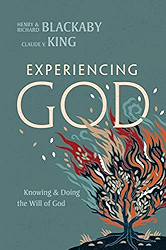
    Experiencing God: Knowing and Doing the Will of God.
    By Henry and Richard Blackaby, and Claude V. King.
    326 pages. B&H Books: 2021 edition.

    May as well start by plugging the book Experiencing God, a book that’s been out since 1976 and has been through a few editions and updates. It’s about taking your Christianity beyond being just an intellectual exercise—beyond merely believing you’re saved, and Jesus is Lord and orthodox Christianity is true, and all the assorted beliefs connected with that.

    Because Christians discover these beliefs, by themselves, are completely unfulfilling. What we want is real live contact with God, not a series of things to accept, verses to memorize, rituals to practice, and motions to go through. We want what the first apostles had. We don’t want to just believe, but see. Because that’s the testimony we see throughout the bible: People saw stuff. It was never enough for the folks in the bible to give testimonies without concrete experiential evidence.

    Yet somehow, that’s become okay for many 21st century Christians. Some of ’em will even insist we’d better expect nothing more—that seeking signs and wonders is somehow devilish, and lacks faith.

    Do read the book. But like most books written by pastors, Experiencing God takes a powerful pile of words before they finally get to the point. I was trained as a journalist, so I won’t. You want to experience God? It’s ridiculously simple: Obey him.

    Yeah, it’s really no more complicated than that. We make it complicated… because we’re trying to find loopholes. We want excuses to not obey him.

    17 July 2022

    The Lost Sheep Story.

    Matthew 18.12-14.

    Since I was already discussing parables where Jesus compares his followers to sheep, and portrays himself as the good shepherd, I figured I’d do the Lost Sheep Story. I kinda did already, but I bunched Luke’s version together with the Lost Coin Story, and focused on God seeking and saving the lost. Matthew’s version is a bit different, ’cause it has a different punchline.

    Jesus begins this parable with a question which is typically translated like the KJV’s, “What think ye?” Except the verb is singular and third-person, not plural and second-person: Ye is not the subject, but the Greek word τί/ti is. It can be translated “what” or “who,” so that’s what I went with. He’s not really asking for his audience’s thoughts; he wants to see who among them has the sense to realize what he means. If Jesus were only fishing for consensus, his parables wouldn’t mean anything. He’s got a point to them—now see if you can spot it.

    Even if he already totally spells out his own point. Hey, sometimes the crowd is just that dense—as you’ll see in a moment.

    Matthew 18.12-14 KWL
    12 “Who among you thinks?
    When a hundred sheep belong to a certain person,
    and one of them might wander off,
    won’t the person leave the 99 on the hills,
    and go to seek the wanderer?
    13 When he happens to find it,
    amen, I promise you, he rejoices over it—
    more so than the 99 who hadn’t wandered.
    14 Likewise it’s not the will
    laid out by your heavenly Father
    that one of these little ones be destroyed.”

    In Jesus’s day, people didn’t keep their wealth in money, which was harder to come by; but in land and livestock. So how wealthy does that make a person with 100 sheep? Well… not poor. Certainly not rich. Think of an individual lamb like 100 dollars. That’d make his flock worth 10,000 dollars. It’s a decent pile, but it’s not disposable income: You can’t just trade all your sheep for luxuries and comforts. You need to keep those sheep, and keep ’em well-fed and in good health so they’ll make more sheep, and produce good milk and good wool, and you can sell that… if you’re patient and work hard.

    And with only 100 sheep, you can’t really afford to lose a lamb or two. A rich person could lose a lamb here and there easily. This guy was gonna have to go look for it himself.

    14 July 2022

    Elders: The grownups in the church.

    ELDER 'ɛld.ər adjective. Of a greater or advanced age.
    2. [noun] A person of greater or advanced age.
    3. [noun] A spiritually mature Christian, usually consulted as part of a church’s leadership, often entrusted with ministerial or priestly responsibility.
    [Eldership 'ɛl.dər.ʃɪp noun.]

    After Jesus was raptured, his church had to continue without him physically here. Which is fine! He’d already trained apprentices, and designated 12 of them as apostles. One was dead, so the other 11 picked a replacement Ac 1.26 and went back to 12. (It’s God’s favorite number, y’see.)

    Running the church with only 12 leaders quickly became unsustainable, because the church immediately surged by 3,000 people, Ac 2.41 and soon after another 2,000 or 5,000; it’s debatable. Ac 4.4 In any event that’s a lot of people to train to follow Jesus. The food ministry alone was chaos, with accusations of prejudice against Greek-speakers. Ac 6.1 The apostles recognized they needed more leaders, and told the people to select their ministers based on their honesty, wisdom, and spirituality. Ac 6.3 In other words their spiritual maturity.

    When Paul of Tarsus wrote to Timothy of Lystra about 20 years later, the apostle reminded the youngish bishop that spiritual maturity is still a requirement for leadership. Y’don’t pick leaders because they’re friendly, popular, magnetic, and entertaining. (Or even because they’re family!) You pick them because they’re fruity. Because they’ve been letting the Holy Spirit develop them into people of good character: He’s making them resemble Jesus, and only christlike people should lead and run Christ Jesus’s churches. Nobody else is appropriate.

    And arguably only christlike people should run anything. No, I’m not at all talking about Christian nationalism; I’m not saying the only people who should ever run things in this country must be Christian. I’m saying they oughta have good character. “Christian,” sad to say, does not automatically mean good character, spiritual maturity, or even any kind of maturity; some Christians are the whiniest snowflakes you ever did see, throwing tantrums and claiming “persecution!” about the smallest of hurdles—especially the ones generated by their own dickishness. Nope; I’m saying non-Christians can often be as patient, thoughtful, gracious, kind, and self-controlled as any Christian, and any pagan who has these traits is much preferred to any Christian or pagan who doesn’t.

    My point is the grownups need to be in charge. That’s especially true in Christ’s churches, but oughta be true everywhere.

    The Christianese term for grownup is elder, which comes from the New Testament’s word πρεσβύτερος/presvýteros, “elder.” It’s also where we also get our Christianese word presbyterian, “elder-run,” meaning a church run by elders, instead of by voting members or solely by the head pastor. Yeah, “elder” makes it sound like the church is being run by its old people (and yeah, such churches totally exist). But whenever the apostles who wrote the New Testament discussed a presvýteros, they meant the longtime, devout, spiritually senior Christians. These are the folks they could legitimately trust to give sound advice about following Jesus. The folks we oughta be able to trust.

    13 July 2022

    Christian leaders must be people of character.

    The only biblical qualification for Christian leadership is good character.

    Yeah, I know; churches pick and qualify leaders for all sorts of other reasons. Usually for two reasons: They’re willing, and they’re able.

    Willing means they actually wanna minister. Because so few Christians do! Or they may want to, but they’re timid, or don’t think they’re ready (sometimes for good reason), or they’re already super busy with other stuff… or to be honest, they like the idea of pitching in, but gah, the commitment. Now you gotta actually be at the Sunday morning services every single week; you can’t just decide, “Y’know, I’m taking this Sunday off to sleep in like a pagan,” because now you obligated yourself. Don’t you feel dumb.

    Able means you can actually do the job. If the task is to run a Sunday school class, you actually know how to keep the kids’ attention, maintain order, and legitimately teach them something. Or, y’know, you know how to stand back and stream the video which does all the teaching for you, and be available in case any of the kids made a boom-boom in their pants—or know how to text their parents. The way some churches work, the “job” might be something a chimpanzee with a hammer could do… but hey, so can you!

    But even if your church throws up their hands, contacts the zoo, and gets that chimpanzee: According to the scriptures, that chimp had better have good character. Otherwise she’s not qualified to minister whatsoever. And neither is any willing ’n able human who wants the job.

    Character matters. Always has. Because when your leaders have bad character, you can’t trust ’em. They’ll be hypocrites and lie to cover up their misbehavior. They’ll break laws, get the other leaders to back ’em up, and take the entire church down with them. They’ll seize power and exploit people. They’ll abuse them, manipulate them, rob them of their time and money and dignity, and give ’em the worst advice about how to follow Jesus. In fact characterless leaders would much rather have you follow them than Jesus. And when you won’t—when you no longer serve their purposes or their lusts—they’ll threaten you with hell, drive you out of the church, or even convince you to quit Jesus. Because they’ll get you to believe Jesus is sending you to hell; or at least that Jesus is immoral, because how could a good Lord permit such evil people to run his churches?

    Character used to matter in other positions of leadership as well. Namely secular leaders: The heads of corporations, the people who run clubs and civic organizations, the people we elect to office. Unfortunately, our larger society seems to have forgotten why character matters, and figure it’s more important to put people with talent and skill—capable people—in charge. ’Cause these folks get stuff done, and isn’t that what we want? And while yes, it’d be nice if our leaders were actually competent… you realize what happens when you put an evil but capable person in charge? You get even more evil, y’know.

    Churches want capable people to lead ministries. I don’t blame ’em; it makes sense! So when they pick leaders, they tend to go with people with skills and talents. You want a pastor who’s taken counseling classes and knows how to empathetically guide and pray for lost and wayward people. You want a preacher who knows how to correctly research the bible, present a practical lecture on the findings, and not bore the listeners to sleep. You want musicians who can play an instrument well, remember the spotlight is supposed to be on Jesus not them, and grows in ability instead of playing the same 20 songs and nothing else. You want a facilities manager who knows how to keep the building in good, working condition. You want janitors who realize the little kids of your church touch everything, so make it clean! There oughta be job descriptions and expectations, and degrees and certificates where appropriate. And of course all of them need to believe your church’s faith statement, ’cause everybody who works for a church is gonna be seen as a leader, and therefore oughta know Jesus and his gospel, and basic doctrine.

    But without good character, their skills and talents aren’t gonna contribute to God’s kingdom. They’re gonna use those abilities only to further themselves. At the expense of God’s kingdom.