28 July 2022

Yahweh-Yireh: God sees us. (And provides… but that’s a different idea.)

Genesis 22.12.

My church’s musicians finally got round to learning “Jireh,” an Elevation Worship song which mixes together the ideas of God being “Jehovah Jireh” and “my grace is sufficient for thee.”

Kinda like the Don Moen’s old song “Jehovah Jireh” did. Here’s the Moen song:

Jehovah Jireh, my provider
His grace is sufficient for me, for me, for me
Jehovah Jireh, my provider
His grace is sufficient for me
 
My God shall supply all my needs
According to his riches in glory
He will give his angels charge over me
Jehovah Jireh cares for me, for me, for me
Jehovah Jireh cares for me

And he does! Anyway, y’notice Moen stitched together a couple different things from the scriptures: There’s the name “Jehovah Jireh.” There’s the “grace is sufficient” concept, which comes from when Paul complained to God about something he suffered from, and God’s response was, “I’m not curing that. I want you weak; it reveals my strength. So you’re just gonna have to settle for my grace.” That’s an extremely loose translation of 2 Corinthians 12.9, a verse that’s also heavily quoted out of context, but I’m not discussing that one today.

Oh, and the “supply all my needs” bit comes from Paul and Timothy’s statement to the Philippians at the close of their letter:

Philippians 4.19 KJV
But my God shall supply all your need according to his riches in glory by Christ Jesus.

Buncha provision scriptures. Moen’s trying to remind us of a biblical principle which Jesus expressed better in his Sermon on the Mount: Stop worrying. God provides way better than, thus far, you’ve been expecting him to… so stop underestimating your loving Father, stop stressing out, and let him provide.

Matthew 6.25-34 KJV
25 Therefore I say unto you, Take no thought for your life, what ye shall eat, or what ye shall drink; nor yet for your body, what ye shall put on. Is not the life more than meat, and the body than raiment? 26 Behold the fowls of the air: for they sow not, neither do they reap, nor gather into barns; yet your heavenly Father feedeth them. Are ye not much better than they? 27 Which of you by taking thought can add one cubit unto his stature? 28 And why take ye thought for raiment? Consider the lilies of the field, how they grow; they toil not, neither do they spin: 29 and yet I say unto you, That even Solomon in all his glory was not arrayed like one of these. 30 Wherefore, if God so clothe the grass of the field, which to day is, and to morrow is cast into the oven, shall he not much more clothe you, O ye of little faith? 31 Therefore take no thought, saying, What shall we eat? or, What shall we drink? or, Wherewithal shall we be clothed? 32 (For after all these things do the Gentiles seek:) for your heavenly Father knoweth that ye have need of all these things. 33 But seek ye first the kingdom of God, and his righteousness; and all these things shall be added unto you. 34 Take therefore no thought for the morrow: for the morrow shall take thought for the things of itself. Sufficient unto the day is the evil thereof.

God provides. And a lot of Christians like to remember that—and love the Moen song—so they’ll call him “Jehovah Jireh.”

But here’s the problem: “My provider” is not what Jireh means. It means “seer.” God sees us.

27 July 2022

Altars, and how God expects us to use them.

ALTAR 'ɔl.tər noun. A table or block used as the focus for a religious ritual, particularly offerings or ritual sacrifices to a deity.
2. In Christianity, the table used to hold the elements for holy communion.
3. In some churches, the stage, the steps to the stage, or the space in front of the stage, where people go as a sign of commitment.

Whenever humans ritually worship God, we usually need a table to put stuff on.

Might be the stuff we need for our rituals. Might be something we’re gonna give to God, or sacrifice for God. If there’s nothing else around—we just kinda did this on the spur of the moment—often humans will use the table itself as the ritual: “Hey God, I built you an altar!” and then we pray at the altar. Which is exactly what we Christians do whenever we use our churches’ various tables or raised platforms (or, y’know, actual altars for holy communion) as makeshift altars for our “altar calls.”

Humanity instinctively just finds something profound about using a raised platform for God-stuff. It’s not solely practical.

When spur-of-the-moment altars get built, it’s usually because we wanna worship God so bad, we can’t wait to get to an existing altar. Or we figure we’re gonna worship God at that place, and frequently, so we may as well have a regular altar around. Sometimes it’s a memorial altar: God did something at that location, so let’s mark it with an altar, and people can use it to continue to worship him.

Among the ancients Hebrews, any flat-surfaced rock would do. But typically they did stuff to make the altar more obviously an altar, and not just some flat rock. Ancient middle eastern custom was simply to stand a rock upright: A rock lying flat on the ground was obviously a product of nature, but a rock standing upright for no good reason probably had some good reason: Somebody propped it up that way as a memorial or an altar. That was the idea when the Hebrews left 12 rocks near the place they first crossed the Jordan River into Palestine:

Joshua 4.8 KJV
And the children of Israel did so as Joshua commanded, and took up twelve stones out of the midst of Jordan, as the LORD spake unto Joshua, according to the number of the tribes of the children of Israel, and carried them over with them unto the place where they lodged, and laid them down there.

Iron Age massebót, or standing stones, found in the middle east. Biblical Archaeology Review

“And laid them down” (Hebrew וַיַּנִּח֖וּם/vey-yannikhúm, “and placed them”) implies they put ’em flat on the ground, or in a pile, or even in a tower. That wasn’t the middle eastern custom. They stood up. It needed to be obvious humans had placed them there for good reason. These were a memorial; these were for worship; sometimes these were altars. They weren’t random rocks in a weird formation.

Y’might notice lots of ancient cultures put up “standing stones” for exactly the same reason. Like the obelisks and steles of ancient Egypt, or the megaliths and menhirs and stone circles found all over the Celtic regions. Heck, I’ve known kids who like to stand rocks upright for fun, so it’s no surprise you’ll find ’em everywhere. But for the really big stones which take effort to put in place, we’re talking important reasons for it: Memorials and worship.

26 July 2022

The prayer journal: Keeping track of our conversations with God.

PRAYER JOURNAL 'pr(eɪ.)ər 'dʒər.nəl noun. A regular record of our interactions with God.
[Prayer journaling - 'dʒər.nəl.ɪŋ verb tense.]

Gotta admit: There’s a lot of old emails and texts I’ve never deleted. I have text chains going back decades now. I delete stuff from businesses and employers; I especially delete ads. But I wanna keep the family and friends stuff.

A prayer journal is as close as we can get to the same thing with God.

It’s sort of a diary. But rather than listing all the main things we did each day (or listing all of them, plus our innermost secret feelings about them, which’ll be a lot of embarrassing fun someday when someone finds and reads it, especially in a courtroom) it’s about what we prayed. We’re keeping track. God’s memory of our interactions is absolutely perfect; ours, not always so much.

Yeah, I realize not everyone keeps a diary. Sometimes because someone found and read it, and we realized such a thing is a great big embarrassment time bomb. Other times because we lack the self-discipline. Mostly because we never saw the point. Well this is the point: You kinda should keep track.

See, your average Christian doesn’t journal their prayers. Don’t see the point. They ask God a question and get an answer, then move on. They ask for stuff, get it, and move on. Or they don’t get what they want, give up, and move on. Or they ask God on behalf of others, but they don’t bother to follow up because they don’t entirely care; or they got some news about whether the prayer worked, then promptly forgot it and again moved on.

Lots of moving on. But no record of anything God’s done for them. No record other than their own personal, and often faulty, memories. And whenever people go through any kind of crisis, sometimes those memories immediately become irrelevant: Our panicking minds don’t recall, or even care, how God’s constantly come through for us in the past.

God answers our prayers all the time. And not just with “no”! But when we never keep track, we can’t always tell you when, how, and how often. When we’re feeling low, we too often forget every good thing God has done for us. You know, like the Hebrews did in the wilderness, every single time they hit a rough patch: “Aw man, we’re gonna die. Y’know, despite all the whippings and work and how they used to murder our babies, I remember Egypt was way better. Why’d we ever leave?” Ex 16.3, 17.3, Nu 11.18, etc. God forbid, but this kind of thing still happens with humans. All the time.

That’s why the prophets and apostles put together a written record of what God did do for ’em. And you oughta have one too. Your prayer journal is what God’s done for you. Keep track!

Especially if you’re involved (or getting involved) with your church’s prayer ministry. Or if you regularly pray for others. Or if you’re not entirely sure prayer works: Keep a journal for three months and see for yourself.

There are dozens of different prayer journal techniques. Today I’ll just start you off with a really simple method, which works for me.

25 July 2022

Prophetic note-taking.

So you’re in church, someone’s preaching a sermon, and you’re taking notes. You do take notes, right?

Oh you don’t? Well start taking notes!

Some churches include a blank page in their bulletin for note-taking… although some churches stopped producing bulletins during the 2020 pandemic, so that’s not always an option anymore. I used to take a notebook to church with me. Nowadays I use Google Documents on my phone.

You don’t have to write down every single thing the preacher says, or every single thing they put on their PowerPoint slides, or deduce and reconstruct their entire sermon outline. You can try, for fun. But I’ve found pretty much the only things you wanna write down are the things you’ll want to remember later:

  • Profound things they said which you’ll want to meditate upon.
  • Profound scriptures they quoted which you’ll want to memorize.
  • Stuff you’ll want to fact-check. It sounds like good stuff… but is it true?

As a result you won’t have an entire page of notes. Maybe three or four important points. More, if the sermon’s full of a lot of good stuff. Less, if you spend the entire sermon trying to “find the pony.” (I explain what I mean by that elsewhere.) But in general you shouldn’t wind up with full notebooks full of stuff which you’ll never find the time to go back to… like all the notebooks I used to fill when I was a teenager.

Oh, and the fourth thing you oughta include in your notes: Anything the Holy Spirit tells you.

This is why I titled this article, “Prophetic note-taking.” This is the prophetic part. You’re paying attention to the sermonizer… and I would hope you’re also keeping an ear open for the Spirit. ’Cause he’s gonna make comments during the sermon. Ideas are gonna pop into your head which relate to God. (And sometimes they won’t even have anything to do with the sermon. Not that this matters.) Whenever this happens, write ’em down.

“So wait: Every stray idea that pops into my head is the Holy Spirit?” No. Honestly, many of those ideas will be your bright ideas. And some of them won’t actually be all that bright. In fact they might be really stupid. But sometimes, sometimes… one of them is a God-idea. And you’d better keep those!

24 July 2022

The Satan Versus Satan Story.

Mark 3.23-26, Matthew 12.24-30, Luke 11.17-18.

Jesus was in the habit of ignoring Pharisee customs. In part because they aren’t biblical and therefore aren’t necessary (and aren’t sin when you break ’em). In part because too many Pharisees pointed to their customs as proof they were devout… and hoped the customs distracted people from the fact they were breaking the Law just as much as any gentile. It was all hypocrisy—the one thing which really pisses Jesus off.

Pharisees who legitimately tried to follow God, easily recognized Jesus is from God. Pharisees who were only interested in looking devout had the darnedest time trying to prove Jesus isn’t from God: It’s kinda impossible to make such a case when Jesus so obviously has God’s power to cure the sick and throw evil spirits out of people. When Pharisees tried to cure people and do exorcisms, they had such a low success rate, lots of Jews turned to witch doctors instead. In comparison, Jesus looks like he put hardly any effort into it. Sometimes he had to pray real hard, or lay hands on someone more than once, or had to give up because people were so faithless. But most of the time he’d say, “You’re cured,” and they were; or “Get out,” and the critters would scream and flee. He had the Holy Spirit without limit, Jn 3.34 and this almightiness showed.

So Pharisees had nothing. But it looks like the Galilean Pharisees decided to pick the brains of Judean Pharisees, who came up with the explanation, “He hath Beelzebub, and by the prince of the devils casteth he out devils.” Mk 3.22 I explained the backstory of “Beelzebub,” properly Baal Zevúl, in another article. It’s pretty much a euphemism for Satan. Like many a cessationist nowadays, these Judeans claimed Jesus did his thing through the power of the devil. ’Cause God would never work through such people.

In response, Jesus told this parable.

Mark 3.23-26 KWL
23 Jesus, summoning them,
is telling them in parables,
“How can Satan throw out Satan?
24 When a kingdom is divided against itself,
that kingdom can’t stand.
25 When a house is divided against itself,
that house can’t stand.
26 And if Satan rises up against itself and is divided,
it can’t stand. Instead it’s the End.”

19 July 2022

When you gotta pray in public.

You might have an amazing, consistent prayer life. You might have regular deep, meaningful conversations with God.

Nah, who are we kidding? You might suck at it. All your prayers are short little “God, can I have [IMMEDIATE DESIRE]?” whenever your wallet can’t immediately answer your requests. And maybe you remember to say grace. And yeah, when someone else at church is praying, you agree with them. That’s about it.

Then, terror of terrors, it comes time to speak to God in front of other people. The small group leader tells you, “Hey, could you lead us in prayer?” and you quickly look behind yourself to confirm the leader was totally speaking to someone else… and when it turns out nope, it’s you, you outwardly say, “Yeah no problem,” and inwardly freak out a little.

Totally normal.

No, it doesn’t mean you suck as a Christian. (Being irreligious does.) You’re praying in front of others. That’s a form of public speaking—the number one fear of all Americans, in survey after survey. People are more afraid of public speaking than death. Than death. Jerry Seinfeld once joked that at a funeral, more people would rather be in the casket than give the eulogy.

So if you’re anxious about public speaking—you don’t know what to say, or you did but as soon as you stood up you blanked out, or you’re anxious about what people might think when you mess up, or you feel you might have an utter meltdown and collapse in tears and even your own pee: This is normal. Yeah, maybe we Christians in particular oughta have more courage than this, but it’s normal to not want to speak or pray to a crowd. You’re not a freak. Relax.

Okay, so how do we deal with this? Glad you asked.

18 July 2022

Experiencing God by obeying him.


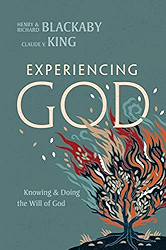
Experiencing God: Knowing and Doing the Will of God.
By Henry and Richard Blackaby, and Claude V. King.
326 pages. B&H Books: 2021 edition.

May as well start by plugging the book Experiencing God, a book that’s been out since 1976 and has been through a few editions and updates. It’s about taking your Christianity beyond being just an intellectual exercise—beyond merely believing you’re saved, and Jesus is Lord and orthodox Christianity is true, and all the assorted beliefs connected with that.

Because Christians discover these beliefs, by themselves, are completely unfulfilling. What we want is real live contact with God, not a series of things to accept, verses to memorize, rituals to practice, and motions to go through. We want what the first apostles had. We don’t want to just believe, but see. Because that’s the testimony we see throughout the bible: People saw stuff. It was never enough for the folks in the bible to give testimonies without concrete experiential evidence.

Yet somehow, that’s become okay for many 21st century Christians. Some of ’em will even insist we’d better expect nothing more—that seeking signs and wonders is somehow devilish, and lacks faith.

Do read the book. But like most books written by pastors, Experiencing God takes a powerful pile of words before they finally get to the point. I was trained as a journalist, so I won’t. You want to experience God? It’s ridiculously simple: Obey him.

Yeah, it’s really no more complicated than that. We make it complicated… because we’re trying to find loopholes. We want excuses to not obey him.

17 July 2022

The Lost Sheep Story.

Matthew 18.12-14.

Since I was already discussing parables where Jesus compares his followers to sheep, and portrays himself as the good shepherd, I figured I’d do the Lost Sheep Story. I kinda did already, but I bunched Luke’s version together with the Lost Coin Story, and focused on God seeking and saving the lost. Matthew’s version is a bit different, ’cause it has a different punchline.

Jesus begins this parable with a question which is typically translated like the KJV’s, “What think ye?” Except the verb is singular and third-person, not plural and second-person: Ye is not the subject, but the Greek word τί/ti is. It can be translated “what” or “who,” so that’s what I went with. He’s not really asking for his audience’s thoughts; he wants to see who among them has the sense to realize what he means. If Jesus were only fishing for consensus, his parables wouldn’t mean anything. He’s got a point to them—now see if you can spot it.

Even if he already totally spells out his own point. Hey, sometimes the crowd is just that dense—as you’ll see in a moment.

Matthew 18.12-14 KWL
12 “Who among you thinks?
When a hundred sheep belong to a certain person,
and one of them might wander off,
won’t the person leave the 99 on the hills,
and go to seek the wanderer?
13 When he happens to find it,
amen, I promise you, he rejoices over it—
more so than the 99 who hadn’t wandered.
14 Likewise it’s not the will
laid out by your heavenly Father
that one of these little ones be destroyed.”

In Jesus’s day, people didn’t keep their wealth in money, which was harder to come by; but in land and livestock. So how wealthy does that make a person with 100 sheep? Well… not poor. Certainly not rich. Think of an individual lamb like 100 dollars. That’d make his flock worth 10,000 dollars. It’s a decent pile, but it’s not disposable income: You can’t just trade all your sheep for luxuries and comforts. You need to keep those sheep, and keep ’em well-fed and in good health so they’ll make more sheep, and produce good milk and good wool, and you can sell that… if you’re patient and work hard.

And with only 100 sheep, you can’t really afford to lose a lamb or two. A rich person could lose a lamb here and there easily. This guy was gonna have to go look for it himself.

14 July 2022

Elders: The grownups in the church.

ELDER 'ɛld.ər adjective. Of a greater or advanced age.
2. [noun] A person of greater or advanced age.
3. [noun] A spiritually mature Christian, usually consulted as part of a church’s leadership, often entrusted with ministerial or priestly responsibility.
[Eldership 'ɛl.dər.ʃɪp noun.]

After Jesus was raptured, his church had to continue without him physically here. Which is fine! He’d already trained apprentices, and designated 12 of them as apostles. One was dead, so the other 11 picked a replacement Ac 1.26 and went back to 12. (It’s God’s favorite number, y’see.)

Running the church with only 12 leaders quickly became unsustainable, because the church immediately surged by 3,000 people, Ac 2.41 and soon after another 2,000 or 5,000; it’s debatable. Ac 4.4 In any event that’s a lot of people to train to follow Jesus. The food ministry alone was chaos, with accusations of prejudice against Greek-speakers. Ac 6.1 The apostles recognized they needed more leaders, and told the people to select their ministers based on their honesty, wisdom, and spirituality. Ac 6.3 In other words their spiritual maturity.

When Paul of Tarsus wrote to Timothy of Lystra about 20 years later, the apostle reminded the youngish bishop that spiritual maturity is still a requirement for leadership. Y’don’t pick leaders because they’re friendly, popular, magnetic, and entertaining. (Or even because they’re family!) You pick them because they’re fruity. Because they’ve been letting the Holy Spirit develop them into people of good character: He’s making them resemble Jesus, and only christlike people should lead and run Christ Jesus’s churches. Nobody else is appropriate.

And arguably only christlike people should run anything. No, I’m not at all talking about Christian nationalism; I’m not saying the only people who should ever run things in this country must be Christian. I’m saying they oughta have good character. “Christian,” sad to say, does not automatically mean good character, spiritual maturity, or even any kind of maturity; some Christians are the whiniest snowflakes you ever did see, throwing tantrums and claiming “persecution!” about the smallest of hurdles—especially the ones generated by their own dickishness. Nope; I’m saying non-Christians can often be as patient, thoughtful, gracious, kind, and self-controlled as any Christian, and any pagan who has these traits is much preferred to any Christian or pagan who doesn’t.

My point is the grownups need to be in charge. That’s especially true in Christ’s churches, but oughta be true everywhere.

The Christianese term for grownup is elder, which comes from the New Testament’s word πρεσβύτερος/presvýteros, “elder.” It’s also where we also get our Christianese word presbyterian, “elder-run,” meaning a church run by elders, instead of by voting members or solely by the head pastor. Yeah, “elder” makes it sound like the church is being run by its old people (and yeah, such churches totally exist). But whenever the apostles who wrote the New Testament discussed a presvýteros, they meant the longtime, devout, spiritually senior Christians. These are the folks they could legitimately trust to give sound advice about following Jesus. The folks we oughta be able to trust.

13 July 2022

Christian leaders must be people of character.

The only biblical qualification for Christian leadership is good character.

Yeah, I know; churches pick and qualify leaders for all sorts of other reasons. Usually for two reasons: They’re willing, and they’re able.

Willing means they actually wanna minister. Because so few Christians do! Or they may want to, but they’re timid, or don’t think they’re ready (sometimes for good reason), or they’re already super busy with other stuff… or to be honest, they like the idea of pitching in, but gah, the commitment. Now you gotta actually be at the Sunday morning services every single week; you can’t just decide, “Y’know, I’m taking this Sunday off to sleep in like a pagan,” because now you obligated yourself. Don’t you feel dumb.

Able means you can actually do the job. If the task is to run a Sunday school class, you actually know how to keep the kids’ attention, maintain order, and legitimately teach them something. Or, y’know, you know how to stand back and stream the video which does all the teaching for you, and be available in case any of the kids made a boom-boom in their pants—or know how to text their parents. The way some churches work, the “job” might be something a chimpanzee with a hammer could do… but hey, so can you!

But even if your church throws up their hands, contacts the zoo, and gets that chimpanzee: According to the scriptures, that chimp had better have good character. Otherwise she’s not qualified to minister whatsoever. And neither is any willing ’n able human who wants the job.

Character matters. Always has. Because when your leaders have bad character, you can’t trust ’em. They’ll be hypocrites and lie to cover up their misbehavior. They’ll break laws, get the other leaders to back ’em up, and take the entire church down with them. They’ll seize power and exploit people. They’ll abuse them, manipulate them, rob them of their time and money and dignity, and give ’em the worst advice about how to follow Jesus. In fact characterless leaders would much rather have you follow them than Jesus. And when you won’t—when you no longer serve their purposes or their lusts—they’ll threaten you with hell, drive you out of the church, or even convince you to quit Jesus. Because they’ll get you to believe Jesus is sending you to hell; or at least that Jesus is immoral, because how could a good Lord permit such evil people to run his churches?

Character used to matter in other positions of leadership as well. Namely secular leaders: The heads of corporations, the people who run clubs and civic organizations, the people we elect to office. Unfortunately, our larger society seems to have forgotten why character matters, and figure it’s more important to put people with talent and skill—capable people—in charge. ’Cause these folks get stuff done, and isn’t that what we want? And while yes, it’d be nice if our leaders were actually competent… you realize what happens when you put an evil but capable person in charge? You get even more evil, y’know.

Churches want capable people to lead ministries. I don’t blame ’em; it makes sense! So when they pick leaders, they tend to go with people with skills and talents. You want a pastor who’s taken counseling classes and knows how to empathetically guide and pray for lost and wayward people. You want a preacher who knows how to correctly research the bible, present a practical lecture on the findings, and not bore the listeners to sleep. You want musicians who can play an instrument well, remember the spotlight is supposed to be on Jesus not them, and grows in ability instead of playing the same 20 songs and nothing else. You want a facilities manager who knows how to keep the building in good, working condition. You want janitors who realize the little kids of your church touch everything, so make it clean! There oughta be job descriptions and expectations, and degrees and certificates where appropriate. And of course all of them need to believe your church’s faith statement, ’cause everybody who works for a church is gonna be seen as a leader, and therefore oughta know Jesus and his gospel, and basic doctrine.

But without good character, their skills and talents aren’t gonna contribute to God’s kingdom. They’re gonna use those abilities only to further themselves. At the expense of God’s kingdom.

12 July 2022

Prayers of self-examination.

Likely you already know the “Rich Young Ruler Story”: It’s not a parable, ’cause it actually happened. Somebody—Matthew calls him a young man, Mt 19.20 Luke calls him a ruler, Lk 18.18 and all the synoptic gospels call him wealthy—came to Jesus, wanting to know how to receive eternal life. He was astute enough to realize following all of the LORD’s commands wasn’t gonna cut it. It took more than the very best karma, and maybe the rabbi knew what it was.

He didn’t like Jesus’s answer.

Mark 10.17-23 KJV
17 And when he was gone forth into the way, there came one running, and kneeled to him, and asked him, Good Master, what shall I do that I may inherit eternal life? 18 And Jesus said unto him, Why callest thou me good? there is none good but one, that is, God. 19 Thou knowest the commandments, Do not commit adultery, Do not kill, Do not steal, Do not bear false witness, Defraud not, Honour thy father and mother. 20 And he answered and said unto him, Master, all these have I observed from my youth. 21 Then Jesus beholding him loved him, and said unto him, One thing thou lackest: go thy way, sell whatsoever thou hast, and give to the poor, and thou shalt have treasure in heaven: and come, take up the cross, and follow me. 22 And he was sad at that saying, and went away grieved: for he had great possessions. 23 And Jesus looked round about, and saith unto his disciples, How hardly shall they that have riches enter into the kingdom of God!

The teenager did have a deficiency. A few of them: A shortage of generosity. Too much dependence on his earthly possessions. True, at the end of this story he went away, and we don’t know what happened to him thereafter. I hope he repented, but the gospels don’t say.

His sad story aside, he reveals a form of prayer which we Christians oughta make from time to time. It’s a prayer of self-examination: We wanna know if there’s anything more God wants us to do. Are we missing something? Have we left anything undone? Any sins of omission? Do we have a blindspot? Maybe a bunch of blindspots. God, what are they?

In my experience it’s often basic stuff which we densely never realized we should also be doing. The rich young ruler didn’t realize he should’ve been giving to the poor. Which is weird, ’cause he claimed he totally followed the Law… but I guess he forgot this passage is in there:

Deuteronomy 15.11 KJV
For the poor shall never cease out of the land: therefore I command thee, saying, Thou shalt open thine hand wide unto thy brother, to thy poor, and to thy needy, in thy land.

Greedy people have invented all sorts of justifications for not helping the needy. Christians may not necessarily be greedy (though yeah, some of us are) but some of us have heard these justifications all our lives… and learned to agree with them, and likewise do nothing to help the needy. We don’t even think about all the teachings of Jesus, all the commands in the scriptures, in which God expects us to help the needy. It’s become this massive blindspot for plenty of Christians: “Jesus himself said ‘The poor you will always have with you,’ so what’s the point in trying to solve the problem of poverty?” The rich young ruler is hardly the only person who never noticed his blindspot till Jesus pointed it out.

But deep down, he knew it was there. The Holy Spirit was poking him in the conscience. Same as he’s poking us in the conscience: “Hey, you’re overlooking something.” So let’s ask him: What’d we forget? What more must we do?

Unless, like the rich young ruler, we don’t really wanna know.

11 July 2022

Saints’ days.

Today is 11 July. In North America this means it’s Free Slurpee Day at 7-Eleven convenience stores, ’cause most of us in North America write the date as 7/11 instead of 11/7. (Blame the British, who used to write their dates that way too. They switched to match the rest of Europe; we didn’t. Anyway.)

It also means today is the feast day of Benedetto de Norcia (480–548) whom English-speaking Christians know as Benedict of Nursia. He founded 12 Italian monastic communities, and created a list of rules for the monks to live by—“the Rule of St. Benedict,” which was adopted by European religious communities throughout the medieval period. The Roman Catholic Order of St. Benedict is named for him. So are a number of popes.

So today is St. Benedict’s Day. Well, it’s St. Benedict’s Day for Roman Catholics, Anglicans, Lutherans, and most Protestants; for the Orthodox Church in America it’s 14 March. Neither of those dates correspond to the day Benedict died, which is traditionally how feast days are determined; that’d be 21 March 547. Back in 1970, the Catholics changed the date ’cause they wanted to honor Benedict, but Lent kept getting in the way, and you don’t fast on feast days, so they figured it was easier to move it to where nobody would schedule a time of fasting. As for the Orthodox… well, it’s close enough.

As I said, a saint’s day is traditionally the anniversary of their death. Usually by martyrdom: They’d get murdered or executed, sometimes in nasty ways, for following Jesus. And since ancient Christians didn’t always know these folks’ birthdays, the date of their death would do as a marker. Plus it’s the day they went to be with our Lord.

Of course there are exceptions. Like St. Benedict’s Day, which got moved for convenience. Like saints from the bible, or saints whose date of martyrdom and birthday we don’t know. And of course there are recent saints, whose birthdays are more likely to get celebrated than their date of death—which is why Martin Luther King Jr. Day is on or around 15 January, not 4 April.

10 July 2022

The Good Shepherd Story.

John 10.11-21.

In the previous bit, Jesus says he’s the sheepfold gate. In this bit, Jesus says he’s the good shepherd.

These passages don’t confuse a lot of people, because most of us have plenty enough brainpower to keep up with the idea of Jesus switching metaphors. “I’m the gate; you don’t go in around me. And I’m the shepherd—a good shepherd, who defends his sheep, unlike people who only start up a church for the power and money and fame, and the instant things get serious or rough, they bail on their church in Seattle, Washington and move to Scottsdale, Arizona, and con another flock into following them.”

…Okay yeah, I’m sounding a tad specific there, like I have a particular guy in mind. Maybe I do. But you could swap in any two cities in the United States—or the planet—and you’ll probably find a bad shepherd fleeing from town to town, hoping to evade accountability so he can get away with yet more evil. There have been bad shepherds throughout history. The people of Jesus’s day no doubt knew a few; maybe some rabbi who stole all his synagogue’s money, or one who slept around, or one who touched the children. Human nature doesn’t change, and ravenous wolves still try to feast on the faithful. So these things still happen.

But Jesus is the good shepherd. Kinda like the LORD is in Psalm 23… and since Jesus is the LORD, it’s totally okay to apply that psalm to him. But let’s deal with today’s passage first.

John 10.11-21 KWL
11 “I’m the good shepherd.
The good shepherd puts down his soul for the sheep.
12 The hireling, being no shepherd—
who isn’t the sheep’s own shepherd
he sees the wolf coming,
and he abandons the sheep and flees.
The wolf snatches and scatters them.
13 Because he’s a hireling!
He doesn’t care about anything about the sheep.
 
14 “I’m the good shepherd.
I know who’s mine,
and who’s mine know me.
15 Just as the Father knows me,
and I know the Father.
16 I have other sheep,
which aren’t from this sheepfold.
It’s necessary for me to lead them as well:
They’ll hear my voice,
and they’ll become one flock, one shepherd.
 
17 “This is why the Father loves me:
I put down my soul,
so I can pick it up again.
18 No one takes it away from me;
instead I put it down by myself.
I have the power to put it down,
and I have the power to pick it up again.
I receive this command from my Father.”
 
19 Again, there became a split among the Judeans
about these words.
20 Many were saying about him, “He has a demon,”
and “He’s raving mad; do you hear him?”
21 Others were saying, “These sayings aren’t demonic;
a demon isn’t able to open blind eyes!”

Jesus says a lot of profound things here, and of course the Judeans’ response was to either say, “Well of course he’s the good shepherd,” or if you’re a bit more closed-minded, “Oh he’s just babbling complete nonsense. Who does he think he is, God or something?”

As you might remember, parables tend to go right over the heads of the closed-minded—not necessarily because they can’t follow what Jesus means by them, but because they have no faith in Jesus. They might totally agree with the metaphor of Jesus’s followers being sheep—but they’re gonna dismiss and ignore the rest. It’s childish rubbish, meant for weak-minded sheeple.

07 July 2022

“By faith alone.”

SOLA FIDE 'soʊ.lə 'fi.deɪ noun. Short for the Latin iustificatio sola fide jus.ti.fi'kat.jo 'so.la 'fi.de, “justification by faith alone”: The Protestant doctrine that our right standing before God depends only on the basis of our trust in him.
2. The popular Evangelical belief that salvation is solely achieved through orthodox Christian belief (i.e. faith).

Yeah, I listed two definitions of sola fide above. One’s right; one’s wrong.

One’s taught in seminaries, and debated by Protestants and Roman Catholics, ’cause Catholics insist justification is a little more detailed than that. They would argue it has to include God’s grace, and our faith-response has to produce good fruit. I don’t disagree! But they’re just going into greater detail about what justification means, whereas the Protestant Reformers simply put the complex idea into very basic words. God’s looking for people to trust him. When we do, he justifies us. We now have a connection to him, a relationship with him; we must abide in him, and he will abide in us. Jn 15.4 And fruit will grow, and we’ll inherit his kingdom.

The other is all over popular Christian culture, and is taught in way too many churches by people who never bothered to learn sola fide is short for iustificatio sola fide. They don’t know “by faith alone” refers to justification. Or they do, but they just presume justification and salvation are the same thing—if God considers us right with him, doesn’t this automatically make us saved?

Plus they’ve defined faith wrong. When they say faith, they don’t mean “trust in God.” They mean religion. They mean orthodox Christian beliefs; the faith of the first Christians, the faith of the ancient church, the faith of our fathers, the creeds, the church’s faith statement, the right stuff to believe. To them, sola fide means we believe that—and once we believe all the right things, we’re saved!

(And conversely, they also believe if we don’t believe the right things, we’re not saved.)

In short, to them sola fide means “saved by the Christian faith alone.” Saved by orthodoxy. I call it “faith righteousness.” Thing is, it’s not at all what the scriptures teach. We’re not saved by the good work of making sure we embrace all the proper Christian doctrines—because that’d mean we’re saved by good works. And the gospel doesn’t teach we’re saved by karma, but grace.

06 July 2022

Justification: How God considers us right with him.

JUSTIFY 'dʒəs.tə.faɪ verb. Show or prove to be correct.
2. Make morally right [with God].
[Justification dʒəs.tə.fə'keɪ.ʃən noun, justificatory dʒə.stə'fɪk.ə.tɔ.ri adjective.]

In our culture “justify” usually means we have an excuse for what we did. Not necessarily a good one.

Fr’instance, let’s say I took someone behind the church building and beat the daylights out of them. Ordinarily and rightly, that’d get me tossed into jail for battery. When I stand before the judge I’d better have a really solid reason for my actions. “He started it; I just finished it” sounds like a good enough explanation for most people, but legally it’s not gonna work: Outside of movies, the law doesn’t give free passes to badasses. Neither do juries. They still send plenty of these badasses to prison.

Nope; justification means I need a profound reason for why I shouldn’t be jailed or institutionalized for my behavior. One that’s either in accordance with the law (“I reasonably feared for my life if I didn’t”) or is good enough to make judges and juries actually set aside the law, declare me not guilty, and set me free.

Now when it comes to sin, I am so guilty. I have no good excuse. Neither do you. Neither does anyone.

Yeah, we all have accidental, unintentional, or omissive sins in our past. But we have way more sins which we fully, thoughtfully, deliberately meant to do. We weren’t out of our right minds; we weren’t backed into tragic moral choices; we weren’t predetermined by God to sin in order to fulfill some secret evil plan of his. We have no excuse. There’s no justification for our behavior. We’re totally guilty.

Yet God forgives us anyway, adopts us as his kids, and lets us inherit his kingdom.

Why? Why does God let us off the hook?

Well, various theologians are gonna pitch all sorts of theories as to how ritual sacrifice and Jesus’s death might actually plaster over those sins in a meaningful way. But while that’s awesome and impressive and all that, that answers how, not why. Why’d Jesus bother to apply this plaster in the first place? Why does God even bother to have a relationship with humanity and Christians, despite our obvious unworthiness?

It’s a really simple explanation: God is love, and God is gracious. He loves us too much to not find some way to restore our relationship with him. So Jesus died to totally, absolutely wipe out the sins of the whole world. 1Jn 2.2 Anybody can have a relationship with God! Our sinfulness is no barrier whatsoever. We might imagine it is, ’cause we prefer karma, in which we merit that relationship instead of getting a free pass from God. But we needn’t waste our efforts—as if we ever could wipe out our own sins. Jesus already took care of that. Sin is defeated. We don’t need to do anything more. We’re forgiven.

So if everyone’s forgiven, why are some people saved, and some people aren’t, even though God wants to save everyone? 1Ti 2.4 Why does God have relationships with some individuals and not others, even though he loves the world? Jn 3.16 Why doesn’t God just drag everyone to heaven, no matter how they kick and scream?

Well it’s not, as Calvinists insist, because God doesn’t wanna save everyone, doesn’t really love everybody, and limits his forgiveness to a select few. It’s because God figures only one thing justifies his having a relationship with us: Whether we’re gonna respond, in any way, to such a relationship. Whether we’re gonna love him back.

The apostles distilled this idea to one word: Faith. I mean, people respond to God in all sorts of ways. Pagans pick and choose what they wanna believe God’s like—and as a result they basically invent their own fictitious “God,” and sometimes then don’t even follow him. Nontheists don’t even try. But if we do try—if we trust God to love us, forgive our screw-ups, make up for our deficiencies with Christ, 1Jn 2.1-3 work with us, guide us, and glorify us Ro 8.30 —and y’know, God’ll accept faith in the tiniest of servings Lk 17.6 —we’re good. It justifies God’s interactivity in our lives: It won’t be time wasted! It’ll lead to our salvation.

So God made faith a condition of our relationship with him. No faith, no relationship. No relationship, no kingdom. Mt 7.22-23 Kinda important.

05 July 2022

When the heavens are brass?

Deuteronomy 28.23.

Depending on whether a Christian grew up with the King James Version or the New International Version, we’re sometimes gonna talk about how sometimes “the heavens are brass,” or “the heavens are bronze.” No we don’t mean the sky’s looking kinda gold or yellowish, like a nice sunset or a looming dust cloud. We’re talking about when we talk to God… and we feel like we’re getting back nothing. Absolutely nothing.

Deuteronomy 28.23 KJV
And thy heaven that is over thy head shall be brass, and the earth that is under thee shall be iron.

But the actual context of this verse isn’t even about prayer. It’s part of a curse Moses spelled out for the Hebrews who were about to enter their promised land: If you dismiss what the LORD tells you, and do evil instead, he’s gonna withdraw his blessings and things are gonna suck. Hard.

Deuteronomy 28.20-24 NLT
20 “The LORD himself will send on you curses, confusion, and frustration in everything you do, until at last you are completely destroyed for doing evil and abandoning me. 21 The LORD will afflict you with diseases until none of you are left in the land you are about to enter and occupy. 22 The LORD will strike you with wasting diseases, fever, and inflammation, with scorching heat and drought, and with blight and mildew. These disasters will pursue you until you die. 23 The skies above will be as unyielding as bronze, and the earth beneath will be as hard as iron. 24 The LORD will change the rain that falls on your land into powder, and dust will pour down from the sky until you are destroyed.”

Sound familiar? Pandemics, climate change and freaky weather, massive drought? No? Well, this was a warning to Hebrews not Americans. But it wouldn’t hurt to shape up a little.

Anyway when Moses spoke of the “skies above will be as unyielding as bronze,” he meant a sky which produces no rain. In his day, the ancients believed the sky, or firmament, was a solid wall holding back the waters of heaven—but it was porous, so occasionally rain would get through. Well, a bronze shield isn’t porous… unless your opponents have iron arrowheads. But if you were hoping to dig wells in the ground, and get water thataway, guess what that’s gonna be like. Yep, iron.

So yeah, whenever you talk about not hearing back from God, do not make the mistake of saying, “Like when the bible says about heavens like brass.” The bible does refer to that, but it’s about literal drought, not a spiritual one.

Now if you wanna talk about unanswered prayer, the bible does actually have passages on the topic. Quote them. Not the “heavens are brass” part; this ain’t one of them. Capice?

03 July 2022

The Sheepfold Gate Story.

John 10.1-10.

A lot of reference materials claim Jesus only shares parables in the synoptic gospels, and that there are no parables in the gospel of John. Seriously, a lot of them. I grew up hearing it all my life. And it turns out it’s rubbish, because John straight-up states,

John 10.6 KJV
This parable spake Jesus unto them: but they understood not what things they were which he spake unto them.

It’s not a mistranslation either. True, John didn’t use the word παραβολή/paravolí, the word from which we literally get our word “parable.” He used παροιμίαν/parimían, which literally means “nearly like it.” But that’s what a parable is: It’s an analogy. A comparison. Something which is nearly like something else, so you can slip people some wisdom in a memorable format.

Other bibles have rendered parimían as “figure of speech” (ESV, NASB, NIV, NRSV) or “illustration” (NKJV, NLT). But again: Parables are figures of speech and illustrations. This is a parable. I suspect the translators were hesitant to use “parable” because it’s so widely believed and taught that John contains no parables. I still call rubbish. This is obviously a parable, and you gotta go through some weird logical gymnastics in order to claim it’s not.

It comes up in John 10, right after Jesus cured a blind man in John 9—whereupon the local Pharisees put the newly-cured guy on trial for heresy and excommunicate him. Jesus calls ’em blind. That’s a figure of speech; this next bit is a parable.

John 10.1-10 KWL
1 “Amen amen! I promise you,
one who won’t enter through the sheepfold gate,
but goes over it some other way:
That one is a thief, a looter.
2 One who enters through the gate is the sheep’s shepherd.
3 The gatekeeper opens up for this shepherd.
The sheep hear the shepherd’s voice.
He calls his own sheep by name, and leads them out.
4 Whenever the shepherd drives out his own sheep,
they go in front of him, and the sheep follow him,
because they’ve known his voice.
5 The sheep won’t follow a stranger,
but will flee from him:
They’ve not known the stranger’s voice.”
 
6 Jesus tells them this parable,
and they don’t know what he’s telling them,
7 so again Jesus says, “Amen amen! I promise you,
I’m the sheepfold gate.
8 Everybody who goes over me is a thief and looter.
But the sheep don’t heed them.
9 I’m the gate. When anyone goes through me, they’ll be saved.
They’ll enter and exit, and they’ll find pasture.
10 A thief won’t come in—
unless it’s to steal, murder, and destroy.
I come so they might have life,
and might have superabundance.”

So. At the end of chapter 9 he was speaking of blindness; now he speaks of sheep? But it’s not a total non-sequitur. Blind or not, people oughta be able to identify their master by voice. The sheep don’t need to identify their shepherd by sight: They can hear. And strangers aren’t gonna sound right.

And yeah, Jesus is also the shepherd, and a good shepherd. But that’s actually another analogy, in the next few verses. We’ll get to it; it’s another of the parables in John. Yep, there are a few of ’em. I’ll get to them all. Meanwhile, in today’s passage, Jesus is the sheepfold gate.

30 June 2022

When Christian leaders become control freaks.

Some years ago I read an article, written to Christian leaders, about how to make sure your small groups don’t go heretic. I guess that was a big concern for the author.

I don’t know how valid a concern it is; when you put people in charge of a small group, shouldn’t you have pre-screened ’em to make sure they’re not heretics? But then again, when we’re talking about the H-word, you do realize there are a number of Christians who are really loose with that definition: They think every error we make about the bible and Christian doctrine is heresy. And, yes, they actually wanna police every error.

This is why you’re sometimes gonna find a church with no small groups at all. Or a few—but every single group is either led by the head pastor, or must have the head pastor in attendance. It’s not that the church doesn’t want (or need!) small groups; it’s that Pastor must be there to directly supervise, because “the shepherd’s job is to protect the flock.”

Yep, it means Pastor’s a control freak.

And there are a lot of churches run by control freaks. Because they don’t believe it’s the Holy Spirit’s job to lead us to truth; Jn 16.13 they’re pretty sure it’s the pastor’s job. They might acknowledge it’s the Spirit’s job… but either the pastor’s pretty sure only he knows how to hear the Spirit correctly, or he doesn’t actually know the Holy Spirit ’cause he thinks the age of miracles is over. So either he, or his wife, or some very trusted lieutenant, has to be at your small group meeting. As your “covering.” Just to make sure.

Yeah, this behavior is far more fearful and cultlike than Spirit-led.

Two of the Spirit’s fruits are gonna be fearlessness—you’re not gonna worry about every little thing, ’cause you trust God to have your back—and self-control. Not pastor-control, self-control. The Spirit’s trying to develop our ability to govern ourselves. When others won’t let us do that, and insist they gotta wield the reins because no one else can do it properly, it doesn’t help the Spirit any!

Control-freak behavior is a character flaw, and if your entire church leadership is structured in such a way that the pastor controls absolutely everything, it means your pastor is deficient in self-control, grace, patience, and often love: They’re too afraid of what may happen, to love the people they gotta serve. You may realize these character defects disqualify people from leadership; you might also notice these defective pastors are pretty good at concealing this fact, or changing the subject (or even the definitions) whenever it comes up.

So if you’re part of a church like this, what can you do about it? Sadly not much. Control-freak leaders rarely listen. So yeah, you’re gonna have to start looking for a better church, whose pastor trusts the Spirit to handle the reins. And the whip.

29 June 2022

Cults: When churches go very, very wrong.

CULT kəlt noun. A religion centered on one particular individual or figurehead.
2. A group (usually small) whose religious beliefs and practices are outside the norm: Too controling, abusive, devilish, or just plain strange.
3. A misplaced devotion to a particular person or thing.
4. A heretic Christian church.
[Cultic 'kəl.tɪk adjective, cultish 'kəl.tɪʃ adjective, cultism 'kəl.tiz.əm noun.]

Since I throw this word “cult” around a lot, I’d better define it. First, what other folks mean by “cult,” all of which are included in the above definition:

  • Sociologists, anthropologists, and other social scientists whose job descriptions end in -ist, tend to use definition #1: A cult is any religion with a guru in charge. Not necessarily controling, abusive, or devilish; just a group which follows a person. Technically Christianity falls under this definition: We follow Jesus, right?
  • Popular culture leans towards definition #2: A cult is any creepy religion. If it weirds people out in any way, they just call it a cult. Even if it’s Christianity. If we trust Jesus a little too much for their comfort, they call us cultish.
  • And popular Christian culture leans towards definition #4: A cult is any heretic church.

The popular Christian definition originated when Charles S. Braden used it, in his 1949 book These Also Believe: A Study of Modern American Cults and Minority Religious Movements to mean

any religious group which differs significantly in one or more respects as to belief or practice from those religious groups which are regarded as the normative expressions of religion in our total culture. Braden xii

And that’s the definition Walter R. Martin went with in his popular book The Kingdom of the Cults. It’s a book I oughta plug, since it’s mighty useful: It explains how certain churches deviate from orthodox Christianity.

But thanks to these guys, when an Evangelical Christian says “cult,” they typically mean “heretic.”

  • Jehovah’s Witnesses and Oneness Pentecostals don’t believe God’s a trinity. So they’d be cults.
  • Latter-Day Saints say Jesus (and for that matter the Father) is a created being. So, cult.
  • Christian Scientists claim death is an illusion, and therefore Jesus didn’t literally die: Cult.
  • Jews, Muslims, and Buddhists don’t even believe Jesus is God: Cults.

Yep, doesn’t even matter if these groups don’t identify as Christian at all. Evangelicals easily slap that label “cult” on any religion they consider wrong. Depending on how Fundamentalist they get—by which I mean how narrowly they define orthodoxy—everything can be a cult but their own group. I grew up in such churches: If they strongly believe women shouldn’t wear makeup, yet your church lets ’em, they’ll actually call you a cult. Their religion is so strict, makeup is orthodoxy, and you aren’t orthodox. Today it’s foundation, eyeshadow, blush, and lipstick; but tomorrow you’re denouncing God and kissing Satan with tongue.

Of course if your church is that strict and controling, the cult is sorta on the other foot. (If you don’t mind me mixing a few metaphors there.)

28 June 2022

Those who no longer think prayer works.

There’s a blog I follow. A few years ago, its author wrote a post about how he no longer believes prayer works—at least not the way we imagine it does.

He no longer believes prayer involves asking God for stuff. Nor asking questions of him, and getting answers. Nor calling on him for help. Forget about God meeting our needs and granting our wishes. Forget about asking this mountain to move over there, and it will.

Prayer, he states, is only about empathy. We pray for others because we love and care about them. It brings us closer to them. It expresses our love for them. It expresses our love for God too. It’s kind.

But otherwise prayer doesn’t do jack. And y’know, he says he’s okay with that.

I’ll take his word for it that he’s okay with that. But man alive, I sure wouldn’t be.

Back in my early twenties, I told God he needed to either do something, or I was gonna quit being Christian. Because I was tired of following a God who, according to my bible, does stuff… yet going to a church where, according to them, he doesn’t do stuff. They were cessationist, and believed God no longer answers prayer. Not for miracles, anyway.

Now, fortunate coincidences: He’d do those, from time to time. If a friend of yours had cancer and was undergoing chemotherapy and you prayed real hard and the tumor shrank, they felt it was wholly legitimate to give God the credit… for permitting the chemo to work, I suppose. Or say a different friend got into a road accident, and a dozen friends coincidentally happened to be on the scene, and helped rescue her, call an ambulance, call the auto insurance company, call a tow truck—why, such coincidences have to be a “God-incidence,” as Christians I know tend to call it. Such things don’t just happen.

But that’s as far as they’d permit God to act. Anything more than that—like actually getting cured of cancer only minutes before the chemotherapy—and they’d doubt the person even had cancer to begin with. Any incident where God told a person in advance, “Hey, be at this intersection; I need to you help somebody; you’ll see it when you get there,” and they’d claim, “Well that can’t be God, ’cause he doesn’t do such things. But Satan does.” According to their worldview, God’s powerless—and Satan’s not. Seriously.

I’m not claiming this blogger is this kind of cessationist. I’m pretty sure he’s not; I suspect if you asked him about Satan, he’d say the devil’s more of a malevolent human attitude than a literal being. But he has determined God doesn’t answer prayer, doesn’t cure the sick, doesn’t act. So, same as the cessationists I grew up with, he thinks prayer’s only about training us to pursue God’s will. Not teaching us to depend on him. We can’t. He’s sitting things out. He’s abandoned us to our fates. Bye kids; see you in heaven!

You can probably tell I disagree with him. A lot.

And no, not because I’d like to imagine God as caring and interactive. It’s because he answered my twentysomething prayer: He did something. Still does. He answers my prayers. Therefore I see no reason he can’t answer yours.

27 June 2022

Deconstruction, and the Christians who do it.

DECONSTRUCT 'di.kən'strəkt verb [with object]. Take apart; unbuild.
2. Analyze a concept, belief system, or text, by taking it apart—usually to expose its hidden workings and assumptions, often to undermine its apparent soundness, significance, truth, or unity.
3. Reduce to its constituent parts, in order to reinterpret it.
[Deconstruction 'di.kən'strək.ʃən noun, deconstructionism 'di.kən'strək.ʃən.ɪz.əm noun, deconstructionist 'di.k(ə)n'strək.ʃ(ə)n.əst noun.]

The term “deconstruction” came from 20th century philosopher Jacques Derrida—who usually gets credit for the whole idea. But the idea doesn’t come from Derrida; just the word. The idea goes all the way back—to the beginning of western philosophy. All the way back to Socrates of Athens. Yep, the founder of western philosophy himself.

See, whenever an Athenian would state something which he was entirely sure was true, Socrates would respond, “Is that really true?” and start asking questions. Piercing questions. Analytical questions. He’d pick that idea apart. Yep, he’d deconstruct it. Taught his students to do likewise. The Socratic method has been practiced ever since, ’cause people realize how utterly valuable it is. The only people who think it’s not valuable, are the people who were awfully fond of their ideas, and absolutely hate to discover there’s no substance to them. Socrates managed to enrage so many of those people, they got him banned from Athens—that or drink poision, and because he never wanted to leave Athens, he chose the poison.

When Derrida first wrote of deconstruction—in his 1967 book De la Grammatologie (English, On Grammatology)—he was writing about words and their meaning. How they only have meaning in context: Whenever we use a word, it might have a dozen definitions in the dictionary, but it only means the one thing the speaker or author intends it to mean, and we figure out that meaning through where and how it was said or written. Further, the word’s meaning is only significant because it’s the opposite of something else: We say “up” because we don’t mean “some direction other than up”; we say “yes” because we certainly don’t mean “no.” Deconstruction analyzes all these things about language, and helps us better understand what it really means.

Same as postmodernism, a term which was originally just about art, people jumped all over deconstructionism, and decided to apply it to everything. Everything. You can deconstruct a piece of literature… but you can also deconstruct the law, and try to understand why laws are really made. Or history, and try to understand why we really tell the stories we do, with the spins we put on ’em. Or politics, and what politicians and their sponsors are really after. Or belief systems, ethical systems, philosophies, worldviews, and religions.

Or Christianity. Which is why I bring up the subject on TXAB; I’m not just jabbering about it ’cause I think it’s a neat idea. There are people who grew up Christian, who realized at some point, “Do I actually believe this stuff?” and are deconstructing it. No, not tearing it down, like deconstruction’s critics often complain: Taking it apart to understand it better. I did that, back in my twenties. I still do it from time to time. I find it profoundly helpful.

But yeah, often people are trying to tear it down. Taking it apart so they can nitpick it to death. Much like you take apart a bomb so it won’t go off, these people either don’t like Christians or Christianity, or think Christianity is something harmful or dangerous. They’re hoping if they do a little deconstruction on it, they’ll prove it false, and it’ll stop working. Or collapse like a house of cards.

There are a lot of Christians who object to deconstruction—same as they object to postmodernism, same as they object to any idea they don’t wholly understand. (Critical race theory, for example.) In my experience, they object because they don’t really have faith in the institutions getting analyzed. They fear, deep down, these things won’t withstand scrutiny. Deconstructionists might actually find something that makes ’em fall apart—so they’re nervous. Even terrified.

Sometimes for good reason! Some of those things don’t hold up to scrutiny. Like racism, sexism, nationalism, militarism, partisanship, violence, fear-based reactionism, or any of the other Christianist practices and idols which people have swapped out for the living God and true religion. Deep down they know their “faith” is in fact hypocrisy, and deconstruction threatens to shed light upon the deep darkness in which they dwell, Jn 3.20 and call ’em out.

To my mind, Christianity at its very core is Christ Jesus, his teachings, and the gospel. All the other stuff we’ve piled on top of that? Meh; my faith’s in Jesus, not them. I trust him, not that. So feel free to take ’em apart. Jesus can always hold up to scrutiny.

22 June 2022

Bad religion.

As I’ve said before, a lot of Evangelicals have it in their heads “religion” is a bad thing. They scoff, “I don’t have a religion; I have a relationship.” But in my experience, if they aren’t religiously working on that relationship (and I do mean that in the sense of “consistent and conscientious regularity,” which is exactly what religion is about) it’s gonna be a really sucky relationship.

Y’see, to their minds “religion” means an absence of that relationship. It means they’re performing all the rituals and acts of devotion: They’re going to church, reading bible, saying rote prayers, doing sacraments, going on pilgrimages, hanging crosses on the wall, putting Jesus fish on their cars, and all their Spotify playlists are non-stop Christian music. But they don’t know Jesus. They never honestly talk with Jesus. They don’t read the Sermon on the Mount and follow it. As soon as they set foot outside the church building, they go back to being the same pagans as everyone else.

Properly, that’s called dead religion. Yes it’s a religion. But a proper religion has a living relationship at the center of it—and the living relationship is the whole point of our religious activities. We’re not just doing this stuff to fit in, or look good, or feel righteous, or win votes for Congress: We’re doing it to get better at following Jesus! And just as faith without works is dead faith, works without faith are dead works. Dead religion.

Dead religion is a common form of bad religion, but it’s not the most common form. That’d be irreligion, in which there’s no religion: No good works. No self-discipline, no habits nor practices, no priorities, no self-sacrifice, no fruit of the Spirit. Yet illogically, despite this utter lack of effort on our part, irreligious Christians still expect to spontaneously grow as Christians. Oh, we’ll grow all right—grow wrong. Grow less Christian.

21 June 2022

Prayer books: Prayers for every occasion.

If you’ve ever been to a church wedding (’cause pagans will do their weddings any which way), y’might’ve noticed whenever an actual member of the clergy officiating the ceremony, she or he held a little black book. Usually. Some clergy members have this stuff memorized; they’ve done so many. Others… well, they’re all over the place, same as pagans.

Most people assume this book is a bible. When I was a kid it’s what I assumed too. So I went poking around my bible for the wedding ceremony… and discovered it’s not in there. ’Cause there are no wedding ceremonies in the bible. Wedding parties, sure. But back in bible times, you hashed out the marriage and dowry details between the families, and that done, the bridegroom went and got the bride, took her home, and they were considered married. No ceremony. Didn’t need one.

I know; some of you are gonna say, “But there was a Jewish wedding ceremony; I saw a video.” Yes you did, and yes that’s a Jewish wedding ceremony. It dates from medeival times, not bible times. It’s got some customs which are uniquely Jewish, but medieval Jews simply copied the Christian wedding ceremony and Judaized it—just like when Christians swipe Jewish rituals and Christianize them. If you notice any parallels between the medieval Jewish ceremony and the second coming, it’s because we Christians put them there in our medieval ceremonies… and took ’em out in our modern ones.

But I digress. The western marriage ceremony ultimately originates with western pagans, not Jews. We Christianized it a bunch. So of course it’s not in the bible. So where do clergy members get the order and words of the wedding ceremony?—what’s this little black book then? Usually a prayer book.

Different denominations have official prayer books. Some don’t; mine doesn’t. So when it comes to baby dedications, baptisms, wedding ceremonies, funerals, and other rituals a pastor’s gonna be less familiar with, they get ahold of Minister’s Manuals, which tell ministers what to do and say and pray. Some are published by one’s denomination; the rest are nondenominational things which a denomination might officially recommend, but any Christian can buy and use ’em. You can find a copy on Amazon.

Back in college I picked up a Book of Common Prayer at a bookstore; that’d be the Episcopal Church’s prayer book, which is an American version of the Church of England’s prayer book. Most of the rote prayers I’d heard all my life are in there. A few weren’t; I’ve since found them in other prayer books. Some worship songs I knew, which had old-timey lyrics, or verses of the psalms which didn’t quite line up with the King James Version: Apparently they were extracted from the BCP’s prayers. Hey, if your music needs lyrics, why not?

The less formal a church, the less likely they’re gonna tap the prayer books. I grew up in churches where we didn’t even read the call-and-response prayers in our hymnals. So I’ve met many a Christian who’s totally unfamiliar with these books, and eye them with a little bit of suspicion: “What’re you trying to slip past me?” I wish they’d likewise apply some of that suspicion to the stuff their churches show ’em on the PowerPoint slides, but that’s another discussion.

For those of you who are familiar with them, or who wanna take a look at them, I’m gonna hook you up with a few. You don’t have to be clergy to read them. They’ll provide you some useful ideas which you can add to your prayer life.

20 June 2022

“The least of these my brethren”—as 𝘸𝘦 define brethren.

Matthew 25.40.

There’s some debate as to where out-of-context interpretations of the bible come from. Goes from the extremes of “Every single last one of them comes from the devil,” to “They’re honest mistakes—perpetuated by laziness, ’cause people should bother to double-check the context, and don’t.”

I would say the reality, most of the time, is somewhere in between the two. I seldom think these mistaken interpretations are honest mistakes. Though certainly honest mistakes can happen: You’ll get someone who’s trying to talk about an old biblical concept in a new and different way—which is fine, if you really are teaching the old concept, and not trying to claim the scriptures are saying something which no other Christian has ever noticed. But sometimes a listener will misunderstand you, repeat it to others but get it wrong, and wind up spreading a new, wrong concept. That’s an honest mistake. I’ve done that. (Sorry.)

Thing is, there are people who want the scriptures to say something entirely new. Something which might make their teaching ministry stand out—“Hey, come and listen to this guy who teaches stuff you’ve never heard before!” Something which gets ’em a little notoriety. It’s not about spreading God’s kingdom, but spreading their brand.

And a lot of these new ideas are designed to appeal to people. Specifically, to our flesh. It’s an interpretation which supports their own ideas and prejudices about power, sexual activity, propriety, money, greed, envy, anger, partisanship, separatism, addiction, personal preferences, and self-justification. ’Cause more often not, they were looking for a proof text to help ’em rationalize any of these bad fruits, and this one oughta do the trick.

“Okay,” you might say, “but doesn’t that fleshliness kinda come from the devil?” Perhaps. I tend to say if you’ve flipped the meaning of a verse a full 180 degrees from what the Holy Spirit intends it to mean, that’s a pretty good sign Satan’s mixed up in it. But some of us are plenty evil ourselves. We can go 180 degrees in the wrong direction without any help or temptation from the devil at all. We’re just that depraved.

Today’s article about context gives an example of that kind of depravity. It takes the point of Jesus’s Lambs and Kids Story, and flips it so we don’t have to do for “the least of these.” Well, certainly a lot fewer of them.

To recap: The Son of Man sends his holy angels to sort out humanity like a shepherd sorts lambs from kids (hence the story’s title) and addresses his lambs, “Enter the kingdom, because you did all this compassionate stuff to me.” They respond (because for some reason they’ve never heard this story before), “Wait, what? When’d we ever do for you?” Jesus continues—

Matthew 25.40 KJV
And the King shall answer and say unto them, Verily I say unto you, Inasmuch as ye have done it unto one of the least of these my brethren, ye have done it unto me.

Let’s pause the story, ’cause you might already know the rest; and if not, go ahead and read it. The point certain Christians wanna make is found in the three words τῶν ἀδελφῶν μου/ton adelfón mu, which the King James Version turns into two words, “my brethren.” We Christians talk about doing compassionate charity work for “the least of these,” but these other Christians point out, “It’s not just ‘the least of these,’ but ‘the least of these my brethren.’ Jesus is talking about charity for his brethren. Not just anyone.”

This is an attitude you’ll find in an awful lot of churches. Not just Jehovah’s Witnesses either; I’ve seen it in way too many Baptist churches, particularly the independent, culty kind. I’ve heard people preach this on the radio, on both Christian stations during preacher shows, and on conservative talk stations. It’s pretty much wherever people wanna justify non-compassionate conservatism. Maybe slip a little Objectivism into the mix. “Don’t give to them: They’re not worthy.”

19 June 2022

The Persistent Widow Story.

Luke 18.1-8.

Last time I wrote about parables, I brought up the Midnight Friend Story. Well… same gospel, same idea, but whole different story. Comes in chapter 18 instead of 11. It’s also called the Unjust Judge, the Importunate Widow, the Persistent Woman, and the Unjust Judge and the Widow. All depends on which of them you wanna emphasize, but since the widow is meant to be our role model, I think the story oughta be named for her.

Luke 18.1-8 KWL
1Jesus is speaking parabolically to his students
on the necessity of them always praying
and not becoming discouraged,
2saying, “There’s some judge in some city
with no respect for God,
no regard for people.
3There’s a widow in that city;
she’s coming to him, saying,
‘Prosecute my opponent for me!’
4For a time, he doesn’t want to.
Afterward, he says to himself,
‘Though I don’t respect God,
nor have regard for the people,
5because this widow keeps bugging me,
I’ll prosecute her opponent for her.
In the end, she may come give me a black eye!’ ”
6The Master says, “Listen to what this unjust judge says.
7 Might God not prosecute on behalf of his elect,
who cry out to him day and night,
and have patience with them?
8I tell you he will prosecute for them, quickly.
But at the Son of Man’s coming,
will he then find any faith on the earth?”

Some notes about my translation. The term Jesus had the widow use is ἐκδίκησόν με/ekdíkisón me, which the KJV translates “Avenge me.” That’s perhaps too literal of a translation. Ekdikéo means to carry out a punishment, and the word isn’t particular about whether it’s a judge sentencing a criminal, a vigilante murdering a criminal, or someone with a grudge taking out petty revenge upon a neighbor. Since Jesus is talking about a judge, he is talking about some level of due process.

Problem is, Jesus isn’t talking about a righteous judge. In his culture there were two kinds of judges:

  • Jewish judges followed and interpreted the Law of Moses, the commands the LORD handed down in the 15th century BC.
  • Roman judges followed and interpreted the laws decreed by the senate and people of Rome.

Jesus probably means the first sort, because he calls this judge “unjust” in verse 6. The Law is absolutely just, but this judge cares neither about God nor people. Jesus is describing a judge who neither bases his rulings on God’s Law, nor human laws. He ignores standards, precedents; even the laws themselves. He follows his own path: He rules as he pleases. He’d what we call an “activist judge”—if he even bothers to claim his rulings are backed by law, really he twists and bends the laws till they do as he wants.

A lot of people love activist judges: They figure the existing laws won’t do as they want, and they’d love it if some judge just said, “Those laws don’t count,” or “Those laws are unconstitutional,” or “The Constitution doesn’t mean that,” or whatever it takes so they can get their way. Problem is, a lawless judge like this creates a lot of instability in society—no matter how moral these judges might imagine they are.