15 March 2022

Versions, translations, paraphrases, and padded texts.

Most English-language bibles have the word version in their title: The King James Version, the Revised Version, the American Standard Version, the New International Version, the English Standard Version, and so on.

It’s a popular way to indicate your bible is different from other bibles: You got a different version. Just like the fifth edition of a textbook might be a little different from the fourth edition: Still the same book, but a little different. It doesn’t tell a different story from other bibles, nor communicates different ideas. There should be exactly the same stories and ideas. But the way one bible puts it into English, isn’t gonna phrase it the same way as another bible will. The KJV will use 16th century English, and the NKJV won’t.

More recently, bibles are starting to be titled translations—like the Good News Translation, the New Living Translation, the New English Translation, the God’s Word Translation. It’s a more precise word than version, ’cause “version” can suggest a different point of view, and bible versions had better not present a different point of view from one another. All should be accurate translations of the original text. And all bibles are translations.

Well… unless they’re not. Sometimes they’re paraphrases.

14 March 2022

Blaming the devil for our drama.

Back in college I was one of the organizers for an evangelism project: We were gonna go to downtown Santa Cruz and hand out bibles to passersby.

Yes I know; The Gideons International already do this. Why weren’t we doing this with them? Several reasons:

  • They won’t let you hand out bibles with them, or hand out their bibles for them, unless you’re a member—“a Gideon.”
  • They won’t let you even be a Gideon unless you’re a man, and have a white-collar job. Seriously. The ministry was founded by businessmen for businessmen, and it’s still kind of a big deal to them that only businessmen be Gideons. (Emphasis on business men.) So, no college students.
  • At the time they only handed out KJV New Testaments, and we wanted to give out entire bibles—in an easier-to-understand translation.

I’m not knocking the Gideons; they do good work. Those bibles they put in hotel rooms have been immeasurably useful. But their exclusivity can be a problem. So we did our own thing.

This was a Christian school, so students had to be involved in one ministry a year, and I picked the bible-handout thingy because, honestly, it was gonna be a cakewalk. All you had to do was order bibles, hand them out one Saturday, and you were done. For the year. You could spend all your other Saturdays on intramural sports. Which I did.

My job on this team—my entire job—was ordering the bibles. I told them I could find bibles for cheaper than their usual sources. I did. It took a bit of work (Google wasn’t invented yet; yeah, I know, I’m old) but I found a place which sold NIV bibles for 50 cents each, and bought 200. They were thick, ’cause they were printed in tiny text on newsprint-quality paper, but they were bibles. They took several weeks to deliver, because two-day shipping wasn’t a thing yet, but they arrived when expected, and on time. My role went off without a hitch.

Everybody else’s role? Load the five boxes into a van, take ’em to Pacific Avenue, and hand ’em out. We set up an undecorated plastic table as our home base, carried a handful to different places on the street, and accosted people with, “Would you like a free bible?” Maybe one in five did. But we gave ’em all away. We figured we’d be there for 4 hours, or until all the bibles were gone; they were gone in about an hour, so we went out for coffee.

All in all this was a really easy ministry. Did it have any impact on the people who were given bibles? I hope so; I liked to think so back then. Unless the Holy Spirit tells me any impact it had, I really have no way of knowing.

Okay, now to the point of this story.

Right after we set up the table, our group leader asked to pray for us. So we gathered round the table, joined hands, and he prayed something along the lines of, “Thank you God for letting us do this ministry. Man did Satan come against us. Hard. But thank you for holding him back. Now let people be touched by your word. In Jesus name amen.” And off we went, bibles in hand.

Of course when he prayed this, none of this felt at all hard to me. Like I said, it was a cakewalk. The bibles arrived on schedule, the weather was nice, turnout was decent (slightly lower than expected, but that always happened), and my personal life was running smoothly. Satan came against us hard? When?

Later I found out the details. Satan wasn’t coming after our project all that hard at all, if at all. It’s just our group leader was going through some really intense stuff with his girlfriend. He personally felt like he was under attack by the devil. So he presumed everyone was likewise under some devilish attack; probably because of the massive effect our bible handout might have on the neighborhood, the city, the county, the state, the world.

Yep, projection.

07 March 2022

Aren’t we living in the last days?

Yes.

But you may not realize what that answer means. Usually because most people don’t realize what the question means.

In the scriptures, “the last days” does not mean the End Times, the world right before Jesus returns, the reign of Jesus which follows, and the end of the world which comes right after that. But that’s what most people think it means; pagans and Christians alike. So when they ask, “Aren’t we living in the last days?” what they really mean is “Aren’t we living in the End Times?” Do the current events we see on the news, correspond with John’s end-time visions in Revelation?

The answer to that question is no. We’re not living in the End Times. Because the End Times actually don’t start till Jesus returns. It doesn’t consist of any pretrib rapture and one-world government and great tribulation. It starts and ends with Christ Jesus.

When we’re living in the End Times, you’ll know it. Everybody’s gonna see that second coming. Whether they believe it, or insist it’s fake news ’cause they have an entirely different-looking second coming in mind—one which better aligns with their terrifying, vengeful views—is another thing.

So if the last days aren’t the End Times, what are they?

Well y’know how the western calendar divides human history into BCE and CE? (Or the older terms, BC and AD?) The Common Era, or Christian Era, is the division we live in; the Before-Christian Era is the division which came before. In the BCE humanity looked forward to Messiah’s first coming; in the CE we look forward to his second. And before these eras were formally made part of the calendar, Christians thought of these periods as the “first days” and the “last days”—and in these last days, God sent us his son. He 1.2

The guys who put the western calendar together got the year of Messiah’s birth wrong; it’s six years off. The last days actually began 2,028 years ago.

And yeah, when you tell people this, they freak out a little. Because they thought the last days are the End Times. And the longer people believe something that’s not true—especially when we’ve made it a core belief!—the bigger the upheaval when someone finally corrects us. In fact, as you might’ve seen, some people refuse the correction, and insist they were right all along. You’re the one who’s wrong. You’ve been misled by evildoers. Maybe you’re an evildoer. And so on, right down the paranoid rabbit hole.

Usually when someone asks me “Are we living in the last days?” they want or expect me to answer “Oh obviously we are,” and confirm all their fearful beliefs about how all the current events have perfectly lined up with their End Times Timeline. In fact they’re kinda hoping I know some other connections between current events and the Timeline. Anything which supports their views.

They don’t want me to correct ’em with, “Actually the last days began when Jesus was born.” In fact I’ve found some of them already know this—“Yeah, yeah, I know the ‘last days’ began when Jesus was born; I mean End Times.” They don’t care that they’re using the wrong term; they’re just using the same term everyone else does. It doesn’t even matter to them. The only thing which matters is there’s evil out there. The Beast is putting together his evil, evil schemes. But they’re on the righteous side—and ready and eager to fight everyone who’s not.

Yeah, they wanna fight. Are we fighting alongside them? Or are they gonna fight us too? ’Cause honestly, they could go either way. We’re either a source of ammunition, or conflict.

04 March 2022

Sundays in Lent.

If you’re observing Lent, and fasting in some form during that time, you actually get Sundays off.

Really. I know; most people aren’t aware of this, and think we have to fast every day of Lent; all 40 days. But Ash Wednesday is actually 46 days before Easter Sunday—which means there are six extra days. Days which aren’t part of the 40 days. Those are the Sundays. We don’t fast on feast days. For most Christians Sunday is our Sabbath, and Sabbath is always a feast day.

So you get little holidays from your Lenten fast. Gave up cocaine? This Sunday, do a few rails.

Kidding. But if you’ve given up something which hasn’t enslaved you (and be honest with yourself and others about this!), go ahead and partake this Sunday. If you’ve given up desserts, feel free to have a little something with your dinner. Try not to overcompensate though!

Since all these Sundays are little breaks from fasting, they can feel a little extra special during Lent. Over the centuries Christians have treated ’em as extra-special days. Even given them special names. And when I, or other Christians, refer to these names, sometimes curious Christians wanna know what that’s all about. Is there anything important we’re meant to do or remember about these Sundays? Nah, not really.

The names come from the first words of the prayer book or missal, used in liturgical churches as part of their services. They’re the first word of the first prayer in the order of service. The traditional names of the Sundays in Lent come from the first words of the German Lutheran prayer book read on that day. Generally it comes from the Latin translation of the psalms they’re reading.

  1. INVOCABIT SUNDAY is the first Sunday after Ash Wednesday. The name comes from the Psalm 91.15: Invocabit ad me, et ego exaudiam eum, “He will call upon me, and I will answer him.” (The Nova Vulgata, Roman Catholics’ official bible, uses the synonym clamabit, but the prayer books quote one of the previous Vulgate editions.)
  2. REMINISCERE SUNDAY is the second. Comes from Psalm 24.6: Reminiscere miserationum tuarum, Domine, “Remember your mercy, LORD.”
  3. OCULI SUNDAY comes from Psalm 24.15: Oculi mei semper ad Dominum, “My eyes are always on the LORD.”
  4. LAETARE SUNDAY is also called Rose Sunday or Mothering Sunday, and is a day for Christians to remember their moms—both the women who raised them, and the elders in their churches who encourage them. Comes from Isaiah 66.10, Laetare cum Jerusalem, “Rejoice with Jerusalem.”
  5. There’s some controversy about what to do on the fifth Sunday of Lent. Historically it’s been PASSION SUNDAY, as Christians used to spend two weeks, not just Holy Week, in remembering Jesus’s suffering. So there’d be Passion Sunday one week, Palm Sunday the next. But more recently churches combine the two into Palm Sunday, and the fifth Sunday is simply another Sunday, sometimes called JUDICA SUNDAY from Psalm 42:1, Judica me, Deus, “Judge me, God.”
  6. PALM SUNDAY begins Holy Week or Passion Week; it’s the week Jesus died, so there are special memorial days throughout.
  7. EASTER SUNDAY isn’t really the last Sunday of Lent; it’s the day after. Lent ended on Holy Saturday. Now it’s Easter for 49 days till Pentecost.

As you can see, there’s not a lot of uniquely Eastery things about the Sundays in Lent; just unique names. Churches vary about how they’re gonna observe them. Some liturgial churches don’t even bring up the particular names for them; they’re just another of the Sundays in Lent. And of course if you don’t go to a liturgical church, it’s just another Sunday… till Palm Sunday.

03 March 2022

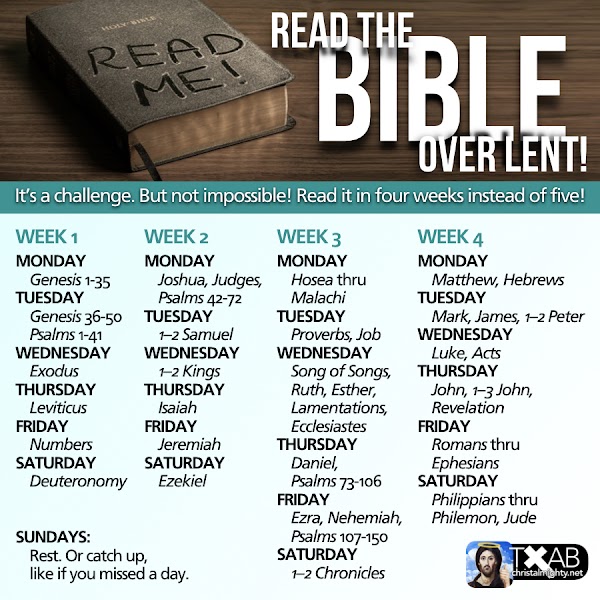
Read the bible over Lent.

So it’s Lent. And during this time, some of us Christians either

  • do a little fasting or other forms of self-deprivation, and spend some time meditate about what Jesus suffered on our behalf;
  • contemplate nothing, but fast anyway ’cause it’s tradition; or
  • contemplate nothing, fast nothing, feel smug because our religious customs don’t obligate us to do a thing, and mock those who do.

Hopefully you’ve chosen the first thing. And if you’re gonna meditate on something, why not read the bible? The whole bible? ’Cause you can. You can actually read it, in its entirety, within a month. So there’s certainly no reason it can’t be done with 10 extra days. You can easily take the time you’d ordinarily spend watching reality TV shows, and read the scriptures. And have time left over. Easy-peasy.

Even if you don’t plan to give up anything for Lent, (’cause you’re American and self-deprivation isn’t your thing), you can still carve out a bit of time each day to read some bible, and make up for the fact you didn’t read the whole thing back in January. Or maybe you did start, but dropped the ball. Or that you’re doing the six-month or year-long bible track, and dropped the ball on that. Either way, it’s catchup time.

So there’s your Lenten challenge: Read your bible. You know you oughta.

One possible schedule.

If you’re gonna tackle the bible this Lent, here’s one possible schedule you can follow. Gets you through the Old Testament (in roughly the order it was composed), then the New (generally bunching authors together).

Lent has five Sundays, so if you skip a day… you have an entire extra week to catch up.

As I’ve said elsewhere, other reading programs carve the bible into equal portions for the day. If you wanna do that, you can: Get one of those yearly bible-reading programs, and read nine to 10 days’ worth of material each day. That’ll get you finished in 40 days. But ideally I like to read a book all the way through, so I didn’t slice and dice the books when I could avoid it. (Psalms technically consists of five individual books of psalms, so I actually didn’t divide those books when I spread ’em out on the schedule.)

Of course, you don’t have to follow this program. You can use TXAB’s bible-reading plan and read it in whatever order, at whatever speed, and get ’er done in 30 or even 20 days. (Or if you’re just crazy enough, 10 days.) Whatever works for you.

Ready to take the challenge? Let’s get to it.

28 February 2022

Shrovetide: Getting ready for Lent.

Christmas definitely gets all the secular attention, but Easter is most definitely Christianity’s biggest holiday. ’Cause Christ is risen. Jesus is alive. His being alive confirms everything he teaches. So we Christians put a lot into it…

…and kinda go overboard. That’s what shrovetide is about. You may already know before Easter we have a fasting period which English-speakers call Lent. Well, before Lent there’s a whole other season called shrovetide in which Christians prepare for Lent.

Shrovetide actually starts the ninth Sunday before Easter—two weeks ago. That’s 63 days before, but western Christian custom is to round it up to 70 and call it Septuagesima Sunday (from the Latin for 70, of course). The Sunday after that is 56 days before, so round it up again and it’s Sexagesima Sunday (for 60); and this Sunday is 48 days before, so Quinquagesima Sunday (for 50). Although more Christians simply call this day Shrove Sunday, the Sunday before Lent starts. And the last day of shrovetide is Shrove Tuesday, the day before Ash Wednesday.

Eastern Christians feel they always gotta outdo western Christians, so their customs start even earlier, with the 11th Sunday before Easter. It’s called Zacchaeus Sunday, ’cause it’s the week in their liturgy in which they read the Zacchaeus story. Lk 19.1-10 They don’t do anything extra-special for Zacchaeus Sunday; it’s just a reminder: “Uh-oh, it’s the Zacchaeus story; Lent is coming.” The 10th Sunday before, they read the Pharisee and Taxman Story, Lk 18.9-14 and use it as a reminder to not get boastful about fasting—but they deliberately don’t fast this week. The ninth Sunday is the Prodigal Son Story; Lk 15.11-32 the eighth is Last Judgment Sunday, after which they stop eating meat; the seventh is Forgiveness Sunday, after which they stop eating dairy… and Forgiveness Sunday is today. What westerners call Shrove Sunday.

The English verb shrive is one we seldom use anymore, unless it’s shrovetide. It means to confess sins. Holy days are coming, so Christians wanna be ritually clean. Unlike the Hebrews, the way Christians traditionally clean up isn’t to get literally clean (which, eww, ’cause we should, but then again this isn’t the point): It’s to get spiritually clean. Stop sinning, and make sure there are no sins on our consciences. Exhibit some of that self-control the Spirit’s trying to develop in us.

Honestly we should be living this way all the time. But liturgical churches use shrovetide as a way of waking Christians up: Easter’s coming! Get your s--t together. And some of us do.

The rest… not so much.

24 February 2022

The former persecutor turned evangelist.

Galatians 1.13-24 KWL
13 For you heard the story of my behavior
when I was in Judaism—
that, in my extremism, I persecuted God’s church
and was laying waste to it.
14 In Judaism, I was advancing
beyond many of the peers in my class,
being extremely zealous
in my spiritual fathers’ “traditional” interpretations.
15 When God thought it best,
he separated me from the time I was in my mother’s womb,
and called me by his grace,
16 to reveal his Son to me
so I might evangelize of him to the gentiles,
I didn’t immediately confer with flesh and blood,
17 nor did I go to Jerusalem
to those who became apostles before me.
I went to Arabia instead.
Then I returned to Damascus again.
18 After three years, then I went up to Jerusalem
to interview Simon Peter.
I stayed with him 15 days.
19 I saw none of the other apostles except James, our Lord’s brother.
20 I write you all about this:
Look, I swear before God I’m not lying.
21 Then I went to the region of Syria and Cilicia,
22 and my face was unknown to the Jewish Christian churches.
23 They had only heard,
“Our former persecutor now evangelizes
the faith he was previously destroying,”
24 and they were glorifying God over me.
Previously:
  • “Christ Jesus’s apostle to this present age.” Ga 1.1-5
  • “The ‘gospel of grace’… with a little karma in it.” Ga 1.6-9)
  • “The gospel doesn’t come from anyone but Christ Jesus.” Ga 1.10-12)
  • Paul gives some of his testimony here. As you know (or oughta know) a conversion story is a testimony, but it’s hardly one’s only testimony. One’s testimony is a story of anything God has done through us, and since God had done a lot through Paul, he had a lot to testify. He’d seen some stuff.

    Various people, much as they have with Historical Jesus, have invented a Historical Paul—the guy they blame for anything in Christianity they don’t like. To them, Historical Paul was an ancient Pharisee rabbi who ditched Pharisaism, opportunistically adopted the teachings of the recently-dead Jesus the Nazarene, and shaped it into a new religion about grace instead of righteously obeying the Law (which they claim Jesus was really all about; not God’s kingdom). Historical Paul invented Christianity, they claim; not Jesus.

    Their rewrite of history disregards Paul’s own writings. Every reference to Paul’s conversion points out no evangelist won him over, no logical explanation got him to change his mind. Paul was absolutely convinced Christianity was heresy. Not just that, Christians like Stephen needed to be dead—lest they outrage God and trigger the cycle of history again. This time it wouldn’t be the Babylonians flattening Jerusalem; it’d be the Romans. (As, it turns out, the Romans did—less than 20 years after Paul wrote Galatians.)

    Paul was absolutely certain he was doing right by God to purge the world of Jesus’s followers, and nobody but nobody could tell him different; he had all the blind zeal of a religious extremist. It is decidedly not the behavior of someone who wanted to adopt, nor create, another religion. This is what a περισσοτέρως ζηλωτὴς/perissotéros zilotís, “superabundant zealot,” does. It’s typical cage-stage behavior. But, y'know, more murdery. There are a lot of overzealous “defenders of faith” who would totally murder everyone they considered heretic, and the only thing mitigating them is the government. Sometimes Jesus—but many of them ignore Jesus, figuring the destruction of “heretics” far outweighs everything Jesus teaches about loving one’s enemies. It’s why they wanna grab the reins of government so badly: This way, nothing can stop them from purging “sinners” and stopping the cycle.