Showing posts with label #Bible. Show all posts

01 April 2026

Passover: When God saved the Hebrews.

Back when I once taught on this topic, one of my students asked, “Why don’t we celebrate Passover?”—meaning we Christians. And it just so happens we do. We call it Pascha, Pascua, Páques; most languages use some form of the original Hebrew word פֶּסַח/pesákh, “skipping or passing over.”

It’s just English-speakers use the word Easter. And obviously we do it way different than we see in the scriptures—so different, English-speaking people routinely assume Easter and Passover are two entirely different holidays.

I can’t argue with this assumption. Christians don’t bother to purge our homes of yeast or leavening. Don’t cook lamb. (Nor practice the modern Jewish custom of not having lamb, since there’s no temple in Jerusalem to ritually sacrifice a lamb in.) Don’t put out the seder plate. Don’t tell the Exodus story. Don’t have the kids ask the Four Questions (what’s with the matzot, why are bitter herbs part of the meal, why roasted meat in particular, and why does the food gets dipped twice?). Don’t hide the afikomen and have the kids search for it; we do that with the eggs though.

And some English-speaking Christians do observe Passover as a separate holiday. Some of us celebrate it Hebrew-style, as spelled out in the scriptures, as in Exodus and Deuteronomy. But more often, Christians follow the lead of our Messianic Jewish sisters and brothers, figuring they’re Jews so they know how to do it. Thing is, Messianic Jews borrow their traditions from the Conservative Judaism movement. (Which, contrary to their name, ain’t all that conservative.) Their haggadah—their order of service—is nearly always adapted from Orthodox or Conservative prayer books, which means it dates from the 10th century or later.

Some Jewish customs come from the Mishna, so they do date back to the third century, and maybe go as far back as the first. But they might not have. It’s entirely likely most of them originated after the temple was destroyed, ’cause now you can’t do the religious portion of Passover at temple, so you gotta do it somewhere, so now it’s made part of the seder, the ritual Passover dinner. Jesus and his students may have simply eaten dinner, quoted the Exodus story, thanked God for his salvation, drank, sang, and that’s about all. No haggadah; no seder plate, no afikomen, no Four Questions, no Airing of the Grievances… oh wait, that’s Festivus.

And not all these customs are part of everyone’s Passover. Just as Christians celebrate Christmas and Easter every which way, Jews then and now got to select their own customs. Hence families have unique customs, and various synagogues emphasize various things. Medieval Jewish communities in eastern Europe, north Africa, Spain, and the middle east, all came up with their individual haggadahs. So did Samaritans.

The point of the haggadah is to teach the Exodus story to those who don’t know it, usually children. And remember, Jesus’s students were teenagers, not children: Legal adults who already knew the Exodus story. If they hadn’t heard it in enough detail at home, Jesus would’ve taught it to them personally, and they’d’ve celebrated several Passovers together by the time of his last Passover supper. So, just as some families don’t tell the nativity story every Christmas once the kids get older, don’t be surprised if Jesus supper skipped the Exodus story as redundant.

Christians usually know very little about Jewish culture, and mistakenly think that’s how Jews and Pharisees behaved in Jesus’s day too. In my experience Messianic Jews think this too—and regularly make a big, big point of how Jesus would’ve behaved exactly like the Jews they know… when the gospels make it really clear Jesus didn’t behave at all like his fellow Jews, and it really annoyed them. In either case when they attend a Passover seder and listen to whatever haggadah the leader borrowed or wrote, they routinely think it’s so profound how Jesus did all these rituals (even though he likely didn’t) and how his life and teachings “fulfilled” all these rituals.

Er, no. Of course we can see similarities between Jesus’s life and teachings, and Passover rituals… and Christian rituals, and really any rituals if you wanna connect the dots hard enough. But today’s Passover customs might entirely postdate Jesus. So let’s not read too much into what Jesus “brought meaning into”—he may not have. Especially when your haggadah was put together by Christians.

31 December 2025

Read the bible in a month. Yes, seriously. A month.

January’s coming; you’re making resolutions, and one of ’em is to read the bible. As you should! It’s gonna make you more familiar with God. Some people unrealistically expect a new, profound God-experience every day as the Holy Spirit shows ’em stuff, but hopefully you’re more realistic about it. Hopefully you’re realistic about all your resolutions. Not everyone is.

So you need to read through through the entire bible, Genesis to maps. (That’s an old Evangelical joke. ’Cause a lot of study bibles include maps in the back. Okay, it’s less amusing once I explain it.) Every year Christians get on some kind of bible-reading plan to make sure they methodically go through every book, chapter, and verse. ’Cause when we don’t, we wind up only reading the familiar bits, over and over and over again—and miss a lot of the parts we should read. The reason so many Christians misinterpret the New Testament is because they know so very little of its Old Testament context. Every time I quote just a little bit of the Law to explain Jesus’s teachings, way too many people respond, “I’ve never heard that before.” Sadly, I know exactly what they’re talking about.

But part of the reason they “never heard that before” is because they totally forgot they did hear it. Because their bible-in-a-year reading plan had ’em read the Law back in February… and when they finally got to the gospels in September, they’ve clean forgot what they read in February. And by next February when they’re reading the Law again, they’ve clean forgot what they read in September.

So why take a year to read the bible? ’Cause everybody else is doing the bible in a year.

Seriously. It’s a big market. Publishers sell one-year bibles, which chop the scriptures into short daily readings. Sometimes really short daily readings, ’cause they’ll give you three readings: A chapter of the Old Testament, half a chapter of the New Testament, and half a psalm or some other poetry for dessert. If you don’t buy their specially sliced-up bible, there are websites which do it for you, or modules to add to your bible software, or you can just get a list of somebody’s bible-in-a-year plan and follow it yourself. Stick to it and in a year—a year!—you’ll have read the bible.

Yes the bible is a big thick book collection. But come on. It’s not so thick it takes a year to go through.

The year-long program makes the bible sound like this huge, insurmountable mountain to climb. It’s no such thing. Why, you can read it in a month. And no, I’m not kidding. A month. I’ve read it several Januarys in a row. Takes me three weeks.

Yes, there are bible-reading programs which read the bible in three months. That’s a little more reasonable. In fact if you wanna really get familiar with your bible, and quickly, it’s a great idea to do this three-month plan and read the bible four times in a year. (Ideally in four different translations.) Read it every time the seasons change—in December, March, June, and September. Get a bible-in-three-months plan and go with their schedule, or get a bible-in-a-year plan and read four times as much.

If you struggle with reading, or reading comprehension, fine; there are six-month bible-reading plans. But when we’re talking a whole year to read the bible, this pace has serious drawbacks. And not just ’cause it makes the bible sound impossibly massive.

26 November 2025

The Jesus Seminar.

Every once in a while someone informs me a particular Jesus-saying in the gospels wasn’t actually said by Jesus. It’s extremely rare; it’s only happened to me thrice.

“No it was said by Jesus,” I’ll tell them. “Best we can tell, it’s been part of Christian tradition since the first century. it’s not a textual variant.”

“No it’s not,” they’ll respond, “because the Jesus Seminar says it’s not.”

First time I heard this, I laughed. A lot. “Who put them in charge of deciding what’s bible and what’s not?” As far as I knew, the Jesus Seminar people were just a bunch of crackpots.

Eventually I looked into this Jesus Seminar stuff and discovered… well crackpot isn’t the kindest way of putting it, but there’s an awful lot of cracked pottery involved in their setup. Lemme back up a bunch and explain what I mean.

The Jesus Seminar was the brainchild of liberal theologian Dr. Robert W. Funk (1926–2005), who created it to publicize his recently-founded Westar Institute, a nonprofit which promoted biblical studies from a liberal theological viewpoint. And before I keep flinging that term around, I’d better define it: Liberal theology presumes the theologian—not the Holy Spirit, scripture, and orthodox Christian tradition—is the authority when it comes to forming one’s beliefs about God. They decide what’s true and what’s not.

Based on what? Well, the conservative theologian will point to other authorities, like the Spirit, scripture, and tradition. Depending on the integrity of the theologian, they might not quote or interpret these authorities properly… but they do recognize it’s important to point to other authorities, and say, “They say so; it’s not just me.” Whereas liberal theologians don’t care if they’re the only ones saying so. They might point to the Spirit, scripture, and tradition, but they figure what ultimately decides whether something’s true or false about God, is them. And their commonsense, assuming they have any.

Hence liberal theologians don't do orthodoxy, don't recognize bible as authoritative, and frequently don't believe God intervenes in human history anyway. You might notice many of ’em go out of their way to reject orthodox and biblical ideas, just to show off how independent, novel, and radical they are. Plus it's great publicity. You’re not gonna gain notoriety for saying, “By golly, it looks like Jesus was born in Bethlehem of a virgin!”—unless you’re already well-known for denying every other creedal belief.

Funk was one of those guys. In 1985, he invited 50 academics and 100 laymen to join him at the new Westar campus in Santa Rosa, California, and participate in a seminar in which they’d vote on the legitimacy of 1,500 individual Jesus sayings, found in the gospels, the rest of the New Testament, and the Gospel of Thomas. Are they authentic Jesus, or hokum? Each participant voted by dropping a bead in a box:

  • RED (3 points) meant it’s definitely Jesus.
  • PINK (2 points) meant it’s likely Jesus—they were pretty sure he said something just like that.
  • GRAY (1 point) meant Jesus didn’t say those exact words, but it’s consistent with his thinking.
  • BLACK (0 points) meant it’s not Jesus at all.

The academics were largely legitimate biblical scholars, regardless of their liberal views. The laymen were… well, laymen. Not scholars. Churchgoers, and not. Filmmaker Paul Verhoeven, who’d just directed his first American movie—hadn’t even made RoboCop and Total Recall yet—was one of ’em. He’s a Historical Jesus fan; he published a book about Jesus in 2008, and has wanted to make a Jesus movie in which he’s a radical political activist. Again, not a scholar. And y’notice the laymen outnumbered—and could easily outvote—the scholars.

What criteria did these people use for determining whether something truly came from Jesus or not? Well, having it in all the gospels certainly helped. They were also looking for certain traits: It had to be memorable; they figured Jesus would say catchy stuff, like “Don’t throw pearls to pigs.” They liked irony, so if Jesus’s teachings sounded ironic to them (“The last will be first, and the first last”) they figured he’d say that. They liked the idea of trusting God, so if Jesus talked about that (“Have faith in God”) they figured that was legit.

What they didn’t consider legit, were End Times stuff, miracle stories, stuff about the church (’cause they didn’t believe Jesus intended to start any church), anything where Jesus talks about himself (“I am the way, the truth, and the life”). Plus if something is found in one gospel but not the others, they presumed the author of that gospel was pushing his agenda, not Jesus’s.

The end result? They published a new translation of the gospels, color-coded to how they voted. Black meant most voted black; red meant most voted red. Thus you wind up with a Lord’s Prayer which looks like so:

Matthew 6.9-13 Jesus Seminar version
9“Instead, you should pray like this: Our Father in the heavens, your name be revered. 10Impose your imperial rule, enact your will on earth as you have in heaven. 11Provide us with the bread we need for today. 12Forgive our debts to the extent that we have forgiven those in debt to us. 13And please don't subject us to test after test, but rescue us from the evil one.”

So the only thing they deem Jesus definitely said was “Our Father,” and he definitely didn’t say “in heaven,” nor “Your will be done on earth as it is in heaven,” nor “Deliver us from evil.” And only mighta said the rest.

In this way, with this criteria, 82 percent of Jesus’s teachings got nullified. Don’t have to follow them anymore! Of course if he’s not really divine, and doesn’t wholly speak for God, you never had to follow him anyway. So this isn’t really about growing closer to Jesus, nor learning to follow him better; this is just a fun intellectual exercise.

19 November 2025

Christians who try to discourage you away from bible apps.

When I bought my first Macintosh, I also bought bible software. I’ve written a little about it elsewhere. I switched software a few times, finally settled on Accordance, spent a lot of money on modules, and now exclusively use it for bible study. I’ve got it on my phone too; I read it instead of my tiny bibles.

My print bibles? Getting dusty.

And I’ve met certain Christians whom this bugs to no end.

Most are bibliolaters, who worship the Holy Bible instead of the Holy Spirit. They may not be aware that somewhere, baked into the moldy filling of their over-elevation of the scriptures, they grew to also revere the printed word. To them, digital books aren’t real books… even though they absolutely are. They’re pretty snobbish about it.

It’s not the medium which makes a book. A book can exist in a stone tablet, a papyrus scroll, a parchment codex, an eight-ring binder, a strip of microfilm, a 30-pack of audio cassettes, a 12-pack of audio CDs, a floppy disk or CD-ROM or thumb drive, the solid-state hard drive of your iPhone or Kindle, or the solid-state hard drive of some internet-accessible server somewhere (which people like to call “the cloud,” but yeah, it’s physically somewhere).

Me, I prefer the hard drive. I don’t always have a wifi signal, so the cloud’s definitely my second choice.

So during Sunday morning services, when these bibliolaters wave their big black pleather-clad KJV study bibles at the listeners and say, “Got your bibles?” what they want to see is a room full of big black pleather-clad KJV print bibles waving back at them, like foam fingers at a baseball game. When they see phones instead… well, a little bit of them dies inside, and not the idolatrous part which needs to die.

Because to them, these aren’t bibles. They’re just phones. And they’re pretty sure you don’t read bible on ’em.

And they’re also pretty sure you don’t actually have a bible on them. In that, they’d usually be correct. I’ve met many a Christian who has no dedicated bible app; they go to Bible Gateway. And when they do have a bible app, most of those apps don’t actually install any text on your phone, which you can still read even when you’re offline. All their bible translations are on a server, not your phone. They’re entirely dependent on internet.

I don’t really see that as a problem, but bibliolaters certainly do: They worry that at some point in the future, probably during the End Times, the Beast’s government is gonna ban bibles, and if you don’t have a print copy you’re boned. Me, I suspect most Beast-like autocrats are gonna be just fine with bible. Will even pretend they love the bible, and hold it up for photo opportunities, and even claim their favorite verse is somewhere in “two Corinthians”—because they know perfectly well Christians don’t follow it, which is how they got elected in the first place. But that’s a whole other tangent. Back to bible apps!

Is it fair to say people don’t read bible on their phones? Well, kinda. Which is just as true for bibles in print.

30 July 2025

Do you know your bible quotes?

Generally if you’re gonna call yourself biblically literate, you oughta at least know these quotes from the bible. Probably already do; you just didn’t realize they were from the bible.

ALL HAVE SINNED AND FALL SHORT OF THE GLORY OF GOD. Or “come short” in the KJV. Comes from Romans 3.23, and means nobody measures up to God’s reasonable standard of perfection. But God graciously forgives us and grants eternal life. Ro 6.23

ALL THINGS TO ALL PEOPLE. Or “all men” (KJV): Paul’s claim he adapted his circumstances so he can find common ground with everyone, and share Christ with them. 1Co 9.22 Y’know, “when in Rome.” Certain Christians are quick to point out Paul didn’t compromise his beliefs or behavior in so doing.

ALL THINGS WORK TOGETHER FOR GOOD. In context, “to them that love God, to them who are called according to his purpose.” Ro 8.28 Various Christians pull it out of context and claim everything always turns out for the best. I remind ’em to read Ecclesiastes sometime.

ALL WE, LIKE SHEEP, HAVE GONE ASTRAY. Isaiah’s warning to his people: They turned away from God, like sheep who disregard their shepherd. Is 53.6

AM I MY BROTHER’S KEEPER? Cain’s excuse to God for not knowing where Abel was, Ge 4.9 though in fact he just murdered him. The phrase gets used to claim we’re not responsible for one other. In reality we often are.

ASK AND IT’LL BE GIVEN YOU. Jesus’s teaching that the Father wants to give good gifts to his kids. Mt 7.7

BE FRUITFUL AND MULTIPLY. God’s directives to the animals after he first created them. Ge 1.22 Including to the first humans. Ge 1.28

BE SURE YOUR SIN WILL FIND YOU OUT. Moses’s warning to two Israeli tribes who promised they’d fight the Amorites alongside the other 11; that if they broke their promise they’d get caught. Nu 32.23 Christians sometimes use this verse to claim every sin eventually gets found out. And many do… and some don’t.

BEAT THEIR SWORDS INTO PLOWSHARES. A prophecy about future peace—or not—found in multiple books of the prophets. Is 2.4, Mc 4.3, Jl 3.10

10 July 2025

The bible as a source of revelation.

Many Christians firmly believe the only way God reveals himself to humanity, is through bible. Which contradicts what we find in the bible.

In the scriptures, God first reveals himself to humans with a God-appearance: He hangs out with Adam and Eve. Ge 3.8 It’s special revelation through regular personal appearances. Now yeah, the humans ruined those visitations… but no, their sin didn’t drive God away; sin doesn’t do that, because God is infinitely mightier than sin. The scriptures tell us God still appeared to people from time to time. And of course he became human, and interacted with people that way.

Likewise there were other forms of revelation—all of which we see in the book of Genesis:

  • We got creation, for those folks who insist nature’s a type of revelation.
  • We got miracles.
  • We got God having conversational prayers with people. (Including, of all people, Cain, the first murderer.)
  • We got prophetic dreams. (And the first guy to have one is neither Abraham nor one of his descendants; he’s a gentile.)
  • We got prophets.

And the bible is a product of all these sources of revelation. People interacted with God, recorded these things, preserved them as best we can, and that’s our scriptures. That’s bible.

The difference between bible and other forms of revelation, is the bible’s been repeatedly confirmed as reliable. In its day, and many times since. Yes, even Revelation—even though its apocalyptic visions talk about the very end of history, plenty of it is about its then-present day, and that stuff came to pass. It’s why ancient Christians kept it. I can’t help that “prophecy scholars” make tons of wild claims about what they think it means, that people buy their books and believe ’em, and that their wild claims regularly don’t come true. They know not what they do, and their fans are wasting their time and money on ’em.

The fact the bible’s been confirmed is why we kept its books: Why keep supposed “revelations from God” which were unproven or disproven? Why seek similar God-experiences for ourselves? But since we’ve sought those experiences and found ’em valid, and since we’ve thus far confirmed many of the bible’s historical events in history, we Christians consider the scriptures faithful and reliable revelations of God. If you wanna fact-check it again, go right ahead; we’ve found it can stand up to scrutiny. Archaeologists still keep digging up stuff which confirms it—sometimes in ways they never expected, ’cause their discoveries put a whole new spin on the scriptures.

Now, with every other source of revelation, we still have to confirm them. We gotta watch miracles to see whether they produce the sort of good fruit we oughta see in God’s handiwork. We gotta confirm prophecy, prayer messages, and dreams, lest people were mistaken, or were tricked, or are lying. But with bible, not so much. From the time the very first books were written, all the way to today, God’s followers have confirmed and re-confirmed and re-re-confirmed the scriptures are solid. Trustworthy. Relevant. Consistent with who God is.

01 July 2025

Praying the scriptures.

It’s a popular Christian practice to drop little bits of bible into our prayers. Kinda like so.

Father, we come to you because you tell us “if my people, who are called by my name, seek my face, I will hear from heaven,” and we recognize “your word won’t return void,” so we call upon you today, Lord. Hear our prayers, meet our needs, heed our cries. “Give us today our daily bread.” Amen.

We pray the Lord’s Prayer of course. Sometimes we pray the psalms. Sometimes full psalms—yes, we can pray entire passages from the scriptures. Many of the more famous rote prayers consist of lines lifted straight from the bible and arranged to sound like a prayer.

We do this for all sorts of reasons. Sometimes not-so-legitimate ones, like we want our prayers to sound more bible-y. That’s why we’ll trot out the King James Version English with its “thee” and “thou” and old-timey verbs. If it’s old-fashioned we figure it’s more solemn and serious and holy. It’s not really—but people think so, which is why they do it.

Or we covet the bible’s power. We quote bible because the bible is God’s word… and since God’s word is mighty and powerful, maybe quoting it in prayer is also mighty and powerful. Maybe those words can make our prayer requests mighty and powerful, and we can get what we want because we’re tapping that power.

Or we’re padding our prayers. Short prayers are fine, but way too many Christians think long prayers are, again, more solemn and serious and holy. So if our prayers are too short, maybe we can stretch ’em out by throwing in a dozen bible verses. Plus they’ll sound bible-y, plus they’ll tap the bible’s power; we can do this for all three inappropriate reasons.

But don’t get me wrong; there are appropriate reasons to include bible verses in our prayers. Really good reasons.

18 June 2025

Bibliolatry: When Christians straight-up worship the bible.

Christianity is based on, and centered upon, the person and work of Christ Jesus. I hope you know this already. Most of us do.

But you’re gonna find a strain of Evangelicals who insist Christianity is based on the bible. They’re “bible-believing Christians,” as opposed to Jesus-believing Christians. (They would never say they don’t believe Jesus, but when they describe themselves, bible takes priority.) They attend “bible-believing churches”; I’ve attended more than one “Bible Church,” whether it be First Bible Church, Community Bible Church, Hometown Bible Church, and so forth. “Bible” has to be in the name somewhere, just to remind you they follow bible.

Being a bible-believing, bible-centered group, means they exalt the bible to a really high position in their religion. Nearly as high as God. Sometimes higher—and that’s where we cross the line into bibliolatry.

They will not call it bibliolatry, of course. They’ll call it love and respect for God’s holy word. Or “a high view of scripture” (a term which properly refers to how the Holy Spirit inspired it, not how highly we think of it). They’ll get into the Christian apologetics in which they argue for the bible’s centrality and preeminence.

But Jesus is meant to be center ad preeminent in our religion. If you put anything else there, no matter how good and useful it is, we’re talking idolatry. Doesn’t matter that it’s bible!

In my experience, bible-worship tends to happen most often among cessationists. No, they’re hardly the only ones who do it. But once you insist God turned off the miracles, and doesn’t talk to us anymore, what’re you left with? Well, your bibles. You’re kinda obligated to depend on your bible; it’s like if your mother abandoned you as a child, but left you a good-bye note saying she loves you, and you cling to that note and make it the most precious thing you own. It becomes a sad substitute for your mother. And for cessationists, that’s bible.

Likewise cessationists make bible a sad substitute for the Holy Spirit. We’re supposed to be talking to him, following his leading, developing his fruit. Cessationists believe we don’t do that; not really. They might imagine the Spirit afffecting our emotions somewhat, giving us nudges and warm fuzzy feelings… but as far as following his leading, nope; they follow the bible’s leading. The only way they expect to have a relationship with the Spirit is by reading what he inspired. By learning about him; not actually knowing him and having experiences of him. They reject such experiences.

So if we dare insult the bible, or show it what they consider a lack of respect, they’ll consider it blasphemy. They’ll actually call it that: We slandered their god. The bible must be treated with nothing but the greatest reverence. Never set your bible on the floor. Never doodle in it. Never toss it onto a table. Protect it in the biggest, thickest, real-leather bible covers. Capitalize “Bible” every time—even when we’re not talking about Christian bibles. To treat it as an ordinary book, is as if we treated God with anything other than majesty.

Yeah, the bibliolatry gets pretty blatant with them. It’s not at all hard to detect.

07 August 2024

The bible’s not a biology textbook!

Leviticus 11.13-19, Deuteronomy 14.11-18, Jonah 1.17, Matthew 12.40

During a talk with a fellow Christian, we went off on a bit of a tangent.

ME. “…Like when Jonah got swallowed by the whale…”
HE. “Sea creature.”
ME. “Whale. How’re you getting ‘sea creature’ from kítus?”
HE. “From what?”
HE.Kítus. The Greek word for ‘whale.’ The word Jesus used when he talked about Jonah being in the whale’s belly three days and nights. Mt 12.40 It’s the word we get our adjective ‘cetacean’ from, which refers to whales, dolphins, porpoises, and other marine mammals.”
HE. [confused; betcha he didn’t expect me to know what I was talking about] “But Jonah said he was swallowed by a great fish.” Jh 1.17
ME. “Sure.”
HE. “Well a whale’s not a fish.”
ME. “But it was a fish in Jesus’s day.”
HE. “Whales used to be fish…?”
HE. “Because the ancients classified them as fish. They figured if it lives in the sea, it’s a fish. Then somebody eventually realized some of these ‘fishes’ have lungs, and decided if you have lungs you’re not a fish, and humanity redefined ‘fish.’ Well, bible’s still using the old definition. So in the bible, whales are big fish.”
HE. [still confused] “But whales aren’t fish.”
ME. “Aren’t fish anymore. They were fish back in Jesus and Jonah’s day.”
HE. “So are you saying the bible’s wrong, or we are?”
ME. “Neither. The bible doesn’t define fish; it explains God. We define fish. You remember Adam got to name the animals. Ge 2.19-20 We get to decide what’s a fish and what’s not. And if we redefine fish, we can do that; it doesn’t violate the bible to do that. The only problem is when we try to update the bible to fit our definition of fish, and make the bible look inconsistent when it’s really not.”

This very issue came up again this weekend. My pastor had a little quiz about bible literacy, and I pointed out to him Jesus said Jonah was swallowed by a κήτους/kítus, “whale.”

Matthew 12.40 KJV
For as Jonas was three days and three nights in the whale’s belly; so shall the Son of man be three days and three nights in the heart of the earth.

It’s right there in red and white. Well, unless you’re reading a more recent translation which renders kítus as “sea creature” or “big fish.”

Amplified, LSB, NASB, NRSV: “sea monster”
CEV, GNT: “big fish”
CSV, NET, NIV: “huge fish”
ESV, MEV, NKJV: “great fish”
ISV: “sea creature”

But I remind you: None of these translations are accurate. None. They’re all conforming to the דָּ֣ג גָּד֔וֹל/dag gadól, “great fish,” of Jonah:

Jonah 1.17 KJV
The LORD arranged for a great fish to swallow Jonah.
Jonah was in the fish’s bowels three days and three nights.

But to Jesus’s mind (at the time) a whale was a great fish. And isn’t Jesus in a position to know which species of “fish” swallowed Jonah? He said kítus, “whale”; so it was a whale.

My point is, if you know your history, there’s not actually a bible difficulty here! The problem is people don’t know history, and think there’s a difficulty if Jesus says “whale”… so y’notice a fair number of bible translators have changed the Lord Jesus’s words so that there’s no difficulty anymore. Which reveals all sorts of disturbing things about them. Namely a bothersome amount of intellectual dishonesty.

01 August 2024

Read the bible this August. Yes, all of it.

Back when you were making New Year’s resolutions, one of them mighta been to read the bible. All the bible, from Genesis to the maps; probably using one of those bible-in-a-year plans. Lots of Christians do.

Then, somwhere around February or March, you kinda fumbled the plan. It happens to the best of us! Hopefully you got right back on it and caught up with the reading. Many don’t. Some skip over all the parts they missed, figuring they’ll read ’em next year. Some never do read ’em next year.

And some, of course, quit altogether.

But you realize you can pick up thty resolution at any part of the year, right? It doesn’t have to be in January. You don’t have to start reading the bible in January. In fact, some of the bible-reading plans have you read the bible twice or three times a year, meaning you start in January and July; or January, May, and September. But September’s usually super busy, and August is not… so hey, why not start in August? Get done in November instead of the busy, busy December.

Of course you can also read the bible in a month. It’s totally doable. I do it in January; you can do it in August. Or September, or October, or any month; if your August happens to be crazy busy, maybe next month would be better. But there’s no reason to procrastinate reading the bible… well, other than crippling depression, and for that you oughta see a doctor. But otherwise there’s not!

As I’ve written elsewhere, the year-long reading plans makesthe bible sound like a massive project, and it’s really not. An audio bible will be less than 100 hours long, and if you listened to it three hours a day (or 90 minutes twice a day), you’re done in 33 days. Audiobooks tend to go at a slow pace, so if you sped it up to 150 percent speed, those three hours will now be two. I of course read much faster than an audiobook will go. So can most of you. An hour of bible a day can get the bible done in a month. I know from experience; I’ve done it for years.

Though the bible’s a big thick book collection, going through the whole of it in August is far from impossible. Go for it!

16 July 2024

Dispensationalists and infallibility.

So here’s a weird little phenomenon I’ve discovered. I’ve actually seen it many, many times throughout my life, but didn’t recognize what was underneath it till recently.

I was talking to a fellow Christian a few weeks ago; we’ll call him Ayokunle. He’s dispensationalist, which means he believes God has saved people in many different ways throughout history. Darbyists believe God used six different ways, ’cause we’re in the sixth dispensation. But most of ’em figure there are at least two dispensations—one before Jesus, one after Jesus. Before Jesus atoned for our sins, they figure God saved people because they were good—if they followed the Law, God saved ’em, and if they didn’t, he didn’t.

Is this true? Not at all. God saves people by his grace, and he’s always saved people by his grace. Paul of Tarsus’s whole argument to the Galatians about why they needed to stop it with the legalism, was that God’s never saved anyone by good works. Abraham included! We’re right with God because we trust him, not because we followed commandments. Ga 2.16 If we ever could be saved that way, Jesus died for nothing. Ga 2.21

Anyway, my discussion with Ayokunle is because he loves to quote the old saying, “God works all things together for our good.” I’ve written on it elsewhere, and it doesn’t mean what he thinks it means. I told him so.

ME. “There’s an entire book of the bible which refutes you. Ecclesiastes.”
HE. “Hm?”
ME. “ ‘Vanity of vanities, saith the Preacher, vanity of vanities; all is vanity.’ Ec 1.2 Vanities have no value. They mean nothing. They’re meaningless. But nothing God does is meaningless.”
HE.Ecclesiastes?”
ME. “It’s a good read. Check it out.”
HE. “That is Old Testament.”
ME. “Correct.”
HE. “I am a New Testament Christian. Old Testament doesn’t apply.”
ME. “The bible doesn’t apply?”
HE. “New Testament does. Old Testament is of the old things which have passed away. ‘Behold, I make all things new.’ Rv 21.5 New Testament.”
ME. “So you don’t think the Old Testament should be in the bible.”
HE. “No; it should be in the bible. It has good stories. It tells us the history of the Jews. But it’s passed away. It’s dead.”
ME. “We’re not to trust it anymore for instructions on how to live our lives.”
HE. “Correct!”
ME. “But the 10 commandments are in there.”
HE. “Oh, the 10 commandments are in the New Testament too. We follow them. But the rest of the commandments are dead.”
ME. “So we can eat pork and shellfish.”
HE. “Yes!”
ME. “And have babies with our daughters.”
HE. “No! Why would you have babies with your daughters?”
ME.I wouldn’t; that’s nasty. But it’s an Old Testament command to not have sex with your daughter. Lv 18.10 And you say that command is dead, so…”
HE. “No! No one should do that!”
ME. “Oh absolutely. But you said God no longer forbids it.”
HE. “Well there are natural laws.”
ME. “True. But people break those all the time, which is why God gives us biblical revelation. But you say it’s not biblical revelation anymore.”

He didn’t know how to answer that, so he quickly changed the subject. But it occurred to me afterward: In saying the Old Testament no longer counts, he also basically revealed he no longer considers it infallible.

In fact a lot of dispensationalists like Ayokunle explicitly teach the Old Testament failed: It didn’t successfully do the job of saving people! That’s why God had to replace its system of works-based salvation with grace. The Law no longer counts because it failed.

So when these folks claim they believe in biblical infallibility… well, it’s not consistent with everything they teach about the Old Testament. They might consider the New Testament infallible, but not the Old Testament. ’Cause it failed.

I pointed this out to a different dispensationalist I know, and after a bit of objecting, he finally said yeah, I got something there. If dispensationalists believe the Law failed to save, and needn’t be followed because it failed, then they can’t properly claim biblical infallibility. At least not for the whole bible. New Testament is fine.

28 January 2024

“All scripture is God-breathed and useful for…”

2 Timothy 3.16.

In pretty much every sermon and lesson I’ve heard about why we have a bible, and what the bible is for, preachers and teachers quote this verse. Which I’m gonna quote in the New International Version, because of the unique and very popular way they translate it.

2 Timothy 3.16-17 NIV
16 All Scripture is God-breathed and is useful for teaching, rebuking, correcting and training in righteousness, 17 so that the servant of God may be thoroughly equipped for every good work.

The NIV describes the scriptures as God-breathed, and people really like describing it that way. It’s a very literal, perhaps too literal, translation of the word θεόπνευστος/theónefstos, “divinely inspired”—or as the KJV puts it, “by inspiration of God.” But the reason Christians like quoting this part, is to remind us the Holy Spirit inspired the books of the bible, so they’re not just any books. God’s behind them.

And sometimes these folks take this idea too far, and claim God’s in them, and they’re worthy of the same reverence God is. That’s idolatry, so let’s not go there. Don’t go replacing the Holy Spirit with the Holy Bible, like too many cessationists do. The Spirit doesn’t imbue the bible with divine powers, so all we now need to do is recite its verses like magic incantations and it’ll do stuff. That’s not its purpose. Reject those teachers who tell you otherwise.

But as for what its purpose actually is—well that’s the other reason people quote 1 Timothy 3.16. It’s so they can list these four things:

  • TEACHING (Greek διδασκαλίαν/didaskalían, “instruction”; KJV “doctrine”). Informing Christians what we should know about God, and how to follow Jesus.
  • REBUKING (ἐλεγμόν/elegmón; in the Textus Receptus ἔλεγχον/élenhon; both mean “disprove, reprimand, convince otherwise”). Challenging Christians who get God wrong, go too far, or sin.
  • CORRECTING (ἐπανόρθωσιν/epanórthosin, “correcting.”) Correcting Christians who lose focus, get off track, or forget what’s important. “Rebuking” deals with Christians who are seriously wrong; “correcting” with Christians who are just a bit off course.
  • TRAINING IN RIGHTEOUSNESS (παιδείαν τὴν ἐν δικαιοσύνῃ/pedeían tin en dikeosýni, “training about the right [way]”). Not just classroom instruction, but hands-on demonstration about how to fairly and morally treat others and behave.

They won’t always interpret these words the same way I have. I’ve been to churches where the main focus is correction. You don’t know the proper bible doctrines?—well, here they are; learn ’em and be orthodox like us. And when people object to our doctrines, learn some Christian apologetics so you can argue with them and win. As for behavior… well, don’t worry about actively following Jesus, for somehow that’s legalism; just don’t sin, for somehow that’s not.

But okay, those four things sound like really good reasons to study a bible. Thing is, they’re missing the most important one. Because they’re not reading the bible in context. You knew I was gonna get to context eventually, right?

12 July 2023

Our inspired bible.

INSPIRE ɪn.spaɪ(.ə)r verb. Breathe (air) in; inhale.
2. Fill with a positive, creative feeling; encourage.
3. Fill with the urge or ability to do or feel something; provoke.
[Inspiration ɪn.spə'reɪ.ʃən noun.]

Whenever we Christians talk about inspiration, whether we refer to inspired prophets, inspired teachings, inspired writings, or even inspired music, we generally assume God did the inspiring. (Specifically God the Holy Spirit.) He’s the one who breathes brilliance into us.

One word we regularly translate “inspired” is θεόπνευστος/theónefstos, a word Paul probably coined. Literally it means “God-breathed,” which is how the NIV prefers to translate it in 2 Timothy 3.16.

2 Timothy 3.15-16 NIV
14 But as for you, continue in what you have learned and have become convinced of, because you know those from whom you learned it, 15 and how from infancy you have known the Holy Scriptures, which are able to make you wise for salvation through faith in Christ Jesus. 16 All Scripture is God-breathed and is useful for teaching, rebuking, correcting and training in righteousness, 17 so that the servant of God a may be thoroughly equipped for every good work.

People tend to fling around the word “inspired” as if it only means we had a brainstorm. That’s not what theónefstos means at all. It’s God involved with, behind, this creation process. It’s the Holy Spirit, living within the teacher, prophet, author, or artist, pointing ’em towards Jesus, getting them to describe God with infallible accuracy.

This is what Christians tend to believe about the books and letters which make up the bible: It’s inspired. The Holy Spirit got its authors to describe God with infallible accuracy.

Some Christians believe this God-breathed inspiration isn’t true of anything else. God inspired the bible, and that’s all. When God inspired Old Testament prophets and New Testament apostles, it was only so they’d write him some bible. Since the bible’s done, he’s inspired no one since. And of course this is bunk; God never stopped interacting with humanity, and still regularly inspires people. Not to write bible, ’cause it doesn’t need any more additions. But certainly the Spirit inspires all sorts of other things which point people towards Jesus.

And on the other extreme we have Christians who believe God inspires every act of human creativity. (Or even animal creativity; they’ll talk about bird nests and beaver dams as inspired.) Whereas I’m pretty sure if every time your kid builds something of Legos it makes you drop to your knees and praise Jesus for his gifts of creativity, you need a psychiatrist. Of course humans create; creativity is something God innately built into us. It’s not always inspired by God. Often it’s inspired by the hopes it’ll make us famous, or make us money. Yep, this is true of Christian artists too. I’ve seen the Jesus junk they sell at Hobby Lobby. Saying the Holy Spirit is behind all that crap? Dirty, dirty blasphemy.

But I digress; I’m trying to write about bible. And yes, the bible’s inspired. People had God-experiences, and wanted to record them for posterity. God dropped various ideas in people’s heads, and they wrote those down too. King David wrote poetry, and God nudged him to write really good poetry. Peter, John, James, Paul, Silas, Timothy, and Sosthenes had some good advice to give fellow Christians, and God nudged them to give profoundly useful advice. Inspired people wrote it, inspired Christians compiled it, and inspired Christians uphold it.

True, inspired people were and are fallible humans. But as people follow the Holy Spirit, he guides us to truth, Jn 16.13 and steers us clear of sin and error. In the moment, we can (and do) write and prophesy infallible stuff. Once done, we might (heck, do) slip up, sin, make mistakes, and fumble right back into fallibility. But the stuff done by the Spirit’s power is still good stuff. The writings in the bible are still authoritative. So we kept ’em.

09 March 2023

Those who don’t use bible as a source of revelation.

So I wrote about how the bible’s a source of revelation, and how it can be a useful tool as we Christians develop good theology. Problem is, not everybody who calls themselves Christian does this. Whether unintentionally or deliberately, way too many of us don’t bother with bible at all.

Whenever I bring up this fact with certain Evangelicals, thanks to certain prejudices they have, they immediately think of mainline churches. The assumption they typically have, is old-timey churches don’t bother with bible; their theology is based on feel-good junk. This assumption’s not based on anything valid, ’cause I’ve visited and studied the history of mainline churches, and know a few of their pastors. Their churches’ official doctrines are based on longtime traditions… and these traditions are regularly based on bible.

Don’t believe me? Look at their catechisms. A catechism is a list of a church’s official doctrines, frequently presented in the form of a list of frequently asked questions, ’cause it’s easier to memorize that way. They regularly encourage children and newbies to memorize ’em so they know exactly what Christianity—more accurately, their church—teaches.

  1. “What is the chief end [by which they mean purpose] of man?”
  2. “Man’s chief end is to glorify God, and enjoy him for ever.”

Now, does that question-and-answer pair come from bible? Kinda.

1 Corinthians 10.31 KJV
Whether therefore ye eat, or drink, or whatsoever ye do, do all to the glory of God.
 
Psalm 145.1-2 KJV
1 I will extol thee, my God, O king;
and I will bless thy name for ever and ever.
2 Every day will I bless thee;
and I will praise thy name for ever and ever.

That question and answer is based on bible. Most of the catechisms connect right back to bible. Or at least they claim to; every once in a while you’ll find a Q&A where you’ll balk: “Wait, is that what the bible meant?” and no, not really. Catechisms are the work of humans y’know, and humans make mistakes.

Hence every so often there’s gonna be an official teaching of that church where y’might wonder, “How’d they come up with that?”—and nope, it’s not from bible. The church’s founder, or one of its more famous preachers, or some significant author, coined it. The people of that church thought it sounded like godly wisdom—and hey, maybe it is! But maybe it’s not. And either way, since it’s not bible, it’d better be consistent with bible. At the very least it’d better not contradict it!

So that’s what you’ll find in mainline churches: People who are trying to be consistent with the scriptures. But also consistent with their traditions. Traditions are very important to them!—they help connect ’em with one another, and with the Christians of the past. Likewise they figure those traditions are ultimately, originally based on the apostles’ teachings, i.e. bible: We shouldn’t find any contradictions between them.

Yeah, those people with hangups about how biblical mainliners are, don’t really know any mainliners.

Me, I’m not necessarily even thinking of mainliners and catechisms. I’m thinking of heretics. ’Cause I know a few.

01 February 2023

Context? Who needs context?

CONTEXT 'kɑn.tɛkst noun. Setting of an idea or event: The larger story they’re part of, the circumstances or history behind them, the people to whom they’re said. Without them, the idea is neither fully understood nor clear.
[Contextual kən'tɛks.tʃ(əw).əl adjective.]

“Neither a borrower nor a lender be.”

It doesn’t come from bible, though from time to time someone will claim it totally does, and therefore it’s a divine command. But nope, it’s not scripture at all. Comes from William Shakespeare’s Hamlet, act 1, scene 3. Shakespeare’s no slouch, but it’s still not bible.

Why do people quote it? Typically because they literally mean it: Don’t borrow! Don’t lend! Because if you never borrow money, chances are you’ll never go into debt or bankruptcy. If you never lend money, you won’t have to fret when your friends can’t repay you. Simple, prudent advice. Words people think we oughta live by.

Okay, so why’d Shakespeare write this line?

Well… actually we don’t care why he wrote it. We’re only interested in what we mean by it: Don’t borrow! Don’t lend! We presume Shakespeare meant the very same thing. It’s straightforward enough, isn’t it?

But a Shakespeare scholar, or anyone who’s stayed awake through Hamlet, will recall exactly where it came from. The wily King Claudius’s not-as-wily adviser, Polonius, is giving advice to his son Laertes before he sends him off to university. If they watched any halfway decent performance of Hamlet, they’ll remember Polonius was kind of an idiot. All his other advice in the play turns out to be wrong, bad, foolish, and fatal.

“Well okay, Shakespeare put it in the mouth of a dunce. But it’s still sound advice.”

Is it? Look at the life stories of certain billionaires, and you’ll notice nearly all of them, in order to start the company which made ’em a billion dollars, borrowed money. (The few who didn’t borrow money, already had money, or had wealthy relatives.) You’ll also notice nearly all of them lent money, and made a bunch of money that way too. As for lending, should I not buy treasury bills? Should I not put my money in long-term certificate of deposit accounts? Should I not invest in businesses and people I believe in?

Really, I find the only people who quote it are self-serving or stingy people. And if they claim it’s godly advice, it’s really not. Bible doesn’t back up Polonius at all.

You see the problem. Context is important. We should care where our quotes come from. We might be giving bad advice. Or, when quoting the bible, we might make a divine command out of something which was never meant to be one.

28 December 2022

TXAB’s bible-reading plan.

Whenever the new year approaches, Christians resolve to read the bible. The entire bible, not just the parts we like best: Genesis to maps, as the old joke goes. (See, when you buy a bible in print, most of them have maps of Israel and the Roman Empire in the back. Yes, explaining the joke makes it less funny. Yes, deliberately making the joke less funny is ironically funny. Yes, this is metahumor. I’ll stop now.)

Christians tend to pick up a bible-reading plan of some sort, and most of the time it goes through the scriptures in a year. Which, I insist, is far too long. I prefer you do it in a month. Yes it’s totally possible; the bible’s a big fat inspired book anthology, but it doesn’t take an entire year to read. What book do you take an entire year to read?—unless you chop it into bite-size bits so small you’re spiritually starving. No wonder so many Christians lose track and lose interest.

Now if a month seems too extreme for you (especially if you don’t read), y’know what you could do: Read the bible at your own speed. Read it till you’re done. However long it takes you to get it done. Might be three months. Maybe two. Then again you might surprise yourself and finish it in one.

That’s where TXAB’s bible-reading plan comes in. It’ll help you read it at whatever speed you’re going.

15 September 2022

Mistakes we might make in our word studies.

Yesterday I posted a piece about how to do a word study, and in it I largely emphasize how not to go to the dictionary first. ’Cause that’s how you do a word study wrong. Instead of drawing from the bible how its authors define a word, y’wind up overlaying the dictionary definition on top of the bible—whether it fits or not. (Or to use scholars’ words for it, y’wind up doing eisegesis instead of exegesis.)

When people overlay a definition upon the bible, they rarely looking at the context of the passage. (Yep, I’m gonna harp about context again. It’s important here too.) The few who do bother to look at context, often try to bend, fold, spindle, or mutilate the context as well till it fits their new definition.

Fr’instance. Years ago a fellow teacher was trying to teach his kids about planning for the future, for “where there is no vision, the people perish.” Pr 29.18 KJV Except he couldn’t find that verse in his NIV, because they translate חָזוֹן/khazón as “revelation.” See, khazón means revelatory vision, i.e. not just any vision, but something we get from God. Not our hopes and wishes for the future, but his. That’s why the second part of the verse—the part everybody forgets to quote—is “But he that keepeth the Law, happy is he.” Pr 29.18 KJV Context explains what “vision” means.

But my fellow teacher didn’t give a sloppy crap about what “vision” actually means. He just wanted to correct his kids who had no goals, and wanted to use the bible to help him smack ’em on the head. So he taught what he pleased. Context shmontext.

The same thing happens whenever Christians fixate on the dictionary in our word studies. We start with a word or concept we like; one which we already sorta know the definition of. We find a dictionary which gives us the definition we like. We dig out a bunch of verses and paste that definition over them, then try to interpret the scriptures by them, then marvel at all the new “revelation” we’re getting.

Hey, if Christians take the bible out of context in our regular, day-to-day bible reading, better than average chance we’re gonna take it out of context in our word studies. Such people don’t think context is important, and don’t care. But if we’re planning to live our lives based on these bible verses, context is always important. When Jesus said “Love your neighbor,” he proceeded to spell out in detail just who our neighbors are, lest we found a Webster’s Dictionary which suggests a neighbor is only someone we like. Lk 10.25-37 Such dictionaries aren’t all that hard to find. There are already plenty of mistakes in our minds; how many more will come out when we skip context?

31 May 2022

Can’t hear God? Read your bible!

Prayer is talking with God, and the emphasis is on with God: Yeah we talk to him, but it’s not a one way-monologue where he doesn’t speak back. We don’t presume, like pagans do, that God’ll tell us stuff like “the universe” does—with omens, signs, coincidences, and other superstitions which can easily be misinterpreted, same as all natural revelations. We talk, and God definitely talks back.

That is… till he doesn’t.

’Cause sometimes we can’t seem to hear him. Much as we try, we can’t detect what he’s telling us. Sometimes because we’re too stubborn or impatient to listen. Sometimes because haven’t listened to the last thing he told us to do, so he’s waiting for us to act on that before he tells us anything more. (Oho, didn’t think of that one, did you?) And sometimes because we’re listening to him instead of reading our bibles.

Y’see, too many of us Christians get into the bad habit of not reading the scriptures. And once we’ve learned to hear God, we figure, “Why bother?” God already tells us what we need to know! Why dig around some 2,000-year-old book for answers when we can just ask our Father, “Hey, what do I need to know rght now?” I mean, if it really is a need-to-know deal, God’ll come through, right?

Yeah, it’s immature behavior. It’s like a history student skipping the textbook, and asking Siri or Google for the answers to every line on the take-home exam.

God’s training us to be better than that. You think Jesus, just because he is God, has godly wisdom and character in abundance, figured it was okay to give the scriptures a pass? Nuh-uh. He made darned sure he knew ’em better than everyone. Jesus read his bible. We’re to be like Jesus, remember?

So from time to time, when he feels we need to crack our bibles and get back into ’em, God puts his side of the conversation on pause. Or he straight-up tells us (as he has me, many times), “I already answered that in the scriptures; read your bible.”

Hence that’s become my go-to response whenever somebody tells me, “I haven’t heard from God lately,” or otherwise complains God feels so distant, or the heavens feel like brass when they pray. Dt 28.23 My usual advice: “Read your bible.”

Okay, maybe you already do read your bible. Good. Keep it up.

16 March 2022

Errors in the bible.

Years ago I was asked whether I believe in biblical inerrancy, the idea the bible contains no errors. Nope, I said. It’s got errors. We learned about ’em in bible college.

He was outraged. I learned about them in bible college? What kind of godless so-called “bible college” did I attend? Well it was an Assemblies of God school, which outraged him all the more because that’s his denomination, and he had presumed Assemblies professors would never, ever teach such a thing. (Actually that particular professor was Presbyterian, but I didn’t tell him that.)

I pointed out, same as my professor pointed out, that if he hadn’t told us about the errors, plenty of nonchristian apologists will gleefully inform us about ’em, just to freak us out. Better we learn about them and deal with them, than never learn about them… then have a massive faith crisis when we stumble across them. (Or when some antichrist forces us to look at them for fun.)

It’s for this same reason I’m writing about them here. They exist. Deal with ’em.

’Cause as you know, plenty of Christians refuse to deal with them. In fact this is part of the reason the New International Version is so popular: Its editors deliberately edited out most of the errors. I’m not kidding. They straight-up changed the text… and now they can claim the NIV is error-free. And anyone who carries an NIV can claim, “I don’t know what you mean about errors in the bible; my bible doesn’t have any such errors.” Well of course.

How can they defend this behavior? Meh; they don’t even try. They just figure it’s their duty as good Christian inerrantists to delete the discrepancies, lest antichrists use the discrepancies against us. How they did it—yet can claim any degree whatsoever of intellectual honesty—is by sliding ’em downward, into the footnotes. When 2 Kings 8.26 says Ahaziah ben Jehoshaphat became king at 22 years old, but 2 Chronicles 22.2 says he was 42, the NIV makes ’em both say 22, then includes this footnote in 2 Chronicles:

Some Septuagint manuscripts and Syriac (see also 2 Kings 8:26); Hebrew forty-two

My copy of the Septuagint says he was 20, not 22; so that’s an inconsistency as well.

But to be fair it’s not just the NIV which translated this verse this way. The Amplified Bible (current edition), CSB, ESV, ISV, Message, NASB, NET, NLT, and Voice have decided to ignore the original text, and go with a translation consistent with their personal beliefs about inerrancy. I leave it to you as whether it’s truly inerrantist of them to change the bible to suit themselves. Because changing the verse to read “22” instead of the original text’s אַרְבָּעִ֨ים וּשְׁתַּ֤יִם/arbayím u-settím, “forty and two,” is actually a clear declaration the original text is wrong—and a clear attempt to hide this fact.

And what’s to say 42 is the wrong number, not 22? Maybe Ahaziah was actually 42 years old. You don’t know.

03 March 2022

Read the bible over Lent.

So it’s Lent. And during this time, some of us Christians either

  • do a little fasting or other forms of self-deprivation, and spend some time meditate about what Jesus suffered on our behalf;
  • contemplate nothing, but fast anyway ’cause it’s tradition; or
  • contemplate nothing, fast nothing, feel smug because our religious customs don’t obligate us to do a thing, and mock those who do.

Hopefully you’ve chosen the first thing. And if you’re gonna meditate on something, why not read the bible? The whole bible? ’Cause you can. You can actually read it, in its entirety, within a month. So there’s certainly no reason it can’t be done with 10 extra days. You can easily take the time you’d ordinarily spend watching reality TV shows, and read the scriptures. And have time left over. Easy-peasy.

Even if you don’t plan to give up anything for Lent, (’cause you’re American and self-deprivation isn’t your thing), you can still carve out a bit of time each day to read some bible, and make up for the fact you didn’t read the whole thing back in January. Or maybe you did start, but dropped the ball. Or that you’re doing the six-month or year-long bible track, and dropped the ball on that. Either way, it’s catchup time.

So there’s your Lenten challenge: Read your bible. You know you oughta.

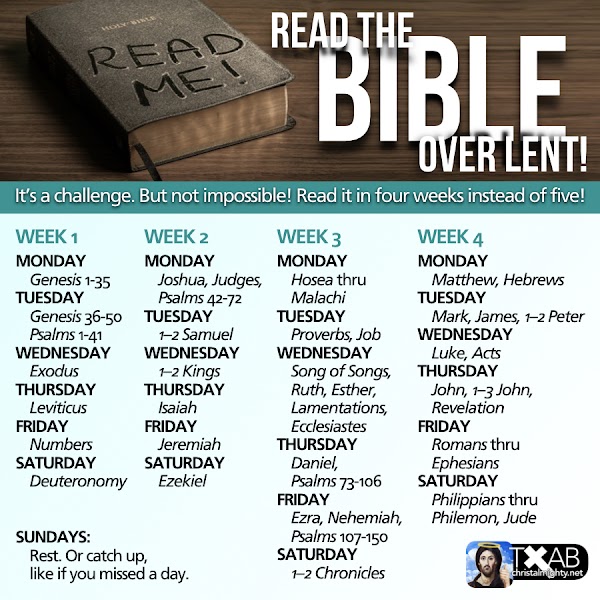
One possible schedule.

If you’re gonna tackle the bible this Lent, here’s one possible schedule you can follow. Gets you through the Old Testament (in roughly the order it was composed), then the New (generally bunching authors together).

Lent has five Sundays, so if you skip a day… you have an entire extra week to catch up.

As I’ve said elsewhere, other reading programs carve the bible into equal portions for the day. If you wanna do that, you can: Get one of those yearly bible-reading programs, and read nine to 10 days’ worth of material each day. That’ll get you finished in 40 days. But ideally I like to read a book all the way through, so I didn’t slice and dice the books when I could avoid it. (Psalms technically consists of five individual books of psalms, so I actually didn’t divide those books when I spread ’em out on the schedule.)

Of course, you don’t have to follow this program. You can use TXAB’s bible-reading plan and read it in whatever order, at whatever speed, and get ’er done in 30 or even 20 days. (Or if you’re just crazy enough, 10 days.) Whatever works for you.

Ready to take the challenge? Let’s get to it.