20 February 2025

God’s names. (And a bunch of his adjectives.)

New Christians—and a bunch of us older ones too—tend to be fascinated by the fact God has a lot of different names.

No, I’m not talking about the different words for “God” in other languages: Theos, Deus, Dios, Diyos, Dieu, Dia, Dio, Zeu, Gott, Gud, Hudaý, Bog, Buh, Elohim, Allah, Ulah, Dev, Ram, Atua, Kami, Haneunim, and so forth. Those are neat too, as are the many different ways humanity has rendered “Jesus.” But people who are into that, are more into languages. Your average Christian is more into the many different things God is called in the bible.


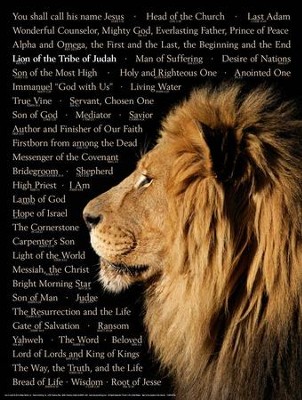
You can also buy a poster of a lion with a bunch of Jesus’s titles on it. ChristianBook.com

There’s “God,” of course. There’s “the Lord” or “the LORD,” depending on the original-language words we’re translating. There’s his personal name יְהוָֹה/YHWH, which we’ve turned into “Yahwéh” and “Jehovah”; and the Hebrew phrase it comes from, אֶֽהְיֶ֖ה אֲשֶׁ֣ר אֶֽהְיֶ֖ה/ehyéh ashér ehyéh, “I am who I am,” or “I Am” for short.

Then there are the adjectives which indicate which God we’re talking about God Almighty, God Most High, the Living God, the Mighty God, Father God, God the Creator, the God of Israel, God of Abraham, God of our fathers, and so forth.

And I haven’t even got to the titles yet. Like Ancient of Days, Alpha and Omega, Lord of Hosts, and so on. Go to your average Christian bookstore (assuming your local one hasn’t shut down, or moved to the internet) and they even have a poster covered in God’s titles. Suitable for framing, if you’re not a teenager but still like posters.

Bust out some Hebrew to go along with it, and some Christians will get sloppy with excitement. I can write articles about God’s attributes till my fingers go numb, but many a Christian doesn’t give a rip about theology: They just want easy ideas which they can meditate upon and come up with their own insights about. One of the easiest ideas to mentally play with is one of God’s names, so these folks just love God’s names.

There’s just something about them. Because, as many Christians teach, there’s power in God’s name. Jr 10.6 Power, power, wonder-working power. Power to break every chain, break every chain, break every chain.

But I should first point out these many names of God… are not necessarily what God names himself.

18 February 2025

Unanswered prayers.

Some months ago I was talking with a fellow Christian about unanswered prayers, and he said, “Y’know, there’s really no such thing as unanswered prayer. God answers every prayer. It’s just sometimes his answer is no. But that’s an answer!”

Okay, it’s true our “unanswered prayers” might be things God has legitimately answered—with no, or “not yet.” Stuff like “Come Lord Jesus” which he will answer, eventually.

But sometimes he legitimately has not answered certain prayers. ’Cause sometimes he says he’s not gonna answer them.

Micah 3.4 ESV
Then they will cry to the LORD,
but he will not answer them;
he will hide his face from them at that time,
because they have made their deeds evil.

Generally if you’re an unrepentant evildoer—if you’re sinning, you know you’re sinning, you know Jesus would have you do otherwise, you don’t care and aren’t sorry, you fully intend to continue sinning, and nothing God says or does will move you—I don’t think it’s realistic to expect God to heed you.

It’s like when Jesus warns us,

Matthew 6.14-15 ESV
14“For if you forgive others their trespasses, your heavenly Father will also forgive you, 15but if you do not forgive others their trespasses, neither will your Father forgive your trespasses.”

Jesus orders his followers to forgive, Lk 6.37 and Paul and Timothy advise us to forgive just as we ourselves have been forgiven. Cl 3.13 If we refuse to forgive, we’re defying Jesus—and if we defy Jesus, again, I don’t think it’s realistic to expect God to heed us. Especially if we’re asking his forgiveness.

I know, I know; I hear all the time from Christians who think God has to forgive every nasty thing they do, ’cause cheap grace. They wanna know how I can say God won’t forgive us, ’cause doesn’t grace mean he forgives absolutely everything? And yes, grace does mean that. But when you’re defying God and his Messiah, when you’re resisting his will, you’re also resisting his grace. You can’t get the grace when you reject the one who gives it!

It’s the same deal with unrepentant evildoers. If you reject the one who answers our prayers, why on earth or in heaven should we expect him to listen to our prayers? Makes no sense. But since when have humans ever made sense?—which is why unrepentant evildoers try to pray, get no answer, and think God’s the one at fault. Or that he’s not even there. Or other such nonsense.

17 February 2025

Stones to bread.

Matthew 4.3-4, Luke 4.3-4.

There’s a line in Lionel Richie and Michael Jackson’s 1984 hit song, “We Are the World,” which goes, “As God has shown us by turning stones to bread.”

As those of us who are biblically literate know, God never did any such thing in the scriptures. Now to be fair to Richie and Jackson, maybe God performed such a miracle for them personally… but I have my doubts. In any case neither of them, nor their producers, nor the roomful of pop stars they brought in to sing the song with them—which has to include people who were raised in church, right?—caught the error. Or convinced the producers to change it. So it’s still in the song. Aw well.

As we know, Jesus was tempted to do such a thing. He’d been fasting; he was hungry; Satan might’ve figured here’s an easy opportunity to get Jesus to fall for its “If you are the Son of God” taunt. Shouldn’t be hard at all for the Son of God to turn stones to bread, right? So that became the devil’s first temptation.

Matthew 4.3 KWL
Approaching, the tempter tells Jesus,
“If you’re the son of God, say something
so these stones might become bread.”
Luke 4.3 KWL
The devil tells him,
“If you’re the son of God, speak to these stones
so they might become bread.”

Back when I was a kid, I noticed something kinda obvious about this particular temptation: It’s not a sin for Jesus to turn stones into bread. There’s no commandment, at all, telling people to not do such a thing. There’s nothing ritually unclean about stones; there’s no command against eating them (though common sense oughta tell us to not do that); so if you turn a stone into bread, you’re not turning an unclean thing into a clean thing, then eating it. Jesus is neither breaking a command, nor going through a loophole, if he did such a thing. So… why was it wrong for him to do it?

Well duh; it’s the “if you’re the son of God” part. Jesus didn’t have to prove anything to Satan. Nor should he be that easy to manipulate, like a child showing off or an insecure president. Jesus knows exactly who he is… and frankly, it’s not a bad idea to keep the devil, who might have its own doubts, wondering. And underestimating him.

So Jesus did nothing, and threw a little bit of Deuteronomy back at Satan.

Matthew 4.4 KWL
In reply Jesus says, “It was written,
‘Not only by bread will humans live,
but by every word coming out of God’s mouth.’ ” Dt 8.3
Luke 4.4 KWL
In reply Jesus tells the devil, “It was written,
‘Not only by bread will humans live.’ ” Dt 8.3

And that’s that.

13 February 2025

We are not saved by our faith.

From time to time I’ll hear a Christian unthinkingly state we’re saved by faith. And I’ll correct them: We are not. We’re justified by faith. We’re saved by grace.

The usual response is they give me an annoyed look: Why are you correcting me?

Not that they disagree with me! They don’t. They’re aware we’re saved by grace. But they figure we’re saved by grace through faith—

Ephesians 2.8 KJV
For by grace are ye saved through faith; and that not of yourselves: it is the gift of God:

—so faith is in the formula somewhere; so they figure they’re not wrong either. That’s why they’re gonna forget what I just said about being saved by grace, and continue to say we Christians are saved by faith. I’m just nitpicking, and they don’t care.

In online discussion groups, I can’t see their annoyed looks in person, but I have no doubt they happen. And their usual response is to ignore my response. Again, they don’t disagree with me; they’re aware we’re saved by grace; but saved thorough faith, and is there any real difference between by and through anyway?

While most discussion-group folks will debate anything and everything at the drop of a hat, they never choose to debate my statement, “We’re justified, not saved, by faith; we’re saved by grace.” After all, it’s true.

There are rare exceptions—I think I only experienced two of ’em—where people respond, “Yes; I misspoke; we’re saved by grace.” The rest of the time, in a rare exercise of online self-control, they simply ignore the fact I said anything. They move along.

And I guarantee you they’re gonna say or write “We’re saved by faith” again.

Yet I persist.

12 February 2025

Pseudepigrapha: Influential ancient Jewish fanfiction.

PSEUDEPIGRAPHUM su.də'pɪ.ɡrə.fəm noun. A document definitely not written by the author it claims, nor in the time it claims. Sometimes fraud; sometimes just fanfiction.
2. A Jewish writing ascribed to one of the patriarchs or prophets of bible times, but actually written after 200BC.
[Plural, pseudepigrapha su.də'pɪ.ɡrə.fə noun; pseudepigraphic su.de.pɪ'ɡræ.fɪk adjective.]

The bible isn’t the only ancient Israeli book in history. Same as today—though certainly not in the same volume as today—tons of books were written, distributed, and became popular. And same as today, many were about God. Were they as Spirit-inspired as the bible? Nah. That’s why they weren’t included in the book collection which became our bible.

Well, most of them. There’s also apocrypha. Certain books were revered by certain churches, and got added to their bibles. Hence Ethiopian Christians have 81 books in their bibles, Orthodox Christians have 79, and Roman Catholics have 73. I’ve read most of their apocrypha; largely it’s good stuff. Good advice to follow; it’s like some of the better writings of Christian saints. Won’t hurt you to read it! But I don’t believe it’s as inspired as bible—same as the better writings of Christian saints. Good stuff, but is it infallible stuff? Meh; be wary.

Then there are the books to be really wary about, and that’d be the pseudepigrapha (Greek for “fake writings”). Whenever I write about Jewish mythology, these books are where these myths come from. They were popular in ancient Judea. Popular even in Jesus’s day. Jesus’s followers grew up hearing about ’em, even reading them.

There are even references to them in the bible. We have a full-on quote from one of ’em in Jude:

Jude 1.14-15 NET
14Now Enoch, the seventh in descent beginning with Adam, even prophesied of them, saying, “Look! The Lord is coming with thousands and thousands of his holy ones, 15to execute judgment on all, and to convict every person of all their thoroughly ungodly deeds that they have committed, and of all the harsh words that ungodly sinners have spoken against him.”

Jude wasn’t quoting the Old Testament, ’cause the OT has absolutely no Enoch quotes whatsoever. And no, Jude didn’t have any special revelation from God about what Enoch did or didn’t say. Jude was quoting a popular book, 1 Enoch, specifically this verse here:

1 Enoch 1.9
“Behold, he comes with myriads of the holy to pass judgment upon them, and will destroy the impious, and will call to account all flesh for everything the sinners and the impious have done and committed against him.”

The book was supposedly written by Enoch ben Jared, the great-grandfather of Noah the ark-builder. Somehow it survived the great flood, then 10,000 years or so of human history, then managed to not get into the Hebrew Old Testament and Septuagint, but leapfrogged them both and got into the Ethiopian bible.

Wait, Enoch wrote a book? No.

03 February 2025

“If you 𝘢𝘳𝘦 the son of God…”

In two of the three temptations the devil tried out on Jesus, Satan began them with the words, ܐܶܢ ܒ݁ܪܶܗ ܐܰܢ݈ܬ݁ ܕ݁ܰܐܠܳܗܳܐ/on bará anát d’Alahó, or as the Greek New Testament puts it, Εἰ υἱὸς εἶ τοῦ θεοῦ/ei yiós ei tu Theú, “If the Son of God you are.” The KJV renders this, “If thou be the Son of God,” and the GNT goes with “If you are God’s Son,” but most of us know it as, “If you are the Son of God,” as the ESV, NASB, NIV, NKJV, NRSV, and other popular translations put it.

Matthew 4.3 NIV
3AThe tempter came to him and said, “If you are the Son of God…”
Matthew 4.6 NIV
6A“If you are the Son of God,” he said…
Luke 4.3 NIV
3AThe devil said to him, “If you are the Son of God…”
Luke 4.9 NIV
9B“If you are the Son of God,” he said, “throw yourself down from here.”

The devil skipped it when it was tempting Jesus with the kingdoms of the world… which kinda makes sense. “If you are the Son of God, bow before me.” Really doesn’t work. So you can see why it skipped those words in that particular temptation. But it’s in the other two.

Okay, so why’d Satan think those particular words were gonna prod Jesus to fall for its temptations?

Well you gotta remember what happened to Jesus just before the Spirit had him go to the wilderness. He had his relative John baptize him in the Jordan, and the skies open up and a voice said, “This is my beloved Son.” God publicly declared Jesus his son. And of course Satan wanted to sow a bit of doubt in Jesus’s head: “Y’know, maybe you’re not.”

Worked on Eve. Ge 3.4-6 Maybe it’d work on Jesus?

27 January 2025

Jesus’s 40-day fast.

Matthew 4.2, Luke 4.2.

Whenever we see people fast (and usually pray; they kinda go together) in the Old Testament, they’re either mourning, repenting, or strongly petitioning God. But after the Spirit sent Jesus to the wilderness to be tempted, we see Jesus fasting—

Matthew 4.2 KWL
Fasting 40 days and 40 nights,
Jesus is famished afterwards.
Luke 4.2 KWL
…to be tested by the devil 40 days.
Jesus is eating nothing in those days,
and is famished by the end of them.

—and we know he’s not repenting, for he has nothing to repent; we’re fairly sure he’s not mourning; so most Christians figure he’s strongly petitioning his Father. He’s about to have a Satan-encounter, and even though he expects to win (’cause come on; he’s God) he gave up his omniscience when he became human, and doesn’t know what Satan’ll bring to their meeting. So the best thing anyone can do in that circumstance, is pray up!

And it definitely wouldn’t hurt to fast. Well, hurt spiritually. With some obvious exceptions, like hypoglycemia, you’re gonna physically be fine till the second hunger pangs kick in. Then you’re gonna be weak. But this isn’t a physical battle anyway; it’s not like that scene in C.S. Lewis’s novel Perelandra, in which Ransom literally has to beat the devil-possessed Weston to death. That was messed up; that was based on the fleshly limitations of Lewis’s imagination. Jesus knows better than to think physical force stops a spiritual one. Fasting is actually a way of renouncing physical force: We make ourselves weak so that God can make us spiritually strong. We use the Spirit’s fruit of self-control to pursue the Spirit all the more.

That’s why Jesus fasted: He wanted to be overprepared to overmatch the devil. So he deprived himself, and as the scripture says, he was famished afterwards. But in his spirit, he was mightier than ever.

22 January 2025

False knowledge, and how it’s confused with faith.

There are plenty of people who “just know” things.

And man alive, are they frustrating. Y’see, they can’t tell you why they know what they do. They don’t know where they got their knowledge, nor what it’s based on. Not that it matters where they got it: They believe it. You can’t tell them any different.

But they’re wrong. It’s false knowledge.

I’ll tell people something they’ve not heard before, and they’ll respond—whether in Sunday school, my classrooms, or the workplace—

THEY. “Why, what you’re saying can’t be true, for I know different.”
ME. [patiently] “Well your knowledge is wrong. Relax; we’re all wrong sometimes.”
THEY. “Nope; can’t be. I know this.”
ME. “Okay, maybe I’m wrong. So prove your case. Show me why you’re right.”
THEY. “Don’t need to. I know I’m right.”

Every once in a while they’ll really try to prove their case. Turns out there’s a thousand holes in their reasoning. Easy to see, easy to chip away at. But they can’t see the holes. And don’t really care there are holes; it doesn’t matter if they prove their point; they know they’re right.

It’s not that they actually believe what they do for logical reasons. Humans aren’t logical. We believe what we do because we find it convenient to believe it. Helps when it’s actually true. But even when it’s not, people will push aside all evidence to the contrary, grasp at any evidence they can find in their favor, and believe what they please anyway.

Certain Christian apologists call this behavior “postmodernism.” It’s not. (If anything, postmoderns are frequently the ones demanding, “Prove it.”) Not that postmoderns aren’t just as guilty of this behavior: Everybody does it. Moderns, postmoderns, everyone. It’s not a worldview thing, not a cultural thing, not a political thing, not even a sin thing. It’s a human thing. We’re comfortable with our beliefs, and don’t wanna change ’em, even if there’s plenty of evidence to the contrary. Change is too inconvenient.

I had to be trained to not think this way. First journalism school, then seminary: We were taught to question everything. Everything. My first journalism professor was fond of saying, “If your mother tells you she loves you, check it out!” Which sounds ridiculous at first… but you do realize there are a lot of dysfunctional mothers out there, who have very distorted definitions of love. Turns out she might not love you; whatever she’s feeling is neither khecéd nor fílos and agápi. Shouldn’t have presumed; now you see why your relationship is so f----d up.

There are naturally skeptical people who automatically question everything. Or so it appears; there are certain beliefs they take for granted, and you’ll find ’em once you drill down far enough. They might be nihilistic about a lot of things, but at their core they’re pretty sure they’re right about a number of things. Cogito ergo sum, at least.

But more often people are comfortable with the knowledge they believe they have, and are willing to trust it. Their minds are made up. Doesn’t matter which way the evidence points: There’s no higher authority than their minds.

It’s why people refuse to believe in climate change, or in an ancient earth, or insist humans are inherently good (regardless of our obvious depravity). Conversely it’s also why people believe in connect-the-dots theories and conspiracies. And it doesn’t matter how much evidence we have of a screw loose in their reasoning: They’re right. They know so. Can’t tell ’em otherwise.

In 2005 Stephen Colbert famously labeled this phenomenon as truthiness—that people believe what they do because they feel it’s true, rather than know it’s true. (And to a large degree it’s also because they feel it’s true; these “facts” are possessions or creations of theirs, so there’s a lot of selfishness bundled with ’em.)

True, false knowledge has a lot of similarities to truthiness. But unlike truthiness, it’s usually borne from apathy. People believe as they do because change and repentance take more effort than they care to spend.

It’s like fact-checking a headstone. My grandfather’s headstone actually has his first and middle names reversed. But nobody bothered to spend the money to fix it. And nobody’s gonna. Cemetery records, and eventually genealogies, are gonna have his names flipped for ages to come, all because nobody cares enough to fix the error. False knowledge has just this kind of effect on real knowledge… and often a much bigger impact.

So yeah: Truthiness has a lot of feelings involved in its practice and propagation. False knowledge has no such feelings. Gets propagated all the same.

21 January 2025

God doesn’t owe us anything for fasting.

I’ve pointed out fasting is a great way to focus our attention on God so we can pray better, hear him better, and develop our self-control.

But no, I don’t guarantee you’ll grow in all these ways when you fast.

All things being equal, you probably will. But as you know, there are lots of ways people can bollix our own growth. If we’re fasting, yet the rest of our lives are just as sinful as ever, why should we expect anything to change whatsoever? And yet Christians do: “I’m fasting! That should count for something.”

The Hebrews did it too, y’know. They’d fast, then make prayer requests ’cause they believed fasting would show the LORD they were serious, and it’d move him a little faster. It’s why Jehoshaphat told Jerusalem to fast so God might rescue them from invaders, 2Ch 20.3 and why Esther asked the Persian Jews to fast before she petitioned the king. Es 4.16 But because God acted on the petitioners’ behalf in these stories, Christians get the idea fasting always makes God move. They’ll claim this is “the biblical principle of fasting”: If you fast, God’ll answer prayer, and give you revelations.

But no it’s not a “biblical principle.” The idea that fasting always makes God move, is based on works righteousness, the idea God we can earn God’s favor through good deeds and acts of devotion. So if we’re good, God supposedly owes us one; if we’re super good God owes us a lot. And supposedly religious acts and rituals can cancel out any evil deeds: If I’m stealing from my workplace’s cash drawer, saying a few hundred Hail Marys oughta work it off, right? What’s the going exchange rate, a buck per hail?

In reality there is no biblical principle of fasting. Because in the bible, the LORD never commanded anyone to fast. Ever. The bible contains no teachings about what fasting does, why it’s important, and how often we oughta do it. The one teaching it does have on fasting is when Jesus tells us to not be hypocrites about it, and do it privately instead of publicly. Mt 6.16-18 The rest of Christianity’s teachings on fasting come from tradition: From fellow Christians’ experiences with fasting, and how it benefited them; and how it personally benefited us when we tried it.

But anyone who claims fasting unlocks God’s promises, and now he owes us stuff: They didn’t get that from bible. They got it from a corrupt Christian tradition, if anything. It’s not so. God owes us nothing. His kingdom runs on grace, not quid pro quo. He grants us grace and prayer requests and revelations because he loves us, not because we racked up enough heavenly frequent flyer miles to get a trip to Belize.

He tends to grant these things to active followers, not because we’re actively following, but because what good would they be in the hands of people who aren’t actively following? Such people will just squander his gifts, and be of little to no help to his kingdom. It’s not merit; it’s pragmatism.

So when we fast, is God obligated to do more for us than usual? Not at all. He tends to, but that’s only because Christians who fast, tend to love Jesus and follow him otherwise.

20 January 2025

The Holy Spirit sent Jesus to be tempted.

Matthew 4.1, Luke 4.1-2A.

In the Lord’s Prayer, Jesus tells us to pray that God not lead us to temptation. Mt 6.13, Lk 11.4 I don’t know whether he included that because God led him to temptation—and he didn’t wanna repeat the experience, and he didn’t wish that on his followers either. But you do realize that particular part of the Lord’s Prayer was answered with “No” in this particular instance: The Holy Spirit led Jesus into the wilderness to be tested by Satan. God—’cause the Holy Spirit is God, remember—led him into temptation.

Matthew 4.1 KWL
Then Jesus is led into the wilderness by the Spirit,
to be tested by the devil.
Luke 4.1-2 KWL
1Full of the Holy Spirit,
Jesus comes back from the Jordan.
He’s being led by the Spirit into the wilderness
2Ato be tested by the devil 40 days.

When we pray this particular part of the Lord’s Prayer, we need to keep Jesus’s temptation in mind. Because sometimes God will put us into circumstances where the devil’s gonna try to derail us. If we’re seriously following Jesus, and in so doing seriously mucking up the devil’s plans, of course Satan’s gonna try to put a stop to us. And the fastest way is to get us to stop following the Spirit and start following our selfish human nature.

Happens all the time. Christians create million-dollar ministries, then start thinking, “I’m a CEO; shouldn’t I get paid like a CEO; shouldn’t I get to live like a CEO?” and start feathering their nests and living luxuriously, instead of putting all that money into God’s kingdom and living reasonably. And plenty of mammonists, plenty of Christians who covet wealth and the things of this world, will come up with plenty of godless reasons why they not only can live like that, but should. Nevermind the fact it’s undermining their character, their witness, their ministry, their ability to hear the Spirit, their relationship with Jesus; that this money could help needy people, and these “CEOs” are nowhere close to needy. Nevermind that they’re robbing the poor, and in so doing, they’re robbing God. But I digress.

Appealing to our selfish human nature is Satan’s favorite tactic. Heck, it’s not just Satan who uses it; everybody tries it. Everybody wants to know what we covet, so they can sell it to us, or manipulate us by it. Why do you think social media companies are trying so hard to keep us on their sites—and when we’re off their sites, track our every movement on the internet? They wanna sell us stuff. Their plans are more benign than malevolent, although the more guardrails they remove, the more malevolence is gonna happen. But that’s what we see throughout Jesus’s temptations: The devil tries three times to appeal to Jesus’s selfish human nature.

And Jesus resisted. Kinda easily. Because he doesn’t have a selfish human nature. He’s got the original human nature; the one Adam and Eve had before they sinned. Plus he has something Adam and Eve coulda gained, but never did, because they sinned long before they could develop it: He’s got God’s nature. And God’s not selfish. Thanks to that divine nature, Jesus immediately identifies those appeals to his flesh, dismisses them as stupid and wrong—and punctuates his dismissals with Deuteronomy quotes. Jesus knows the Law, and never ever broke it.

When the Spirit led Jesus into temptation, Jesus was totally ready for it. Arguably he’s always been ready for it. Yes, he fasted for 40 days once he got there, to try to steel himself against temptation even further. I’ll write about that another time. But there’s nothing at all wrong with over-preparing yourself for spiritual battle. You don’t just wanna win by the skin of your teeth; you wanna win decisively. You want that devil reluctant to challenge you again, ’cause losing so bad to a lowly human embarrasses it in front of all the other devils on the playground.