24 October 2022

Angry Christians.

Anger’s a work of the flesh. If you didn’t know this, you need to check out Paul’s list again. It’s right there in verse 20.

Galatians 5.19-21 NRSVue
19 Now the works of the flesh are obvious: sexual immorality, impurity, debauchery, 20 idolatry, sorcery, enmities, strife, jealousy, anger, quarrels, dissensions, factions, 21 envy, drunkenness, carousing, and things like these. I am warning you, as I warned you before: those who do such things will not inherit the kingdom of God.

A number of present-day translations have weaseled out of translating θυμοί/thymí (KJV “wrath”) as “anger” by translating it as a type of anger which sounds more brief. More temporary.

  • AMP, ESV, “fits of anger.”
  • CSB, ISV, LEB, NASB, NET, WEB “outbursts of anger.”
  • CEB “losing your temper.”
  • GW “angry outbursts.”
  • NABRE “outbursts of fury.”
  • NIV “fits of rage.”
  • NKJV “outbursts of wrath.”

But I’m pretty sure the KJV’s “wrath,” and its synonyms “anger,” “rage,” and “fury,” are fully accurate descriptions of what Paul wrote and meant.

Why are the translations trying to weasel out of it? Because there are a lot of angry Christians out there. A LOT. Too many. It’s everywhere. And just like gluttony in the United States, Christians are pretending anger’s not the profoundly serious problem it is.

Christians are pretending anger’s not the thing which regularly makes us least like Jesus. We’re mighty quick to point out Jesus himself got angry, more than once. Evil, sin, hypocrisy, and inhumanity regularly enrage God throughout the scriptures; heck, in Revelation entire bowls of wrath get dumped out in judgment for humanity’s sins. If God himself can get so righteously pissed off, why can’t we?

But when we know God, and know ourselves, we know exactly why not. God is love. We aren’t. We’re meant to develop God’s love in our lives… and don’t. When God gets angry, his love mitigates this; it’s why it takes a lot to get him angry. Ex 34.6, Nu 14.18, Jl 2.13, Jh 4.2 And when he does get angry, he doesn’t go berserk and do reckless things. He only concentrates on stopping evil.

Christians who’ve developed the good fruit of love oughta be just as slow to anger, Jm 1.19 and when we do get angry, we still keep our cool enough to keep from sinning, nor listening to devilish temptation. Ep 4.26-47

Oughta be. Aren’t. Instead we’re full of excuses. Our anger is a “righteous anger” because we insist we’re enraged by the very same things God is. And we need to stamp these things out now. Right now. Right the f--- NOW. Get your guns; we’re gonna go lynch some evildoers. We gotta eliminate them before they finally piss off God and he starts dumping wrath on all of us.

Really what angry Christians do, is justify their anger, justify never being rid of it, and justify incorporating it into their Christianity. Their anger, they insist, is biblical. Not mitigated by God’s love; these folks dismiss God’s love as irrelevant by pointing out, “But God is also just,” and therefore their his outrage at “evil” cancels out any love he might display towards sinners. Instead they do “tough love”—a type of casual cruelty towards sinners, which is supposedly “love” because they don’t straight-up murder them, like they feel they have every right to do.

Angry Christians’ anger completely wipes out any love, compassion, grace, and christlikeness they oughta have in their lives. It doesn’t look like Jesus at all. Since pagans are generally aware of what Jesus oughta look like, it means these self-described “Christ-followers” aren’t Christian; they’re hypocrites. Since there are so many angry Christians out there, these pagans often wonder whether all Christians are actually Jesus-denying hypocrites.

Heck, some of us Christians wonder that too.
23 October 2022

The “abomination of desolation.”

Mk 13.14, Mt 24.15-16, Lk 21.20-21.

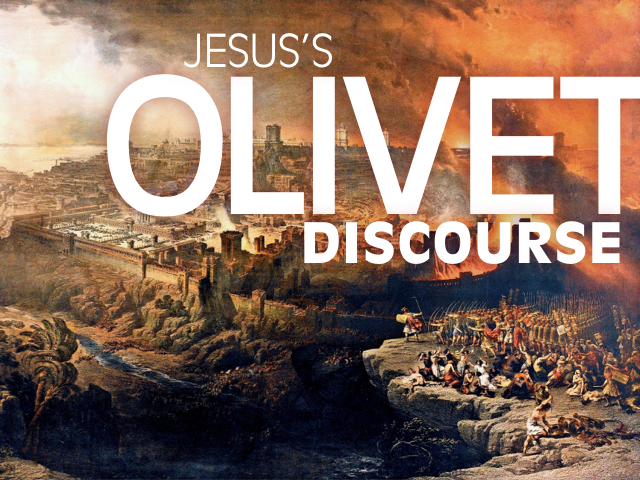
Up to now in his Olivet Discourse, Jesus only spoke of the events leading up to the Roman-Jewish War in the year 70. The first Christians would get persecuted, but the gospel would spread all over the Roman Empire. And then these events would happen—the events his students first asked him about; the events where not one of the temple’s impressive stones would be on top of another. Mk 13.2, Mt 24.2, Lk 21.6 The events which’d happen during 37 years later, within lifetime of the very first Christians… though James, Simon Peter, and Andrew wouldn’t live to see them.

Jesus starts by mentioning the βδέλυγμα ἐρημώσεως/vdélygma erimóseos, “disgusting spoiler”—not in the sense of ruining the ending of a movie, but ruining whatever you place it upon. It’s a term from Daniel, which was actually fulfilled by Antiochus Epiphanes in 141BC, but Jesus brings it up again ’cause history is about to repeat itself.

Mark 13.14 KWL
“When you see ‘the disgusting spoiler’
placed where it mustn’t be” (understand, reader?)
“then those in Judea: Flee to the hills!”
 
Matthew 24.15-16 KWL
15 “So then when you see ‘the disgusting spoiler’
as said to the prophet Daniel,
put in the holy place” (understand, reader?)
16 then those in Judea: Flee to the hills!
 
Luke 21.20-21 KWL
20 “When you see Jerusalem encircled by army units,
then know this: Its spoil has come near.
21 Then those in Judea: Flee to the hills!
And those in the middle of it: Leave!
And those in the fields: Don’t enter the city!

If you’re alive to see these things—and you might be—get out. Don’t even go back to get your stuff. Mk 13.15-16 It’s gonna be awful. The worst.

Jesus is speaking of the Roman-Jewish War, but a number of Darbyist “prophecy scholars” are absolutely sure he’s not. Or not entirely; some will confess he’s speaking of the Roman-Jewish War too. But they insist he’s primarily speaking of a future disgusting spoiler, an End Times “abomination of desolation” to be committed by the Beast in the temple.

What temple? Well I’ll get to that.

18 October 2022

So you feel unclean. Pray anyway.

Probably the most common reason Christians don’t pray… is because we don’t feel clean enough.

I’m not talking about ritual cleanliness. (Most Christians don’t even know what that is anyway: It’s the idea of ritually washing yourself before worship. Since the Holy Spirit now dwells in us Christians, we don’t need to ritually wash before temple; we are his temple.) But it’s not that; it’s feeling clean, because we feel dirty, because we sinned. Maybe we sinned recently; maybe we didn’t, but we’re aware we sinned a lot over the past few weeks, so we figure we’re not worthy to approach God. He’s too holy, and we’re too gross.

Some Christians even claim God is repelled by our sins. If there’s any sin in our lives, there’s no point in approaching God ’cause he’ll just turn away from us and ignore our prayers. Or even leave, in offense and outrage, like a heavenly snowflake.

It’s because these Christians either don’t understand, or don’t truly believe, Jesus covers everything. They don’t recognize when God accepted us as his kids, he was entirely aware of every sin we were gonna commit in the future. Even sins we’re committing this very instant. (Cut that out, by the way.) But Jesus paid for everything. God doesn’t dole out grace on a sin-by-sin basis: You and he are good. You’re his kid. He’s happy to talk with you!

Now I can say this, and you might understand it and sorta believe it… but Christians still find this a really difficult hangup to get past. For three reasons.

  1. Partly it’s because other people don’t act this way at all, so it’s a wholly foreign mindset, and we’re not familiar with it.
  2. Mostly it’s because it’s our mindset. We’re so used to karma! We can’t fathom the idea of preemptive total forgiveness. We’d certainly never do it, so of course it’s hard to imagine God doing it.
  3. And, y’know, the devil. It’d prefer we never pray, and the longer it can keep us acting upon our unhealthy beliefs, the better.

16 October 2022

The gospel preached to all before the end.

Mt 24.14.

Last week I discussed the verse about not completing all the cities of Israel before the Son of Man comes, Mt 10.23 and how that’s neither part of Jesus’s Olivet Discourse, nor a prophecy of the End: It’s about Jesus sending out the Twelve to preach the gospel, Mt 10.5-7 and how he’d catch up with them at the end of this specific mission. Christians who project End Times stuff onto this passage are quoting it out of context—a common practice among End Times “prophecy scholars,” who aren’t actually scholars.

Some of the reason these “prophecy scholars” quote that verse is because of this verse, which is in the Olivet Discourse. They think it’s a parallel verse. It’s also found in Matthew, and to help you understand it better, I’ll also quote the verses right before it.

Matthew 24.9-14 KWL
9 “Then they’ll hand you over to tribulation and kill you.
You’ll be hated people to every ethnic group because of my name.
10 Then many will be tripped up,
will betray one another, will hate one another.
11 Many fake prophets will be raised up,
and will lead many astray.
12 Because of the exponential spread of lawlessness,
the love of many will grow cold.
13 One who perseveres to the end—
this person will be saved.
14 And this gospel of the kingdom
will be proclaimed to the whole civilization
as a witness to every ethnic group.
Then the end will come.”

The “prophecy scholars” claim the whole of the Olivet Discourse is about a great tribulation right before the second coming. It’s not. After Jesus told his students the temple would be destroyed, they wanted to know when, so he told ’em what’d happen before it was destroyed… in the year 70, during the actual great tribulation of the Roman-Jewish War. All this stuff was fulfilled by that war. If “prophecy scholars” know anything about the Roman-Jewish War (and too often, they don’t) they’ll claim Jesus’s prophecies are actually gonna happen again during the End Times; that the Roman-Jewish War is just a foreshadowing of what the Beast will do to the entire world. But Jesus’s prophecies about the Beast are in in Revelation, not the gospels. These “prophecy scholars” are trying to add details to what Jesus disclosed in Revelation—and hey, isn’t there a curse upon anyone who tries to add or take away from that book? Rv 22.18-19 Illegitimately adding the Olivet Discourse to End Times prophecy definitely sounds like something that’d activate that curse.

But back to the Discourse. Jesus says the gospel of God’s kingdom is getting preached to the whole civilization before the end comes. Does he mean the End-end?—the end of the End Times, the days before his second coming, the last few years before the millennium? Or does he simply mean the end of the temple, which is entirely what the Olivet Discourse is about? As you’ve likely guessed, I’m gonna say it’s that second thing.

“Hold up,” a hypothetical prophecy scholar is gonna object, “the gospel wasn’t preached to the entire world by the time the temple was destroyed. It hadn’t reached the Germans, nor the sub-Saharan Africans, nor the Chinese, nor the Russians, nor the indigenous Americans and Australians and Pacific islanders. Only the Roman Empire had heard the gospel. That’s it.”

Well yeah. That’s what Jesus said would happen.

12 October 2022

Be kind. For once.

We Christians don’t have a reputation for being kind.

I wish it weren’t so, but I know a lot of pagans, and kindness is definitely not the first thing which comes to mind when they think of Christians. More like easily outraged, quick to judge, quick to condemn, holier than thou, just as bad as any pagan but such utter hypocrites about it, impatient, shunning, unforgiving buttholes. And if you were immediately offended by my using that word “buttholes,” you kinda proved my point.

Every so often I’ll read a discussion on Reddit which brings up Christianity, and the immediate response of the commenters—even when an atheist didn’t start the discussion!—is how thoroughly awful Christians are to everybody. Some of the critics will even be fellow Christians!—“Yeah, we suck.”

Then someone will point out Jesus. And the inevitable response of everyone, pagans and Christians alike—atheists included!—is he doesn’t suck. He’s a good guy; he taught peace and love, hung out with sinners and whores and lepers, railed against hypocrites… and unlike his followers, actually forgave sins. Jesus always gets a thumbs-up. Christians, of course, not.

It annoys me to no end. What’s with all the Christian jerks? Don’t we know better? Shouldn’t we?

I’m not gonna perpetuate the myth our fleshly attitudes are the leading cause of unbelief. They certainly don’t help, but people who don’t believe in Jesus are simply looking for any excuse not to. Otherwise they’d be Christian: “Well Christians suck, but despite them, Jesus is legit. So I’m gonna follow him on my own.” They’d be one of those Christians who shun all the other Christians and won’t go to church. But no matter how much they claim to respect Jesus, they still won’t follow him… because hypocrisy isn’t solely a Christian practice, y’know.

Anyway. The reason there are awful Christians is ’cause we’re deficient in love—and love is kind. 1Co 13.4 Christians who don’t love, who swap out the charitable, unconditional love of God for the vastly inferior substitute of reciprocity: A “love” which expects to receive “love” in return, and if it doesn’t, nevermind; it’s withdrawn. A “love” which demands payback, which is only offered to “worthy” and “good” people. A “love” that’s largely based on karma.

Which is a massive problem. Χρηστότης/hristótis, the word we translate “kindness,” Ga 5.22 more accurately means “graciousness.” It’s the grace of God, in action. It’s one of God’s character traits—which is precisely what the Spirit’s fruit is. When we’re fruity, we exhibit God’s grace: We’re kind, like he is.

Whereas when we’re not kind, not gracious, we’re still gonna be fuming about my dropping the B-word seven paragraphs ago. And plan to write an angry email, then never, ever read this blog again. And feel totally justified in such behavior. Grace and kindness is for people who don’t use rude words, even if they’re TV-safe words.

When we’re kind, we’re gonna be gracious, friendly, generous, humble, courteous—and nice. Yeah, I know plenty of Christians who are quick to point out kind and nice aren’t the same thing: Niceness is entirely about getting along with other people. And people will frequently lie, deceive, stifle their opinions, compromise their standards, or choose other evils, just to get along with others. They’ll be nice hypocrites.

But I would object we don’t have to lie and deceive in order to be nice to others. We can be gracious! We can forgive. We can agree to disagree. We can be patient. And hey, if all it takes to get a better reputation with others is to simply be pleasant to them, why are we objecting to this? Why is being a thorn in everyone’s side so fundamental to our integrity?

10 October 2022

Covenant: How God makes our relationship official.

COVENANT 'kəv.ən.ənt noun. Agreement.
2. [Law] A contract drawn up by deed, or a clause in a contract.
3. [Theology] An agreement which creates a committed relationship between God and his people—such as the covenants between the LORD and Abraham, Moses, and David, or between Jesus and Christians.
4. [verb] Agree by lease, deed, or other legal contract.
[Covenantal kəv.ən'ənt.əl adjective.]

In our culture, “covenant” is a fancier, or more formal, way of saying “contract.”

Because that’s what our English word means. It comes from the Latin word convenire, “go together,” which evolved into the French word, then our English word. Early bible translators used it for the Hebrew word בְּרִית/berít, “treaty, alliance, constitution, ordinance, pledge,” and the word the Septuagint used to translate it, διαθήκην/diathíkin, “will, testament, agreement, arrangement.” Y’notice the Hebrew word has more of a sense of loyalty and diplomacy, and the Greek word has more of a sense of carrying out one’s wishes. Whereas the way we tend to use our English word “covenant” nowadays is either to talk about how sacred and binding marriage oughta be… or about the restrictions a neighborhood puts on the homeowners who live in it, and usually the penalties for violating those restrictions.

Not sure whether any of these concepts describe what God actually does with his covenants in the bible.

And when you ask your average Christian what a covenant is, most of the time we lean hard towards the idea it’s an agreement… and it’s binding. I’ve heard more than one preacher claim covenant means “a contract which cannot be broken.” Which certainly isn’t the way we use the word nowadays. Marriage covenants are dissolved all the time. Neighborhood covenants get changed whenever new leaders get elected; heck, most of those people run for office specifically to either make the covenants stricter or looser! In fact those people who claim a covenant is an unbreakable contract: Many of ’em claim God did away with the Law and replaced it with Jesus’s new covenant… so how’s it an unbreakable contract if God considers it null and void? (Isn’t the Law part of God’s word?—and isn’t it true God’s word never returns void?)

Frankly, the reason our English dictionaries say covenant means an agreement—that it’s nothing more than a verbal or written contract between interested parties—is because that’s how we use the word. A covenant is a contract; a contract is a covenant; they’re synonyms. “Covenant” sounds harder to get out of, but it’s really not. Ask any divorced Nevadan.

So if we wanna understand what covenants in the bible are all about, we need to put aside our English word and our culture’s ideas about covenant, and look at how God set up a berít or two with humanity.

09 October 2022

Going city to city till the Son of Man comes.

Mt 10.23.

Today’s verse isn’t actually part of Jesus’s Olivet Discourse. But plenty of Christians think it is, and a number of Christians have shoehorned it into their End Times views.

In Matthew 10, Jesus sends out the Twelve in teams of two, to share the good news that God’s kingdom has come near, with Israeli towns. Mt 10.5-7 He instructs them on how they’re to do it, and to be wary because people can be awful. Mt 10.8-16 And then Jesus starts to say some stuff about the students getting persecuted.

Most scholars believe the synoptic gospels were written together thisaway: Mark was written in the late 50s, and Matthew and Luke quoted it for their gospels in the mid-60s. (Those who think Matthew was written by the Matthew in Jesus’s Twelve, and not by some different guy named Matthew, theorize Mark is a condensed version of Matthew… but if that’s true, Mark is garbage; he took out the Sermon on the Mount and Jesus’s great commission! Nah; other way round.)

Now. When Jesus talks about persecution, Matthew takes the verses from Mark’s version of the Olivet Discourse. Some of it’s word for word. It’s why I’ve been quoting these verses in my previous Olivet Discourse articles; it’s because they’re parallel. But in Mark, Jesus says it to only four students in his Olivet Discourse, and in Matthew, it’s to all the students as they prepare for their mission. Different contexts altogether.

Matthew 10.17-22 KWL
17 “Be aware of the people.
For they’ll hand you over to senates,
and have you flogged in their synagogues.
18 You’ll be brought before leaders and kings
for my sake, for testimonies of me, to people groups.
19 Whenever they hand you over,
don’t fret over how or what you should say,
for what you should say will be given to you
at that hour.
20 For you aren’t to be the speakers.
But your Father’s Spirit should be speaking in you.
12 Sibling will betray sibling to death,
and parent to child,
and children will revolt against forebears,
and put them to death.
13 You’ll be hated by everyone because of my name—
and this person will be saved
when they endure to the end.”

So… when did Jesus actually say it? At the Olivet Discourse, or years earlier when he sent out his students to evangelize?

Personally I don’t see why Jesus can’t have said the same thing twice. I’m sure he did! We all do. Dig through TXAB’s articles and you’re sure to find me repeating myself from time to time. I have a book of assorted C.S. Lewis articles which he wrote for various publications: Not only does he repeat certain ideas in multiple articles; you’re gonna find those ideas in his other books too. He had pet issues and ideas which he loved to talk about—or always felt he had to talk about. We all do. So does Jesus.

So Jesus certainly could’ve said this stuff dozens of times, and at the Olivet Discourse he simply said it again. But now let me get to the verse we find in Matthew which we don’t find in Mark or Luke—one which is wholly unique to Matthew’s gospel, and isn’t included in Matthew’s version of the Olivet Discourse either. It’s in chapter 10, not chapter 24.

Matthew 10.23 KWL
“When they persecute you in this city,
flee to another.
For amen!—I promise you,
you ought not complete the cities of Israel
before the Son of Man might come.”

In context, Jesus is talking about the Twelve at that time; however long they were meant to travel from Israeli city to Israeli city, sharing the gospel. Long enough to hit many of the cities by the time he caught up with them. Not all, but he didn’t expect them to finish. Although, since Jesus was using subjunctive verbs (“ought not complete” and “might come,” which indicate it’s likely, not definite) he allowed for the possibility that—who knows?—maybe they might get to all of ’em.

But as I said, Christians frequently ignore the context.

03 October 2022

The red letters.

Back in medieval times, western scribes used to rubricate certain texts. If you’re not familiar with that word, it means “render in red letters”—they’d highlight certain important parts of the books, like headers and commentaries and pull quotes, by putting the words in red ink. After the printing press was invented, full-color or spot-color printing was of course possible (’cause the Gutenberg Bible was full color) but time-consuming and not cost-effective. So printers went with bold letters, slanted letters, capital letters, capitalized letters, bigger letters, or whole different typefaces—whatever you could print in black.

Meaning bibles were likewise printed in black ink. Red-letter editions didn’t begin till 1899. It started with Louis Klopsch, editor of The Christian Herald, who was writing an editorial, and read this passage from the gospels. (Which, for once, I’m not gonna put in red letters, ’cause it’s not what Klopsch would’ve read.)

Luke 22.20 KJV
Likewise also the cup after supper, saying, This cup is the new testament in my blood, which is shed for you.

I’m guessing Klopsch at first imagined the New Testament printed in Jesus’s blood, and then that grisly image was replaced with the idea of simply Jesus’s words printed in blood-red text. He thought it was a neat idea; his pastor thought it couldn’t hurt; he produced 60,000 copies of a red-letter New Testament later that year. They sold out quickly.

The reason I’ve lumped this article under the category of bible translations rather than simply bible, is because a certain amount of interpretation is involved in figuring out what parts of the bible oughta be printed in red letters.

Fr’instance Revelation. The book is Jesus’s revelation to his apostle John. A “Lamb as it had been slain” Rv 5.6 KJV sits upon the heavenly throne in Revelation 5 to open the seals of an important scroll, and it’s safe to assume every statement from the throne thereafter comes from the lamb. The lamb is obviously Jesus. Yet not every publisher of a red-letter bible remembers this, and puts the statements from the throne into red letters.

Sometimes it varies by publisher; sometimes translation. Fr’instance when Jesus is instructing Nicodemus in John 3. In the second edition of the New International Version, published 1984, John 3.16 is in red letters, ’cause most translators figure he said it. But in the third edition, the current 2011 edition, Jesus’s quote stops at 3.15. Verse 16 isn’t red-letter anymore. It’s not a Jesus quote; now it’s the apostle John’s commentary.

John 3.14-17 NIV
14 “Just as Moses lifted up the snake in the wilderness, so the Son of Man must be lifted up, 15 that everyone who believes may have eternal life in him.”
16 For God so loved the world that he gave his one and only Son, that whoever believes in him shall not perish but have eternal life. 17 For God did not send his Son into the world to condemn the world, but to save the world through him.

The NIV isn’t the only translation which does this. There’s the Lexham English Bible and the New English Translation. The Good News Translation (a.k.a. Today’s English Version) cuts Jesus off even before, at verse 13.

Yeah, where Jesus speaks and where he doesn’t is pretty much interpreters and translators’ judgment call. Therefore it’s also a judgment call as to where the red letters go. True from the very beginning: When Klopsch put together the first red-letter New Testament, he used the King James Version, which has no quotation marks because they weren’t in standard use till his century. Kopsch had to use his best judgment as to where the Jesus-quotes begin and end. That’s not always clear. The hope was the red letters would help make it clear.

02 October 2022

Friends and family may turn on you.

Mk 13.12-13, Mt 10.21-22, Lk 12.16-19, Jn 16.2-3.

In Jesus’s Olivet Discourse, he warns his students of the tribulation they’d undergo in the near future. Not just the Romans destroying the temple, but specifically how the first Christians themselves would be persecuted. Here are some of those specifics.

Mark 13.12-13 KWL
12 “And sibling will betray sibling to death,
and parent to child,
and children will revolt against forebears,
and put them to death.
13 You’ll be hated by everyone because of my name—
and this person will be saved
when they endure to the end.”
 
Matthew 10.21-22 KWL
12 “Sibling will betray sibling to death,
and parent to child,
and children will revolt against forebears,
and put them to death.
13 You’ll be hated by everyone because of my name—
and this person will be saved
when they endure to the end.”
 
Luke 21.16-19 KWL
16 “You’ll also be betrayed by parents, siblings,
relatives and friends,
and they’ll put some of you to death.
17 You’ll be hated by everyone because of my name.
18 But if every hair on your head isn’t destroyed,
19 save your souls by your endurance!”

Rough stuff, right? But something Jesus’s students needed to hear. Something all Christians need to hear. ’Cause if we’ve grown up in not-so-dysfunctional families, where parents and siblings don’t stab you in the back on a regular basis, we’ll assume that should continue to be the case when times get rough. But the reality is this isn’t always so. Parents turn on their kids all the time. Even “good Christian parents.”

Give you an obvious example: All the “good Christian parents” who disown their gay kids. Now these parents will use the argument, “But the kids are sinning.” So what? When has sin ever been a justification for disowning one’s kid? Did King David ben Jesse disown his son Absalom after the young man not only tried to overthrow his dad, but publicly raped his dad’s concubines? 2Sa 16.21-22 If you wanna talk sin, that’s sin. God regularly forgives much bigger sins than that… but “good Christians” regularly don’t.

So the day will come (and already has, multiple times) when self-described “good Christians” will get suckered by some fascist into following him, and the fascist will want to go after anyone who rightly refuses to follow him instead of Jesus… and these “good Christians” will immediately take the side of the fascist. What if their loved ones get killed? “Oh, they brought this on themselves.” They’ll mourn their dead—but they won’t give up their idol.

27 September 2022

Two types of worship music.

There are two types of worship songs we tend to see in churches.

No, I’m not talking about hymns versus Christian pop songs. That’s been an old Evangelical debate ever since churches began using contemporary worship choruses in the early 1970s. Nor am I talking about traditional-ish (hymnlike songs) versus contemporary-ish, nor organs and pianos versus guitars and basses, white gospel music versus black gospel music, or any of the other music debates we find nowadays. Those are stylistic choices, and Christians are free to disagree about all of ’em.

Nope, I said type of worship song. It refers to the purpose and content of the song. Generally there are two of ’em.

INSTRUCTIVE describes the songs written to deliberately teach an idea—to put it to music, and get it into Christians’ heads. They teach us about amazing grace, about what a friend we have in Jesus, about how great God art, and that he’s holy holy holy. They tend to have a lot of verses, various complicated words… and no I’m not only talking about hymns, though a lot of ’em totally fit the description.

MEDITATIVE describes the intentionally simple songs. They have few verses, or lots of repetition; their ideas are basic Christianity. Like how there’s wonder-working power in the blood of the Lamb, or on Christ the solid rock we stand, or God’s a good good Father. Their purpose is to give us something we already know by rote, so we can sing ’em and not ponder the words… and instead meditate on God and his greatness, and pray to him while our lips go on autopilot. Yep, exactly like when we pray in tongues.

Didn’t know your worship songs had these purposes, didja? You just thought you were singing nice things to God. But yep, every Christian song does one or the other. (Even if—and yeah this is gonna sound cynical of me, but it’s nonetheless true—even if the song was really only written to be catchy and sell albums. Because the artists are fully aware it won’t be recognized as a worship song otherwise.)

Okay. Since humans are creatures of extremes—us Christians included—many of us love one type and hate the other. We won’t always know why we have this preference; we tend to think it has something to do with the style.

26 September 2022

Get into a bible study.

BIBLE STUDY 'baɪ.bəl 'stə.di noun. One’s individual reading and research of the scriptures.
2. Short for “bible study group”: A gathering of people who meet to discuss the scriptures, or Christian topics, together.

Hopefully you read your bible on a regular basis; hopefully all the way through from time to time. (You can do it in a month y’know.)

And if you want to understand certain parts of it better, I would also hope you get hold of some bible handbooks, bible commentaries, or bible dictionaries—resources which help explain some of the historical and cultural background. ’Cause too many Christians forget we, and the folks in the bible, have very different worldviews. Even if you think you have a “biblical worldview,” you still really don’t think like a first-century Judean under Roman occupation, a seventh-century-BC Jerusalemite with the threat of the neo-Babylonian Empire coming for you, a tenth-century-BC Israelite who only just found himself living in a monarchy, a 14th-century-BC Hebrew slave newly freed from captivty, or a 19th-century-BC Sumerian nomad surrounded by pagans.

So get those reference materials, and get to learning. Don’t be intimidated; they write ’em for average Christians who lack seminary degrees.

But here’s the only catch with studying the bible on our own: How do we know we’re doing it correctly?

How do we know we haven’t picked up some poorly-researched book by some crank, and instead of learning solid stuff, we’re learning weird heresy? How do we know our conclusions are accurate, and whether the Holy Spirit really is guiding us through our studies?

Simplest answer: You confirm what you’re studying through fellow Christians who also studied this stuff, or who are also currently studying it. Yeah, you could all be individually studying it at home, and come together and compare notes… or you could study it together under some teacher who already knows a bit about it.

Christians generally call these get-togethers bible studies. But I should tell ya: All my life I’ve encountered “bible studies” in which the bible is not the primary book everyone’s reading. They’re doing a study on some other book. Some bible-adjacent book. Like a commentary, or a book about important people in the bible, or a book about certain biblical principles, or prayer books. Properly those are book clubs, not bible studies… but we still call ’em bible studies. Bible’s gonna come up pretty frequently, y’see.

And in these groups we can ask questions, confirm our interpretations, and learn a few things. After all, if we’re all listening to the same Holy Spirit, our interpretations should have some consensus to them… depending on what the Spirit wants to emphasize to each individual, of course.

It’s why I always recommend we plug into one bible study or another. Go interact with some fellow Christians, let iron sharpen iron, and get to know God better.

25 September 2022

Get ready for persecution. But 𝘥𝘰𝘯’𝘵 defend yourself.

Mk 13.9-11, Mt 10.17-20, Lk 12.11-12, 21.12-19.

After Jesus said the temple’s coming down, his students wanted to know when and how, so Jesus gave the Olivet Discourse, loosely telling ’em what’d become of them when the Romans destroyed the temple in the Roman-Jewish War, i.e. the great tribulation.

What’d become of them? Persecution. Which happened in Acts, happened over and over again in the various Roman persecutions, happened throughout Christian history whenever Christians went to lands where Christianity upended the status quo, and still happens. Never stopped. Our first-world rights to freedom of speech and religion aren’t perfect, but they’re still way better than the rest of the world. But don’t kid yourself: They’re hardly the rule; they’re a huge exception.

Now, your average American doesn’t know squat about history, and your average Evangelical doesn’t know squat about Christian history. Mostly ’cause their anti-Catholic bigotry calls it “Catholic history,” so they know little to nothing till the King James Version showed up—and even then, their version of events is all warped. So they believe the previous tribulations of Christians under persecution were nothing. And that the great tribulation is yet to come. They’re steeling themselves for it. “When they come for me, here’s what I’m gonna do.”

That’s where whatever Christian beliefs they have, start to turn profoundly dark. Many of ’em are planning to do some mighty violent things. Not just Simon Peter with a machete type things: They’re planning to shoot cops and soldiers. They already have the assault weapons and the armor-piercing bullets. Even though many of ’em claim they “love” our police, “love” our troops. Sure, that’s what they say now. But their gun stockpiles indicate no, they really don’t.

As for those Christians who aren’t planning to murder law enforcement officers, a number of us are already planning our defense if we’re ever hauled before courts and city council chambers and Congress. Watch David A.R. White’s godawful God’s Not Dead movies and you’ll see what I mean. They’re pretty sure the government is already coming for them, even though our local, state, and national governments are so predominantly Christian (yep, even here in my liberal state of California) it’s silly. They’re expecting persecution—so they’re getting their logical and legal defenses ready.

But here in the Olivet Discourse, what did Jesus say about such defenses? To not put any such thing together. To shut up and listen to the Holy Spirit and let him defend us. To practice faith. You know—exactly what fearful Christians aren’t doing. Have no intention whatsoever of doing.

Mark 13.9-11 KWL
9 “Look out for yourselves.
People will hand you over to senates
and you’ll be flogged in synagogues.
You’ll stand before leaders and kings because of me,
to testify of me to them.
10 Primarily, this testimony
has to spread the gospel to every people-group.
11 Whenever they may take you to hand you over,
don’t worry beforehand about what you should say.
Instead, whatever is given to you at that hour, say it.
For you aren’t to be the speakers.
But the Holy Spirit is.”
 
Luke 21.12-19 KWL
12 “Before all these things happen,
they’ll throw their hands on you;
they’ll hunt you down,
handing you over to synagogues and prisons,
dragging you away to kings and leaders because of my name.
13 It’ll turn you into witnesses,
14 so determine in your hearts to not prepare a defense:
15 I’ll give you a mouth and wisdom
which every one of your adversaries
will be unable to withstand or dispute.
16 You’ll also be betrayed by parents, siblings,
relatives and friends,
and they’ll put some of you to death.
17 You’ll be hated by everyone because of my name.
18 But if every hair on your head isn’t destroyed,
19 save your souls by your endurance!”

21 September 2022

“No weapon formed against you shall prosper.”

Isaiah 54.16.

I’ve lost count of how many times Christians have cited this verse and claimed it for themselves. Or for others, to encourage them. “It says in the bible no weapon formed against me shall prosper. And I believe that, and it won’t!

The verse in question would be this one. I quoted the translation which sounds the most like the way people quote it.

Isaiah 54.16 NKJV
“No weapon formed against you shall prosper,
And every tongue which rises against you in judgment
You shall condemn.
This is the heritage of the servants of the LORD,
And their righteousness is from Me,”
Says the LORD.

The original saying comes from the KJV’s, “No weapon that is formed against thee shall prosper,” but of course people prefer “you” instead of the out-of-date “thee”—and most other translations like to go with other words than “formed” and “prosper.”

Anyway. Since I can be a smartass y’know, I have tested just what people mean when they quote this verse. “You’re saying no weapon formed against you will prosper. Well I can take this perfectly harmless hair tie” (I have long hair, and I usually have elastic bands on me so I can tie it back) “and form it into a weapon against you.” Here’s where I put it over the tip of my finger and pull back. “If I flick this hair tie at you, are you saying God will miraculously keep it from hitting you?”

Most of them, especially when they’re younger, immediately flinch. Or hold their hands up to block the hair tie. Because confronted with a literal weapon—even though I’m not pointing it at their face; it’s harmless—it turns out no they didn’t mean that.

Well again, depending on how young they are. Little kids sometimes are thinking of literal weapons. Sometimes toy weapons, like sticks and squirt guns and plastic swords. Sometimes not. In the United States, we have school shootings on far too regular a basis; and in nonwhite neighborhoods, too often the police are far more antagonistic than helpful. So sometimes little kids are naïvely thinking maybe, maybe, if they pray really hard, God’ll keep the scary men with guns away.

But for most of us: No they didn’t mean literal weapons. They don’t imagine God’ll stop the fists of an abusive spouse, or the assault rifles of the gun nut next door. Not that he can’t, but that’s not what they had in mind when they were talking about how no weapon formed against ’em would prosper.

So… what, were they saying this for no reason? Not at all. They’re thinking of spiritual weapons. They’re thinking of spiritual warfare. They think God’ll make it so none of those weapons formed against us will prosper. Whereas if Sig Sauer, Smith & Wesson, Remington, or Lewis Machine and Tool makes ’em… yeah they’ll most definitely put holes through us. But they aren’t thinking of AR-15s. They’re thinking of the devil’s fiery darts. Ep 6.16

Okay. So if all we’re talking about are the weapons of spiritual warfare, is this verse then valid?

Of course not. You think I’d write an article about its context if it were?

20 September 2022

Hallelujah: The highest praise?

I’ve heard a whole lot of people claim the Hebrew word hallelujah means “highest praise.” It doesn’t.

The word הַ֥לְלוּ/hallelú is an imperative verb which means “praise ye,” or “praise, all of you,” and יָ֨הּ/Yah (KJV “Jah”) is of course short for יְ֭הוָה/YHWH, the LORD. It literally means “praise ye the LORD.” Exactly like this old children’s worship song I grew up with. (YouTube has a version of it with cats. Yea cats!)

Hallelu hallelu hallelu hallelujah
Praise ye the LORD
Hallelu hallelu hallelu hallelujah
Praise ye the LORD
Praise ye the LORD
Hallelujah
Praise ye the LORD
Hallelujah
Praise ye the LORD
Hallelujah
Praise ye the LORD

The children’s pastor would instruct one half of the room to stand to sing, “Hallelujah,” then sit while the other half stood to sing “Praise ye the LORD.” Of course the song would speed up as we repeated it, and we kids found all this jumping out of our seats to be very entertaining. It’s why you don’t see it practiced this way in a lot of adult services. Way too many creaking knees.

It’s a very simple song, but it’s meant to teach us precisely what “hallelujah” means. It’s technically not even praise! It’s the command to praise. “Praise ye the LORD” tells people to praise God… and leaves it up to us as to how we’re gonna praise him. Maybe with loud musical instruments, Ps 150.3-5 maybe with singing. Ps 150.6 Maybe with art, dance, barbecue… all of which are actually in the bible, believe it or don’t. Heck, why not a laser light show? Get creative!

But of course not every Christian has grown up with this children’s song, and a lot of us have taken our definition from another song—CeCe Winans’ 2003 song “Hallelujah Praise (The Highest Praise).” Which begins like so.

Hallelujah, hallelujah, hallelujah
Hallelujah is the highest praise, hallelujah is the highest praise

Lately I’ve heard it in Bishop Carlton Pearson’s 2019 song “Hallelujah is the Highest Praise.” Other gospel artists are repeating the idea, ’cause it’s all over the place. But let’s be fair; the teaching didn’t originate with Winans. I’ve heard it long before her song came out.

It’s obviously not based on bible. Not just because of what the word hallelujah literally means, but because God makes it pretty obvious that saying fancy, holy-sounding biblical-language words are way less important to him than simply obeying him. Praise him aloud till your throat’s sore, but if you don’t do what he says, what good is that? “Hallelujah” in the mouth of an unbeliever or hypocrite isn’t even remotely the highest praise.

What’s the highest praise we an offer Jesus? Do as he says. Abide in him. Jn 15.4 The devout, fruitful, obedient Christian can say nothing, and by their actions praise God mightily.

19 September 2022

Jesus still appears to people, y’know.

Several years after Jesus was raptured, Paul of Tarsus (sometimes referred to by his Hebrew name Saul) met him enroute to Damascus. Ac 9.1-9 He later retold that story to King Herod Agrippa 2.

Acts 26.13-16 NLT
13 “About noon, Your Majesty, as I was on the road, a light from heaven brighter than the sun shone down on me and my companions. 14 We all fell down, and I heard a voice saying to me in Aramaic, ‘Saul, Saul, why are you persecuting me? It is useless for you to fight against my will.’
15 “ ‘Who are you, lord?’ I asked.
“And the Lord replied, ‘I am Jesus, the one you are persecuting. 16 Now get to your feet! For I have appeared to you to appoint you as my servant and witness. Tell people that you have seen me, and tell them what I will show you in the future.”

Up to this point Paul was dead set on destroying Christianity—and he flipped hard. Preached Jesus with such fervor, his former backers wanted him dead. Went to his own death for Jesus.

That’s not the behavior of a man who merely changed his mind. Paul saw something—and for the rest of his life, claimed it was Christ Jesus.

Nearly all Christians accept Paul’s story without question. Not just ’cause Paul produced fruit of the Spirit from then on, and performed various miracles. Usually it’s because Paul wrote 13 books of the New Testament, particularly Romans, which spells out how the self-sacrifice of Jesus revealed God’s grace to the world.

But as far as further Jesus-sightings are concerned, they’re pretty certain Paul’s experience was a special circumstance. Only Paul got to have a special Jesus-appearance. Nobody else. Nobody since.

There I gotta disagree with them.

18 September 2022

Warnings when persecution comes.

Mk 13.9, Mt 24.9-13, Lk 21.12-19.

In his Olivet Discourse, Jesus warned his students what’d happen before, as he predicted, the Romans destroyed the temple in the great tribulation in the year 70.

But fearful Christians insist this passage isn’t at all about ancient Jerusalem, but our future: A seven-year worldwide tribulation. Darbyists manipulate the Olivet Discourse to defend their beliefs, and people believe ’em because they don’t know first-century history, don’t know their bibles, and aren’t depending on the Holy Spirit to help them defeat fear, paranoia, peacelessness, and the lack of basic discernment in interpreting scripture.

Today’s passage especially triggers their fears, because here Jesus speaks of the active persecution of Christians. Which, when Jesus taught this discourse in 33, was coming soon. Really, really soon. Probably before the year was out, Peter and John would cure some guy on the temple steps, Ac 3.1-10 and the Sadducee head priests would arrest and try ’em before the Judean senate for it. Ac 4.1-22 Things would only escalate from there.

Because when you legitimately follow Jesus—even in a country which considers itself predominantly Christian, even in a country full of Christian nationalists who want to make it officially Christian—you’re gonna get pushback. Just as Jesus himself did, from Pharisees who thought he was heretic. Who’d have him killed five days later.

It’s only common sense to expect Jesus’s active followers to be treated like our Lord, so that part doesn’t take the Holy Spirit to foretell. What does are the details Jesus included in his warnings about persecution. Christianity was gonna advance despite persecution. It always has, despite the careful plans of persecutors.

Mark 13.9 KWL
9 “Look out for yourselves.
People will hand you over to senates
and you’ll be flogged in synagogues.
You’ll stand before leaders and kings because of me,
to testify of me to them.”
 
Matthew 24.9-13 KWL
9 “Then they’ll hand you over to tribulation and kill you.
You’ll be hated people to every ethnic group because of my name.
10 Then many will be tripped up,
will betray one another, will hate one another.
11 Many fake prophets will be raised up,
and will lead many astray.
12 Because of the exponential spread of lawlessness,
the love of many will grow cold.
13 One who perseveres to the end—
this person will be saved.”
 
Luke 21.12-19 KWL
12 “Before all these things happen,
they’ll throw their hands on you;
they’ll hunt you down,
handing you over to synagogues and prisons,
dragging you away to kings and leaders because of my name.
13 It’ll turn you into witnesses,
14 so determine in your hearts to not prepare a defense:
15 I’ll give you a mouth and wisdom
which every one of your adversaries
will be unable to withstand or dispute.
16 You’ll also be betrayed by parents, siblings,
relatives and friends,
and they’ll put some of you to death.
17 You’ll be hated by everyone because of my name.
18 But if every hair on your head isn’t destroyed,
19 save your souls by your endurance!”

15 September 2022

Mistakes we might make in our word studies.

Yesterday I posted a piece about how to do a word study, and in it I largely emphasize how not to go to the dictionary first. ’Cause that’s how you do a word study wrong. Instead of drawing from the bible how its authors define a word, y’wind up overlaying the dictionary definition on top of the bible—whether it fits or not. (Or to use scholars’ words for it, y’wind up doing eisegesis instead of exegesis.)

When people overlay a definition upon the bible, they rarely looking at the context of the passage. (Yep, I’m gonna harp about context again. It’s important here too.) The few who do bother to look at context, often try to bend, fold, spindle, or mutilate the context as well till it fits their new definition.

Fr’instance. Years ago a fellow teacher was trying to teach his kids about planning for the future, for “where there is no vision, the people perish.” Pr 29.18 KJV Except he couldn’t find that verse in his NIV, because they translate חָזוֹן/khazón as “revelation.” See, khazón means revelatory vision, i.e. not just any vision, but something we get from God. Not our hopes and wishes for the future, but his. That’s why the second part of the verse—the part everybody forgets to quote—is “But he that keepeth the Law, happy is he.” Pr 29.18 KJV Context explains what “vision” means.

But my fellow teacher didn’t give a sloppy crap about what “vision” actually means. He just wanted to correct his kids who had no goals, and wanted to use the bible to help him smack ’em on the head. So he taught what he pleased. Context shmontext.

The same thing happens whenever Christians fixate on the dictionary in our word studies. We start with a word or concept we like; one which we already sorta know the definition of. We find a dictionary which gives us the definition we like. We dig out a bunch of verses and paste that definition over them, then try to interpret the scriptures by them, then marvel at all the new “revelation” we’re getting.

Hey, if Christians take the bible out of context in our regular, day-to-day bible reading, better than average chance we’re gonna take it out of context in our word studies. Such people don’t think context is important, and don’t care. But if we’re planning to live our lives based on these bible verses, context is always important. When Jesus said “Love your neighbor,” he proceeded to spell out in detail just who our neighbors are, lest we found a Webster’s Dictionary which suggests a neighbor is only someone we like. Lk 10.25-37 Such dictionaries aren’t all that hard to find. There are already plenty of mistakes in our minds; how many more will come out when we skip context?

14 September 2022

How to do a proper word study.

WORD STUDY 'wərd stə.di noun. Learning the scriptures’ definition of a word through its use in the text.

In the churches where I grew up, when people talked about “doing bible study,” they really meant doing a word study. They weren’t actually studying the bible—by which I mean read a story or section of the scriptures, look at its literary and historical context, analyze the original language, determine what it meant to the people who originally wrote and read it, and determine how this info is relevant to us today. Much as you’d study any work of history or literature—but somehow the definition of “study” got changed in church into looking up all the instances of a word in the bible.

Well you are using a bible, and you are studying.

But properly they were doing a word study: They chose an individual, significant word, found in the bible. Like grace. Or gossip, redemption, repentance, longsuffering and any of the other fruits of the Spirit; any words which have a particular importance to Christians. They’d try to dig out that meaning and understand the word better.

And that’s good! We should understand those words better. You’d be surprised (or annoyed) at how many Christians don’t know the definitions of words we use all the time. I already told the story of a pastor who didn’t know what a soul is. He’s hardly the only Christian who should know better, doesn’t, and has resorted to guessing. A little word study would help such people.

Problem is, few Christians are taught how to properly study a word. They do it like so:

  1. Look up the word in the dictionary. (If they feel adventurous, they might look it up in a Hebrew or Greek dictionary, like the ones in back of a concordance. But usually they’ll just go with a Webster’s.)
  2. Use a concordance, or a computer bible, to get a list of every verse in the bible with that word in it.
  3. Read a few of the verses with that word in it, so they know “what the bible says” about that word.
  4. Assume these verses are using the very same definition they read in the dictionary. Regardless of whether it does or doesn’t. Read that definition into every verse. Get some “insights” as a result.
  5. Feel all knowledgeable, profound, and spiritual.

Outside of Christendom, only schoolchildren will claim they “studied” when all they really did was look up a word in the dictionary. Come on, Christians. Let’s do some actual study, shall we?

13 September 2022

Lamentation: Sad prayers.

When Christians believe we gotta evoke some form of prayer mood before we can talk with God, y’might notice Christians try to pick a mindset which reflects how they think they gotta approach him. Not boldness, like the writer of Hebrews suggests; He 4.16 more like awe at how amazing God is, or self-loathing at how amazing we’re not. Sometimes sadness because of just how much we suck; we’re rotten sinners, and how dare we approach the holy Almighty in our unclean state.

If we had to manufacture any mood before we could pray, it’s artificial; it’s hypocrisy. Don’t do that. Don’t make yourself sad just so you can approach God repentantly.

But if you’re legitimately sad, that’s fine! There’s nothing wrong with sad prayers. God’s totally cool with them. It’s called lamentation—and yeah, there’s a book Jeremiah wrote called Lamentations in your bible, which consists entirely of his sad prayers. You wanna learn how to pray sad prayers?—you got Jeremiah’s example right there in your bible.

You also have King David ben Jesse, who was an emotional guy, and didn’t hide it at all from the LORD when he got low. Didn’t hide it from anyone, which is why his lament psalms are included in the books of Psalms. He had no qualms about writing the Bronze Age equivalent of the blues.

Psalm 38.0-9 NET
0 A psalm of David, written to get God’s attention.
 
1 O LORD, do not continue to rebuke me in your anger.
Do not continue to punish me in your raging fury.
2 For your arrows pierce me,
and your hand presses me down.
3 My whole body is sick because of your judgment;
I am deprived of health because of my sin.
4 For my sins overwhelm me;
like a heavy load, they are too much for me to bear.
5 My wounds are infected and starting to smell,
because of my foolish sins.
6 I am dazed and completely humiliated;
all day long I walk around mourning.
7 For I am overcome with shame,
and my whole body is sick.
8 I am numb with pain and severely battered;
I groan loudly because of the anxiety I feel.
9 O Lord, you understand my heart’s desire;
my groaning is not hidden from you.

David goes on and on like this. Y’notice he even blames God for some of it. Yeah, various Christians will leap to the conclusion that because this is infallible scripture, God literally did do this stuff to David, and literally does stuff like this to sinners nowadays. But a more accurate interpretation is that David felt like God was behind some of his misery, and said so; not that God actually was or is. As Job reveals, sometimes he’s not. Since Jesus tells us not to worry, clearly David’s stress and anxiety is generated by David himself. Not God.

Notice as well: Even though David suspected the LORD was behind some of his suffering, he still turned to God for help and relief. Because he knew—and this part is entirely true—God is our comfort. 2Co 1.3 He comforts us so we can turn round and comfort others. 2Co 1.4 So because that’s who he is, that’s why we need to turn to him when we’re sad with our sad prayers. Lament to God. He’ll comfort the sorrowing.

11 September 2022

Stop prematurely freaking out over the End!

Mk 13.7-8, Mt 24.6-8, Lk 21.9-11.

No doubt you’ve read the Sermon on the Mount. (You are Christian, right? It’s kinda required reading.) So you’re aware Jesus orders us followers not to worry.

Matthew 6.31-34 NRSV
31 “Therefore do not worry, saying, ‘What will we eat?’ or ‘What will we drink?’ or ‘What will we wear?’ 32 For it is the gentiles who seek all these things, and indeed your heavenly Father knows that you need all these things. 33 But seek first the kingdom of God and his righteousness, and all these things will be given to you as well.
34 “So do not worry about tomorrow, for tomorrow will bring worries of its own. Today’s trouble is enough for today.”

Kinda straightforward instructions. But when we’ve not surrendered our lives to Jesus—our entire lives, not just the religious bits and beliefs—we’re gonna suck at obeying them. We’re gonna worry. If we’re poor, about the necessities of life; if we’re wealthy, about staying comfortable and influential.

Professional End Times prognosticators try to make us worry about both. If we’re wealthy, they want us to worry about losing our wealth; if we’re poor, they want us to worry about losing our freedom. Believe it or don’t, it’s not because they’re trying to con us into buying their lousy books—or worse, their lousy food buckets for our End Times bunkers. It’s because they’re preaching out of their own paranoia. They worry even more than you do about the rubbish they write about. They write it because they believe it.

And they write it because they don’t believe Jesus. “Don’t worry about tomorrow”? That’s all they do. Because tribulation is coming. Oppressive governments, cashless societies, stealth drones that could blow you up when you least expect, spy cameras in every computer and phone, people trying to rig elections… They’re everywhere. Read the times, man!

All of ’em ignore today’s passage. Or in many cases flip its meaning over entirely.

Mark 13.7-8 KWL
7 “When any of you hear wars
and the noises of wars,
don’t panic. It happens.
But it’s not the end yet.
8 For ethnic group will be pitted against ethnic group,
and kingdom against kingdom.
Quakes will happen various places.
Scarcity will happen.
These are first birth pangs.”
 
Matthew 24.6-8 KWL
6 “You’re all about to hear wars
and the noises of wars.
Look, don’t panic, for it happens.
But it’s not the end yet.
7 For ethnic group will be pitted against ethnic group,
and kingdom against kingdom.
Quakes and scarcity will happen various places.
8 All these are first birth pangs.”
 
Luke 21.9-11 KWL
9 “When any of you hear wars
and instability,
don’t panic, for these things happen first.
But the end isn’t at hand.”
10 Then Jesus told them,
“Ethnic group will be pitted against ethnic group,
and kingdom against kingdom.
11 Both great quakes and scarcity in various places,
and plagues will happen.
Both terrifying events
and signs from heaven will happen.”

I translated μὴ θροεῖσθε/mi throeísthe, “don’t wail aloud in terror,” Mk 13.7, Mt 24.6, Lk 21.9 as “don’t panic.” I could also go with “don’t freak out,” and have in the past.

’Cause people do. Did back then. They’d hear of violence, earthquakes, signs from heaven, and immediately think, “What does it mean?” Then spend a whole lot of time speculating what it might mean. Is it a sign from the gods, like ancient pagans insisted?—or like “prophecy scholars” still do?

Well I just showed you three synced-up Jesus quotes which say no it’s not. And if you don’t trust my translation, fine; read others. They’re all gonna mean the same thing though. Stop prematurely freaking out over the End!

08 September 2022

On critiquing other churches.

There are Christians who believe we should never, ever criticize one another. Nor other churches. What they do is their own business; it’s between them and God; it’s not for us to say they’re right or wrong. If you need a proof text, they point to this one:

Romans 14.4-5 KJV
4 Who art thou that judgest another man’s servant? to his own master he standeth or falleth. Yea, he shall be holden up: for God is able to make him stand. 5 One man esteemeth one day above another: another esteemeth every day alike. Let every man be fully persuaded in his own mind.

Okay, here’s a fun paradox: Isn’t this passage of scripture… a form of correction? Isn’t Paul right here telling the Roman Christians they’re wrong, and oughta do better?

Yeah, I’m clearly not one of those “live and let live” Christians. I tend to be mighty libertarian about a lot of things, but whenever it comes to immorality and irreligion, I’m gonna say something. And I believe I have biblical precedent for this. In the scriptures, Jesus and the apostles most definitely rebuked people. Paul, who wrote the above verses, did too—in every letter he wrote. Even to really good churches like that of Ephesus.

But I believe in loving, constructive criticism. Hopefully we’re all trying to get better at following Jesus. Well, you can’t do that without other people, the Holy Spirit included, prodding us to do better. And sometimes pointing out blind spots which we’re too dense to notice. But we gotta do it as the Spirit does it—with kindness, patience, love, and all his other fruit.

I appreciate the Spirit’s criticism, ’cause he does it so encouragingly we sometimes don’t even realize it’s criticism. Other times he’s completely blunt and matter-of-fact with me… because he knows me, and knows that’s what it’s gonna take to get through my thick skull. It always depends on the person he’s working on. He knows what works. Us, not no much; we need to follow his example much better than we do.

I suspect a lot of the reason certain Christians frown on critiquing other churches, is because they don’t see the encouraging, fruitful forms of constructive criticism. They only see angry, outraged Christians ranting against some church’s practices, calling them heretics and cultists and condemning them to fiery hell. That, not gentle guidance, is what Paul was rebuking when he wrote Romans 14.

As for Jesus telling us “Judge not, that ye be not judged,” Mt 7.1 —a passage taken out of context constantly—he was critiquing our tendency to practice double standards. If you judge, expect to be judged by the very same yardstick. It’s only fair. You are not an exception.

And again, we tend to see a lot of that same inconsistency and hypocrisy when Christians critique fellow Christians and our churches. We rebuke ’em for doing stuff, but we do similar stuff. We might complain their worship music lacks spiritual depth, but I’ve heard contemporary Christian songs, ’80s-style worship choruses, and hymns, all of which were mighty shallow. We might complain about their overt sexism, but what about our subtle sexism—where we claim we recognize women can be in Christian leadership, but our churches have no women on the church board, and our few women pastors only minister to the women and children?

Like I said, I have no trouble with constructive criticism—but we gotta be prepared to stand up to the very same criticism. If we’re holding Christianity up to Jesus’s standards, we don’t get to be exceptions to those standards. No loopholes.

06 September 2022

Prayer, and the law of attraction.

The “law of attraction” is a popular pagan belief. Basically it’s that when you put positivity out into the universe, it attracts positivity. Whereas if you put negativity out into the universe, it attracts negativity. You know—the exact opposite of how magnets work.

It’s karmic thinking. It’s exactly how people imagine a fair and just universe should work. I put out all these good vibes, so I deserve to get some goodness back, right? Whereas that barista earlier today was such a dick to me, safes and pianos and anvils and air conditioners oughta fall on him. My goodness should be rewarded; his evil should be punished.

And one of the interesting things about this “law”—the part we read about in Rhonda Byrne’s The Secret and dozens of other self-help books jumping on this bandwagon—is that we can use it to get whatever we want. All you gotta do is be a positive person, then declare your intentions and plans to the universe. And the universe will grant you these wishes.

This idea is so common and popular, Christians have regularly attempted to Christianize it, and claim they can actually find it in bible. No they can’t. Not without pulling various verses out of context, and really stretching their meaning. But they don’t mind bending the bible to fit the idea, then naming and claiming all the stuff they covet, in the hopes the universe (although Christians usually say “God”) will give ’em what they desire. ’Cause didn’t he say he’ll give us whatever we desire?

Mark 11.23-24 KJV
23 For verily I say unto you, That whosoever shall say unto this mountain, Be thou removed, and be thou cast into the sea; and shall not doubt in his heart, but shall believe that those things which he saith shall come to pass; he shall have whatsoever he saith. 24 Therefore I say unto you, What things soever ye desire, when ye pray, believe that ye receive them, and ye shall have them.

Like Jesus said: Believe! Don’t doubt. What things soever ye desire. Verily!

Hence you’ll find a lot of Christians who insist the “law of attraction” is a perfectly legitimate practice. They claim God built it into the universe; it’s a “law” just like Isaac Newton’s laws of motion, or John Locke’s laws of nature, or Adam Smith’s laws of economics. That’s why they do it: They’re just tapping a perfectly legitimate power of the universe. Why should only pagans get to do so?

04 September 2022

Kingdom against kingdom.

Mk 13.8, Mt 24.7-8, Lk 21.10-11.

“Wait, you already did this text.” Some of it, yeah. Not all. I’m kinda going line by line through it. Last time was about “nations,” i.e. ethnic groups. Today’s about kingdoms.

And while the word “nation” in most bibles is more accurately translated “ethnic group,” the word “kingdom” comes from the Greek word βασιλεία/vasileía, meaning “the domain of a king.” In short, kingdom. It’s an accurate translation.

Lemme quote Jesus in the scriptures again.

Mark 13.8 KWL
“For ethnic group will be pitted against ethnic group,
and kingdom against kingdom.
Quakes will happen various places.
Scarcity will happen.
These are first birth pangs.”
 
Matthew 24.7-8 KWL
7 “For ethnic group will be pitted against ethnic group,
and kingdom against kingdom.
Quakes and scarcity will happen various places.
8 All these are first birth pangs.”
 
Luke 21.10-11 KWL
10 Then Jesus told them,
“Ethnic group will be pitted against ethnic group,
and kingdom against kingdom.
11 Both great quakes and scarcity in various places,
and plagues will happen.
Both terrifying events
and signs from heaven will happen.”

I tend to structure Jesus’s words as poetry, because that is how he talks when he teaches people; he does it on purpose to make his teachings more memorable. He’s doing the Hebrew poetry thing where one repeats ideas, or builds off previous ideas. “This against that” in line 1; “another thing against yet another thing” in line 2. Ethnic fighting, then kingdoms fighting.

Again, Jesus is not listing the “signs of the times.” He makes this clear, even though many an End Times prognosticator totally ignores Jesus and claims these things are indicators—really clear ones!—that the End Times are upon us, and the great tribulation is near. These are the normal activities you’re gonna see in our fallen world. Humans are gonna be awful to one another, and both natural and manmade disasters are gonna happen. They don’t mean it’s the End. This is life. And life is suffering.

When Jesus says “Ethnic group will be pitted against ethnic group” in line 1, he doesn’t supply a verb in line 2; in all three synoptic gospels it’s βασιλεία ἐπὶ βασιλείαν/vasileía epí vasileían, “kingdom against kingdom.” He means for us to borrow the verb from line 1, ἐγερθήσεται/eyerthísete, “it’ll be raised up [against],” meaning somebody else is gonna provoke these ethnic groups and kingdoms to fight. You can speculate it’s the devil, and End Times prognosticators will speculate it’s the Beast. Me, I wouldn’t at all be surprised if this is the result of humans trying to manipulate other humans for profit and power. It’s what we do.

31 August 2022

Why are there so many churches?

Properly, Jesus’s church is his followers. Not a church institution nor organization; not the hierarchy of a denomination nor the people in leadership who try to steer the masses; certainly not a building. It’s people. The church is people. All the people who are enroute to God’s kingdom… and all the hangers-on who may yet get in as well.

So since Jesus’s church is that, instead of all our individual denominations… why are there so many different denominations of church? And why do some of ’em even actively compete with one another, as if they’re a bunch of different retail businesses trying to win over customers?

Well there are lots of reasons. Some are good and valid. Some really not.

I’ve simplified them down to five. Maybe oversimplified; you can tell me whether I’m missing any particular nuances here. The first two reasons I consider valid, and even have scriptures to back me up. The last thee… not so much.

30 August 2022

The prayer mood.

As we know, prayer is talking with God. You have something to tell him? Start talking. You want him to talk to you? Ask him stuff. It’s not complicated; it is just that simple.

It’s just we overcomplicate things. We learned a bunch of prayer rituals, which we figure gotta happen every time we pray. Gotta get in the prayer closet. Gotta assume the right posture: Head to the ground, facing Jerusalem; or eyes closed and hands folded; or facing the sky, arms lifted high. Whatever your tradition dictates.

And just as we put our bodies in a posture, we put our mindset in a posture too. We figure the best way to get ready to receive God, the best way to submit to his will, is to assume a prayer mood, an emotional state which we imagine is best for prayer.

You might not even be aware you’re psyching yourself into that state. It’s just you always have. It’s what you’ve always seen other Christians do, and that’s how you picked it up. You feel you oughta be humble when you approach God, so you mentally lower, or even degrade yourself. You feel you oughta be open to stuff he wants to teach you, so you imagine your mind wide open, ready to accept anything. You feel if God’s gonna be present, it’s time to put on a display of loving him with all our mind, so you conjure up that feeling as best you can. And so on.

I was just reading something by E.M. Bounds, who’s full of bad advice when it comes to prayer… but unfortunately his books on prayer are really popular. He believed we should ask God for “a fervent spirit” when we pray, so we can be all intense and passionate and emotional and anxious. Wait, didn’t Jesus teach us not to be anxious?

Most of us know this prayer mood thingy isn’t mandatory. After all if we had to attain this mood before we could pray, the devil could easily keep us in any other mood but the prayerful one. So, thankfully, we never think of it as, “God’ll be displeased if I don’t feel this way when I pray.” But we wanna feel this way. It helps prayer feel good.

So, positive attitude. Clear mind. Loving, humble, focused thoughts. Emotions on the surface… yet more or less under control. Any stray thoughts, any unpleasant emotions—any pessimism, pride, or evil—has gotta be shoved aside. If we can’t do these things, it still totally counts as prayer; we just won’t consider it a good prayer. It’ll feel ineffective.

Yeah of course all this thinking is crap.

Prayer’s not about how we feel when we pray. As the psalms demonstrate, we can feel any which way. Sometimes the psalmists were psyched about talking to God… but sometimes they were distracted, agitated, irritated by all their enemies whom they wished God would curb-stomp. Sometimes their emotions were in check; sometimes they most definitely weren’t.

It’d be nice if prayer felt good. But it isn’t necessary that it has to. And since we can’t trust our emotions, who says it always has to?