13 November 2023

Once we accept the light.

John 1.9-13.

The apostle John described Jesus as the light of life, and says in 1.9 that he’s coming into the world. Not everybody accepts him—even his own people, the Israelis, don’t—but in today’s passage he states those who do accept him, Israelis included, become God’s children.

John 1.9-13 KWL
9The actual light, who lights up every person,
is coming into the world.
10He’s in the world,
and the world comes to be through him,
and the world doesn’t know him.
11 He comes to his own people,
and his own people don’t accept him.
12Whichever of them do accept him,
he gives to them, to those who believe in his name,
the power to become God’s children.
13These people aren’t children by blood,
nor by carnal desire, nor by a man’s desire,
but are begotten by God.

Which was a mind-blowing idea for Pharisees of the first century, who figured they already were God’s children. They figured God had made them his children by befriending Abraham, rescuing Israel from Egypt, giving them his Law, shepherding them through history… Israelis still think they’re God’s children just because they defied the odds and established the state of Israel 75 years ago.

But nope; John states it here pretty clearly. Everybody has the potential to become God’s children; Jews and gentiles alike. But only those who trust the light—trust Jesus, in case you forgot who this “light” metaphor represents—are granted the power to truly become God’s children.

Because we’re not automatically his children just because we’re human. That’s a common idea which plenty of pagans will insist upon: God’s the creator and we’re the creation, so God’s our father and we’re his daughters and sons. Automatically. We automatically have a relationship with him; we’ll automatically go to heaven because of it. Even if we spend our entire lives wanting nothing to do with him, refusing to believe in him, worshiping any and every other god there is, inventing our own gods for fun and profit, even deliberately defying him and being as evil as we can just to show off our autonomy. Pagans might make an exception for truly evil people… but then again they might not, because they believe so very strongly that God’ll save everybody, regardless.

Nope. God wants to save everybody, 1Ti 2.4 but like John the apostle said, it’s whichever of us who do accept the light—again Jesus.

And lemme reiterate: Light, in this passage, means Jesus. Yes, elsewhere in the bible light means other things. Like truth and wisdom. And yes, Jesus is truth, Jn 14.6 and Jesus is wisdom. 1Co 1.24 But don’t mix the metaphors. In accepting the light, we accept Jesus.

Yes, we oughta accept truth and wisdom too, ’cause there are way too many brain-dead Christians out there who believe all the dirty lies and stupid beliefs their favorite preachers and pundits tell them, and won’t even practice basic discernment because they think they’re saved by orthodoxy, not God’s grace. They think they’re saved by trusting all the proper beliefs about Jesus, instead of trusting Jesus. They think all that other stuff is the light because they’ve mixed their metaphors. And y’notice, in so doing, they stop trusting Jesus, and trust their own wisdom, and made-up “truths,” instead. You can tell by their fruits; they get bad because they lose sight of whom they’re meant to be following. That’d be Jesus.

Not for nothing does John point out Jesus’s own people didn’t accept him. Because they figured they had truth and wisdom already; because they figured they were God’s children already. Christians today tend to get the very same attitude. We think, like first-century Judeans, we have the light; we know so much, and we said the sinner’s prayer and were baptized, and we’ve memorized tons of bible verses and Christian pop songs, and “once saved always saved.” We trust all that crap—’cause without Jesus, it’s all crap. We leave the Sermon on the Mount undone, because we trust that crap instead of Jesus.

Pretty dark stuff.

08 November 2023

When Abraham didn’t yet know God’s name. (Or did he?)

Genesis 12.8, Exodus 6.2-3.

Here’s a bible difficulty which tends to stymie a number of biblical literalists. Not all of ’em; most of them realize there’s a really simple solution to it. But some of ’em are in serious denial.

Genesis 12.8 ESV
From there [Avram] moved to the hill country on the east of Bethel and pitched his tent, with Bethel on the west and Ai on the east. And there he built an altar to the LORD and called upon the name of the LORD.
 
Exodus 6.2-3 ESV
2 God spoke to Moses and said to him, “I am the LORD. 3 I appeared to Abraham, to Isaac, and to Jacob, as God Almighty, but by my name the LORD I did not make myself known to them.”

God, the Creator, is identified as the LORD in the very second chapter of the bible—

Genesis 2.4 ESV
These are the generations
of the heavens and the earth when they were created,
in the day that the LORD God made the earth and the heavens.

Throughout that book, the author of Genesis calls God “the LORD” or “the LORD God,” because he’s identifying which god he means. It’s not just אֵ֣ל/El, the generic Canaanite word for “god”; it’s not the Hebrew plural form of that word, אֱלֹהִ֑ים/Elohíym, which usually means the God, although of course it can sometimes mean “gods,” plural. The author is indicating this is the specific God who identified himself as יְהוָ֥ה/YHWH to Moses ben Amram—the God who rescued Israel from Egypt, who’s also the God who called their ancestor Avram ben Terah out of Sumer and renamed him Abraham, who’s also the God who created the sky and land. He’s not just one of the chief gods of a pagan pantheon; he’s the God, the only god they worship, ’cause he’s the only one who actually actively does stuff. He’s the living God.

But in Exodus, this specific God tells Moses that Abraham, and all the Hebrews since, didn’t know him by that name YHWH, which we traditionally translate “the LORD.” They knew him as אֵ֣ל שַׁדָּ֑י/El Šaddáy. Properly it means “Sovereign God,” but for the longest time people didn’t wholly know what šaddáy means (and it didn’t help that the Septuagint regularly translated it ὁ θεός μου/o Theós mu, “my God,” or ὁ θεός σου/o Theós su, “your God”). Most figured it means “high” or “mountainous.” Since sovereignty implies almightiness, “almighty” is fine; we needn’t nitpick the traditional translation. Anywho, God says they knew him as El Šaddáy, not YHWH.

Despite all the many, many instances of YHWH in Genesis—128 times in my copy of the Biblia Hebraica. That’s a lot of times they identify God by a name he’s not yet revealed!

But biblical literalists insist, on the contrary, it was revealed. It’s in Genesis, after all. People called the LORD by name!

Genesis 4.26 ESV
To Seth also a son was born, and he called his name Enosh. At that time people began to call upon the name of the LORD.

Seth was the son of Adam, the very first human; so all the way back then it looks like people identified the name of their Creator as YHWH, the LORD, and were using that name to invoke him. So… we got a difficulty here. What’s the way out of it?

Yes of course literalists have an answer. It’s that the LORD doesn’t really mean to say his name was unknown to the people before Moses.

07 November 2023

Light.

John 1.4-9.

I brought up the apostle John’s use of “word” in John 1, and of course the other metaphor he uses a whole bunch in this passage is light.

John 1.4-9 KWL
4 What came to be through the word, is life.
Life’s the light of humanity.
5 Light shines in darkness,
and darkness can’t get hold of it.
6 A person came who’d been sent by God;
his name is John.
7 This person came as a witness,
so he might witness about the light,
so through him, everyone might believe.
8 This person isn’t the light,
but he came so he might witness about the light.
9 The actual light, who lights up every person,
is coming into the world.

The word of God—i.e. the second person of the trinity, whom we know as Jesus of Nazareth, the Christ—created life in verse 4, and John immediately started calling this life “light.” Then said Jesus is the actual light coming into the world in verse 9. As Jesus himself claimed later in this gospel, twice: “I’m the light of the world.” Jn 8.12, 9.5 He comes to give us life. Abundant life in this age; eternal life in the next.

Now lemme remind you the bible is not a series of codes for clever Christians to crack. “Light” is a metaphor for life in this passage. It doesn’t mean life in every passage. When other writers of the bible refer to light, they mean other things. Even when the apostle John refers to light in his first letter, and says God is light, 1Jn 1.5 he’s not using this metaphor anymore. He’s using a different one; in that passage light means truth. And yet various Christians will insist the “truth” of 1 John isn’t simply a metaphor; it’s a definition of the secret bible codeword φῶς/fos, “light”—and so is “life,” so let’s blend the two concepts together to create some freakish gnostic chimera and claim it’s bible knowledge. And turn the light into darkness.

06 November 2023

Word!

John 1.1-5.

I’ve written previously about when God became human. Now let’s look at God before he became human. Beginning with the beginning of the Gospel of John.

John 1.1-5 KWL
1In the beginning is the word.
The word’s with God,
and the word is God.
2This word is in the beginning with God.
3Everything comes to be through the word,
and not one thing, nothing, comes to be without him.
4What came to be though the word, is life.
Life’s the light of humanity.
5Light shines in darkness,
and darkness can’t get hold of it.

“The word” which the author of John wrote of, exists at the beginning of creation. Is with God. Is God. And is the means by which everything is created.

And round 7BC, this word became a human we know as Jesus of Nazareth. Christians recognize him as the Christ.

Why’d the author of John (and for convenience we’ll just assume he’s John bar Zebedee; he probably is) use “word” to describe the pre-incarnate Jesus? You realize this passage is the reason so many Christians are hugely fascinated by the word “word” (and its Greek equivalent λόγος/lóyos, which they mistransliterate logos and pronounce all sorts of ways; and sometimes its Syriac equivalent ܡܐܡܪܐ/memrá), and have written endless things about the Word of God. Some of it is extremely profound and useful… and some of it is sour horsepiss. I grew up hearing a lot of both.

This John passage tends to get translated in past tense. The KJV famously renders it, “In the beginning was the Word, and the Word was with God, and the Word was God.” Which is fine; the beginning of time and creation of the cosmos did happen in our past. But most of this passage was written in the aorist tense, a verb tense which is neither past, present, nor future. It has no time connected to it. You have to figure its time from other verbs in the passage, or from context. Well, there is a verb in this passage with a time-based tense; the present-tense ἦν/in from καὶ θεὸς ἦν ὁ λόγος/ke Theós in o lóyos, “and the word is God.” He is God, present tense. God at creation, and never stopped being God.

Okay, now to the concept of λόγος/lóyos. It literally means “word.” Why’d John use it?

For centuries, Christians presumed lóyos comes from ancient Greek philosophy. Blame ancient gentile Christians. As non-Jews, they had no idea what Pharisees taught about the lóyos of God—or as the Syriac-speaking Pharisees called it in Jesus’s day, the memrá of God. They usually figured whatever the Pharisees taught was wrong, hypocritical, and heresy, so they ignored it altogether.

Instead they interpreted bible through the lens of their own culture. Which was wrong then, and is wrong now. Yet Christians still do it. But that’s a whole other rant; let’s get back to criticizing ancient Christian gentiles.

Ancient Greek philosophers had written a whole bunch of navel-gazing gibberish about the word lóyos. ’Cause they were exploring the nature of truth: What is it, how do we find it, how do we prove it, how do we recognize logical fallacies, and what’s the deal with words which can mean more than one thing? For that matter, what’s a “word” anyway? Is it just a label for a thing, or is it a substantial thing on its own? Maybe that’s why God can create things by merely saying a word. Ge 1.3 And so on.

Follow the Greek philosophers’ intellectual rabbit trails, and you’ll go all sorts of weird, gnostic directions. Which is exactly what gentile Christians did.

Now let’s practice some actual logic. John wasn’t a gentile; he was a Galilean Jew who grew up attending, and getting the equivalent of a middle-school education in, Pharisee synagogues. So let’s look at that culture: What’d Pharisees teach about what a memrá is and means?

Turns out Pharisees had a lot of interesting ideas attached to it.

02 November 2023

Day of the Dead. Or “All Souls Day,” for traditionalists.

Once you become Christian you receive the Holy Spirit: He comes to live within you, to confirm your salvation, and lead and teach you, and hopefully grow good fruit in you. Many Christians confuse this with being baptized in the Spirit, but that’s a different thing. Regardless, he lives in you, and makes you holy. You’re a saint now.

Yes, you are.

Yes, an actual saint, same as all the other famous Christian saints. Same as the first apostles and Jesus’s parents. Same as St. Augustine, St. Francis, St. Nicholas, St. Joan of Arc, St. Teresa of Calcutta, St. John Paul; same as those non-Orthodox and non-Catholic saints who don’t always go by the title, like Jonathan Edwards and D.L. Moody and C.S. Lewis and Billy Graham. The only difference between your sainthood and theirs, is degree. They did more for Jesus, or at least had better publicists. That’s not to say you can’t do just as much for Jesus—because you too have the very same Holy Spirit in you as they did.

I know; not every Christian believes this. Many believe you’re not a saint till you’re definitely in heaven. Till then, you’re on earth, or dead and in purgatory. You may yet become a saint, but not yet.

For those people there’s All Souls Day, which in the west is observed on 2 November. In the United States it’s usually called the Day of the Dead—or if you speak Spanish, Dia de los Muertos.

Day of the Dead is huge in Mexico, where Roman Catholic customs have largely been ditched, ’cause Mexicans way prefer partying to mourning. A lot of Aztec and indigenous customs got mixed in, much like Halloween swiped British and German folklore, and evolved in the United States into something which doesn’t look at all like All Saints Day. But no, Day of the Dead isn’t Mexican Halloween; the holidays don’t practice the very same things. Fr’instance if you’re dressing up, or eating candy, you’re always gonna go with a skull motif. Skulls everywhere. (Hey, everybody has one.)

The reason you don’t see Evangelicals bother with All Souls Day, is because Evangelicals generally believe the same as I do: Every Christian is a saint. If we’re gonna remember our fellow Christians, it’s gonna be on their particular memorial day, or All Saints Day. We don’t need a second holiday to remember the Christian who aren’t saints; there is no such creature.

Still, if you wanna remember departed loved ones, and All Saints Day is a little too solemn for what you have in mind, the Day of the Dead is way less formal. And has tamales and candy! Every holiday should have tamales and candy.

31 October 2023

Reformation Day.

31 October isn’t just Halloween. For Protestants, many of us observe the day as Reformation Day.

On 31 October 1517, bible professor Dr. Martin Luther of the University of Wittenberg, Saxony, Holy Roman Empire (now Germany), nailed to the chapel door, which served as his school’s bulletin board, 95 propositions he planned to discuss with his students. Specifically, about certain church practices to which he objected.

Technically Luther’s 31 October doesn’t line up with our 31 October. Y’see, in 1517 Europeans were still using the Julian calendar, and it was out of sync with the vernal equinox by 11 days. That’s why the Catholics updated it with the Gregorian calendar in 1582. Once we correct for that, this really took place on 10 November. But whatever. Reformation Day!

Luther didn’t realize what he’d done was a big deal. Certainly not the huge deal it later became. It’s dramatically described as if Dr. Luther, enraged as if he just found out about these problems in his church, nailed a defiant manifesto on the Castle Church door. Really this was just a class he was teaching, and he may not have personally thumbtacked ’em to the door at all; he could’ve had a teaching assistant do it.


Joseph Fiennes playing Martin Luther, tacking up the theses. From the 2004 film Luther—not to be confused with the Idris Elba cop show Luther, which is… actually much better. Okay, I’m gonna watch that now.

Luther posted his propositions (or theses, as we tend to call ’em), then sent a copy to his bishop and archbishop, ’cause he still did answer to them you know. But in January 1518, Luther’s friends translated them from Latin to German and printed copies for the general public. Now they got controversial. Because instead of a controlled classroom discussion about whether Luther had a point, now you had people in pubs throughout the Holy Roman Empire (which I’m just gonna shorten to HRE) raging about how the Roman Catholic Church had no biblical basis for what they were up to. Now it wasn’t just an internal debate among clergy-in-training. It was everywhere. It was a firestorm.

30 October 2023

Miracles and the laws of nature.

Lemme start by pointing out the “laws of nature,” as scientists call them, aren’t actually laws. That’s just what we call them. Because, all things being equal, they’re how nature works.

  • Newton’s first law of motion is that a body remains at rest, or at a constant speed in a straight line, unless acted upon by some force.
  • The second law of thermodynamics is that heat spontaneously flows from hotter to colder regions of matter.
  • The law of conservation of energy, is that matter can neither be created nor destroyed; only turned into a different form, like energy.

There are dozens more. They describe how scientists observe the universe working; they’re how it’s always worked, and there’s no reason to assume they’ll stop working this way in future. They don’t work this way because they must, but because they just do. Laws of nature are very important to the way our daily life functions. Imagine how chaotic things would be if the gravity switched off!

Thing is, in the bible we have miracles which appear to ignore these laws. God creates something out of nothing. God makes things which shouldn’t float, float. God stops the earth from turning and moon from orbiting. Stuff which, by the laws of nature, doesn’t happen. Can’t happen.

Theologians simply have to ask the question: How attached is God to these laws? Since he created the universe—and the laws of nature appear to be the rules he’s built into his universe—are they there because they’re how he insists things must be? When he performs a miracle, does he respect the laws of nature, because they’re his laws? Or does he violate them because he only created them for our convenience?

Since God’s almighty, just how obligated is he to follow the laws of nature? Or does his almightiness mean he just plows right through them?

23 October 2023

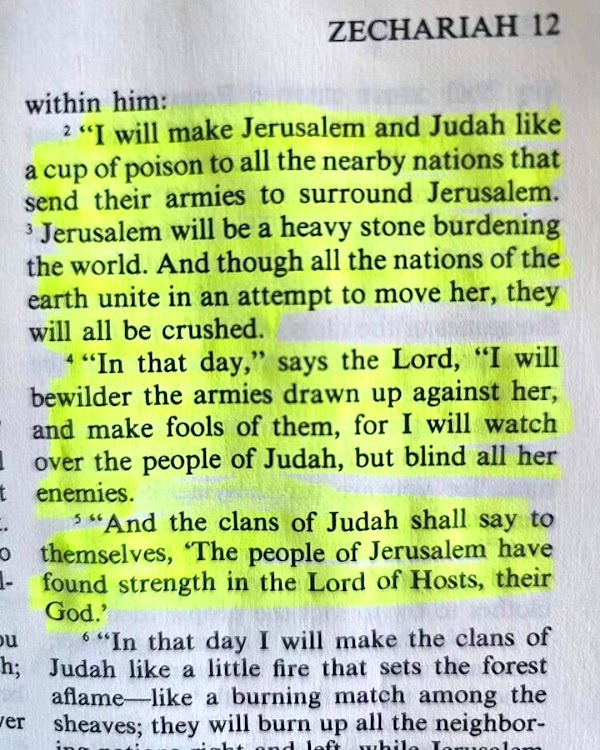
Zechariah’s prophecy “about the Israel-Hamas War.”

Zechariah 12.

After the Israel-Hamas War began on 7 October 2023, this highlighted bit of Zechariah started making the rounds on social media, usually captioned, “This is going to happen very soon. Watch.”

Zechariah 12.2-5, Living Bible.
From the 1971 edition of The Living Bible.

Memes like this are very popular with people who worry about the End Times, who want to know when it’s time to start buying the food buckets and guns for their bunkers.

The way Darbyist “prophecy scholars” interpret the End Times, every time they come across a passage of scripture which appears to be about anything in their End Times Timeline, they immediately declare that’s precisely what it is. God said it, and his prophets recorded it, not for the people of their day; not for the ancient Israelis of millennia ago. Oh they might’ve thought it was for them, but they were just illiterate foreigners who lived in mud huts without electricity and science, and didn’t even speak English—it’s for us, for the people of our day, for God’s actual chosen people.

The actual context of the scripture doesn’t matter. It only means what we want it to mean. It shall accomplish that which we please, and it shall prosper in the thing whereto we sent it. As for what God meant by it?… well surely he thinks like we do.

Yeah, it’s pretty darned arrogant of these interpreters. But they’re so desperate to find End Times puzzle pieces in the bible which fit into their timelines—however awkwardly—they’re often not even aware what they’re doing. It’s like a child who’s so intent on drawing the perfect picture of a unicorn… she doesn’t realize she’s using permanent markers on the penboard. Or, really, care. Rebuke her for it, and she’ll wonder what all the fuss is about—it’s such a good picture! Why should you want to erase it?

So, Zechariah 12. What’s it historically about? Glad you asked. Let’s take a look at it.

19 October 2023

Those accused of heresy for their End Times views.

That’d include me.

My view of the End Times is preterist—meaning most of the prophecies in Daniel, Revelation, and the Olivet Discourse were fulfilled by the second century of the Christian Era. Obviously Jesus has yet to return, the millennium hasn’t yet started, and New Heaven and New Earth have not yet replaced the current heavens and earth. So not everything has been fulfilled; duh. But just about everything else has.

And when I tell certain Christians this, they’re horrified. Horrified. It’s like I sprouted horns and a tail right in front of ’em, and suddenly I have a pitchfork in my hand, and the flames of hell burst forth behind me as I laugh evilly.

’Cause somehow it got in their heads that if you believe any differently than they about the End Times—or believe any variant other than “premillennial dispensationalism”—generally meaning the various Darbyist End Times timelines proposed by Hal Lindsey, Tim LaHaye, John Hagee, or your favorite prognosticating TV and internet preachers—you don’t believe the bible. Because all their beliefs come from bible. True, they had to massage, finesse, tweak, ditch the historical context, overlay a whole new context, bend, fold, spindle, and mutilate it till it finally means what their favorite “prophecy scholars” insist it means.

Interpreting it in its actual interpretive context, like I do… well their “prophecy scholars” have regularly told them any systems of interpretation other than theirs, are flat-out wrong. They’ve never even heard of “apocalyptic literature,” or think “apocalypse” only means “the very End.” And if they haven’t heard of it, surely it must be wrong. Surely I must be wrong.

And if I’m teaching people wrongly about the End Times… well that’s just extra wrong, in their minds. Why, I might convince people to not watch out for evil. To ignore all the signs of the times. To dismiss the Beast when he finally appears; maybe even convince people to follow him! To not look for Jesus’s second coming, like we’re supposed to.

In short, they think I’m heretic. Worse—that I’m deliberately interpreting bible wrong, deliberately leading people astray, deliberately working for the devil. They think I’m going to hell. When I tell ’em I’m preterist, some of them physically back away, as if at any second the fire and sulfur will fall from heaven to consume me, and maybe scorch them a little if they’re too close.

Their favorite “prophecy scholars” don’t discourage this attitude and behavior at all. They kinda share it. They’re entirely sure they’re right and every non-Darbyist is wrong; they’re helping lead people to Jesus, and every non-Darbyist is hindering, and that’s as good as following Satan.

Okay. Lemme first of all remind you heretic is simply the opposite of “orthodox.” There are certain non-negotiable things every Christian oughta believe. We oughta believe in God; we oughta follow Jesus; we oughta believe he’s alive not dead; we oughta believe he’s returning. These basics are spelled out in the creeds. Some churches add to the creeds, but no churches should be taking doctrines away from them. And the creeds expect us to only believe the following five things about the End:

  • Jesus is coming again in glory.
  • There’s a bodily resurrection of the dead.
  • Jesus will judge the living and the dead.
  • There’s eternal life in the world to come.
  • Jesus’s kingdom will have no end.

Those are non-negotiable. Everything else is negotiable.

But, like I said, plenty of Darbyists are entirely sure their beliefs are just as non-negotiable as the creedal, orthodox stuff. And if you don’t believe as they do, you’re not Christian, and going to hell.

Yep, they think I’m going to hell. And if I convince you Darbyism is all wet, they think I’m dragging you to hell with me.

18 October 2023

Other English-language bibles in the 1600s and 1700s.

No doubt you’ve heard of the King James Version. But KJV fans and worshipers tend to be oblivious to the fact there were other English-language translations of the bible in that day. The KJV was one of many.

The KJV came out ahead of the pack, not because it was better than the rest—it was just as good as the rest—but because James Stuart, king of Scotland and England, suppressed the other existing translations… for political reasons. Y’see the Geneva Bible—the most popular translation of the day, the bible of William Shakespeare and the Pilgrims of Plymouth Rock—flat-out said in its notes Christians should resist tyrants. Unwelcome words to Stuart, who grew up in France and kinda coveted the French kings’ absolute dictatorships. Stuart’s son Charles was later overthrown and beheaded by Parliament for trying to create that kind of monarchy.

The KJV is debatably an improvement on its predecessors—the Tyndale Bible, Matthew’s Bible, the Bishops Bible, and the Geneva Bible among them. But KJV fans take it as a given these were inferior bibles, and haven’t a clue how good and valuable a bible the Geneva Bible was in its day. Usually because they’ve never even heard of it. Many KJV fans like Jack T. Chick like to pretend it never existed. The KJV fans never looked into its history, never took a peek at the previous English translations, and just assumed newer must mean better… until we start talking about present-day translations, and then suddenly newer isn’t better.

Naturally KJV fans know nothing about the KJV’s English-language successors. At least not till the 1881 Revised Version (adapted for the United States as the 1901 American Standard Version), which again, fans dismiss as irrelevant because it doesn’t base the New Testament on the Textus Receptus; as if the KJV translators bothered to look at the Textus most of the time; and as if they actually know why the Textus would be better than current Greek bibles. (It’s not, though.)

Usually they also don’t know about the KJV’s own revisions. They all know it was published in 1611; they don’t know the translators made more than 300 corrections to the text before its second printing in 1613. And that doesn’t even count the spelling. Spelling wasn’t standardized yet, so anyone could spell anything any which way, so long that people understood what they meant. So silent letters got dropped (“owne” became “own,” or “diddest” became “didst,” or “goe” became “go”) and minor grammatical and verbal changes were made (“you” became “ye” 82 times, “lift” became “lifted” 51 times, and so forth; “cheweth cud” became “cheweth the cud,” Lv 11.3 or “reign therefore” became “therefore reign.” Ro 6.12).

Minor changes, but lots of people felt free to make minor changes thereafter. Noah Webster produced an edition of the KJV in 1833 which Americanized the spelling. C.I. Scofield’s 1909 reference bible replaces hundreds of words from the KJV with what Scofield felt were much better translations.

These changes kinda let us in on the biggest problem with the KJV: It’s written in old-timey English. Not just old-timey English from our point of view; it was old-timey for 1611. The KJV’s translators—as they say in their preface!—didn’t actually want to create a whole new translation; they only wanted to fix existing ones. They considered themselves part of the translation tradition which extended all the way back to William Tyndale in 1522. But they hadn’t adjusted for the way language evolved over that century. Only poets and Quakers were referring to one another as “thee” and “thou” anymore, yet the KJV is full of these out-of-date pronouns. Vocabulary and styles were changing. Bibles always need to be translated to fit the way people currently speak—not demand people first learn how people used to speak. That may be fine for literature classes, but sucks in evangelism.

The other issue back then was the discovery of new ancient manuscripts. The Textus Receptus, the Greek New Testament the early English translations were based on, is full of errors. (That’s on purpose. Its editors wanted to include every word found in every available Greek manuscript. So of course that’d include any errors which crept into any bibles over the past 15 centuries.) But in 1627, King Charles Stuart 1 was given the Codex Alexandrinus by St. Cyril Lucaris, patriarch of Alexandria—a near-complete parchment copy of the Septuagint and New Testament, dating from the 400s, although some traditions claim it was copied earlier. It went to the British Museum; it’s been there ever since; English and Scottish scholars had full access to it. Totally could fix all the errors the Textus had put in the KJV.

So when the Puritans under Oliver Cromwell took over England in 1649, Parliament eventually created a commission to work on updating the bible. Unfortunately nothing ever came of it. Why not? Cromwell expelled them in 1653 for not holding new elections. New bibles had to wait.

In the meanwhile, Puritans created paraphrases—bibles and New Testaments where they translated the KJV into present-day English. (With big long book titles, which is what people did back then.) Like John Dale’s Bible Explained in 1652. Or Henry Hammond’s A Paraphrase and Annotations upon All the Books of the New Testament, Briefly Explaining All the Difficult Places Thereof in 1675. Or Richard Baxter’s New Testament with Paraphrase and Notes in 1685. Or Daniel Whitby’s A Paraphrase and Commentary upon All the Epistles of the New Testament in 1700. Or the volumes of John Guyse’s The Practical Expositor, or an Exposition of the New Testament, in the Form of a Paraphrase, with Occasional Notes in 1739-52—which John Wesley later used for his 1755 Explanatory Notes on the New Testament.

I should point out these paraphrases aren’t like the Living Bible or The Voice, in which the writers take creative license with the text; nor like the 2015 Amplified Bible, in which they try to shoehorn popular Evangelical doctrines and beliefs into it. They weren’t really trying to create new bible versions. They were trying to interpret it for their readers. Like when an expositor is analyzing a new bible verse, and briefly puts it in her own words: She’s just trying to make it more understandable.

17 October 2023

Standing with Israel?

My views on Israel are not conventional. So, of course, they’re controversial.

For the average American Evangelical, the Jews are God’s chosen people. Ek 20.5 There might be more than a few antisemites among us, but for the most part we believe God established a relationship with Abraham ben Terah, and God chose Abraham’s and Israel’s descendants as his particular people. God graciously freed Israel’s descendants from Egyptian slavery. God set up a king over them whom they called Messiah (or as gentiles usually call him, Christ). Jesus of Nazareth is the final and greatest and eternal Messiah. Our religion is a descendant of the Hebrew religion. We even swiped their holidays.

Likewise the average American Evangelical also believes God promised the descendants of Israel a land on the Mediterranean Sea’s west coast, known as the Levant, or Canaan, or Palestine. The promise was conditional: If the Israelis kept covenant with the LORD and upheld his Law, they could live there and prosper. God encouraged the nations round about Israel to support it and ally themselves with it, if they knew what was good for them. Of course this is based on the presumption Israel followed God: When Israel followed God, it and its allies prospered. When it didn’t, not so much.

And because it didn’t, ancient Israel was destroyed by the Assyrian and neo-Babylonian empires. It was made a client state of them, and later of the subsequent Persian, Greek, Seleucid, and Roman empires. (With a tiny bout of independence between the Seleucid and Roman periods.) Then, in the year 70, the Romans destroyed Israel again. And it stayed destroyed. Stayed destroyed, most Evangelicals say, until the 20th century, when the Jews reestablished the modern state of Israel in 1948.

And here’s where they and I part company. The modern state of Israel is an entirely new state. It’s not the same state as ancient Israel.

It contains God’s chosen people, in that many Israelis are Jews. It consists of a lot of land which ancient Israel occupied. It’s ancient Israel’s successor state. But it’s not the same state. No more than Italy is the Roman Empire, Türkiye is the Ottoman Empire, or Russia is the Soviet Union. It’s a new country, younger than the United States.

Despite what both Jews and Evangelicals claim, it’s a whole different country than the one founded by the LORD through Moses ben Amram in the 1400s BC. Therefore none of the bible’s prophecies and promises which have to do with the country of Israel, apply to present-day Israel. They were fulfilled by ancient Israel. They might look like they repeat themselves with present-day Israel… but that’s only because history repeats itself. That, and certain Evangelicals love to stretch those bible passages to suit their ideas, but they’re not at all what God means by them.

16 October 2023

Does God have the right to judge anyone?

Throughout the bible it’s taken for granted that God has every right to judge humanity for sin. He created us, created this planet for us to take care of, and set the terms and conditions for us to live by. Either we trust him, follow them, and be blessed by his aid and comfort… or we don’t, won’t, and fall subject to every natural disaster there is.

For that matter, as spelled out in God’s TOS, he also reserves the right to sic some of those disasters on us—triggering recessions, causing droughts, provoking invaders, starting fires, dropping meteors, blotting out the sun. And that’s not just Old Testament behavior either. Revelation tells of him doing that stuff during the Christian Era as well.

And pagans and nontheists find the very idea of this behavior really offensive. God judging humanity? God condemning humanity? God punishing humanity? How dare he?

To pagans, that’s not the behavior of a loving God. A loving God would never. He’d bail us out of all our problems and clean up all our messes. He’d never send a giant flood to wipe out sinners; he’d never dump burning sulfur on Sodom to destroy its rapists; he’d never kill all the firstborn Egyptians to convince their pharaoh to free Israel; he’d never task Israel with genocidally wiping out the Amorites to take their land; he’d never task Assyria and Babylon and Rome with near-genocidally wiping out the Israelis who’d gone pagan. A loving God would at the very most mitigate evil, or make it very very hard for humans to commit it. But he would never stop it cold in its tracks by smiting the evildoers.

Or he would… but they’d have to really be evildoers. Like murderous dictators and their soldiers. He’d strategically smite them. But the “collateral damage,” as our militaries call it, of civilians who lived near by, or innocent family members who somehow weren’t actively or quietly supporting them in their evildoing: God would somehow spare them. He’s God; he could figure out how to target them precisely, and spare innocents… and then somehow make sure those “innocents” never get radicalized against God and his people for taking away their loved ones.

As for nontheists, they insist there is no God judging humanity or mitigating evil. That’s just people murdering other people same as always, and using God to justify ourselves. The bible is merely a book of myths; Israelis conquered their neighbors, then inserted God into their stories and claimed it was all his idea. Then Jesus showed up centuries later and said no, God is love—which is a nice idea, but Jesus must be talking about a different God than the one his ancestors invented, ’cause that guy is all smitey.

Okay. There are gonna be various pagans and nontheists who come at this issue from other directions, but I think I’ve laid out the general idea here: The scriptures reveal God as someone who represses or stops evil, and doesn’t rule out destruction and death and war as ways of doing so. And the skeptics argue he can’t do it these ways, for that’d make him evil. Captain America can shoot bad guys and remain noble and virtuous and good… but God can’t.

02 October 2023

Are you experienced?

Every so often someone’ll ask me, “How do you know there’s a God?”

This isn’t a rhetorical question. They aren’t looking for Christian apologists’ various proofs for God’s existence, and would in fact be very annoyed if that’s what I gave them: “Well we know there’s a God because the universe works on cause-and-effect, and if we trace all the causes back to a first cause…” Yeah yeah, they’ve heardd the “unmoved mover” idea before. They don’t care about deducing God’s existence through reason.

And if that’s the only basis I have for believing in God, they’ll move on. They’re not looking for a logical argument. They’re looking for God Himself. Have I, me, K.W. Leslie, the guy who talks about God as if he’s met him personally, encountered God Himself?

Yep. Met him personally.

No, really.

No, really. Three decades ago I was attending a largely cessationist church. There were some Christians in that church who were exceptions, who believed God still does stuff; but there weren’t many, and they weren’t in leadership. I had heard God still does stuff through some of their testimonies, and sometimes missionaries would visit, preach, and share their God-experiences; and sometimes people would leave copies of Guideposts Magazine—which is pretty much all about God-experiences. So I knew some Christians had ’em. I just figured I didn’t; not really.

So I told God to either reveal himself, or I was giving up on Christianity. I didn’t give him a deadline; I just figured I’d gradually fade out of church attendance, much like my high school friends had. Maybe I’d try Buddhism or something. Meanwhile I’d pay attention, ’cause you never know; maybe he’d show up!

And he did. And no, that wasn’t the only time. He’s revealed himself in many different ways, many times since, on a frequent basis. No way I’m ever quitting now. I might, and have, quit an individual church if they go bad. But never Jesus.

Whereas the folks in that cessationist church weren’t entirely sure “met him personally” is even a valid option when we’re talking with people who have questions and doubts. Most have been taught the usual God-damned rubbish that God stopped personally intervening in the universe, stopped interacting with his kids once the bible was completed or science was invented; that the only way to encounter God anymore is through a near-death experience. Miracles have ceased, and any “miracles” you hear of today aren’t God-things; they’re Beelzebub-things.

And of course these folks insist they’ve never seen a miracle, and since they presume (sorta arrogantly) they’re the standard for what’s “normal” in our universe: If miracles never happened for them, they never happen for anyone.

So when I tell these unbelieving Christians I met God—and continue to meet God—they figure I have a screw loose. Because deep down that’s really what they believe about God: Believing in him is screwy. He’s a figment. He’s imaginary. He doesn’t interact with the real world, and isn’t remotely “real” in that sense. He’s a platonic ideal or an anthropomorphized abstract. He’s myth.

The very idea God’s substantively real… kinda scares them a little. ’Cause that’d mean they should take God a lot more seriously than they currently do. Right now the idea of an impossibly distant, remote, otherworldly, outside-our-universe and doesn’t-intervene God kinda works for them. They’re comfortable with the arrangement: God expects nothing more of us than that we intellectually accept his existence and Jesus’s kingship, and in exchange he’ll graciously let us into heaven. Done deal. Easy-peasy.

Only problem: That’s not who God is, nor all he expects of us. We know better. He wants us to take much, much bigger steps. But before we ever do that—before we get radical about our Christianity (and hopefully not in crazy legalistic ways), we wanna know our religion isn’t based on wishful thinking. We wanna know there’s a real live God behind it all.

There is. If you’re Christian, he lives inside you. You wanna see him? You wanna silence your doubts about his existence for good and all? Then you gotta put aside that imaginary-God manure and start treating him like he’s real. And you’re gonna discover that all this time, while you weren’t paying attention ’cause you were too busy playing church, God’s been here all along.

27 September 2023

Partisanship is a work of the flesh.

In Paul’s list of works of the flesh in Galatians, one of the words he used is ἐριθεῖαι/epitheíe. The King James Version translates it as “strife;” the ESV went with “rivalries,” and the NIV and NASB with “selfish ambition.” I translate it “partisanship.”

No, I didn’t translate it this way because I wanna rebuke partisanship, and needed a bible verse to back me up. I got it out of Greek dictionaries when I translated this Galatians passage years ago. I’ll quote ’em for you. My Liddell-Scott-Jones lexicon has this:

ἘΡΙ̅ΘΕΊΑ epiθ'eɪ.ɑ noun. Labor for wages. Hesychius, “Lexicography”
2. Canvassing for public office. Intriguing. Aristotle, “Politics.”
3. Selfish or factious ambition. Jm 3.14, Pp 1.17 Intrigues, party squabbles. Ga 5.20

Joseph H. Thayer has this in his lexicon:

eritheias (eritheuō to spin wool, work in wool, Heliodorus 1.5 middle in the same sense; Tb 2.11 used of those who electioneer for office, courting popular applause by trickery and low arts; Aristotle, “Politics” 5.3 the verb is derived from erithos working for hire, a hireling; from the Maced. age down, a spinner or weaver, a worker in wool; Is 38.12 LXX a mean, sordid fellow), electioneering or intriguing for office; Aristotle 5.2-3 hence apparently in the New Testament a courting distinction, a desire to put oneself forward, a partisan and factious spirit which does not disdain low arts; partisanship, factiousness; Jm 3.14, 16, Pp 1.16, 2.3 Ignatius “Philadelphians” 8 equivalent to contending against God. Ro 2.8, 2Co 12.20, Ga 5.20

Lastly a contemporary Greek teacher, William D. Mounce:

the service of a party, party spirit; feud, faction; 2Co 12.20 contentious disposition, selfish ambition; Ga 5.20, Pp 1.17, 2.3, Jm 3.14 by impl. untowardness, disobedience. Ro 2.8, Jm 3.16

The word was originally used to describe weavers. At some point in the past, weavers began to use their guild to influence city politics—and were willing to do anything it took to gain political power. So the word evolved to mean that instead. It means partisanship.

Galatians 5.19-21 KWL
19Fleshly works are obvious in anyone who practices the following:
Promiscuity. Uncleanness. Unethical behavior.
20Idolatry. Addiction. Hatred. Rabble-rousing.
Too much zeal. Anger. Partisanship. Separatism. Heresy.
21Envy. Intoxication. Constant partying.
And other people like these.
I warn you of them just like I warned you before:
Those who do such things won’t inherit God’s kingdom.

Of course partisans are gonna seriously be in denial about this. Which is why they tell me, “It only says partisanship because you made it say that,” and point to other translations they like much better. Translations which imply it’s totally okay for them to be partisan!

Okay… but in those other translations it says “strife,” “rivalries,” and “selfish ambition.” Don’t partisans regularly do that stuff too?

26 September 2023

Wanna feel the Holy Spirit? Crank up the bass.

Wanna feel the Holy Spirit? Crank up the bass.

I joke all the time about this with the people in my church: If you want people to really feel like the Holy Spirit is in the building, get on the soundboard and make sure the bass guitar, the bass drum, and all the lower notes on the keyboard, are cranked all the way up to 11. Conversely if you want ’em to feel like he’s missing, you do the opposite and turn all of ’em off.

It’s one of those jokes which is funny because it’s true. If you actually did this, it’s actually how people would respond. The higher the bass, the more people “felt” the Spirit move. Turn it all the way down and you’ll get, “I don’t know what was wrong this morning, but I wasn’t really feeling the Spirit today.”

’Cause bass causes stuff in the building to vibrate. Including people. Most of us know this already… but we never really think about how else it affects us.

Go to any movie theater and you know they make darned sure there are subwoofers under the floor, and they’re cranked all the way up. They want you to feel every crash, bang, gunshot, and explosion in that movie. Low sound waves shake your innards, and turn a spectacle into an experience.

Same with dance clubs. Same with concerts. People weep at concerts. Same as they’ll weep at worship services. It doesn’t always register how this is the physical effect of soundwaves, and how our brains have connected the sensation to our emotions, so it triggers us. All we know is we feel.

So when people don’t know there’s a difference between spirit and emotion (or even when we’re totally aware of this fact, but we’ve never bothered to discern which is which), we’ll assume the feelings are the Spirit at work. Especially when it feels really good.

Conversely, when “my spirit is downcast,” we’re still talking about emotions and sensations. Not anything the Spirit is actually doing—and he’s usually doing quite a lot! But because we don’t feel something positive, we presume he must be absent.

This isn’t a uniquely Christian thing. Most people don’t know the difference between spirit and emotion. Most people don’t think there is any difference. Pagans in particular, but I’ve caught even mature Christians making this mistake as well. I know better, and even I slip up sometimes. I’ve yet to meet a Christian who hasn’t.

13 September 2023

Heavens!

HEAVEN 'hɛ.vən noun. The dwelling place of God, his angels, and debatably good humans after they die. Traditionally depicted as above the sky.
2. A euphemism for God himself. [“Sin displeases heaven.”]
3. The sky, perceived as a vault containing the sun, moon, planets, and stars.
4. A place of bliss. [“This is heaven!”]
5. Short for the kingdom of heaven, i.e. God’s kingdom.
6. The state of being in God’s presence, namely after death.
[Heavenly 'hɛv.ən.li adjective.]

As you can see, there are multiple definitions of our word “heaven.” But when Christians talk about heaven, we mean the dwelling place of God. Right?

Not really. In fact not usually.

In my experience, when Christians talk about heaven, we’re actually talking about the kingdom of heaven. In other words, God’s kingdom. Which is meant to happen here on earth. We Christians are supposed to be already living like it’s here—and when Jesus returns, he’ll fully set it up and run it. But too often Christians act like this kingdom does not happen on earth, and never will: It’ll happen in heaven. In the future. After we die. When we do stuff in heaven, “heaven” is always way later. Or we describe the stuff we’ll be doing in New Jerusalem… which is actually in New Heaven, which is not even the same heaven the scriptures typically mean.

I listed six definitions of heaven. No, I’m not gonna therefore say there are six heavens, like C.S. Lewis did when he wrote about four loves. There are likely more definitions of heaven than even that.

But there are Christians who claim there are multiple heavens. Not just the current heaven, and the New Heaven of Revelation 21. There’s the seven heavens of Dante Alighieri’s Paradisio, the 10 heavens of the Pharisees, and the three heavens which you’ll hear Evangelicals talk about ’cause they’ve neither read Paradisio nor 1 Enoch.

Confused yet? Maybe a little. Hope not. Let’s start with the bible’s descriptions of the heavens.

11 September 2023

The Dives and Lazarus Story.

Luke 16.19-31.

This story is often called the Story of the Rich Man and Lazarus, or Lazarus and the Rich Man, depending on who oughta come first. Since it’s actually not about Lazarus, stands to reason the rich man should come first. Traditionally this man’s been called Dives (usually pronounced 'daɪ.viz instead of like the verb) ’cause that’s what he’s called in verse 19 in the Vulgate; dives is Latin for “rich.” So I’m gonna call him Dives; it saves time.

Every once in a while some literalist insists this story is not a parable. This is the only story where Jesus refers to someone by name—so they figure this must mean something, and claim Jesus is straight-up talking about a real-life guy named Lazarus, who lived in first-century Israel. Some of ’em even claim the Lazarus of this story is Lazarus of Bethany, Jesus’s personal friend whom he later raised from the dead, Jn 11.1-44 and this is how Lazarus died. Which makes no sense, because Lazarus’s family asked Jesus to come cure him; they didn’t just dump Lazarus at Dives’s door, hoping this idle rich guy might uncharacteristically do something charitable.

On the other extreme, we have people who insist this story is pure fiction. Primarily because they have very different beliefs about afterlife. Jesus, they insist, is not accurately describing what happens when people die. We go to heaven. Or hell. Some insist we’re immediately resurrected and live in New Jerusalem from now on; others claim we live in some glorified spiritual form while we await the Resurrection. Hindus and Buddhists believe we get reincarnated, and of course pagans and Mormons believe we become angels.

In some cases, the Christians who insist Jesus isn’t accurately describing afterlife are dispensationalists who believe this used to be the way afterlife worked—maybe—but not anymore. There’s a popular Christian myth called “the harrowing of hell,” which says before Jesus died to atone for our sins, God saved nobody by his grace—therefore nobody but the most saintly people ever, like Job or Abraham (and here, Lazarus), could make it to paradise. Nobody had the karma! So they were forced to wait in hell till Jesus died. Once he died, Jesus went to hell, same as them… but with keys! He unlocked the gates, stepped on gatekeeper devil Belial’s neck, freed all the Old Testament saints, and took ’em with him to heaven. And now, nobody experiences anything like Jesus describes in this story. Christians go to heaven.

Considering that God isn’t limited by time whatsoever, it makes no sense that he can’t apply Jesus’s then-future atonement to the sins of the people who existed before Jesus. In fact there’s every indication he did: Their sins, which were many, never hindered him with instigating relationships with them!

Nah, both the literalists and the myth-believers have it wrong. This story is a parable. Lazarus isn’t a literal guy. But this is, loosely, what the afterlife looks like. Then, and now. And it’s meant as a warning to those of us who are wealthy, but don’t bother to use our wealth to further God’s kingdom. If all we care about is our own comfort, we may not experience any such comfort in the afterlife. Billionaires beware.

Luke 16.19-31 KWL
19“Somebody is wealthy.
He’s wearing purple and white linen,
partying daily, in luxury.
20Some pauper named Lazarus was thrown out by the plutocrat’s gate,
covered in open sores,
21desiring to be fed with whatever fell from the plutocrat’s table,
but the dogs which came are licking his sores.
22The pauper comes to die,
to be carried off by the angels to Abraham’s fold.
The plutocrat also dies
and is entombed.
23In the afterlife, the plutocrat lifts up his eyes—
he’s getting tortured in the pit—
and sees Abraham far away,
and Lazarus in his folds.
24Calling out, the plutocrat says, ‘Father Abraham!
Have mercy on me and send Lazarus,
so he might dip his fingertip in water, and might cool my tongue,
because I suffer great pain in these flames!’
25Abraham says, ‘Child, remember:
You received your good things in your life,
and Lazarus likewise received evil.
Now, here, he is assisted—
and you suffer.
26In all this space between us and you,
a large gap was fixed
so those who want to come to you from here, can’t.
Nor can they pass from there to us.’
27The plutocrat says, ‘Then I ask you, father,
might you send Lazarus to my father’s house?
28For I have five siblings.
So Lazarus might urge them,
lest they also come to this place in the pit.’
29Abraham says, ‘They have Moses and the Prophets.
Heed them.’
30The plutocrat says, ‘No, father Abraham!
But if anyone comes back from the dead to them,
they’ll repent!’
31Abraham tells him, ‘If they don’t heed Moses and the Prophets,
neither will they be convinced
when someone rises from the dead.’ ”

03 September 2023

Jesus forgives, then cures, a paraplegic.

Mark 2.1-12, Matthew 9.1-8, Luke 5.17-26.

The story of Jesus curing the paraplegic lowered down through the roof, is one of the more famous stories in the gospels. Partly because the paraplegic’s companions were so eager to get him cured, so believed Jesus could cure him, they committed serious property damage. And partly because Jesus’s first act wasn’t to cure him—it was to forgive him.

That second thing is why bible scholars call this story a controversy pericope, which is a fancy way of saying it’s a story which provokes debate about who Jesus really is. Not among us Christians; we already know he’s God. Jn 1.14 But among Pharisees, Jesus’s fellow Galileans, and his new followers—who didn’t know this yet, and it’s because of these stories they figured it out. Jesus isn’t just a guru, just a prophet, just our king; he’s God-become-human.

But because people couldn’t fathom God becoming human (and a lot of people still can’t!), Jesus steps on a lot of toes. Pagans and heretics still try to explain his divinity away by claiming we Christians misunderstand him, and claim he’s God when he’s only a really enlightened human… or saying we’re all kinda God and Jesus is just better at it than average; or saying he’s a lesser god but not the God. Closed-minded folks firmly embrace any interpretation of Jesus which doesn’t offend them any, and we outrage them by showing them where the bible pokes holes in these wrong ideas. (Welcome to my world.)

Well. This story takes place in Mark and Luke right after Jesus cures a “leper,” and in Matthew after Jesus visits the Dekapolis and kicks 2,000 demons out of some guy. Various gospel synopses like to link this story up with a different paraplegic Jesus cured at a pool. But that happens in Jerusalem; this happens in Jesus’s home base of Capharnaum.

The gospels don’t say whose house it is, and a lot of Christians like to speculate it’s Simon Peter’s—for no good reason. Most likely it’s Jesus’s house. Yes, Jesus’s. People assume he had no house, ’cause he elsewhere says the Son of Man “had no place to lay his head,” Lk 9.58 but that’s because he traveled. When he wasn’t traveling, when he stayed in Capharnaum, he lived somewhere. Likely with family. James and John were Jesus’s first cousins, so likely he lived in their family home.

Who, I’m sure, were initially startled to find their home overrun with Jesus’s followers. Then horrified when a bunch of guys decided to bust through the roof and drop a paraplegic on ’em.

27 August 2023

The “leper” whom Jesus cured, then drove away.

Mark 1.40-45, Matthew 8.1-4, Luke 5.12-16.

There’s are two words in the bible usually translated “leprosy.” They’re the Hebrew word צָרָ֑עַת/chara’át and the Greek word λέπρα/lépra. In Leviticus it’s described like yea:

Leviticus 13.1-3 NASB
1 The LORD spoke to Moses and Aaron, saying,
2 “When someone has on the skin of his body a swelling, or a scab, or a bright spot, and it becomes an infection of leprosy on the skin of his body, athen he shall be brought to Aaron the priest or to one of his sons the priests. 3 The priest shall look at the infected area on the skin of the body, and if the hair in the infection has turned white and the infection appears to be deeper than the skin of his body, it is an infection of leprosy; when the priest has looked at him, he shall pronounce him unclean.”

The chapter goes into further detail about whether it’s a temporary or chronic case of “leprosy,” and whether “lepers” need to be temporarily isolated, or permanently—which includes walking around in torn clothing and shouting, “Unclean!” to anyone who approaches. Also whether clothes have “leprosy,” and what should be done with them; and chapter 14 tells of buildings which have “leprosy,” and whether they should be washed or torn down.

Now yeah, since we’re talking about something clothing and buildings can get, we’re not talking about a particular disease. More like a condition. Anything which makes your skin white and scaly, or red and raw; anything which turns your clothing or walls red or green. In the case of clothing and walls, it sounds like mold; in the case of skin ailments, it could be an infection, or even skin cancer.

Nowadays when we say “leprosy” we mean Hansen’s disease, a bacteriological infection which damages nerves and extremities. And it’s curable! Early treatment can prevent any permanent injury, but after six to 12 months of meds and therapy, you’re fine. Don’t need to wear torn clothing; don’t need to shout “Unclean!” For that matter, we’re not entirely sure Hansen’s disease is even what the LORD was talking about in Leviticus: Biblical “leprosy” sounds like skin rashes or skin cancers, and Hansen’s disease doesn’t present as skin lesions till you’ve lost feeling in your extremities—at which point, because you can’t feel pain, you injure yourself more easily.

Regardless of what the bible means by chara’át or leprós, that was the disease to avoid—and the disease ancient Israelis most feared. It made you ritually unclean, which means you couldn’t go to temple or synagogue, ’cause you were self-quarantined. Couldn’t go into town. Nobody but other “lepers” could touch you. And, thanks to Pharisee attitudes of the day, people presumed you were cursed—because why else would God let such a horrible thing happen to you?

People still develop this attitude about chronically unwell people. If you’re regularly suffering from maladies; if you’re deaf, blind, can’t walk, or are mentally ill, Christians regularly develop the attitude of “That’s your fault. ’Cause if you only trusted God enough, he’d cure you.” Which is pure a--holery on their part, ’cause it’s not like they did anything to particularly deserve health and wellness. They’re sinners too. In fact, being able-bodied, they’re quite able to sin way more than someone who’s not.

Anywho, here’s the part of the gospels where someone with “leprosy” first approaches Jesus. Dude cured everyone in Capharnaum, but what about the “lepers” who were quarantining outside Capharnaum and all the other cities? Might Jesus be able to cure them too?

This one “leper” decided to give it a shot.

20 August 2023

Ready to take on the whole of the Galilee.

Mark 1.35-39, Matthew 4.23-25, Luke 4.42-44.

Whenever preachers talk about Jesus curing everyone in Capharnaum, they tend to describe it as Jesus spending all day curing people and throwing out demons. But read the text: The people came to him at sundown, Mk 1.32, Mt 8.16, Lk 4.40 so he actually spent all night curing people. Hope he got his Sabbath rest, ’cause he sure needed it.

By the end, preachers tend to describe Jesus as exhausted. And he might’ve been really tired, ’cause he was up all night. But exhausted? That’s only because they don’t know what it’s like to supernaturally cure the sick. Faith-healers will tell you it’s just the opposite. It’s not like a medical doctor, repairing patient after patient with treatment after treatment, taxing your mind and body with thought and work. You aren’t doing the work; the Holy Spirit is. You watch him do his thing; you rejoice once he’s done it. It’s not tiring. It’s invigorating. It’s a rush.

More likely, Jesus was wired after curing person after person after person. Too jazzed to ever get to sleep.

Since translators don’t realize this, they tend to make it sound like Jesus woke up crazy-early in the morning, after maybe two or three hours of sleep. But ἀναστὰς ἐξῆλθεν/anastás exílthen doesn’t mean, as the KJV puts it, “rising up… he went out,” but “the one who is up [already], goes out.” Jesus didn’t wake up and figure it’s prayer time; he was still up, and didn’t wanna sleep. He wanted more.

What kind of mood did you imagine Jesus was in?

Mark 1.35-39 KWL
35 Still awake in the still-dark morning,
Jesus comes out and goes to a solitary place,
and is praying there.
36 Simon Peter and those with him
search for Jesus,
37 and find Jesus and tell him this:
“Everybody looks for you!”
38 Jesus tells them, “We should go elsewhere,
into the other towns there are,
so I can preach there also,
for this is why I’ve come!”
 
Luke 4.42-44 KWL
42 Once it became day,
Jesus comes out and goes to a solitary place,
and the crowds are looking for him,
and come to him.
They’re holding on to him
lest he leave them.
43 Jesus tells them this:
“In the other cities as well,
I have to proclaim the good news of God’s kingdom.
For this is why I’m sent.”
44 And Jesus is preaching
in the Jewish synagogues.

“Capharnaum is cured. Who’s next? Give me more!”

See, one’s mindset makes a huge difference when it comes to interpreting bible. If we bring our own pessimism, skepticism, cynicism, negativity, and exhaustion to the text, we wind up with a negative-sounding Jesus who’s just plain done with these people. And that’s not Jesus. He loves people! He came to save people. Not ditch ’em at the first opportunity.

The idea of an exhausted Jesus, desperately trying to claw back some strength through prayer, is based on our own lack of experience, and bad attitudes. Y’ever notice how many preachers are introverts? To them, people are tiring. Ministry drains them. So they need to get away from people on a regular basis, and renew their strength in prayer… and project themselves upon Jesus, and it’s entirely wrong. He didn’t look at the Galilee and think, “Man, I have so much still to do.” He looked at it in the Holy Spirit’s might, and thought, “I’m gonna conquer the world!”

15 August 2023

The passive-aggressive prayer.

Years ago in a small group, it came time for people to take turns praying, so we did. I prayed for… something. Don’t recall what. It’s not relevant to this article.

What is relevant is I had prayed, regarding my request, that regardless of what I wanted, God’s will be done. Because, I stated in the prayer, sometimes it’s not, and I don’t want that. I want God to answer my prayers however he sees fit.

Well, this little statement of mine triggered one of the other guys in the group. Let’s call him Prakash. He believed God’s will is always done, because he believed God determines everything in the universe. (Evil too.) And he was still in the “cage-stage,” meaning he was ready, willing, and eager to argue theology with you. Especially since he was entirely sure he was right. I’m using past-tense verbs because I hope Prakash is better now. But sometimes cage-stagers never grow out of it, and turn into angry Fundamentalists whose list of mandatory fundamentals gets shorter, tighter, stricter, and less gracious with every passing year.

Anywho, Prakash had already taken a turn at praying, but he couldn’t help himself: He helped himself to another turn. And this prayer wasn’t about anything our prayer leader had asked us to pray about. Wasn’t about any personal requests he had for God. Wasn’t about any other people Prakash was interceding for.

Nope. He just wanted to remind God that he’s sovereign and therefore always gets his way. To appreciate the fact God’s will is always done, even though the rest of us human simpletons may not recognize this, and might imagine otherwise. To worship God for this particular trait of his.

To, y’know, passive-aggressively correct me by slipping a little theology lesson into prayer time.

Gotta admit, I was a little tempted to take another turn myself, and slip my own passive-aggressive prayer into the mix: “And God, we thank you for Prakash and his wisdom and humility, and pray that you water that mustard seed and make it grow into a mighty tree under which birds can perch. He’s got more than enough fertilizer; he’s ready; just make him grow, Lord. In Jesus’s name.

But not seriously tempted. I know better than to be a dick during prayer.

Thing is, if we’ve been to enough prayer groups—or simply if we grew up Christian and had to deal with annoying Christian siblings who pulled this kind of stunt (or, admittedly, pulled it ourselves) —we’ve all encountered the passive-aggressive prayer. The prayer which isn’t really a prayer; we’re talking to someone else instead of God, but for one reason or another we’ve chosen to disguise it as a prayer. Not that it’s fooling anyone.

It’s pure hypocrisy, and the proper way to deal with it is to call it out. But more often we Christians avoid our duty to rebuke bad behavior, and simply ignore it as if someone ripped a wet fart in the elevator: We all know it happened, but we’re not gonna say anything, and we’re gonna hope it dissipates as fast as possible.

Only problem is, when this behavior isn’t rebuked, the passive-aggressive petitioner is gonna think they cleverly got away with it. It wasn’t all that clever… but since nobody rebuked them, yeah they did get away with it.

So they’re totally gonna do this again.

14 August 2023

We’re all going to die, y’know.

I know, I know. “Unless the Lord tarries.” It’s a phrase preachers love to say, which reminds us there is Jesus’s second coming yet to take place—and because he can return at any time, he may very well return in our lifetimes. And if he does return in our lifetimes, we’re not gonna die: We’re getting resurrected without dying, like the apostles described.

1 Thessalonians 4.16-17 NLT
16 For the Lord himself will come down from heaven with a commanding shout, with the voice of the archangel, and with the trumpet call of God. First, the believers who have died will rise from their graves. 17 Then, together with them, we who are still alive and remain on the earth will be caught up in the clouds to meet the Lord in the air. Then we will be with the Lord forever.

Although I have heard some theologians argue that having our old bodies transformed into our new bodies means our old bodies pass away—they die. But that doesn’t jibe at all with the way Paul and Sosthenes put it when they wrote, “We shall not all sleep, but we shall all be changed.” 1Co 15.51 KJV Sleep is a euphemism for die, so they’re saying we won’t die. The preachers are right: When Jesus returns, those who are alive aren’t gonna die.

But are we gonna be alive when Jesus returns? Statistically, no. We’re gonna die.

Yep. You and me, and our kids, and our grandkids, and our great-grandkids, and all our descendants. People die, and we’re no different. We’re gonna die. You’re gonna die. Deal with it.

Yeah, I know. I’m gonna get accused of all sorts of heresy and apostasy and unbelief for saying this. Jesus can return at any time! How dare I give people the idea he won’t?

Well, I dare because thus far he hasn’t. For thousands of generations of Christians, he hasn’t. For good reason!—he’s trying to save everyone he can. 2Pe 3.9 And if it takes him a thousand more generations of Christians to save everyone he can, I’m okay with that. We should all be okay with that. I don’t want him to let other people perish just so I can avoid the uncomfortability of dying. I may be a dick sometimes, but I’m not that big a dick.

So Jesus is trying to save everyone he can, but despite this, every generation of Christians has claimed, “He’s coming back in my lifetime.” True, there were some generations where many of ’em weren’t saying this. Postmillennialism was really popular among Evangelicals for a few centuries, and postmil Christians thought it was their job to start the millennium—and Jesus wouldn’t return till it was over. But the majority of Christians still believed Jesus can and would return at any time, and return for them, and they wouldn’t die.

So they didn’t deal with it. And, y’know, died.

And you’ve likely seen what happens when people don’t prepare for their own death: Chaos. Family members who don’t know what to do. Wealth which they squabble over. Greedy opportunists who swoop in and take as much of that wealth as they can get their grubby hands on. Things left unsaid. Tasks left undone. Hurt feelings. And Christians who never, ever expected them to die—’cause Jesus was supposed to return first!—and now they go through a big unnecessary faith crisis because they thought Jesus was gonna return on their schedule.

I’ve seen this happen way too often. It’s entirely not necessary. It’s because Christians, and our teachers, aren’t dealing with reality. “Unless the Lord tarries” is likely gonna happen. It’s happened for 20 centuries; what’s another century? You’re not getting raptured before your 90th birthday. Or before Grandma’s 90th birthday. You’re gonna die.

Deal with it. Deal with it in a much better, healthier way than one of those pagans who don’t believe in resurrection and have no hope, but deal with it. Prepare for your demise. Get your family ready.

What, you figure you’re too young? You’re not. No one is. Accidents happen. Disease happens. People too stupid to take preventative measures because they don’t believe in science, happen—and sometimes happen to those of us who do believe in science, and we catch something deadly from these selfish morons. Even if you figure Jesus is returning within the next seven years, some driver fiddling with his phone could plow into you tomorrow, and nobody will be ready for that. So get ready for that. Practice some basic common sense, wouldya?

13 August 2023

Jesus cures the crowds.

Mark 1.32-34, Matthew 8.16-17, Luke 4.40-41.

In ancient Israel there was no such thing as healthcare. If you got sick, your only recourse was either for God to miraculously heal you, or folk medicine. Science hadn’t been invented yet!

Following the standards of the day, folk medicine was largely unproven: People did what they believed oughta work, based on guesses (educated or not), hearsay, rumor, or homeopathy—if something makes you ill, why not dose yourself with more and build up resistance? You know, like shooting yourself with smaller-caliber bullets to build up your immunity to larger bullets.

Some of it did actually work—like willow bark, which we nowadays call “aspirin.” Or poppy juice, which we nowadays call “opium.” But y’notice sometimes these cures did more harm than good.

Because the “experts” didn’t know what they were doing. All of them were fumbling around in the dark. Read Hippocrates or Galen sometime: Their philosophical theories are kinda entertaining, but when you realize people were actually trying to cure desperately ill people with their “knowledge”—it gets kinda horrifying.

The King James Version translated the Greek word ιἀτρός/yatrós (plural, ιἀτροί/yatrí) as “physician”—by which they meant “one who gives you physic,” and physic means “medicine.” A physician gave you folk remedies. Or drugs; they’d dope you up till you didn’t care about pain anymore. It’s the best they knew. But don’t get the wrong idea these “physicians” in the bible were in any way doctors of medicine. A far more proper translation of yatrós is “witch doctor”—which is what I tend to use.

Among pagan yatrí, one of the tools in their iffy arsenal was δαιμόνια/demónia. We translate that word as “demons,” but to Greeks a demónion was a lesser god; kinda like a guardian angel. If you were sick, the yatrí would ask their gods Apollo or Æsculapius for help… and if those gods were busy, maybe they could call upon a demónion to help you. Maybe stick one in you, and it could root around in there and fix you right up! Maybe two or three for extra help, or expediency. Maybe more! If one tablet of aspirin is good for you, why not an entire bottle? Why not a legion’s worth of demónia?

So as I said in my article on Jesus’s first exorcism, if you’ve ever wondered why the gospels contain so many exorcisms, and how they’re connected to supernatural healing, this is why. Jesus lived in the Galilee, which wasn’t entirely Jewish: It was full of Syrian Greek villages filled with Syrian Greek pagans. And if a Jewish person was sick, and desperate, they’d try anything—including some pagan yatrós who was rumored to get results. So they’d get demonized. Way bigger problems than ever they bargained for.

As I also said in that article, when Americans get sick, and western medicine doesn’t know how to treat them, we too will get desperate, and dabble in witch doctoring. Call it “eastern medicine,” call it “alternative medicine,” call it “natural healing,” call it whatever; none of these guys went to medical schools, and some of them call upon demónia same as the ancient Greeks. Times change; human nature hasn’t.

10 August 2023

Reminding Titus to not be “wild at heart.”

Titus 3.1-3.

Back in the 1990s there were two popular fads among American men. There was Promise Keepers, an organization started by football coach Bill McCartney as a way to encourage Christian men to be faithful husbands, good fathers, and to fight racism. And there was the Mythopoetic Men’s Movement, founded by poet Robert Bly to help men “restore” what they felt were their “deep masculine” traits and urges—abandoned by our egalitarian society, rejected as toxic masculinity. (And to be fair, a lot of the things men call our “masculine urges” are really works of the flesh, repackaged to be socially acceptable, but the only people that fools are fleshly men.)

Bly’s movement is pagan; his proof texts come from Greek and Norse mythology, and European folk tales, which he claims are ancient descriptions of how men really are. But author John Eldredge wrote a bestselling book, Wild at Heart, which repackaged the principles of Bly’s movement with Christian labels, and borrowed out-of-context scriptures as its proof texts. Thus Eldredge encourages Christian men to be wild, virile pagans—but, y’know, not capital-P pagan; just virile warriors who are tough guys like we see in Mel Gibson and Clint Eastwood and John Wayne movies. Be fighters; God made us fighters. Forget all this “turn the other cheek” crap; what soft, domesticated she-male taught us that?

I’m still a big fan of Promise Keepers. Not at all the Wild at Heart bushwa, which is total depravity disguised as Christianity. The reason it resonates with so many Christian men is ’cause it encourages us to be boldly, unrepentantly, fleshly. To defy Jesus’s teachings to be kind and patient and love one another; instead fight everything we don’t like, ’cause God meant us to be wild donkeys, in hostility with all our brothers. Ge 16.12 That God’s happy with this.

It’s a devilish spin on the scriptures, and the very same behavior Paul warns Titus against in today’s passage.

Titus 3.1-3 KWL
1 Remind the people about rulers, about powers—
to be submissive, to listen to authorities,
to be ready for every good work.
2 To never slander. To not be “tough guys.” Appropriate.
Showing every humility to every person.
3 For at one point we were just as stupid—
unyielding, wayward, slaving for desires and various pleasures,
spending our lives in evil and envy,
hated and hating each other.

Y’notice it’s not just the people of Crete, whom Titus is ministering to, whom Paul is writing about. In 3.3, Paul points out both he and Titus used to be that way.

Because these traits aren’t “deep masculine” characteristics we need to rediscover and revive. They’re basic human depravity. Before we followed Christ, they were our fleshly human nature. We’re supposed to reject them in favor of the new, godly human nature the Holy Spirit is trying to develop us; in other words his good fruit. But if we won’t resist the temptation to indulge in our “lost wildness” and savagery again… well, we’ve made ourselves unfit to live in God’s kingdom.

Good luck telling the “wild at heart” bullies any such thing.