15 September 2016

When we remake Jesus in our image.

PROJECTION prə'dʒɛk.ʃən, proʊ'dʒɛk.ʃən noun. Unconscious transfer of one’s ideas to another person.
[Project prə'dʒɛkt, proʊ'dʒɛkt verb.]

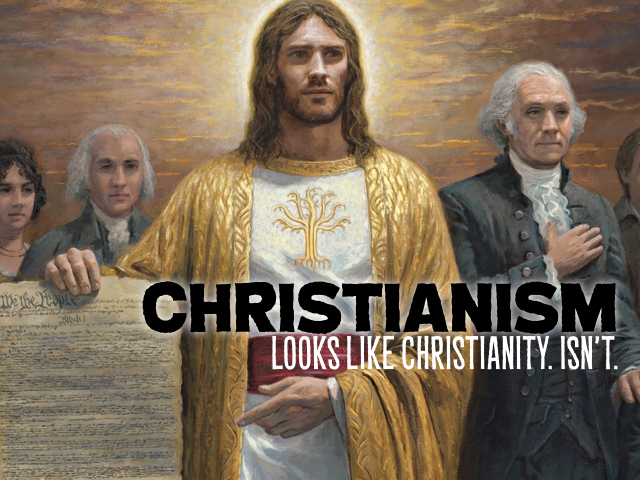
When we’re talking popular Christian culture’s version of Christianity, i.e. Christianism, we’re not really talking about what Jesus teaches. We’re talking about what we’d like to think Jesus teaches. We’re talking about our own ideas, projected onto Jesus like he’s a screen and we’re a camera obscura. We’re progressive… and how about that, so is Jesus! Or we’re conservative… and how handy is it that Jesus feels precisely the same as we do?

Y’know, the evangelists told us when we come to Jesus, our whole life would have to change. But when we’re Christianist, we discover to our great pleasure and relief our lives really didn’t have to change much at all.

We had to learn a few new handy Christianese terms:

PAGAN WAY OF SAYING ITCHRISTIAN WAY OF SAYING IT
“I think…”“I just think God’s telling me…”
“I strongly think…”“God’s telling me…”
“I feel…”“I just feel in my spirit…”
“I don’t wanna do that.”“We should just take that to God in prayer.”
“That scares me.”“I just feel a check in my spirit.”
“That pisses me off.”“That just grieves my spirit.”
F--- you and the horse you rode in on.”“I’ll pray for you.”

and we learned a few handy ways to act more Christian. Like learning all the Christian-sounding justifications for our fruitless behavior. Like pointing to orthodox Christian beliefs as the evidence of our new life in Christ; it’s way easier to learn and repeat than to develop fruit of the Spirit. Like how to act like Christians when surrounded by Christians, but be your usual pagan self otherwise, and never once ask yourself whether this is hypocrisy.

As for what Jesus actually teaches, for actually following him: Christianists figure we do follow him. ’Cause we believe in him. Jn 6.40 That’s how you get eternal life, right? Jn 3.16 Just believe. Nothing more. So we do nothing more. We’ve got faith, God figures this faith makes us righteous, Ro 3.22 and being righteous means we’re right. God rewires our minds so everything we think is right and good and usually infallible.

Problem is, that’s not how we become right. That’s how we stay wrong. That’s how we wind up arrogantly assuming the way we think, is the way God thinks. That all our depraved, self-centered motives are spiritual insights into how God’s gonna bring glory to himself. How God’s sovereignty and God’s kingdom works. How God’s sense of justice and wrath is gonna affect all the people in the world who, coincidentally, are the objects of our ire, spite, and disgust.

God’s ways are not our ways. Is 55.8-9 All the more true if we never bother to study God’s ways. But when we’re Christianists we think we know his ways, ’cause we have his Spirit (whom we barely follow), learned a few memory verses (some even in context!), skimmed a bit of bible, heard Sunday sermons for the past several years… and all our Christianist friends believe the very same way we do. There’s no way we could all be leading one another astray.

14 September 2016

Every Christian is a priest.

PRIEST prist noun. An ordained minister of the Roman Catholic Church, Orthodox Church, or Church of England, having authority to perform certain rites and administer certain sacraments.
2. A person who performs the religious ceremonies and duties of a religion.
3. A mallet used to kill the fish one catches when angling.
[Priestlike 'pris(t).laɪk adjective, priestly 'pris(t).li adjective.]

I pulled the definition up top out of the dictionary. I hadn’t heard definition #3 before; I included it ’cause it amuses me.

Y’notice it either says a priest is an ordained minister of a liturgical church, or implies it’s some person who does the rituals in some other religion. But definition #2 in fact applies to Christianity too. If you perform religious ceremonies, duties, rituals, or whatever else in your church, you’re being a priest.

Yes, you. ’Cause you’re a priest. Every Christian is.

It was after all God’s intention to create a kingdom of priests, a holy nation. Ex 19.6, 1Pe 2.9 So Jesus made his followers—us Christians—his priests. A kingdom of priests to our God. Rv 1.6, 5.10 Every Christian can minister to fellow Christians; therefore every Christian is a priest.

Yeah okay, elders in particular tend to get called to do these duties. Rightly so, because they generally know what they’re doing. They’re mature enough to perform priestly functions correctly. They can preach, prophesy, lead us in worship, perform baptisms, anoint sick people, distribute communion, lay hands on people for dedication or commission or anointing, intercede for others in prayer, and perform weddings. (Although the state tends to get picky about who can do that last one, separation of church and state regardless.)

Because the ancient Christians’ elders were usually the ones doing these priestly duties, over time the Greek word for elder, πρεσβύτερος/presvýteros, came to mean “priest” in those churches. (Technically that’s inaccurate; the ancient Greek word for priest is ἱερεύς/yereýs.) The rest of us just translate it “elder” or “presbyter.” So yeah, when liturgical churches read the bible, they read the qualifications for elders just a bit differently than we do; they’re looking for the critieria for priests.

But again: Every Christian is a priest. A new believer can anoint and heal a sick person, same as any elder. God can use anybody, y’know.

Still, whenever we’re sick, and want a fellow Christian to pray for us, whom do we usually go to? Right you are: An elder. A mature Christian. Not some newbie, who doesn’t yet have the hang of hearing the Holy Spirit; not some longtimer who lacks spiritual maturity. We want someone whom we know can minister properly. Some Christians won’t permit anybody to minister to ’em but an elder; and in many cases they only want the senior pastor of their church, ’cause they’re sure that guy knows God. (Hopefully so!)

That’s why, when a newbie comes running to the front of the church, hoping to preach a little something, they’re not automatically gonna get the microphone. We tend to keep priestly functions in the elders’ hands. We permit newbies to do it only under an elder’s supervision and training.

Or, of course, when there’s absolutely no one else available. Or, let’s be honest, when they’re the pastors’ kids. Or when nobody else knows how to play the piano so well. Or when they’re interns who’ve been really good at hiding their hypocrisy whenever the grown-ups are around. Let’s be honest; we’ve got a few cracks in the system. But generally we’ve screened people before they minister as priests.

Oh yeah: I should mention many of the same Christians who claim presvýteros means “priest,” never ever translate πρεσβυτέρας/presvytéras, “elder women,” 1Ti 5.2 as “priestesses.” Relax. I’ll get to that.

13 September 2016

We’re not the only ones who do grace, y’know.

Scott Hoezee told this story in his 1996 book The Riddle of Grace.

The story is told that, many years ago, a conference was convened to discuss the study of comparative religions. Theologians and experts from various fields of religious studies gathered from all over the world to tackle certain knotty questions relating to Christianity and its similarities or dissimilarities to other faiths. One particularly interesting seminar was held to determine whether there was anything unique about the Christian faith. A number of Christianity’s features were put on the table for discussion. Was it the incarnation? No; other religions also had various versions of the gods coming down in human form. Might it be the resurrection? No, various versions of the dead rising again were found in other faiths as well.

On and on the discussion went without any resolution in sight. At some point, after the debate had been underway for a time, C.S. Lewis wandered in late. Taking his seat, he asked a colleague, “What’s the rumpus about?” and was told that they were seeking to find Christianity’s unique trait among the world religions. In the straightforward, no-nonsense, commonsense approach that was to make Lewis famous, he immediately said, “Oh, that’s easy. It’s grace.” As the other scholars thought about that for a moment, they concluded that Lewis was right: It is grace. No other religion had ever made the ultimate acceptance by the Almighty so absolutely unconditional. In other faiths, there is usually some notion of earning points. Whether it was karma, Buddhist-like steps among the path to serenity, or some similar system, the idea was that to receive the favor of the gods one had to earn the favor of the gods.

Not in Christianity, at least not in true Christianity. Hoezee 41-42

Philip Yancey was so impressed by it, he retold the story in his 1997 book What’s So Amazing About Grace? which is where I first heard it. Hoezee says he heard it from Peter Kreeft, in a speech Kreeft gave at Calvin College. I’ve no doubt he did.

Too bad it’s gotta be bunk though. Told to make C.S. Lewis sound clever. Smarter than those religion experts, who somehow never read anything G.K. Chesterton wrote about the uniqueness of Christian grace.

But Lewis, and any religion scholar who’s not a chauvinistic ninny, would know full well grace is found in other religions.

Grace is in Judaism, ’cause grace is all over the Old Testament. The LORD rescued the Hebrews from Egypt, not because they were a great and deserving people who merited salvation, but purely out of his love. Dt 7.7-8 The LORD gave them Palestine, not because they deserved it, but because he promised it to Abraham and their ancestors. Dt 9.5 We make the same mistake Pharisees did, and confuse the Law with the foundation of their faith. But the foundation is Abraham—who trusted the LORD, and the LORD graciously considered his faith to be righteousness. Ge 15.6

Grace is in Islam. Those whose only experiences with Islam is with its legalists, assume it’s not. They assume Muslims struggle to follow Islam’s rules because it’s how they earn heaven. It’s not. Muslims are quick to remind people we can follow the rules perfectly, yet still not know whether you attain heaven, ’cause heaven has nothing to do with the rules. Only God decrees who’s going to heaven or not, and it’s entirely based on his grace. The Quran begins, بِسْمِ ٱللَّهِ ٱلرَّحْمَٰنِ ٱلرَّحِيمِ/Bismi Allahi alrrahmani alrraheemi, “In the name of God, the wholly gracious, the wholly merciful.” Muslim prayers regularly address him this way. They’re continual reminders of his grace.

Grace is even found in Hinduism. Karma only gets people so far, y’know. But Hinduism’s gods can be appealed to, intervene, and push people ahead a little further. Apparently they can be gracious.

That’s the thing: Scratch the surface of every religion, and you’ll find despite any legalism they might have, they also have grace to grease the wheels. Otherwise their wheels can’t turn.

Nope, Christianity doesn’t have a monopoly on mercy, forgiveness, kindness, compassion, and grace. In fact many’s the time Christians don’t practice these things… and other religions do, and frustrated Christians see this, quit Jesus, and go try out those other religions. And regularly claim these religions are the ones with grace, and Christianity isn’t, ’cause they never experienced any grace in their Christian upbringing.

Yeah, I’ve heard many a Christian apologist repeat this claim we’re the only ones who do grace. We’d sure like to think so, wouldn’t we? But we make that claim only when we don’t know squat about other religions. (Or we hope our debate opponents don’t know squat—and lying to win such debates is evil, Dt 5.20 so don’t do that.)

12 September 2016

Jesus’s most misinterpreted teaching.

Matthew 5.17-20, Luke 16.16-17.

Matthew 5.17-20 KWL
17“None of you² should think
that I come to tear down the Law or the Prophets.
I don’t come to tear down,
but build up.
18For amen!—I promise you:²
Heaven and earth might pass away,
but neither one yodh nor one dot
ought ever pass away from the Law;
not until everything’s done.
19So whoever might annul the smallest of these commands,
and might teach this to people:
They¹ will be called least in heaven’s kingdom.
And whoever might do and teach them,
this one will be called great in heaven’s kingdom.
20For I tell you² this:
Unless your² rightness superabounds—
more than scribes and Pharisees—
you² might not enter heaven’s kingdom.”
Luke 16.16-17 KWL
16“The Law and the Prophets
are preached as good news until John.
Since then, God’s kingdom is preached as good news,
and everybody forces their way into it.
17It’s easier for heaven and earth to pass away
than one dot of the Law to fail.

Despite this very lesson, many Christians do in fact teach Jesus did come to dissolve “the Law and the Prophets”—the way people in his day referred to the bible, our Old Testament.

As in Luke 16.16-17, Jesus is not announcing the termination of the OT’s relevance and authority (else Luke 16.17 would be incomprehensible), but that “the period during which men were related to God under its terms ceased with John”; and the nature of its valid continuity is established only with reference to Jesus and the kingdom.

D.A. Carson, Expositor’s Bible Commentary at Mt 5.17

It’s still relevant, still authoritative; it’s why Christian bibles still include it. But it’s no longer valid. It no longer counts. Fun to read, useful for historical context, and we can even pull a few End Times prophecies out of it. But follow it? Nah.

Exactly how is that not dissolving it? See, καταλῦσαι/katalýsë, which I translated “to dissolve,” refers to breaking stuff apart, like in water. Pour water on a sugar cube to dissolve it, and it’s no longer solid. Can’t construct any sugar-cube buildings, like the ones we made in grade school: It’s useless for any function which requires it to be solid. That’s precisely what Jesus said he didn’t do: He didn’t turn the Law and Prophets into crumbling, insubstantial mush. Yet that’s precisely what we claim he did: Rendered it moot. Invalid. Not binding. And therefore, really, not relevant and authoritative.

This idea exposes a huge, huge error in the way Christians think about God, his commands, the Law, and legalism. Worse, this false idea worms into the rest of Jesus’s teachings. Really, every instruction we find in the bible. As a result, Christians use grace as a loophole, an excuse to ignore Jesus’s teaching—or misunderstand it, misapply it, even violate it.

Gonna be a lot of “smallest” Christians in his heavenly kingdom.

09 September 2016

My favorite End Times novel.

Years ago, I was complaining about one of Tim LaHaye and Jerry Jenkins’s Left Behind novels. Don‘t remember which one, but I do remember my complaint—for once—wasn’t about the terrible Darbyist theology, but about the poorly-developed characters. Caricatures of characters, really.

The fellow I was ranting to was a bit of a Left Behind fan, so he didn’t appreciate my critique… although he admitted the writing “felt rushed.” There, I don’t agree. My beef wasn’t with how fast the Left Behind novels were cranked out. Some authors only need a month, start to finish, to produce a book. But they produce three-dimensional characters, whereas the Left Behind books produced melodramatic heroes and villains.

“Well fine,” he said, “what’s your favorite End Times book?”

“Easy,” I said, The Stand.”


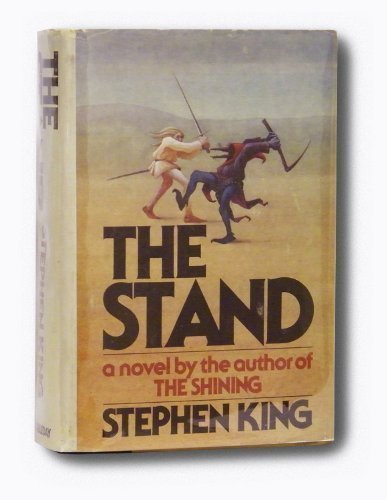
Yep, this book.

When I realized I meant the Stephen King novel, he was outraged. Which I get. After all, King uses swears in his novels. And some Christians have never forgiven King for his depictions of manic dark Christians in his previous novels Carrie and The Dead Zone. (His Christian characters are way better in The Stand and The Green Mile. But I digress.)

Yes, I have read other End Times novels, books, and so forth. I may as well tell you about a few of ’em, so you’ll know why I picked The Stand over the others.