15 June 2022

Activating prophecy.

Every Christian has the Holy Spirit within us, and we gotta learn to listen to him when we pray. And when he has something to tell not just us, but other people—whether other Christians or not—that’s prophecy. That’s all prophecy is. It’s not complicated.

But not every Christian has the patience to wait for God to tell us something. We want a message now. Right now. ’Cause we wanna share God with someone, and it’d really blow their minds if God himself told ’em something. Or we want to know something about the future, or need some encouragement, or need a reminder God’s here… or, let’s be honest, we wanna show off how we really do hear God.

That’s why various Christians will claim we can activate prophecy. That it’s not just the Holy Spirit’s supernatural gift, but a power we can switch on, once we learn to “move in the prophetic,” by which they mean we learn to tap that power, much like connecting your phone to the wifi at the coffeehouse.

So these folks teach us certain techniques we can use to help get us into the appropriate mindset for prophecy. The prophetic realm is all around us! All we gotta do is become aware of it, listen to what the Spirit’s trying to tell us—’cause we’re usually too dense to notice—and we’ll gain the ability to speak a word of prophecy wherever and whenever the need arises.

These techniques include paying attention to your surroundings. Or looking for clues in the person you’re trying to prophesy to: What they’re wearing, what they’re saying, what they react to when you talk to them. Or looking for clues in yourself: The very first word that comes to your mind, or the very first mental image you have, or the very first bible verse which pops into your head. Colors or fragrances might stand out, and evoke a memory or thought from you. Whatever cues might jump out at you and trigger a prophecy. Look for them!

Your job is to take these cues and extrapolate a positive message from them. Those who teach activation, make it very clear all prophecy must encourage and uplift. You know, like Paul said. 1Co 14.4 So if you come up with something negative, you’re doing it wrong; don’t do that; we’re trying to encourage not discourage. Keep it motivational and supportive. And where appropriate, quote bible.

I’ve been to a few of these activation classes and seminars. I agree—these techniques can produce really interesting, encouraging results.

But none of it is actual prophecy. It’s mentalism.

14 June 2022

Prayer in the public schools.

The United States has a separation of church and state.

Yeah, there are plenty of Christian nationalists who insist we don’t. Or they claim the idea isn’t constitutional, because the specific words “separation of church and state” aren’t found in our Constitution. (Ugh, literalists.) But just as the word trinity isn’t in the bible, yet it’s an entirely orthodox idea, separation of church and state is totally in our Constitution. In two places.

First, Article 6 bans religious qualifications for office. You don’t have to be Christian; you don’t have to not be atheist. Whatever your religion (or non-religion), hopefully you’re no hypocrite, but it’s explicitly not a prerequisite.

The Senators and Representatives before mentioned, and the Members of the several State Legislatures, and all executive and judicial Officers, both of the United States and of the several States, shall be bound by Oath or Affirmation, to support this Constitution; but no religious Test shall ever be required as a Qualification to any Office or public Trust under the United States. Article 6, ¶3.

Other countries (i.e. the United Kingdom, from which the United States separated) do require a religious test for certain office. For obvious reasons: The UK’s parliament funds the Church of England, and appoints its bishops. So if Brits didn’t know the religious sentiments of their elected ministers, the worry is they might internally corrupt the Church of England. It’s not a worry now; the current prime minister, Boris Johnson, is nominally Roman Catholic. But back during the English Reformation, when church loyalty might get you killed, this was a big, big deal.

Whereas the United States’ founders wanted a government where no religious faction was banned; Catholics could run for office, same as Anglicans, because we wanted it clear England’s old religious wars were not happening here. So the Constitution bans religious tests. We’re not gonna ban Catholics—even though there were a lot of years where anti-Catholics fought tooth and nail to make sure we never elected any. And today, even though there are anti-Muslims and anti-atheists in the electorate, Muslims and atheists too can hold office.

Next, obviously, is our First Amendment.

Congress shall make no law respecting an establishment of religion, or prohibiting the free exercise thereof; or abridging the freedom of speech, or of the press; or the right of the people peaceably to assemble, and to petition the Government for a redress of grievances. Amendment 1

That first clause—“respecting an establishment of religion”—bans Congress from creating an official, or established, religion of the United States. Many American colonists came here to specifically get away from state religions (though, in the case of Massachusetts and many other colonies, it was so they could set up their own state religions). Religious differences were a regular point of friction whenever the colonies tried to unite. Or go to war; our pacifist Quakers refued to even countenance the idea, and it took a lot of maneuvering to get ’em to at least not vote against our Revolution. So the goal was to keep the national government altogether out of it.

The Constitution makes the United States officially non-sectarian. Arguably it’s even secular… although that’s hard to argue when our national motto is “In God We Trust.”

So should a non-sectarian government, mandate prayer? Absolutely not. But that’s what school prayer is.

12 June 2022

The Midnight Friend Story.

Luke 11.5-8.

Right after teaching his students the Lord’s prayer, Jesus told the Midnight Friend Story. Yeah, he meant it in context of prayer. Yeah, it’s an odd little story. Odd because the protagonist is so annoying—yet Jesus presents this as if it’s a good thing.

Luke 11.5-8 KWL
5 Jesus tells them, “Who among you has a friend like this?
He’ll go to another friend at midnight,
and might tell him, ‘Friend! Lend me three loaves!
6 Because a friend of mine comes off the road to visit me,
and I have nothing I’ll give him to eat.’
7 From within, this person may say in reply, ‘Don’t put your trouble on me!
The door was already shut, and my children are with me in bed.
I can’t get up to give you a thing.’
8 But I tell you, if he’ll not get up and give it
for the sake of being his friend,
he will indeed get up and give it
because of his rudeness,
and will give him as much as he needs.”

And this is why he tells us to ask, seek, and knock. That part comes immediately afterward.

This parable is phrased a little awkwardly, ’cause Jesus introduces it with “Who among you has a friend?”—and then proceeds to talk about two other guys. It’s not about you and your friend; it’s about two entirely different guys. It’s an awkward transition, and for this reason a number of translators try to insert “you” into the story. Like the NET starting, “Suppose one of you has a friend, and you go to him at midnight…” Lk 11.5 NET or the NIV’s ending, “I tell you, even though he will not get up and give you the bread because of friendship, yet because of your shameless audacity he will surely get up and give you as much as you need.” Lk 11.8 NIV But Jesus actually stops talking about “you” as soon as his one-liner introduction is over. This is why I inserted the words “like this”: He’s talking about the hypothetical friend. Not you. Don’t take it personally—the lesson is for you.

Jesus’s audience knew all about unexpected guests at night. Unlike our culture, it wasn’t at all easy to send word ahead: No phones, texts, emails, telegrams, nor postal service. Yep, no postal service: The way Paul sent letters all over the Roman Empire was to send someone with the letter, to deliver it personally. That person might be the one to unexpectedly show up at your house at 2AM… and need a place to sleep, and probably food.

08 June 2022

The “clap offering.”

CLAP OFFERING 'klæp 'ɔf(.ər).rɪŋ noun. Applause. (Meant for God.)

In American culture, the custom after someone performs—particularly if they performed well, but sometimes just to be polite or kind—is to clap one’s hands. It’s either praise for a good job, or meant to cheer up a performer who’s, y’know, trying. Not clapping means you either missed your cue, or you’re offended but aren’t gonna boo, or (which is more commmon) you didn’t know you were supposed to clap, ’cause you’re at a solemn or formal occasion—a fancy restaurant, a funeral, or even a church service.

Yes, a church service. When someone gets up to sing, in theory they’re doing it for God. Not the audience, not the congregation; not to entertain us, but praise God. So hold the applause, ’cause it’s inappropriate. They want God’s praise, not ours.

Which sometimes feels just weird. We’ve been conditioned to applaud a performance ever since we were little children. Any performance; even sucky ones. So if someone gets up and belts out a really stirring song for God, and they did a fine job, it feels just wrong to leave it unacknowledged. Especially when we enjoyed it too.

So Christians invented the “clap offering.” We applaud. Supposedly we’re applauding God, not the performer. But… yeah, we’re applauding the performer.

And those who are offended by such an idea can pretend it’s really directed at God. “Yeah, give God a clap offering! Give him the praise!” And some of us actually will direct our applause at God, and the performer can redirect our praises towards him… and again yeah, we’re applauding the performer. Didn’t they do a good job? (Or hey, it’s our kids on the stage!—and they weren’t good at all, but let’s make ’em feel better. Way to defeat that stage fright! Or whatever.)

07 June 2022

Needing a saint to pray for you.

I know; the title might give you the idea I’m writing about praying to the saints in heaven. It’s an Orthodox, Roman Catholics, Lutheran, and Anglican practice—’cause they believe God resurrected the saints in heaven, so they’re alive. (So no, they’re not praying to dead people.) And same as prayer is talking with God, prayer to those saints is talking with those saints. So they figure, “Why not?” and bring their prayer needs to them—“Can you help me out with this?”

Jesus’s brother St. Jude, fr’instance. If you have a hopeless or desperate cause, popular belief is he’s the guy to go to; he specializes in prayers for hopeless causes.

This may be mighty Evangelical of me, but I still figure it makes way more sense to pray directly to Jesus. Nothing against his brother (or even his mom) but all Jude’s really gonna do is forward the prayer to his heavenly Father… and heck, I could talk to God. I already do.

Thing is, even good Evangelicals regularly go to saints with our prayer requests.

Yes we do. I’m talking about the saints here on earth. Living Christians. Like your pastor, or one of the elders in your church: “Can you pray for me about this?” We ask ’em to do the very same thing people ask of St. Jude. We have a really important request, feel it’s either a big ask or a hopeless cause, so we don’t trust our own prayers to work. So we figure we’d better go to someone who’s really good at prayer. Someone God is known to listen to.

Again, just like St. Jude. There is no difference between a Catholic praying to Jude, and a Baptist asking Pastor to keep her in his prayers. People who ask others to pray for them, on earth or in heaven, are attempting the very same thing: They want the prayers of a professional. An expert. Someone holier than them. You know, a saint.

God listens to saints, right? So their prayers oughta get better results than ours.

06 June 2022

Not going to church is heresy.

Yeah, this article’s title, “Not going to church is heresy,” is gonna be provocative. Mostly because most people don’t understand what heresy means. It means “not orthodox”—when people don’t believe what Christians have historically believed, and oughta believe, because to believe otherwise is gonna lead us away from Jesus. Most people presume heresy means “a belief that’ll send you to hell.” No; we’re saved by grace, remember? Not good works. And our belief system (our “faith,” if you wanna call it that) is a good work.

Going to church is one of those good works. Jesus created the church when he picked the apostles and told ’em to go make him more followers. Which they did; which we still do, I hope! And he expects us followers to fellowship. That means we talk about Jesus with one another, share what he’s done in our lives, encourage one another, confess shortcomings and sins if necessary, pray together, worship together, do sacraments together, listen to some teachings about Jesus together… in other words, do church. Go to church!

But people don’t wanna.

Which I get. There’s many times I didn’t wanna. I wanted to sleep in on Sunday mornings like a pagan. I wanted to listen to anything other than my pastor’s sermon series—either it was full of stuff I already know, or it’s full of stuff I don’t believe. I likewise wanted to listen to anything other than the worship music: Our worship pastor didn’t care to stay current with music, and was stuck in the 1980s… as you could tell by his wardrobe. And I wanted to avoid the jerks in my church who just frustrated me about how much partisanship has infiltrated American Evangelical Christianity, and made us less patient, generous, kind, and gracious.

Plus nowadays there are entire church services on YouTube! Didn’t have those 20 years ago; at most we had radio, and Christian radio shows are often just sermons, abridged to 25 minutes, or edited into two or three parts. But I could watch video church instead! I could even watch ’em from the bathroom, during my high-fiber-cereal-induced B.M. I love modern technology.

But. But but but.

All these things are convenient substitutes for the Sunday morning services. And while the coronavirus pandemic was raging in 2020, they were a godsend. But do I need to remind you Sunday morning services are not church? Guess I do: They’re not.

The church is people. Not the denomination, not the 501(c)3 nonprofit organization, not the leadership, not the building. It’s people. It’s the collective Christians who make up the Holy Spirit’s temple, and when we got the temple, we got church. Yet usually, those who wanna ditch church don’t even think of the people when they think of church. They’re thinking of the Sunday morning services, the unimpressive pastors, and the uncomfortable building—which is never at the right temperature. Poorly ventilated, or someone went a little bonkers with the air conditioning. Why is the only pastor undergoing menopause in charge of the thermostat?

But I digress; back to the point. The church is people. If you’re avoiding the people, you’re not doing church!

And that’s why we’re instructed to not skip meeting with one another He 10.25 if we can help it. If we’re gonna have healthy and productive relationships with our fellow Christians, and encourage one another to follow Jesus, we gotta interact. The ancient Christians, who spent most of their lives under persecution, realized this support system is absolutely necessary—and intentionally put “the fellowship of saints” in their creeds. It’s not an afterthought; it’s not something they threw in there ’cause it sounds nice. People were ditching church even back then.

Thing is, going it alone leads people astray constantly. Constantly. CONSTANTLY. Do I have to emphasize this harder?

People go astray even when we do attend church services faithfully! But when we’re not attending at all, we’re guaranteed to go wrong. Not sometimes gonna go wrong; will. Without fellow Christians to correct one another, reinforce one another, confirm what the Spirit is telling us, it’s a given that we’re gonna develop wrong beliefs and heresies, and become less and less Christian over time. I’ve seen it happen more times than I can count.

So no, it’s not just me saying skipping church is heresy. I don’t get to define orthodoxy and heresy, y’know. (Neither do you. Neither does your denomination.) Christianity determined it, centuries ago. They recognized it’s vitally important we interact—because Jesus made it important. It’s why he created the church to begin with.

02 June 2022

Monotheists.

MONOTHEIST mɑ.nə'θi.ɪst adjective. Believes there’s only one god.
2. Believes there are various beings called “gods,” but one of them is mightier than the rest, and only that one is worthy of worship (or to be recognized as the capital-G “God”).
[Monotheism mɑ.nə'θi.ɪz.əm noun, monotheistic mɑ.nə.θi'ɪst.ɪk] adjective.

Most of the pagans I encounter believe in God, in one form or another; very few are nontheist. Oh, they may not be religious at all… towards God, anyway. They’ll get fully religious when it comes to sports, politics, music, or whatever their favorite recreational activities might be; they simply worship weed, fr’instance. God, not so much.

But when you talk to ’em about God at all, by and large they figure there’s only one God.

Most of that is because of western culture. There’s a lot of Christianity and Judaism in European history, and both these religions insist upon one God… so yeah, the idea works for them too: One God. Or they have a middle eastern background, and Muslims are most definitely monotheist, so they are too. Or they’ve dabbled in eastern cultures, and picked up a few Hindu and Buddhist ideas, and even though there are thousands of gods in Hinduism, the branches of Hinduism which have really caught on in the United States have been the ones which emphasize pantheism, the idea the universe is God. Well there’s only one universe (although they might recognize there’s a multiverse), so in their minds there’s also only one God.

I have found it extremely rare to find a pagan who believes in multiple gods. Oh, there are some—like the capital-P Pagans who are trying to bring back pre-Christian European religions, and deliberately have multiple gods. Or the Yoruba gods, or the Chinese folk religion’s ancestors, or old-school Hindus of Indian descent who don’t care what Oprah Winfrey’s favorite Hindus teach about pantheism; they have straight-up multiple gods, and worship a few favorites.

But my experience is not the baseline for humanity. For that, you need proper stats taken by proper scientists… so I found a report by the Pew Research Center in 2017. They figured as of 2015, Christians are the largest religious group, at 31.2 percent of the earth’s 7.3 billion people; followed by Muslims, unaffiliated, Hindus, Buddhists, folk religion, and other religions. (Jews made up 0.01 percent of the world’s population.) Put the Christians and Muslims together, and this means 55.3 percent of humanity—more than half—is definitely monotheist.

31 May 2022

Can’t hear God? Read your bible!

Prayer is talking with God, and the emphasis is on with God: Yeah we talk to him, but it’s not a one way-monologue where he doesn’t speak back. We don’t presume, like pagans do, that God’ll tell us stuff like “the universe” does—with omens, signs, coincidences, and other superstitions which can easily be misinterpreted, same as all natural revelations. We talk, and God definitely talks back.

That is… till he doesn’t.

’Cause sometimes we can’t seem to hear him. Much as we try, we can’t detect what he’s telling us. Sometimes because we’re too stubborn or impatient to listen. Sometimes because haven’t listened to the last thing he told us to do, so he’s waiting for us to act on that before he tells us anything more. (Oho, didn’t think of that one, did you?) And sometimes because we’re listening to him instead of reading our bibles.

Y’see, too many of us Christians get into the bad habit of not reading the scriptures. And once we’ve learned to hear God, we figure, “Why bother?” God already tells us what we need to know! Why dig around some 2,000-year-old book for answers when we can just ask our Father, “Hey, what do I need to know rght now?” I mean, if it really is a need-to-know deal, God’ll come through, right?

Yeah, it’s immature behavior. It’s like a history student skipping the textbook, and asking Siri or Google for the answers to every line on the take-home exam.

God’s training us to be better than that. You think Jesus, just because he is God, has godly wisdom and character in abundance, figured it was okay to give the scriptures a pass? Nuh-uh. He made darned sure he knew ’em better than everyone. Jesus read his bible. We’re to be like Jesus, remember?

So from time to time, when he feels we need to crack our bibles and get back into ’em, God puts his side of the conversation on pause. Or he straight-up tells us (as he has me, many times), “I already answered that in the scriptures; read your bible.”

Hence that’s become my go-to response whenever somebody tells me, “I haven’t heard from God lately,” or otherwise complains God feels so distant, or the heavens feel like brass when they pray. Dt 28.23 My usual advice: “Read your bible.”

Okay, maybe you already do read your bible. Good. Keep it up.

30 May 2022

The Geneva Bible: The first really good English bible.

The English-language bible of William Shakespeare, of John Bunyan, of John Donne, of the first colonists who founded the future American states—namely the pilgrim fathers who traveled aboard the Mayflower and founded Plymouth and Massachusetts—was not the King James Version. And no, this isn’t a knock on the KJV; it didn’t exist yet. It was first published in 1611, and this stuff predates it.

And some of it doesn’t. Despite the publication of the KJV, many people held onto that previous English translation and used it instead. Like Oliver Cromwell, the Puritan parliamentarian who overthrew King Charles Stuart in 1649, who published an assortment of 150 bible verses, called The Souldiers Pocket Bible, for his troops: The verses didn’t come from the KJV.

It’s called the Geneva Bible because it was translated in Geneva, Switzerland, by a team of Protestant scholars who fled England during the reign of Mary Tudor (as Queen Mary 1, 1553–58).

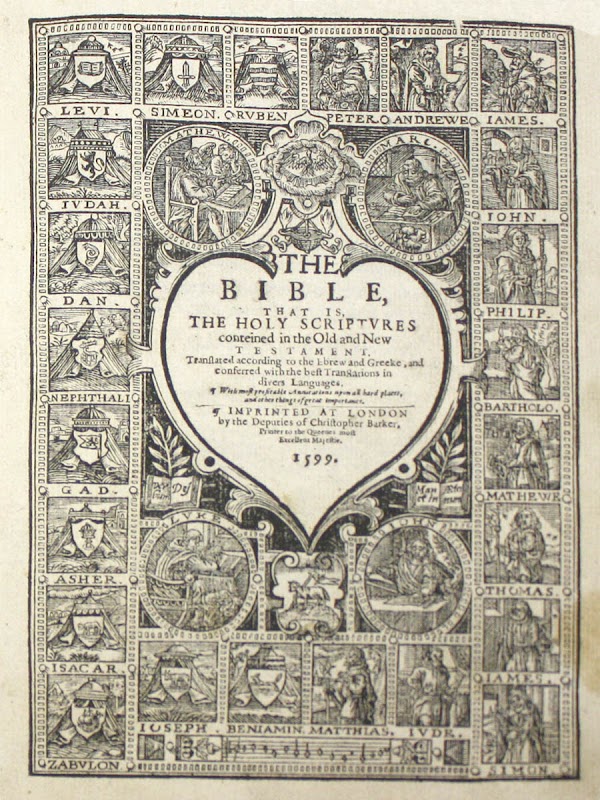
Geneva Bible title page
A Geneva Bible title page, published in London by John Barker in “1599.” That’s the date Barker put on all Geneva Bibles published after King James banned their production in 1611. Houston Baptist University

Tudor was a Roman Catholic. In part for political reasons, since her legitimacy as queen was based on it; in part for personal reasons, as she had been convinced by her Catholic family members she had to save England from the “heresy” of Protestantism. So Tudor started persecuting Protestants, particularly Protestants who had dared to translate the bible into English without Catholic permission. The persecution began with John Rogers, who had dared to revise the Tyndale Bible; he was burned to death in 1555. Protestant scholars decided it was safest to go into exile in a good Protestant country.

Since most educated Englishmen spoke French, where better than a French-speaking country? And since many of ’em were Calvinist, where better than the city Jean Calvin himself governed, Geneva? Several hundred Protestants thus became refugees in Geneva.

There were English-language bibles at the time, but not good ones. John Wycliffe's bible was only partially complete, and many Protestants still considered him heretic. William Tyndale made a pretty good translation of the New Testament, but he was also considered heretic, and executed for it in 1535. Myles Coverdale, who was neither a Greek nor Hebrew scholar, borrowed Tyndale’s NT, cobbled together an Old Testament from German bibles and the Vulgate, and published the Coverdale Bible in 1535; parts of it are still used in the Book of Common Prayer. And there’s that unfortunate John Rogers I just mentioned: He’d borrowed Tyndale’s NT, parts of Tyndale’s and Coverdale’s OTs, published it under the name “Thomas Matthew” in 1537, and it came to be called the Matthew Bible.

So since these refugees had time—and the resources of a whole lot of Protestant scholars who’d moved to Geneva under persecution—they decided to tackle a new bible.

29 May 2022

Jesus’s great commission.

Matthew 28.16-20 KWL
16 The 11 students go to the Galilee,
to the hill where Jesus first appointed them.
17 Seeing Jesus, they worship him—
but they hesitate.
18 Coming forward, Jesus speaks to them:
“All power in heaven and earth is given to me.
19 So go make students of every nation!
Baptize them in the name of the Father
and the Son and the Holy Spirit.
20 Teach them to retain everything I commanded you.
Look, I’m with you every day
till the end of this age.”
Previously:
  • “The resurrection in Matthew.” Mt 28.1-10
  • After Jesus was resurrected in Matthew, the angel told Mary and Mary to tell the other students that he’d meet them in the Galilee. In other gospels they didn’t believe the women, but Matthew skips all that: The students went right home to the Galilee.

    Did the Holy Spirit tell ’em where to meet Jesus? No idea. It’s entirely possible they guessed: “Well, where should we expect to see him? Um… how about where he first made us apostles? In Matthew that’s actually the hill where Jesus gave his Sermon on the Mount. Kind of a profound place, so sure, it stands to reason that’s where they should see him.

    Me, I figure Jesus would’ve shown up at any place they picked. Maybe at the beach where he first called Peter, Andrew, James, and John. Maybe his house in Capharnaum, or the synagogue. Maybe his mom’s house in Nazareth. After Jesus rose, the way the gospels describe him, he now appears to have the ability to appear and disappear—so he could reappear anywhere, right?

    But I admit there’s every chance we Christians have wholly misinterpreted this “new power” of Jesus’s. When Jesus became human he limited himself. He’s wholly divine, but gave up the power we typically associate with divinity. A number of us would really like to imagine the newly resurrected Jesus got some of his power back. But maybe he didn’t; maybe his “appearing” and “disappearing” isn’t some superpower that resurrected humans now have, but some supernatural ability any Christian can exhibit as the Holy Spirit allows. Remember, the evangelist Philip disappeared too. Ac 8.39

    Anyway, Jesus appeared to them on the very hill they chose, and that’s where he gave ’em what Christians tend to call “the great commission.” Frequently we capitalize it. I don’t; you know which great commission I’m talking about.

    25 May 2022

    Why the United States doesn’t control our guns.

    I have friends outside the United States who look at our rampant gun violence, notice how our mass shootings even happen on a daily basis, and wonder why in God’s name we do nothing about it.

    Two reasons. The first is Americans consider gun ownership a right. Not an option, not a privilege, a right. We even put it into our Constitution.

    Y’see in the 1760s and ’70s, the British occupying forces tried to take Americans’ guns away lest we start a revolution. (’Cause we were gonna.) Once we Americans got our independence, we became fearful lest the Brits, or any other government, try to take us over, or go too far to curtail our liberties. So we made gun ownership the fourth article of the Bill of Rights, which became our Constitution’s second amendment.

    A well regulated militia being necessary to the security of a free state, the right of the people to keep and bear arms shall not be infringed.

    Guns aren’t an obvious and inherent right. This is why the Congress had to spell out their justification for guns: If we’re gonna remain a free state, we need militia, armed civilians who can help our police and armed forces defend our homeland. Some folks assume our National Guard fulfills the role of a militia, but nope; guardsmen are part of the Army and Air Force, and not civilians. (As demonstrated whenever guardsmen are called in to stop civilian unrest.) The way we keep civilians at the ready, is we let ’em keep their guns. And make sure they know how to properly use ’em. So once people hear the British are coming—or the Soviets, the North Koreans, the Iranians, the terrorists, or whoever’s the boogeyman today—they can grab their rifles and fall in.

    Thing is, we Americans tend to describe our rights as sacred and God-given. In other words holy. With all the other baggage which comes with civic idolatry.

    Proper religion involves self-control, but civic idolatry means when we Americans get it into our heads that something’s a right, we treat it as an unlimited right. Zero control. No limits. Absolute.

    Fr’instance freedom of speech. We treat it like we can say absolutely anything, no matter how offensive, profane, or seditious. And should be able to say anything, without any repercussions from our neighbors or employers. That’s why we’re often stunned when there are totally repercussions: We lose jobs, money, status, or relationships over the dumber things we say. But what’d people expect would happen? Freedom of speech only means government can’t censor or censure us. Everybody else can.

    So that’s the very same way many an American gun nut looks at guns: The right to bear arms means we can own any gun we like, decked out with any accessories or ammunition we like, take it anywhere, and shoot anyone we perceive a threat. ’Cause it’s a right. Constitution says so, which makes it sacred.

    Now read the second amendment again. It describes our American militia as well regulated. Is it? Not in the slightest. Largely it’s not regulated at all.

    This is where the United States goes horribly wrong. If the amendment were scripture, we’d be guilty of taking it out of context. Our militia is unregulated, and whenever any politician tries to regulate it, the gun nuts scream tyranny. And the gun lobby has bought so many senators, nothing gets regulated. Nothing changes for the better. Hence the daily shootings.

    24 May 2022

    Doubt is our friend.

    You might’ve heard the following verse before.

    Matthew 21.21 NIV
    Jesus replied, “Truly I tell you, if you have faith and do not doubt, not only can you do what was done to the fig tree, but also you can say to this mountain, ‘Go, throw yourself into the sea,’ and it will be done.”

    Jesus says ἐὰν ἔχητε πίστιν καὶ μὴ διακριθῆτε/eán éhite pístin ke mi diakrithíte, “when you have faith and don’t hesitate,” though most translations follow the KJV’s lead and go with “doubt not.” Either way, people assume he’s contrasting opposites: Hesitation, or doubt, is the opposite of faith.

    So either we have faith or we have doubt—so have faith, and never doubt. Doubt is bad. Doubt is evil. Doubt is how the devil convinces us to never do as the Spirit wants.

    But in college I studied logic. (Hey, it’s a math class, and I wasn’t a fan of math, but logic sounded like something I could get into. Boy did I.) In logic I learned a lot of supposed “opposites” aren’t really. What’s the opposite of big? It’s actually not small. Big and small are contrasts, not opposites. A big coffee is not the opposite of a small coffee; both are coffee!

    Big faith isn’t the opposite of small faith either. Jesus told us even small faith, mustard seed sized faith, will do the job. Mt 17.20 Same with hot and cold, black and white, young and old, male and female. Especially male and female. They’re not opposites; they’re complements!

    The proper opposite of anything is its absence. The opposite of big is not big. Which could be medium, small, tiny, or even 3XL; what makes it opposite is it’s not what we want. Not what we’re looking for. And that’s not just something relatively smaller; it’s everything else. When it’s not as big as we want, it’s the opposite of big. “That’s not a ‘big.’ Get me a ‘big’!”

    Likewise the opposite of black is not-black. The opposite of young is not-young. The opposite of love is not-love. And the opposite of faith is not-faith.

    Now, if not-something has a one-word definition, we can probably say that’s a precise or true opposite. Fr’instance the definition of false is “not true,” so that’d truly make it the opposite of true. Likewise the definition of impatient is “not patient,” the definition of inconsiderate is “not considerate,” the definition of dissimilar is “not similar,” and the opposite of “inflammable” is… okay, that’s a tricky one.

    Does doubt mean precisely the same as “not faith”? Actually no. It means not enough faith. There’s still a little faith in there! There oughta be more. And sometimes there’s no good reason why we don’t have enough faith, ’cause we really oughta trust God more than we do.

    But sometimes we don’t have enough faith for a totally valid, very good reason: This isn’t a God thing.

    Yep. Sometimes it’s not. There are a lot of things which Christians claim are God things, claim are holy, claim are Christ Jesus’s expectations for his followers, claim are mandatory doctrines or mandatory practices. Are they? Well… we doubt. And it turns out we’re right to doubt.

    The reason we doubt is the Holy Spirit is making is hesitant. The Christianese term for this is, “I have a check in my spirit,” which usually means “I really don’t think we should.” True, sometimes we say this because of hypocrisy; we selfishly don’t wanna do something we should, and we’re trying to weasel out of it by claiming the Holy Spirit is warning us away. But sometimes it legitimately is the Spirit telling us, “Whoa there little buckaroo. That’s a cliff you’re heading towards.”

    Sometimes we call this supernatural discernment: We know something’s not right, don’t know why, but trust God enough to put things on pause. Other times it takes no revelation from God whatsoever; any onlooker can see this is all kinds of wrong. And we should practice the regular kind of discernment as well—though you’d be surprised and annoyed how often Christians don’t, and get suckered into all sorts of cons. Christians can be some of the most gullible people sometimes.

    Other times the Holy Spirit will obviously tell us, “No; don’t.” Ac 16.6-7 Won’t necessarily tell us why. Nor does he need to! We gotta trust him, y’know. But clearly the “doubts” we might have, aren’t always the product of doubting God. Sometimes they’re just the opposite. We doubt circumstances. We doubt fellow Christians. We doubt everything but God.

    It’s a great thing to have the sort of mountain-moving faith Jesus speaks of. It’s just as great to pay attention to our doubts, lest we attempt to move the wrong mountains. ’Cause doubt isn’t always our opponent! Often doubt is our friend.

    And few Christians have been taught this. Or even understand this. They’ve been taught Christians should never, ever, EVER doubt. Shove all those doubts out of your mind. Turn ’em off like a lightswitch. Suppress them. Fight them. Psyche yourself into believing.

    In other words, embrace denial. And because denial’s a lie, it doesn’t legitimately get rid of our doubts. Instead, denial unravels our faith and turns us into hypocrites.

    Y’see, whenever we Christians have doubts, our next step is to investigate. Confirm whether our doubts are valid. Find out whether there’s anything rock solid behind them, or whether we’re getting scammed by some Christian who only wants our money or loyalty. If these things are of God, they can absolutely hold up to scrutiny. If they’re not, they don’t—and the people trying to pull us in those directions get really angry, and all sorts of other fleshly behavior starts coming out of ’em.

    Use those doubts to get solid about what you oughta believe and who you oughta follow—and get closer to God.

    23 May 2022

    Relevance versus holiness.

    Relevance became a pretty big buzzword among young Christians in the late 1990s. I was one of those young Christians back then, so I’d hear it all the time: “If we wanna reach our culture for Jesus, we can’t be one of those old fuddy-duddy Christians who act like we were wrong to progress past the 1950s. We gotta be able to interact with people outside the popular Christian subculture—and not just to critique and condemn them. We gotta be relevant.”

    And no, this wasn’t just some clever reasoning we could use on old people whenever we went out and got tattoos. Well, okay, some of us went that route; but most of us honestly did mean it. The cultural conservatism of American Evangelical Christianity was making it impossible for us to share the gospel with our pagan peers.

    And by “impossible” I don’t just mean really, really hard. I mean impossible.

    Maybe you read my piece, “The limitations of legalists.” Maybe not; I’ll summarize anyway. Back in college I was trying to share Jesus with some pagans, and there was this conservative Evangelical who tried to insert himself into our conversation. To make him go away, I invited the pagans to a pub. Conservative guy’s tradition not only forbade alcohol, but even setting foot in a pub; shunning the appearance of evil y’know. It did the job and got rid of him.

    The reason I knew to pull this stunt with him, is because I used to be the very same kind of conservative Evangelical. I would never have set foot in a pub—and not just because I was underage. I would’ve presumed anybody who practiced pub evangelism was probably a rotten Christian. (Even though I was a big fan of C.S. Lewis, and he hung out in pubs all the time—which I justified to myself by saying, “Well he’s British,” and ignoring the fact Britain has a drinking problem. Not to pick on Britain; my own homeland definitely has a drinking problem too. But I digress.)

    See, if you don’t live in the Bible Belt, you gotta interact with (gasp!) liberals. Your neighbors and coworkers are often gonna be progressives who don’t bother to read the Moral Majority’s voter guides, and vote for the wrong party. How on earth are you gonna share Jesus with them? Many Bible-Belt Christians have told me they don’t even try anymore, and have abandoned them to the devil. But where I live, we don’t have that luxury… and some of them are so close to God’s kingdom, and all they need are a few nudges in the right direction.

    17 May 2022

    The “Forgive me” prayer.

    Part of the Lord’s Prayer is the line, “Forgive us our sins.” Or “Forgive us our debts,” or “Forgive us our trespasses”; it all depends on the translation. Jesus goes on: “As we forgive those who sin against/trespass against/are indebted to us.” It’s one line in the whole of the prayer.

    But there’s a whole category of prayer which consists of begging God’s forgiveness for sins. Sometimes it’s a part of a bargain with God—we wanna ask him for stuff, and we wanna first make sure we have a clean slate with him before we start negotiating. But most of the time it’s because we’ve sinned, we know it, we feel bad or guilty about it, and we wanna repent and get right with God.

    Emotions vary. Some of us get mighty weepy. Lying on the floor, mascara running, blubbering, sobbing, snot pouring out of our noses, and so forth.

    I’m not one of those. I’m the type which is really annoyed with myself for repeating the same stupid sins. Far less weeping; far more angry self-recrimination. Still others are upset, frustrated, embarrassed, exasperated, resigned, furious, woebegone… There’s no one way people feel, and they won’t always feel the same way every single time. But the one thing we have in common isn’t emotion, but unhappiness. We fell short of God’s glory. So we repent.

    (Well… some of us don’t repent. We don’t like being on the wrong side of God, and wanna rectify that. But we don’t really have any plan to change our behavior any. I’ll discuss that rotten attitude another time.)

    There are two ways Christians approach the “Forgive me” prayer. Some of us are just crushed by it. Others of us are blasé: “Hey, sin’s a part of life, and God knows I’m not perfect.” There are attitudes in between, but these are the main two extremes I find in Christians: Those who worry we’re taxing the limits of God’s grace, and those who take this grace way too much for granted. There’s a happy medium in there somewhere. That’s what we should seek. Sin should bother us… but God has us covered! 1Jn 2.1 So repentance shouldn’t be a regular meltdown. Grace should take away all the extremes, and leave us feeling sorry, but not bothered.

    16 May 2022

    The sepulcher guards.

    Matthew 27.62-66 KWL
    62 In the morning,
    which is [the Saturday] after preparation,
    the head priests and Pharisees
    assembled with Pontius Pilate,
    63 saying, “Master, we remember this imposter said while alive,
    ‘After three days I rise.’
    64 So command the sepulcher to be secured for three days,
    lest his coming students might steal him,
    might tell the people, ‘He’s risen from the dead!’
    and the last imposture will be worse than the first.”
    65 Pilate tells them, “You have a guard.
    Go secure it as best you know.”
    66 Those who go, secure the sepulcher,
    sealing the stone with the guards.
     
    Matthew 28.2-4 KWL
    2 Look, a great quake happens,
    for the Lord’s angel, which comes down from heaven,
    upon coming, rolls away the stone
    and is sitting down upon it.
    3 Its appearance is bright as lightning,
    and its clothing white as snow.
    4 The sepulcher guards shake in terror of it,
    and become like the dead.
     
    Matthew 28.11-15 KWL
    11 As the women leave, look:
    Some of the guards, coming into the city,
    report to the head priests everything that happened.
    12 Getting together for a meeting with the elders,
    taking enough silver to give the soldiers,
    13 the priests were saying, “Say this:
    ‘His students, coming at night, stole him as we slept.’
    14 And when this is heard by the governor,
    we’ll convince him, and you needn’t worry.”
    15 Those who took the silver, did as the priests taught,
    and spread this word throughout the Judeans
    until this very day.

    There’s some debate among Christians as to who these soldiers are. Did Pontius Pilate send his own soldiers to secure the sepulcher? Or were these Senate police?—the same guys who secured the temple for the priests; the same guys who arrested Jesus; the same guys who handled Senate security? When Pontius said, “You have a guard,” did he mean “You can have my guards,” or “You already have guards, and don’t need any of my guys”?

    I lean towards temple guards. Here’s why.

    13 May 2022

    Why Amazon is my favorite Christian bookstore.

    Unless you count all the mini-bookstores found in the larger churches, my hometown has only one bookstore. One. It’s downtown; it mostly sells used books.

    We used to have a Borders, a Crown Books, a Book Outlet, and multiple used bookstores. And a Family Christian Stores—which wasn’t so much a bookstore as a one-stop shop for all Christian. They had books, but they had even more Christian tchotchkes: CDs, shirts, toys, art for the walls. “Jesus junk.” Now we have just that one bookstore… and the book sections at Walmart, Costco, Target, the other department stores, and the thrift stores. (And the local library’s monthly book sale.)

    Why can’t a town of 102,000 sustain a new-books bookstore? Because those stores, for the most part, didn’t know what they were doing. They didn’t realize, till it was too late, their primary competition was Amazon—and that Amazon had ’em so beat, people would shop at Amazon while browsing their stores. I did it myself. I’d browse their stacks, find a book I was interested in, take down its ISBN, and look it up on Amazon. Guess who always had the better price.

    No, Amazon doesn’t pay me to sing their praises. Even though I link a lot of the books, movies, and albums I mention on TXAB to their website.

    I learned a long time ago, and keep seeing it: No matter the bookstore, Amazon offers a lower price on the same book. Even if the bookstore marked everything at 20 percent below the suggested retail price. Even when the books are on the clearance shelf at 60 percent off. Even when they’re in a $2 bargain bin. Even when I find ’em at Dollar Tree for $1.25. Amazon regularly has ’em beat.

    I’m not the only bookstore customer who noticed this. I’ve seen other customers browse the bookstore… then whip out their smartphone, compare prices, go with Amazon, and buy nothing from the bookstore but their coffee. If that. Too often Starbucks is cheaper.

    12 May 2022

    Unitarians: Those who insist God’s not three.

    UNITARIAN ju.nə'tɛr.i.ən noun. A person or doctrine which emphasizes God’s oneness, and rejects the doctrine of the trinity.
    2. [capitalized] A member of a church or group which asserts this belief.
    3. adjective. Having to do with this belief, or with unitarians.
    [Unitarianism ju.nə'tɛr.i.ən.ɪz.əm noun.]

    Christians correctly understand God’s a trinity. One God; three people (or “persons,” as theologians prefer, but it’s bad English) who are the one God. Well, most of us do; there are holdouts who insist he’s not. They tend to fall into one of two camps:

    • MODALISTS. Those who say the Father, Son, and Holy Spirit are God… but really all three of them are just one person. Not three people. Just one person in different modes.
    • UNITARIANS. Those who say the Father is God—and the Son and the Holy Spirit are not.

    People are more familiar with unitarians—mostly because there are entire unitarian denominations, like the Unitarian Universalists, the Unitarian Christian Church, and Unity Church. (The United States has even had four Unitarian presidents.) But that’s also because unitarianism is very obviously non-trinitarian, and very obviously denies Jesus is God. Whereas modalists will never say Jesus isn’t God. For that matter you’d likely never even know they were modalist… until you start asking ’em about trinity and they reply, “Well I really don’t like to use the word trinity to describe God…” then go on to explain why they say he’s not.

    The main difference, y’notice, is modalists believe Jesus is God and the Holy Spirit is God. Unitarians do not. Well, generally unitarians do not; some of ’em are kinda pantheist and believe everyone is God. But for the most part, they insist God is One: One person, one being, one heavenly Father (or Mother; some of ’em aren’t particular); our Creator, the Almighty, and infinitely good. And while they consider Jesus to be Lord and Savior and King, they don’t consider him God. Same with the Holy Spirit—although I’ve known a few unitarians who believe the Spirit is God, but like modalists, don’t believe he’s a different person than the Father. To them, “Holy Spirit” is just one of God’s titles, like when certain indigenous Americans refer to God as “the Great Spirit.”

    But unitarian doesn’t just describe Christians. Technically it describes everyone who believes in the One God, and doesn’t believe he’s a trinity. Most unchurched pagans figure there’s one God, aren’t so sure about Jesus, and know nothing about the Holy Spirit—and this description would mean they’re unitarian. Every Muslim would be unitarian: They definitely believe in one God, believe Jesus is a prophet but not God, and believe the Holy Spirit is a messenger of God but also not God. Religious Jews are unitarian, Sikhs are unitarian, Baha’is are unitarian.

    But if you’re unitarian and call yourself Christian, you’ve chosen to ignore the scriptures which reveal God as a trinity. Which puts you outside historical orthodox Christianity and makes you heretic. And here I gotta remind you heresy does not send you to hell—but it does greatly interfere with getting to know and trust God, so it always needs to be dealt with.

    11 May 2022

    By Law we’re good as dead—so live for Jesus!

    Galatians 2.17-21 KWL
    17 “While looking to be justified by Christ,
    if we’re found to be sinners ourselves,
    then isn’t Christ a servant of sin?”
    This ought not be said!
    18 For if I rebuild the things I destroy,
    I stand up for my own transgressive behavior.
    19 For I, through the Law,
    die to the Law so I can live for God.
    I was crucified with Christ.
    20 I no longer live. Christ lives—
    in me. He now lives in flesh.
    I live by faith in the Son of God, who loves me
    and hands himself over for me.
    21 I don’t reject God’s grace,
    for if rightness comes by Law,
    then Christ died for nothing.
    Previously:
  • “Paul and the apostles of note.” Ga 2.6-10
  • “Paul challenges Simon Peter.” Ga 2.11-14
  • “Being good justifies nobody. Nobody.” Ga 2.15-16
  • Paul’s academy trained him in Greco-Roman rhetoric, the art of speech and debate. Most of us don’t know how the Romans practiced rhetoric, so sometimes we struggle to follow Paul’s arguments, and come to some very different conclusions than he was trying to make. This is nothing new; few things are. Peter rebuked ancient Christians for doing the very same thing. 2Pe 3.14-15

    Anyway it’s why I translated verse 14 with quotes. Paul’s doing a rhetoric thing: He’s quoting what other Christians have said, and responding μὴ γένοιτο/mi ghénito, “This ought not [be said]!” Most bibles translate it some variant of the KJV’s “By no means”—this is an idea we oughta strongly oppose. It’s heresy.

    So apparently this is what certain early Christians were teaching, particularly the legalists in Antioch. “You claim you’re following Jesus. But you sin. Everybody sins. You shouldn’t, but you do. So are you saying Jesus is okay with your sins? It’s fine with him if you sin? He even endorses your sinful lifestyle? (Because certainly we would never say this.) You need to stop; Jesus can’t save a willful sinner.”

    To some degree we still hear this from today’s legalists. Yes, of course we’re to resist temptation and quit sinning—but they turn it into something we have to do lest we lose salvation. Lest we undo everything Jesus did for us. Lest Jesus himself reject us, because sin offends him so much, and he simply can’t work with people like us. It’s a mindset which entirely goes against Jesus’s stated practices in the scriptures, and of course grace. But that’s kinda to be expected of legalists.

    So Paul preemptively deals with this one: No it’s not okay to sin. Jesus doesn’t say that; Paul didn’t write that. Sin is still evil and wrong. But the fact Jesus works with and through sinful humans, does not mean he endorses sin, nor overlooks sin, nor did some behind-the-scenes jiggery-pokery which nullifies the Law and means nothing’s a sin anymore.

    What he did do, is kill our sin. Killed it on the cross with himself. Killed us on the cross with himself. Our penalties are paid for. Our debts are paid. Now follow Jesus.

    10 May 2022

    Hearing God. It’s vital!

    Prayer is of course talking with God: We talk to him and he talks back. It’s not a complicated idea—though Christians obviously overcomplicate it all sorts of ways.

    And because it’s talking with God—’cause he talks back—prayer is therefore the most common, usual way God communicates with people.

    Yep, even more common than bible. I know; I’m fully aware plenty of Christians claim bible is the only way God communicates with people. They believe this because it’s what they’ve been taught: “God doesn’t talk to people anymore, so stop trying to hear him and read your bible.” And hey, if you shut your ears to everything God tells you in prayer, in dreams, through prophets, or even full-on personal appearances, of course you’re gonna claim he only communicates through bible. It’s like someone who throws out their phone and computer, burns their mail, refuses to interact with anyone in person, and only communicates by carrier pigeon: Okay, guess we’d better get some carrier pigeons. God’s frequently willing to work around our ridiculous arbitrary rules. But for normal people, we pray and he talks back.

    I’m also aware there are Christians who insist they don’t hear anything. They’ve tried hearing God, but they got nothing. So they gave up and presume prayer is unidirectional: We talk, he hears, but he says nothing—’cause he doesn’t need to say anything, ’cause he said everything he cares to say in the scriptures. Such people are easily swayed into believing God only talks through bible. You can find whole churches full of people who claim they never, ever hear God in their prayers.

    But you’ll also find that’s what they tell you when other people from their church are around. In private, they’ll confess they did hear God once. Or twice. Or all the time.

    And hearing God is confirmed by the scriptures. All over the scriptures. ’Cause the guys who wrote the scriptures heard God, and they’re writing about other people who likewise heard God. The whole reason there are scriptures in the first place is because people hear God. Yeah, certain cessationists are gonna claim prophecy doesn’t work that way; that prophets opened their mouths, God took ’em over like a ventriloquist manhandles a puppet, and his voice came out of ’em. Or his words flowed from their pens. Whichever. But that’s more like the mumbo-jumbo we find among Spiritualists and pagan religions; it’s not at all how God works. The prophets came to God with questions—

    Habakkuk 1.2-4 GNT
    2 O LORD, how long must I call for help before you listen, before you save us from violence? 3 Why do you make me see such trouble? How can you stand to look on such wrongdoing? Destruction and violence are all around me, and there is fighting and quarreling everywhere. 4 The law is weak and useless, and justice is never done. Evil people get the better of the righteous, and so justice is perverted.

    —and God responds with answers.

    Habakkuk 1.5 GNT
    Then the LORD said to his people, “Keep watching the nations around you, and you will be astonished at what you see. I am going to do something that you will not believe when you hear about it.”

    (Followed by an answer they probably didn’t like at all—if you keep reading Habakkuk.)

    This is why prayer and prophecy is so closely connected: It’s how God gives prophets his messages for other people. We’ll ask God questions; he’ll give answers, and add, “Tell this to others.” ’Cause other Christians have the same questions, and God’s answer applies to them too.

    But of course if you don’t pray—or you think all your prayers are unidirectional—you’re not gonna get prophecies like this. Or have any prophecies in your church at all. Or you’ll have what your preachers claim are “prophecies,” but they’re all angry, political, fruitless, and otherwise inconsistent with God’s character.

    09 May 2022

    The resurrection in 𝘔𝘢𝘵𝘵𝘩𝘦𝘸.

    Matthew 28.1-10 KWL
    1 After sabbath, at dawn on the first day of the week,
    Mary the Magdalene (and the other Mary) comes
    to see the sepulcher.
    2 Look, a great quake happens,
    for the Lord’s angel, which comes down from heaven,
    upon coming, rolls away the stone
    and is sitting down upon it.
    3 Its appearance is bright as lightning,
    and its clothing white as snow.
    4 The sepulcher guards shake in terror of it,
    and become like the dead.
    5 In reply the angel told the women, “Don’t fear, you two:
    I knew you seek Jesus the crucified.
    6 He’s not here. He’s risen, just as he said.
    Come see the place where he was laid.
    7 Go quickly; tell Jesus’s students
    that he’s risen from the dead,
    and look, he goes before you into the Galilee.
    He will see you there. Mark what I tell you!”
     
    8 The two, leaving the sepulcher quickly,
    with fear and great joy,
    run to report to Jesus’s students.
    9 Look: Jesus meets them, saying, “Hello!”
    They come to him, grasp his feet, and worship him.
    10 Then Jesus tells them, “Don’t fear.
    Go. Report to my brothers
    so they can leave for the Galilee,
    and there they will see me.”

    Ordinarily in the synoptic gospels, if they share a story in common, Matthew and Luke typically use Mark as the main source of their information. It’s why the gospels sync up so well.

    But in the resurrection stories, they don’t sync up very well at all. Oh, they get the basics right. Jesus rises before dawn, the women get there first, there’s an angelic explanation of what just happened, and everybody’s freaked out because they weren’t expecting it—even though Jesus totally foretold it.

    The stories are all different because the writers of the gospels aren’t quoting one another anymore. They’re quoting four different people who were there. Tradition claims Mark gets its data from Simon Peter… though if that’s so, why didn’t Peter tell Mark about running to the sepulcher to see for himself? Lk 24.12, Jn 20.3-10 John of course is written by an eyewitness; we don’t know Matthew’s source (and no, it’s not the apostle Matthew; there are two Matthews); and we don’t know Luke’s.

    What we do know is Matthew and Luke chose to go with their independent sources rather than Mark—probably because they figured they had a better account. More details, perhaps. Mark does after all end with the women being told Jesus was risen… then drops the story. Hence other endings were added. Endings which ancient Christians much preferred.

    06 May 2022

    Abortion, and Christian conservatives.

    Abortion doesn’t come up in the bible. At all.

    Infanticide does. Many ancient cultures used to strangle or smother a baby after birth. Ex 1.16 Or drown it, either in a nearby river Ex 1.22 or the local bathhouse. The Romans were notorious for exposing their unwanted kids to the elements: If a patriarch didn’t consider their child healthy enough, or simply didn’t want another kid, he could order it to be abandoned in the woods, to die of exposure.

    The scriptures don’t specifically condemn such practices as murder… but neither do they treat ’em as if they’re not murder.

    Miscarriage does come up in the bible. Again, it’s not condemned as murder. But it’s not like the ancients didn’t know how to trigger a miscarriage. There were certain herbal poisons you could take, and a miscarriage would result. Sometimes the mother would die too, but them’s the risks. Since people didn’t care for these risks, what they usually went with was infanticide.

    Now there is a command in the Law which indicates God doesn‘t approve of triggering a miscarriage.

    Exodus 21.22-25 KJV
    22 If men strive, and hurt a woman with child, so that her fruit depart from her, and yet no mischief follow: he shall be surely punished, according as the woman’s husband will lay upon him; and he shall pay as the judges determine. 23 And if any mischief follow, then thou shalt give life for life, 24 eye for eye, tooth for tooth, hand for hand, foot for foot, 25 burning for burning, wound for wound, stripe for stripe.

    “Her fruit depart” implies a premature birth; “mischief follow” implies the baby is born dead, or dies. So the guy who punched the mother could merit a life-for-life penalty. Unless the judge or her בַּ֣עַל/baál, “master”—her patriarch, meaning her husband, father, brother, father-in-law, or whatever man had the care of her—had mercy, the perpetrator would be executed. Usually by her closest male relative, who was instructed to take vengeance in such cases. Nu 35.19

    Now obviously there are Christians who read this passage differently. They figure “her fruit depart” means of course the child died, and “mischief follow” actually means the woman had complications, which varied. Hence that list of “life for life, eye for eye, tooth for tooth,” etcetera: These were all the types of “mischief” which might follow. If the man knocked her eye out, he’d have to pay with his own eye. But if the man knocked her fetus out… he’d only have to pay a fine. Because a fetus doesn’t count as a life. And hey, they could always make another.

    So, some Christians are adamant this passage proves a fetus is a baby, and other Christians are adamant this passage proves just the opposite. Which one they go with, largely depends on their abortion politics.

    Because, like I said, the bible is mum on the subject of abortion.

    Not that people don’t try to read abortion into all sorts of verses. And frequently they take the scriptures out of context—because they’re not really interested in what these passages are actually about. They have an ax to grind. They’re entirely sure they’re right, and God has taken their side. True of most political issues, but abortion especially.

    05 May 2022

    Christians who don’t believe God’s a trinity.

    God’s a trinity. Jesus is God, his Father is God, and the Holy Spirit is God; yet there’s only one God, an idea which shoulda sunk in after read in the Old Testament about the Hebrews trying to worship multiple gods. Nope, there’s just the One God—and these three are the One God.

    And that’s a hard concept for a lot of people. It’s a paradox, and they simply can’t allow God to be a paradox: God is reasonable, rational, logical. Not impossible. And when we’re trying to explain our belief in God to other people, it’d help a whole lot if he didn’t sound impossible. So they downplay trinity as much as they can… and in some cases, dismiss it altogether. God, they insist, is not a trinity.

    Some of these people happen to consider themselves Christians. Sometimes really good Christians, as opposed to Unitarians who consider Jesus and his teachings to be optional. They actually strive to follow Jesus’s teachings. They just… don’t really care for the trinitarian idea. Lots of them lean more towards modalism, the belief God isn’t three people (or in theologian-speak, “persons”), but has different modes—and sometimes he’s the Spirit, sometimes the Father, sometimes Jesus.

    Problem is, modalism—and any other theory about God which denies the idea of trinity—is inherently flawed. We Christians didn’t just make up the idea of trinity. We found it in the bible. We tried to explain it, couldn’t, and came up with a doctrine which states what little we do know… and likewise what we can’t say trinity is, ’cause it goes too far, and it’d be wrong. God’s not a three-headed, three-bodied, three-pronged being. He’s not a committee of three gods which speak in union, like the Mormons posit. He’s not one guy with three personalities, like someone with dissociative identity disorder whose three alters happen to also be nice guys. He’s not working in three modes.

    These alternative ideas are wrong, and often so wrong it gets in the way of people’s relationship with God. (And may get in the way of their salvation.) That’s why we call ’em heresies.

    Of course people regularly, incorrectly think “heresy” means bad. (Usually ’cause certain cultish heretics are really bad people.) So they’re gonna be offended by my calling them heretics. “I’m no heretic. You are. You’re the heretic. Trying to get people to believe in three gods…” No I’m not; three gods is a heresy too.

    But okay, in the interest of fairness I’ll present their point of view. Generally they stick to five points.

    04 May 2022

    Levites: A tribe of priests.

    If you’ve heard of “the 12 tribes of Israel,” I remind you ancient Israel had 13 tribes, not 12. Yet the bible regularly, consistently refers to the 12 tribes, because it’s referring to the tribes which had land, which had territory we could see on a map, designating their borders and landmass. One of the tribes had no such territory. Just cities—which were located without the boundaries of the other tribes. The tribe wasn’t on the map, so it wasn’t listed with the 12.

    This tribe would be Levi, the descendants of Levi ben Israel, Jacob and Leah’s third son. He’s notorious for plotting with his elder brother Simeon to kill a Canaanite who raped their sister… and while they were at it, kill every last man in the rapist’s city. Ge 34 Jacob greatly disapproved of his homicidal sons, and as patriarch he could’ve totally punished them for it, but it seems he did nothing. The only thing he did was “bless” them by prophesying Simeon and Levi (really, their tribes) would be scattered.

    Genesis 49.5-7 NKJV
    5 “Simeon and Levi are brothers;
    Instruments of cruelty are in their dwelling place.
    6 Let not my soul enter their council;
    Let not my honor be united to their assembly;
    For in their anger they slew a man,
    And in their self-will they hamstrung an ox.
    7 Cursed be their anger, for it is fierce;
    And their wrath, for it is cruel!
    I will divide them in Jacob
    And scatter them in Israel.”

    Bible doesn’t say anything about them hamstringing an ox, so I can’t speak to that. Maybe it was something they did while murdering Canaanites; maybe it was some sick ’n twisted fun they had as kids—some kids get off on torturing animals, and it’s no surprise when they grow up to be mass murderers. But that’s pure speculation.

    In any event Simeon’s descendants, or tribe, were granted a territory which was wholly surrounded by Judah—and the Simeonites were eventually absorbed into that tribe. As for Levi’s descendants, the Levites (Hebrew לֵוִיִּי/Levyíy, or לֵוִי/Leví for short), they were granted cities, not territory.

    Seems rather harsh to curse Levi’s descendants for their murdery ancestor. But in fact this wasn‘t a curse. The LORD did this to designate Levi’s tribe—yep, the entire tribe—as his priests.

    Israel was God’s chosen people. Levites became the chosen of the chosen. They weren’t to become farmers (well, other than farming their own gardens), nor merchants, nor builders. Instead they were to worship God, maintain the worship sites, carry out God’s rituals, and otherwise help their fellow Israelis follow God. Priesthood, not land, was to be their birthright.

    So whenever we find the word “Levite” in the bible, it’s considered a synonym for priest.

    And of course Christianity has a parallel. Every Christian is likewise a priest.

    03 May 2022

    “Praying right.”

    Prayer is, as I’ve said, simply talking with God. But for many Christians, it’s a profound ritual which connects us with the divine… so that we can get stuff from him.

    This is why their focus is so much on effective prayer. On powerful prayer, and how “the power of prayer” can change one’s life. On appeasing God… as if he’s a petty human oligarch who won’t give us what we want unless we suck up to him in just the right ways, and if we get any one part of the ritual wrong, “Whoops! Didn’t do that right. No grace for you.”

    From time to time I get rebuked for “praying wrong.” For not being formal enough, not bowing my head, not closing my eyes, not being solemn enough (or at all; I have no problem making jokes with God), not taking my hat off. I remind you when the LORD first spoke to Moses, he never told him to remove his keffiyeh; only his shoes. Ex 3.5 But y’know, different cultures.

    The idea that we activate prayer through our good works, is of course crap. But popular crap. And because the people who practice this crap will actually get their prayers answered—not because they did the rituals right, but because God is good; it’s correlation not causation—they’re convinced the crap works. You’re never gonna change their minds about it. I’ve tried; I’ve failed.

    Since they are still legitimately talking with God, I figure that’s the important thing. Yeah they’re wasting their own time and effort in trying to talk with him “right,” and they unnecessarily agitate themselves over the rest of us who “boldly approach the throne of grace” He 4.15 i.e. approach God informally, ’cause we can, ’cause he’s Dad. But don’t let them bug you. Talk with God, and don’t fret at all about making sure you’ve prostrated yourself properly. He doesn’t care about that, and we shouldn’t either.

    02 May 2022

    The long ending of 𝘔𝘢𝘳𝘬.

    Mark 16.9-20 KWL
    9 [Rising at dawn on the first of the week,
    Jesus first appears to Mary the Magdalene,
    out of whom he had thrown seven demons.
    10 Leaving, this woman reports
    to the others who were continuing with Jesus,
    to those mourning and weeping,
    11 and they’re hearing that Jesus lives—
    and was seen by Mary!—and don’t believe it.
    12 After this, as two of them are walking,
    Jesus is revealed in another form, going with them,
    13 and leaving, they report to the rest.
    The rest don’t believe them either.
    14 Later, as the Eleven are reclining at table,
    Jesus appears, and rants against
    their unbelief and hard-heartedness,
    for people had seen him risen up,
    and they don’t believe it.
     
    15 [Jesus told them, “Go into the world
    and proclaim the gospel everywhere to every creature.
    16 Those who believe and are baptized will be saved.
    Those who don’t believe will be judged.
     
    17 [“Miracles will accompany the believers:
    In my name, people will throw out demons.
    People will speak in tongues.
    18 People will pick up snakes in their hands,
    and if anyone drinks poison, it won’t injure them.
    People will lay hands on the sick,
    and they will be well.”
     
    19 [So after Master Jesus’s speech to them,
    he’s raptured into heaven and sits at God’s right.
    20 Leaving, these apostles proclaim everywhere
    about the Master they work with and his message,
    confirming it through the accompanying signs. Amen.]

    This passage—often found in brackets in our bibles—is called the Long Ending of Mark. I already wrote about the Short Ending. Mark wrote neither of these endings. Some eager Christian, unsatisfied with the abrupt way Mark ended—or unhappy with the brevity of the Short Ending—tacked it onto Mark in the 300s or 400s. Speaking as someone who’s translated all of Mark, I can definitely say he doesn’t write like Mark.

    However. Even though Mark didn’t write it, it’s still valid, inspired scripture. Still bible. No, not because of the King James Only folks; they have their own reasons for insisting it’s still bible, namely bibliolatry. Nope; it’s bible because it was in the ancient Christians’ copies of Mark when they determined Mark is bible. It’s bible because it’s confirmed by what Jesus’s apostles did in Acts and afterward. It’s bible because it’s true.

    Those who insist it’s not bible, are usually Christians who insist it’s not true. And like the KJV Only folks, they have their own ulterior motives.

    29 April 2022

    Portable bibles.

    For convenience, we Christians oughta always have a bible on us, or near us. And now we technically do: We have phones. Our phones have web browsers. And those web browsers can easily call up Bible Gateway, or one of the other bible websites—and voilá, we got bible.

    But before phones with internet access became so ubiquitous, I encouraged Christians to get a portable analog bible. One they could always have on them, or carry with them. Not just stash extra bibles everywhere we usually go—like an extra bible at work, in the car, in one’s gym locker, and so forth. I’m talking about a convenient portable bible. I tend to get ’em pocket-size, and call ’em “tiny bibles.” But they don’t need to be tiny. Just portable.

    Yes, bible apps have kinda made the portable bible moot. Our phones are already portable, and they’re usually on our person. Plenty of women keep their phones in their pockets, not their purses (assuming they’re wearing pants, and their pants have decent phone-size pockets), so for many people our bibles are always on us. Always immediately accessible. More so than a portable bible.

    Still, I’m kinda partial to tiny bibles. Even though I read my bible app way more often than that tiny bible, I still stash a tiny bible in my duffel bag.

    28 April 2022

    Trinity: The paradox in the middle of Christianity.

    TRINITY 'trɪn.ə.di noun. The godhead as one God in three people: Father, Son, and Holy Spirit.
    [Trinitarian trɪn.ə'tɛr.i(.)ən adjective.]

    In the scriptures, from the very beginning of the scriptures, it’s strongly emphasized that YHWH, the LORD God of Abraham, Isaac, and Israel, is one. Israel was to have no other god.

    Deuteronomy 6.4-5 KJV
    4 Hear, O Israel: The LORD our God is one LORD: 5 and thou shalt love the LORD thy God with all thine heart, and with all thy soul, and with all thy might.
     
    Exodus 20.3-6 KJV
    3 Thou shalt have no other gods before me. 4 Thou shalt not make unto thee any graven image, or any likeness of any thing that is in heaven above, or that is in the earth beneath, or that is in the water under the earth: 5 thou shalt not bow down thyself to them, nor serve them: for I the LORD thy God am a jealous God, visiting the iniquity of the fathers upon the children unto the third and fourth generation of them that hate me; 6 and shewing mercy unto thousands of them that love me, and keep my commandments.

    One God. No other gods. Got that?

    Well, Israel didn’t always get that, which is why the LORD let their enemies conquer them, drag them off to Assyria and Babylon, and keep ’em there till it finally sunk in. After which, idolatry wasn’t so much the problem anymore; hypocrisy was. Still is. But I digress.

    Okay, one God. Till we get to the gospels, and the teachings of Jesus, and the rather obvious statements from the gospels that Jesus is actually, literally, YHWH. Jn 1.1 But, y’know, he’s now human. Jn 1.14 He came to earth and walked among his people, and explained who God is so we’d understand him better. Jn 1.18

    Yet Jesus talks about his Father, “whom you say is your God.” Jn 8.54 They’re two different people. But wait… wasn’t it spelled out in the Old Testament how there’s only one God? Weren’t the Israelis dragged off to exile because they refused to acknowledge this?

    Then Jesus talks about the Holy Spirit. He’ll pray to the Father, who will send us this παράκλητον/parákliton, “helper, assistant, advocate” (KJV “Comforter”) who’s gonna both dwell among us, and in us. Jn 14.15-17 It’s also made pretty explicit this Holy Spirit is likewise God. So there are three different people who are God. But wait… one God, right? Unless the Israelis got sent into exile for nothing.

    This idea of three people (or to use the way theologians much prefer to put it—and rebuke me all the time for not putting it—three persons) who are nonetheless one and only one God, is called trinity. And it’s the hardest concept in Christian theology. It’s brought far wiser men than me to ruin. It’s based on two ideas, both of which are absolutely true. And both absolutely contradict one another.

    1. There’s only one God.
    2. Three individual people—Jesus, his Father, and the Holy Spirit—are God.

    Got that? Good. Hold both ideas in your head at once. Accept and believe both. Never dismiss one idea in favor of the other, or try to explain away one by using the other. And there ya go. That’s the trinity.