16 March 2025

The earth’s salt.

Mark 9.43-50, Matthew 5.13, Luke 14.34-35.

If you’ve ever heard someone called “the salt of the earth,” usually they mean an ordinary but decent person. And no, that’s not what Jesus meant when he coined the phrase “salt of the earth”—or as I translated it, “the earth’s salt.” I’ve no idea how it evolved from a remarkable person to an unremarkable person. When Jesus uses it in his Sermon on the Mount, he means remarkable.

He means a flavor enhancer. Be the salt of the earth: Enhance it. Make it taste better.

Mark 9.49-50 KWL
49“Everything for the fire will be salted. Lv 2.13
50Salt is good—
when salt becomes saltless,
in what way will it season anything?
Have salt in yourselves:
Have peace with one another.”
Matthew 5.13 KWL
“You’re* the earth’s salt.
When salt is tasteless,
in what way will it salt things?
It’s good for nothing—
unless it’s thrown outside for people to walk on.”
Luke 14.34-35 KWL
34“So salt is good—
when salt is also tasteless,
in what way will it salt things?
35It’s useful for neither the ground nor the dungheap.
They throw it outside.
One who has an ear to hear: Hear me!”

09 March 2025

Beatitudes: Both awesome and awful.

Matthew 5.3-12, Luke 6.20-26.

Many of Jesus’s teachings are bunched together as the Sermon on the Mount in Matthew, and the Sermon on the Plain in Luke. They overlap a bunch, so I’m going through ’em together. Both of them begin with beatitudes.

Beatitude is an old-timey word for “blessing.” Most translations follow the KJV’s convention and begin each line with “Blessed are the…” as Jesus lists the sucky, not-so-great situation under which these folks are groaning. They’re poor. Mourning. Humble. Starving for justice. Merciful in a world without mercy. Pure-hearted in a dirty culture. Striving for peace where there’s nothing but rage and fear. Getting hunted down, mocked, slandered, driven out. These things sure don’t sound like blessings.

And let’s be blunt: They’re not blessings. Jesus is not blessing us with poverty, misery, injustice, no peace, and persecution. He’s telling us our Father intends to relieve the people suffering from these things. I’ll explain further, but first let’s get to the beatitudes in these two gospels.

Matthew 5.3-12 KWL
3“The spiritually poor: How awesome!
—the heavenly kingdom is theirs.
4Those mourning: How awesome!
they’ll be comforted.
5The gentle: How awesome!
—they’ll inherit the land.
6Those hungry and thirsty for justice: How awesome!
—they’ll be filled.
7The merciful: How awesome!—
they’ll be shown mercy.
8Those of clean mind: How awesome!—
they’ll see God.
9Those making peace: How awesome!—
they’ll be called God’s children.
10Those hunted down because of justice: How awesome!
—the heavenly kingdom is theirs.
11When people condemn you², hunt you² down,
say everything evil against you², lie,
all because of me: How awesome you² are!
12Rejoice and celebrate for your² great reward in heaven!
For they persecuted the prophets before you² this way.”
Luke 6.20-23 KWL
20Jesus, lifting his eyes to his students, says:
“The poor: How awesome!
—God’s kingdom is yours².
21Those hungry now: How awesome!
—you’ll² be filled.
Those crying now: How awesome!
—you’ll² laugh.
22When the people hate you², segregate you²,
condemn and throw out your² names as if evil,
all because of me: How awesome you² are!
23Rejoice on that day! Skip!
Look at your² great reward in heaven!
Their ancestors did likewise to the prophets.”

Yeah, you likely noticed I went with a much different translation of μακάριοι/makárihi than the traditional “blessed.”

03 March 2025

Don’t break up with unbelievers!

1 Corinthians 7.10-17.

When I was growing up, both Mom and my pastors taught us kids we shouldn’t date non-Christians. Because, God forbid, you were gonna fall in love with them, marry them, and now you were gonna have perpetual disagreements with your pagan spouse about religion. Then we’d have kids, and she’d of course object to me wanting to raise ’em Christian. Then she’d let the Jehovah’s Witnesses talk to her some morning, join them, and now I’d have to deal with all the heretic garbage they taught her. Or pick some other worst-case scenario; just imagine your spouse turns into a massive jerk… and presume you somehow won’t turn into one too.

Done? Good. I myself didn’t need to imagine any worst-case scenarios, ’cause I grew up with a Christian mom and an atheist dad, so I knew exactly what that looked like. Dad didn’t forbid us kids from going to church with Mom and becoming Christians, but he certainly wasn’t thrilled about it. And he especially wasn’t thrilled whenever he did something immoral—usually theft—and his Christian kids would object, and spoil his evil fun.

In the Roman Empire, divorce was widespread, and people did it for any and every reason. So if a Roman’s spouse got mixed up in some new gnostic religion, and was suddenly spending all the family’s money on it, and our hypothetical Roman wanted nothing to do with it: Divorce! Easy-peasy. Property gets divided, and you go your way with your money. And your spouse goes to temple with all their money, and leaves temple with no money, but at least you still got all your money.

Some of this attitude leaked into Jesus’s culture, and as a result a number of Jews likewise divorced for any and every reason. And certain Pharisee rabbis let them. This, despite the LORD telling Malachi he hates divorce. Ml 2.16 NKJV The rabbis would simply find a convenient loophole which permitted divorce in this instance… and could always somehow find a way to permit divorce in every instance. Human depravity is clever like that.

When Jesus was questioned about the issue, he said nope, divorce was never God’s idea. Moses permitted it “because of your hard-heartedness,” Mt 19.8 KWL i.e. your closed-mindedness; people won’t accept any scenario where divorce isn’t an option. Indeed Jesus’s own students came to him afterwards and objected Mt 19.10 —and Jesus said yeah, not everyone’s gonna accept this teaching. Mt 19.11 People should go into marriage expecting it to be lifelong, but they just don’t. They want, “just in case,” loopholes. We all want loopholes.

So some of the first Christians figured religion oughta be one of those loopholes, right? If a Greco-Roman pagan became Christian, but her spouse was a massive Zeus worshiper and wanted to stick with Zeusery, what was she to do? Especially if he demanded she come to temple with him, and couldn’t figure out why she couldn’t worship Jesus and Zeus, just like she worshiped Athena and Zeus, or Demeter and Zeus, or Artemis and Hera and Hestia and Zeus. Why’s Jesus so exclusive? What, are you monotheist now?

So that’s the cultural background to today’s scripture—namely, how Paul and Sosthenes addressed the whole pagan-spouse problem.

02 March 2025

The background of the Sermon on the Mount.

Matthew 5.1-2.

Jesus’s Sermon on the Mount begins in Matthew 5, where Jesus “went up into a mountain” Mt 5.1 KJV to teach his students (Greek μαθηταὶ/mathité, “pupil,” KJV “disciple”).

Matthew 5.1-2 KWL
1Seeing the crowds,
Jesus goes up, into the hill,
and as he is sitting down
his students come to him.
2Opening his mouth,
Jesus is teaching his students,
saying…

and he starts with the Beatitudes.

Y’notice my translation has “hill.” The original Greek text has ὄρος/óros, which can mean either “hill” or “mountain,” and the person (not necessarily St. Jerome) who originally translated Matthew for the Vulgate decided it meant montem, “mountain,” so that’s how Christians have historically interpreted it. That’s why it’s the Sermon on the Mount, not Hill.

Thing is, I’ve been to the Mount of Beatitudes in northern Israel, where Christian tradition says Jesus gave this sermon. It’s a hill.


A view of the Mount of Beatitudes from Capharnaum. See that domed building? That’s the octagonal Church of the Beatitudes, built by the Roman Catholics in 1938. Berthold Werner, Wikimedia

True, not everybody agrees what the difference is between a hill and a mountain. In English and American custom, a mountain is 1,000 feet above its surrounding geography. But of course if the locals are used to calling a nearby hill “the mountain,” state geographers might disagree, but it’s a mountain to the locals regardless. The same is true with the Mount of Beatitudes: Christians keep calling it a mountain, but it’s not. It’s only about 200m (about 650 feet) above Lake Tiberias (i.e. the Sea of Galilee). It’s actually 25m below sea level. Where I’m sitting in the Sacramento Valley, as I write this, I am at an elevation 31m above the Mount of Beatitudes. That’s how low of a “mountain” it is.

27 February 2025

The 𝘴𝘰𝘭𝘢𝘴.

Most movements have slogans; they help promote the movement. The Protestant movement is no different. When it began in the 1500s, the Reformers came up with slogans. Back then the international language of Christendom was Latin, so of course the slogans are all in Latin.

The three I’m writing about today are called the solas—because they all start with the Latin word sola. You’re probably more familiar with the masculine form of it, solo, which is also an English word and means the very same thing: Alone, only, unaccompanied, done by one person without assistance. Anyway, the three slogans are:

Sola fide, “by faith alone.”
Sola gratia, “by grace alone.”
Sola scriptura, “by scripture alone.”

In the 20th century, various Christians created two more slogans which they claim are also part of the solas: Solus Christus, “Christ alone”; and soli Deo gratia, “glory to God alone.” I have no problem with people coming up with new slogans, but they aren’t part of the original solas, so I won’t talk about them as much.

So… why am I bringing up some five-century-old Latin slogans? Because sometimes you’re gonna hear Christians quote them, talk about them, use them… and use them wrong. The early Reformers had specific reasons for coining these slogans, and we gotta know what they meant by them before we just quote ’em haphazardly.

And even if people don’t use the Latin words—if they use the English translations “by faith alone,” “by grace alone,” and “by scripture alone,” or translate ’em into any other language and teach Christians about ’em—again, let’s know what the Reformers meant by them.

26 February 2025

Do we perform sacraments or ordinances?

ORDINANCE 'ɔr.dɪ.nəns, 'ɔrd.nəns noun. Authoritative order or decree.
2. Religious ritual; particularly one ordained by Christ.
3. What Evangelical Christians call sacraments.

When I talk about certain Christian rituals, I call them sacraments. And you’re gonna find many Evangelicals really don’t like this word.

These folks think of “sacraments” as a Roman Catholic word… and some of them are a bit anti-Catholic… and some of ’em are extremely anti-Catholic. They still got a lot of hard feelings about the Catholics, dating all the way back to the original Protestant spats with Roman Catholicism. To them, “sacrament” has a lot of bothersome Catholic baggage attached… so they refuse to use it.

What do they call Christian rituals then? Well Evangelicals could just call ’em rituals, but for some reason we never really wanted to; it makes us think of dead rituals, or dead religion, which they’re not. Somehow the word “ordinances” caught on. Or “holy ordinances.” ’Cause Jesus ordained them.

The two ordinances which Evangelicals tend to single out, are holy communion 1Co 11.23-26 and baptism. Mt 28.19 Some of us also recognize Jesus also mandated foot-washing, Jn 13.14-15 but not every Evangelical lists it as an ordiance. Probably because they don’t wanna wash feet, which sorta merits its own article.

Anyway. Communion and baptism are definitely ordinances… and you’ll find Evangelicals tend to also practice all the other sacraments the Catholics do. They just won’t call them sacraments. Or ordinances, ’cause they figure Jesus didn’t ordain them. Although often the apostles did.

CATHOLIC
SACRAMENT
EVANGELICAL
EQUIVALENT
WHO
ORDAINED IT
BaptismBaptismJesus
ConfirmationConfession of faith at baptismPeter
EucharistHoly communionJesus
PenanceCounseling, confession, and intercessionJames
Anointing the sickAnointing the sickJames
Holy ordersLaying hands on people for ministryThe LORD, to Moses
MatrimonyWedding ceremonies9th-century Christians

As you notice, Evangelicals still anoint and pray for the sick. Still lay hands on people they’re sending out to do ministry. Still perform wedding ceremonies, funerals, and baby dedications. Still counsel and intercede for people. It’s just they won’t call these other things “ordinances” because they’re not the three ordinances Jesus gave us… and they’ll still try to avoid the word “ritual,” even though it’s precisely what we’re doing.

It’s all about “not doing as Catholics do,” even though we’re totally doing as Catholics do.

25 February 2025

Using your imagination to meditate.

When I was a kid there was a Japanese TV show called Aníme Óyako Gekíjo/“Anime Parent-Child Theater,” which Americans know better as Superbook. Christian TV stations used to air it every weekday. Your own kids are more likely to have seen the 2009 American remake.

In the 1981 original, two kids named Sho and Azusa discovered a magic bible which transported them, and their toy robot Zenmaijikake, back to Old Testament times. (Yeah, they all had different names in the English redub: Chris, Joy, and Gizmo.) The kids would interact with the bible folks, who somehow spoke Japanese instead of ancient Hebrew, and were surprisingly white for ancient middle easterners.


The kids, and their robot in the red galero, have a not-at-all-awkward conversation with a buck-naked pre-genitalia Adam and Eve. Aníme Óyako Gekíjo episode 1, “Adamu to Eba Monogatari”

Well in the first series they did. In the second series—also called Superbook in the States—Pasókon Toráberu Tántei-dan/“Computer Travel Detective Team,” the kids totally ignored the bible characters ’cause they were trying to rescue a missing dog. Which is best, I suppose: Less chance they’d accidentally change history, and whoops!—now we’re all worshiping Mammon, and Biff Tannen became president. (Well…)

Obviously we’ve not yet invented time travel, and it’s not possible to have any Superbook-style adventures. But a whole lot of us would love to check out the events of bible times, and maybe interact with it. It’s why there are bible-times theme parks in the Bible Belt, like The Ark Encounter or The Holy Land Experience, which Christians flock to. (Or, for about the same price, actual real-life Israel, which I far more recommend.)

But when time travel or pilgrimage are out of the question right now, it is possible to meditate on a story from the scriptures, by imagining ourselves there as it happened, imagining ourselves watching it as it took place.

Some Christians call this practice Ignatian meditation, after St. Ignatius Loyola, founder of the Jesuits. In his 1524 book Exercitia Spiritualia/“Spiritual Exercises,” Ignatius taught his followers to not just contemplate certain passages in the bible, like Jesus preaching in synagogue or temple, or teaching students, performing miracles, getting born, getting crucified, paradise, hell…. Instead, really mentally put themselves there. Imagine breathing the air. Feeling the weather. Hearing the sounds, smelling the smells. Being in these places.

The idea is to stop thinking of these events as just stories, but as real-life history. Stuff that truly happened. Stuff the prophets and apostles truly experienced. Stuff where God came near and interacted with humanity—same as he does now. Stop looking at them from the outside, and visualize yourself in the inside, in the bible, fully immersed in the story, just as you’re fully a part of God’s salvation history now.

Try this with the passages you’re reading now. Put yourself there, in your mind. See what new insights come out of it.

24 February 2025

Which of Jesus’s temptations came second?

Matthew 4.5-10, Luke 4.5-12.

In Matthew, the order of Jesus’s temptations is

  1. Stones to bread. Mt 4.3-4
  2. Jumping from the temple. Mt 4.5-7
  3. Bowing before Satan. Mt 4.8-10

And in Luke, it’s

  1. Stones to bread. Lk 4.3-4
  2. Bowing before Satan. Mt 4.5-8
  3. Jumping from the temple. Lk 4.9-12

The gospels are agreed that stones to bread came first, but not about whether bowing before Satan or jumping from the temple came second and third.

Does it matter? Not really. But if you’re a biblical inerrantist, and insist the bible has no errors, one of the gospels mixed up the order.

And if you’re a biblical inerrantist, you’re gonna downplay this fact as much as you possibly can. Because there’s no reasonable explanation for how one of the gospels isn’t wrong about the order of the temptations.

So instead… you’re gonna do the very same thing non-inerrantists like me do. You’re gonna say the order isn’t important. That the authors of the gospels likely put the temptations in the order they did, intentionally—because they were writing to different audiences, and wanted to emphasize different things. The author of Matthew wanted to move from near venues to far—from right there in the wilderness, where Jesus chose to fast; to Jerusalem, the capital of Judea; to the Roman Empire and the world. And Luke chose to end his version of the temptations story in Jerusalem, the epicenter of the Judean religion, to emphasize Jesus’s special relationship with his Father—“if thou be the Son of God,” Lk 4.3, 9 KJV as Satan kept saying.

And okay, this explanation might work for you. But back when I was a little kid, and my pastors and Sunday school teachers kept insisting the bible is inerrant, this explanation absolutely didn’t work for me. Kids are literalists! We knew—from the many times we tried to fudge the truth, and subsequently, correctly got in trouble for it—you don’t get to play fast and loose with the order of events when you tell a story. Parents, historians, cops, and courtrooms don’t allow it. Nor should they! So why does Matthew or Luke get to?—and how can you say the bible’s inerrant when you’re saying one or the other of them deliberately introduced an inaccuracy?

Nope, doesn’t work. That is, till you’re older, throw up your hands in frustration, and decide what the heck; we’re gonna accept that either Matthew or Luke changed the order around… yet still call ourselves literalists and inerrantists, because the Fundamentalists in our churches seem to be really insistent that we remain literalists and inerrantists. If we’re not, they might call us heretics, or get us removed from our ministries. So, best to keep up that appearance as best we can, and call ourselves literalists and inerrantists even though we’re not really.

Oh, and please don’t bring up Jesus’s two genealogies either.

21 February 2025

Typical TXAB correspondence.

Since I’m paying for TXAB’s domain name, I figured I may as well use it for my email address too. Problem is, whenever you post your email address on a website, people find it and send spam to it, and now most of my spam goes to that address instead of my personal email address. So if your comments get lost in my spam folder: Sorry! I try to fish them out.

Anyway it’s time I caught up on some correspondence, isn’t it? And today I’m gonna answer some of the emails I typically get.

Q. I love your blog! Would you consider linking to my blog? I really need to rise in search engine rankings. In return maybe I can make a small donation to you, or a ministry of your choice.

You really would not believe how often I get this request, or a variation of this request, from people who want to make a living by blogging. I turn them all down.

There are many ways to get a lot of traffic to your blog. My way has been to just keep generating relevant, informative content for 20 years. Works great! But I understand if you don’t have the patience for that… especially if you have a day job you’re kinda desperate to quit.

I have noticed certain blogs taking off big-time, and quickly, because the blogger wrote a book. I would recommend you do that. Find a literary agent, ask ’em if there’s anything on your blog that might make a good book, develop a whole book out of it, find a publisher who’s wants to produce and publicize it, and use your blog to help promote it. Watch the traffic pour in.

The downside: If your blog permits comments, you’re gonna spend a whole lot of time moderating comments. Lotta nutjobs out there! You might have to turn them off entirely, as I did. But if you have the time, and can filter out all the chaff from the wheat, your commenters can also attract people to your blog. There are a few sites that I visited regularly because the commenters were just as insightful as the writers.

Moving on!

20 February 2025

God’s names. (And a bunch of his adjectives.)

New Christians—and a bunch of us older ones too—tend to be fascinated by the fact God has a lot of different names.

No, I’m not talking about the different words for “God” in other languages: Theos, Deus, Dios, Diyos, Dieu, Dia, Dio, Zeu, Gott, Gud, Hudaý, Bog, Buh, Elohim, Allah, Ulah, Dev, Ram, Atua, Kami, Haneunim, and so forth. Those are neat too, as are the many different ways humanity has rendered “Jesus.” But people who are into that, are more into languages. Your average Christian is more into the many different things God is called in the bible.


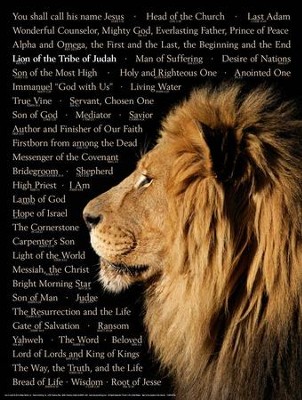
You can also buy a poster of a lion with a bunch of Jesus’s titles on it. ChristianBook.com

There’s “God,” of course. There’s “the Lord” or “the LORD,” depending on the original-language words we’re translating. There’s his personal name יְהוָֹה/YHWH, which we’ve turned into “Yahwéh” and “Jehovah”; and the Hebrew phrase it comes from, אֶֽהְיֶ֖ה אֲשֶׁ֣ר אֶֽהְיֶ֖ה/ehyéh ashér ehyéh, “I am who I am,” or “I Am” for short.

Then there are the adjectives which indicate which God we’re talking about God Almighty, God Most High, the Living God, the Mighty God, Father God, God the Creator, the God of Israel, God of Abraham, God of our fathers, and so forth.

And I haven’t even got to the titles yet. Like Ancient of Days, Alpha and Omega, Lord of Hosts, and so on. Go to your average Christian bookstore (assuming your local one hasn’t shut down, or moved to the internet) and they even have a poster covered in God’s titles. Suitable for framing, if you’re not a teenager but still like posters.

Bust out some Hebrew to go along with it, and some Christians will get sloppy with excitement. I can write articles about God’s attributes till my fingers go numb, but many a Christian doesn’t give a rip about theology: They just want easy ideas which they can meditate upon and come up with their own insights about. One of the easiest ideas to mentally play with is one of God’s names, so these folks just love God’s names.

There’s just something about them. Because, as many Christians teach, there’s power in God’s name. Jr 10.6 Power, power, wonder-working power. Power to break every chain, break every chain, break every chain.

But I should first point out these many names of God… are not necessarily what God names himself.

18 February 2025

Unanswered prayers.

Some months ago I was talking with a fellow Christian about unanswered prayers, and he said, “Y’know, there’s really no such thing as unanswered prayer. God answers every prayer. It’s just sometimes his answer is no. But that’s an answer!”

Okay, it’s true our “unanswered prayers” might be things God has legitimately answered—with no, or “not yet.” Stuff like “Come Lord Jesus” which he will answer, eventually.

But sometimes he legitimately has not answered certain prayers. ’Cause sometimes he says he’s not gonna answer them.

Micah 3.4 ESV
Then they will cry to the LORD,
but he will not answer them;
he will hide his face from them at that time,
because they have made their deeds evil.

Generally if you’re an unrepentant evildoer—if you’re sinning, you know you’re sinning, you know Jesus would have you do otherwise, you don’t care and aren’t sorry, you fully intend to continue sinning, and nothing God says or does will move you—I don’t think it’s realistic to expect God to heed you.

It’s like when Jesus warns us,

Matthew 6.14-15 ESV
14“For if you forgive others their trespasses, your heavenly Father will also forgive you, 15but if you do not forgive others their trespasses, neither will your Father forgive your trespasses.”

Jesus orders his followers to forgive, Lk 6.37 and Paul and Timothy advise us to forgive just as we ourselves have been forgiven. Cl 3.13 If we refuse to forgive, we’re defying Jesus—and if we defy Jesus, again, I don’t think it’s realistic to expect God to heed us. Especially if we’re asking his forgiveness.

I know, I know; I hear all the time from Christians who think God has to forgive every nasty thing they do, ’cause cheap grace. They wanna know how I can say God won’t forgive us, ’cause doesn’t grace mean he forgives absolutely everything? And yes, grace does mean that. But when you’re defying God and his Messiah, when you’re resisting his will, you’re also resisting his grace. You can’t get the grace when you reject the one who gives it!

It’s the same deal with unrepentant evildoers. If you reject the one who answers our prayers, why on earth or in heaven should we expect him to listen to our prayers? Makes no sense. But since when have humans ever made sense?—which is why unrepentant evildoers try to pray, get no answer, and think God’s the one at fault. Or that he’s not even there. Or other such nonsense.

17 February 2025

Stones to bread.

Matthew 4.3-4, Luke 4.3-4.

There’s a line in Lionel Richie and Michael Jackson’s 1984 hit song, “We Are the World,” which goes, “As God has shown us by turning stones to bread.”

As those of us who are biblically literate know, God never did any such thing in the scriptures. Now to be fair to Richie and Jackson, maybe God performed such a miracle for them personally… but I have my doubts. In any case neither of them, nor their producers, nor the roomful of pop stars they brought in to sing the song with them—which has to include people who were raised in church, right?—caught the error. Or convinced the producers to change it. So it’s still in the song. Aw well.

As we know, Jesus was tempted to do such a thing. He’d been fasting; he was hungry; Satan might’ve figured here’s an easy opportunity to get Jesus to fall for its “If you are the Son of God” taunt. Shouldn’t be hard at all for the Son of God to turn stones to bread, right? So that became the devil’s first temptation.

Matthew 4.3 KWL
Approaching, the tempter tells Jesus,
“If you’re the son of God, say something
so these stones might become bread.”
Luke 4.3 KWL
The devil tells him,
“If you’re the son of God, speak to these stones
so they might become bread.”

Back when I was a kid, I noticed something kinda obvious about this particular temptation: It’s not a sin for Jesus to turn stones into bread. There’s no commandment, at all, telling people to not do such a thing. There’s nothing ritually unclean about stones; there’s no command against eating them (though common sense oughta tell us to not do that); so if you turn a stone into bread, you’re not turning an unclean thing into a clean thing, then eating it. Jesus is neither breaking a command, nor going through a loophole, if he did such a thing. So… why was it wrong for him to do it?

Well duh; it’s the “if you’re the son of God” part. Jesus didn’t have to prove anything to Satan. Nor should he be that easy to manipulate, like a child showing off or an insecure president. Jesus knows exactly who he is… and frankly, it’s not a bad idea to keep the devil, who might have its own doubts, wondering. And underestimating him.

So Jesus did nothing, and threw a little bit of Deuteronomy back at Satan.

Matthew 4.4 KWL
In reply Jesus says, “It was written,
‘Not only by bread will humans live,
but by every word coming out of God’s mouth.’ ” Dt 8.3
Luke 4.4 KWL
In reply Jesus tells the devil, “It was written,
‘Not only by bread will humans live.’ ” Dt 8.3

And that’s that.

13 February 2025

We are not saved by our faith.

From time to time I’ll hear a Christian unthinkingly state we’re saved by faith. And I’ll correct them: We are not. We’re justified by faith. We’re saved by grace.

The usual response is they give me an annoyed look: Why are you correcting me?

Not that they disagree with me! They don’t. They’re aware we’re saved by grace. But they figure we’re saved by grace through faith—

Ephesians 2.8 KJV
For by grace are ye saved through faith; and that not of yourselves: it is the gift of God:

—so faith is in the formula somewhere; so they figure they’re not wrong either. That’s why they’re gonna forget what I just said about being saved by grace, and continue to say we Christians are saved by faith. I’m just nitpicking, and they don’t care.

In online discussion groups, I can’t see their annoyed looks in person, but I have no doubt they happen. And their usual response is to ignore my response. Again, they don’t disagree with me; they’re aware we’re saved by grace; but saved thorough faith, and is there any real difference between by and through anyway?

While most discussion-group folks will debate anything and everything at the drop of a hat, they never choose to debate my statement, “We’re justified, not saved, by faith; we’re saved by grace.” After all, it’s true.

There are rare exceptions—I think I only experienced two of ’em—where people respond, “Yes; I misspoke; we’re saved by grace.” The rest of the time, in a rare exercise of online self-control, they simply ignore the fact I said anything. They move along.

And I guarantee you they’re gonna say or write “We’re saved by faith” again.

Yet I persist.

12 February 2025

Pseudepigrapha: Influential ancient Jewish fanfiction.

PSEUDEPIGRAPHUM su.də'pɪ.ɡrə.fəm noun. A document definitely not written by the author it claims, nor in the time it claims. Sometimes fraud; sometimes just fanfiction.
2. A Jewish writing ascribed to one of the patriarchs or prophets of bible times, but actually written after 200BC.
[Plural, pseudepigrapha su.də'pɪ.ɡrə.fə noun; pseudepigraphic su.de.pɪ'ɡræ.fɪk adjective.]

The bible isn’t the only ancient Israeli book in history. Same as today—though certainly not in the same volume as today—tons of books were written, distributed, and became popular. And same as today, many were about God. Were they as Spirit-inspired as the bible? Nah. That’s why they weren’t included in the book collection which became our bible.

Well, most of them. There’s also apocrypha. Certain books were revered by certain churches, and got added to their bibles. Hence Ethiopian Christians have 81 books in their bibles, Orthodox Christians have 79, and Roman Catholics have 73. I’ve read most of their apocrypha; largely it’s good stuff. Good advice to follow; it’s like some of the better writings of Christian saints. Won’t hurt you to read it! But I don’t believe it’s as inspired as bible—same as the better writings of Christian saints. Good stuff, but is it infallible stuff? Meh; be wary.

Then there are the books to be really wary about, and that’d be the pseudepigrapha (Greek for “fake writings”). Whenever I write about Jewish mythology, these books are where these myths come from. They were popular in ancient Judea. Popular even in Jesus’s day. Jesus’s followers grew up hearing about ’em, even reading them.

There are even references to them in the bible. We have a full-on quote from one of ’em in Jude:

Jude 1.14-15 NET
14Now Enoch, the seventh in descent beginning with Adam, even prophesied of them, saying, “Look! The Lord is coming with thousands and thousands of his holy ones, 15to execute judgment on all, and to convict every person of all their thoroughly ungodly deeds that they have committed, and of all the harsh words that ungodly sinners have spoken against him.”

Jude wasn’t quoting the Old Testament, ’cause the OT has absolutely no Enoch quotes whatsoever. And no, Jude didn’t have any special revelation from God about what Enoch did or didn’t say. Jude was quoting a popular book, 1 Enoch, specifically this verse here:

1 Enoch 1.9
“Behold, he comes with myriads of the holy to pass judgment upon them, and will destroy the impious, and will call to account all flesh for everything the sinners and the impious have done and committed against him.”

The book was supposedly written by Enoch ben Jared, the great-grandfather of Noah the ark-builder. Somehow it survived the great flood, then 10,000 years or so of human history, then managed to not get into the Hebrew Old Testament and Septuagint, but leapfrogged them both and got into the Ethiopian bible.

Wait, Enoch wrote a book? No.

03 February 2025

“If you 𝘢𝘳𝘦 the son of God…”

In two of the three temptations the devil tried out on Jesus, Satan began them with the words, ܐܶܢ ܒ݁ܪܶܗ ܐܰܢ݈ܬ݁ ܕ݁ܰܐܠܳܗܳܐ/on bará anát d’Alahó, or as the Greek New Testament puts it, Εἰ υἱὸς εἶ τοῦ θεοῦ/ei yiós ei tu Theú, “If the Son of God you are.” The KJV renders this, “If thou be the Son of God,” and the GNT goes with “If you are God’s Son,” but most of us know it as, “If you are the Son of God,” as the ESV, NASB, NIV, NKJV, NRSV, and other popular translations put it.

Matthew 4.3 NIV
3AThe tempter came to him and said, “If you are the Son of God…”
Matthew 4.6 NIV
6A“If you are the Son of God,” he said…
Luke 4.3 NIV
3AThe devil said to him, “If you are the Son of God…”
Luke 4.9 NIV
9B“If you are the Son of God,” he said, “throw yourself down from here.”

The devil skipped it when it was tempting Jesus with the kingdoms of the world… which kinda makes sense. “If you are the Son of God, bow before me.” Really doesn’t work. So you can see why it skipped those words in that particular temptation. But it’s in the other two.

Okay, so why’d Satan think those particular words were gonna prod Jesus to fall for its temptations?

Well you gotta remember what happened to Jesus just before the Spirit had him go to the wilderness. He had his relative John baptize him in the Jordan, and the skies open up and a voice said, “This is my beloved Son.” God publicly declared Jesus his son. And of course Satan wanted to sow a bit of doubt in Jesus’s head: “Y’know, maybe you’re not.”

Worked on Eve. Ge 3.4-6 Maybe it’d work on Jesus?

27 January 2025

Jesus’s 40-day fast.

Matthew 4.2, Luke 4.2.

Whenever we see people fast (and usually pray; they kinda go together) in the Old Testament, they’re either mourning, repenting, or strongly petitioning God. But after the Spirit sent Jesus to the wilderness to be tempted, we see Jesus fasting—

Matthew 4.2 KWL
Fasting 40 days and 40 nights,
Jesus is famished afterwards.
Luke 4.2 KWL
…to be tested by the devil 40 days.
Jesus is eating nothing in those days,
and is famished by the end of them.

—and we know he’s not repenting, for he has nothing to repent; we’re fairly sure he’s not mourning; so most Christians figure he’s strongly petitioning his Father. He’s about to have a Satan-encounter, and even though he expects to win (’cause come on; he’s God) he gave up his omniscience when he became human, and doesn’t know what Satan’ll bring to their meeting. So the best thing anyone can do in that circumstance, is pray up!

And it definitely wouldn’t hurt to fast. Well, hurt spiritually. With some obvious exceptions, like hypoglycemia, you’re gonna physically be fine till the second hunger pangs kick in. Then you’re gonna be weak. But this isn’t a physical battle anyway; it’s not like that scene in C.S. Lewis’s novel Perelandra, in which Ransom literally has to beat the devil-possessed Weston to death. That was messed up; that was based on the fleshly limitations of Lewis’s imagination. Jesus knows better than to think physical force stops a spiritual one. Fasting is actually a way of renouncing physical force: We make ourselves weak so that God can make us spiritually strong. We use the Spirit’s fruit of self-control to pursue the Spirit all the more.

That’s why Jesus fasted: He wanted to be overprepared to overmatch the devil. So he deprived himself, and as the scripture says, he was famished afterwards. But in his spirit, he was mightier than ever.

22 January 2025

False knowledge, and how it’s confused with faith.

There are plenty of people who “just know” things.

And man alive, are they frustrating. Y’see, they can’t tell you why they know what they do. They don’t know where they got their knowledge, nor what it’s based on. Not that it matters where they got it: They believe it. You can’t tell them any different.

But they’re wrong. It’s false knowledge.

I’ll tell people something they’ve not heard before, and they’ll respond—whether in Sunday school, my classrooms, or the workplace—

THEY. “Why, what you’re saying can’t be true, for I know different.”
ME. [patiently] “Well your knowledge is wrong. Relax; we’re all wrong sometimes.”
THEY. “Nope; can’t be. I know this.”
ME. “Okay, maybe I’m wrong. So prove your case. Show me why you’re right.”
THEY. “Don’t need to. I know I’m right.”

Every once in a while they’ll really try to prove their case. Turns out there’s a thousand holes in their reasoning. Easy to see, easy to chip away at. But they can’t see the holes. And don’t really care there are holes; it doesn’t matter if they prove their point; they know they’re right.

It’s not that they actually believe what they do for logical reasons. Humans aren’t logical. We believe what we do because we find it convenient to believe it. Helps when it’s actually true. But even when it’s not, people will push aside all evidence to the contrary, grasp at any evidence they can find in their favor, and believe what they please anyway.

Certain Christian apologists call this behavior “postmodernism.” It’s not. (If anything, postmoderns are frequently the ones demanding, “Prove it.”) Not that postmoderns aren’t just as guilty of this behavior: Everybody does it. Moderns, postmoderns, everyone. It’s not a worldview thing, not a cultural thing, not a political thing, not even a sin thing. It’s a human thing. We’re comfortable with our beliefs, and don’t wanna change ’em, even if there’s plenty of evidence to the contrary. Change is too inconvenient.

I had to be trained to not think this way. First journalism school, then seminary: We were taught to question everything. Everything. My first journalism professor was fond of saying, “If your mother tells you she loves you, check it out!” Which sounds ridiculous at first… but you do realize there are a lot of dysfunctional mothers out there, who have very distorted definitions of love. Turns out she might not love you; whatever she’s feeling is neither khecéd nor fílos and agápi. Shouldn’t have presumed; now you see why your relationship is so f----d up.

There are naturally skeptical people who automatically question everything. Or so it appears; there are certain beliefs they take for granted, and you’ll find ’em once you drill down far enough. They might be nihilistic about a lot of things, but at their core they’re pretty sure they’re right about a number of things. Cogito ergo sum, at least.

But more often people are comfortable with the knowledge they believe they have, and are willing to trust it. Their minds are made up. Doesn’t matter which way the evidence points: There’s no higher authority than their minds.

It’s why people refuse to believe in climate change, or in an ancient earth, or insist humans are inherently good (regardless of our obvious depravity). Conversely it’s also why people believe in connect-the-dots theories and conspiracies. And it doesn’t matter how much evidence we have of a screw loose in their reasoning: They’re right. They know so. Can’t tell ’em otherwise.

In 2005 Stephen Colbert famously labeled this phenomenon as truthiness—that people believe what they do because they feel it’s true, rather than know it’s true. (And to a large degree it’s also because they feel it’s true; these “facts” are possessions or creations of theirs, so there’s a lot of selfishness bundled with ’em.)

True, false knowledge has a lot of similarities to truthiness. But unlike truthiness, it’s usually borne from apathy. People believe as they do because change and repentance take more effort than they care to spend.

It’s like fact-checking a headstone. My grandfather’s headstone actually has his first and middle names reversed. But nobody bothered to spend the money to fix it. And nobody’s gonna. Cemetery records, and eventually genealogies, are gonna have his names flipped for ages to come, all because nobody cares enough to fix the error. False knowledge has just this kind of effect on real knowledge… and often a much bigger impact.

So yeah: Truthiness has a lot of feelings involved in its practice and propagation. False knowledge has no such feelings. Gets propagated all the same.

21 January 2025

God doesn’t owe us anything for fasting.

I’ve pointed out fasting is a great way to focus our attention on God so we can pray better, hear him better, and develop our self-control.

But no, I don’t guarantee you’ll grow in all these ways when you fast.

All things being equal, you probably will. But as you know, there are lots of ways people can bollix our own growth. If we’re fasting, yet the rest of our lives are just as sinful as ever, why should we expect anything to change whatsoever? And yet Christians do: “I’m fasting! That should count for something.”

The Hebrews did it too, y’know. They’d fast, then make prayer requests ’cause they believed fasting would show the LORD they were serious, and it’d move him a little faster. It’s why Jehoshaphat told Jerusalem to fast so God might rescue them from invaders, 2Ch 20.3 and why Esther asked the Persian Jews to fast before she petitioned the king. Es 4.16 But because God acted on the petitioners’ behalf in these stories, Christians get the idea fasting always makes God move. They’ll claim this is “the biblical principle of fasting”: If you fast, God’ll answer prayer, and give you revelations.

But no it’s not a “biblical principle.” The idea that fasting always makes God move, is based on works righteousness, the idea God we can earn God’s favor through good deeds and acts of devotion. So if we’re good, God supposedly owes us one; if we’re super good God owes us a lot. And supposedly religious acts and rituals can cancel out any evil deeds: If I’m stealing from my workplace’s cash drawer, saying a few hundred Hail Marys oughta work it off, right? What’s the going exchange rate, a buck per hail?

In reality there is no biblical principle of fasting. Because in the bible, the LORD never commanded anyone to fast. Ever. The bible contains no teachings about what fasting does, why it’s important, and how often we oughta do it. The one teaching it does have on fasting is when Jesus tells us to not be hypocrites about it, and do it privately instead of publicly. Mt 6.16-18 The rest of Christianity’s teachings on fasting come from tradition: From fellow Christians’ experiences with fasting, and how it benefited them; and how it personally benefited us when we tried it.

But anyone who claims fasting unlocks God’s promises, and now he owes us stuff: They didn’t get that from bible. They got it from a corrupt Christian tradition, if anything. It’s not so. God owes us nothing. His kingdom runs on grace, not quid pro quo. He grants us grace and prayer requests and revelations because he loves us, not because we racked up enough heavenly frequent flyer miles to get a trip to Belize.

He tends to grant these things to active followers, not because we’re actively following, but because what good would they be in the hands of people who aren’t actively following? Such people will just squander his gifts, and be of little to no help to his kingdom. It’s not merit; it’s pragmatism.

So when we fast, is God obligated to do more for us than usual? Not at all. He tends to, but that’s only because Christians who fast, tend to love Jesus and follow him otherwise.

20 January 2025

The Holy Spirit sent Jesus to be tempted.

Matthew 4.1, Luke 4.1-2A.

In the Lord’s Prayer, Jesus tells us to pray that God not lead us to temptation. Mt 6.13, Lk 11.4 I don’t know whether he included that because God led him to temptation—and he didn’t wanna repeat the experience, and he didn’t wish that on his followers either. But you do realize that particular part of the Lord’s Prayer was answered with “No” in this particular instance: The Holy Spirit led Jesus into the wilderness to be tested by Satan. God—’cause the Holy Spirit is God, remember—led him into temptation.

Matthew 4.1 KWL
Then Jesus is led into the wilderness by the Spirit,
to be tested by the devil.
Luke 4.1-2 KWL
1Full of the Holy Spirit,
Jesus comes back from the Jordan.
He’s being led by the Spirit into the wilderness
2Ato be tested by the devil 40 days.

When we pray this particular part of the Lord’s Prayer, we need to keep Jesus’s temptation in mind. Because sometimes God will put us into circumstances where the devil’s gonna try to derail us. If we’re seriously following Jesus, and in so doing seriously mucking up the devil’s plans, of course Satan’s gonna try to put a stop to us. And the fastest way is to get us to stop following the Spirit and start following our selfish human nature.

Happens all the time. Christians create million-dollar ministries, then start thinking, “I’m a CEO; shouldn’t I get paid like a CEO; shouldn’t I get to live like a CEO?” and start feathering their nests and living luxuriously, instead of putting all that money into God’s kingdom and living reasonably. And plenty of mammonists, plenty of Christians who covet wealth and the things of this world, will come up with plenty of godless reasons why they not only can live like that, but should. Nevermind the fact it’s undermining their character, their witness, their ministry, their ability to hear the Spirit, their relationship with Jesus; that this money could help needy people, and these “CEOs” are nowhere close to needy. Nevermind that they’re robbing the poor, and in so doing, they’re robbing God. But I digress.

Appealing to our selfish human nature is Satan’s favorite tactic. Heck, it’s not just Satan who uses it; everybody tries it. Everybody wants to know what we covet, so they can sell it to us, or manipulate us by it. Why do you think social media companies are trying so hard to keep us on their sites—and when we’re off their sites, track our every movement on the internet? They wanna sell us stuff. Their plans are more benign than malevolent, although the more guardrails they remove, the more malevolence is gonna happen. But that’s what we see throughout Jesus’s temptations: The devil tries three times to appeal to Jesus’s selfish human nature.

And Jesus resisted. Kinda easily. Because he doesn’t have a selfish human nature. He’s got the original human nature; the one Adam and Eve had before they sinned. Plus he has something Adam and Eve coulda gained, but never did, because they sinned long before they could develop it: He’s got God’s nature. And God’s not selfish. Thanks to that divine nature, Jesus immediately identifies those appeals to his flesh, dismisses them as stupid and wrong—and punctuates his dismissals with Deuteronomy quotes. Jesus knows the Law, and never ever broke it.

When the Spirit led Jesus into temptation, Jesus was totally ready for it. Arguably he’s always been ready for it. Yes, he fasted for 40 days once he got there, to try to steel himself against temptation even further. I’ll write about that another time. But there’s nothing at all wrong with over-preparing yourself for spiritual battle. You don’t just wanna win by the skin of your teeth; you wanna win decisively. You want that devil reluctant to challenge you again, ’cause losing so bad to a lowly human embarrasses it in front of all the other devils on the playground.

15 January 2025

Universalism: Isn’t God gonna save everybody?

UNIVERSALIST ju.nə'vər.səl.əst adjective. Believing all humanity will (eventually) be saved.

Generally, pagans believe good people go to heaven, and bad people to hell. There’s a minority among them who believe there is no hell—not even for genocidal maniacs; everybody goes to the same afterlife, and if you’re a westerner that’d be heaven. There might be some karmic consequences to the afterlife, like you might find yourself in the suckier part of heaven; but it’s all heaven, so it’s not that bad.

The reason many pagans believe this, is because they believe the universe is benevolent, or believe God is love. Which he is! 1Jn 4.8 And he does love everyone; “for God so loved the world” Jn 3.16 and all that. So they figure a loving God would never throw people into hell, especially for something so minor as not believing in him—which is an honest mistake, most of the time. Hardly sound loving of God to toss someone into hell simply because they were born in a part of the world where they were never taught God properly, be it North Korea, Nepal, Mali, or Mississippi.

Now I agree God’s unlikely to smite people for honest mistakes. But I also seriously doubt the bulk of humanity’s mistakes are honest ones. Face it: Lots of us embrace our God-beliefs purely out of convenience, pragmatism, or selfishness. That Iranian who’s never gonna hear the gospel: He already wouldn’t listen to it if offered. If he honestly wanted to hear the gospel, it doesn’t matter what filters his nation puts on the internet; he’d track down Christians (there actually are some in Iran) and ask questions. Or Jesus might personally appear to him, as he does throughout Christian history, beginning with Paul. (No, that wasn’t just a one-time deal.)

Or that American whose parents raised her a militant atheist: No matter how skeptical and free-thinking she claims to be, she honestly doesn’t wanna challenge her parents’ claims, and examine whether there’s anything to this God stuff. If she did, the first miracle she experienced would shatter her atheism like a cinderblock through safety glass.

Honest mistakes are like Calvinism: People try to defend God’s sovereignty, go overboard, and wind up teaching God’s secretly evil. But if they’re honest mistakes, these people are nonetheless pursuing God despite their errors. And the Holy Spirit’s still producing love and patience and kindness in them, and still letting ’em into his kingdom. (Unless they’re only pursuing clever arguments, producing no fruit, and wind up some of those poor souls who’re mighty shocked Jesus doesn’t recognize ’em. Mt 7.23) The whole “honest mistakes” cop-out is a convenient excuse to ignore God, avoid obeying him, and dodge religion, church, and Christians.

It’s a risky little game they’re playing, for Christ Jesus says not everyone’s getting saved.

Matthew 7.21-23 GNT
21“Not everyone who calls out to me, ‘Lord! Lord!’ will enter the Kingdom of Heaven. Only those who actually do the will of my Father in heaven will enter. 22On judgment day many will say to me, ‘Lord! Lord! We prophesied in your name and cast out demons in your name and performed many miracles in your name.’ 23But I will reply, ‘I never knew you. Get away from me, you who break God’s laws.’”

That’s the people who really thought they were Christian. How much chance does the “honestly mistaken” nontheist have? Well, God is gracious, so we’ll see.

Though God absolutely does wants everyone saved, 1Ti 2.4 he knows full well many people want nothing to do with him. Nor his kingdom. They don’t want saving. Since God did create ’em with free will, he permits them to tell him no. He won’t force ’em into his kingdom. They don’t have to enter. But man alive are they gonna hate the alternative.

13 January 2025

Trying to tempt Christ Jesus.

Mark 1.12-13.

I’ve lost count of the sermons and articles I’ve read about Jesus’s temptations by Satan in the wilderness… and how this was supposedly a cosmic struggle for the ages. And I find every single one of ’em ridiculous. Because seriously: Do any of you—does anyone—imagine there was any chance whatsoever of Jesus giving in to the devil’s temptations? Does anyone think Satan had a chance? Had the smallest of chances?

Okay granted, if you don’t know Jesus, or if you’ve never read about him in the gospels and Revelation, I could understand thinking his temptations might’ve been a threat. Popular culture has this idea in its collective head that Satan is a mighty demon, big as a kaiju, capable of all sorts of elder-god world-destroying activities. It’s all rubbish; Satan’s been padding its resume ever since humanity found out it exists. Unwitting Christians have been helping it along, ’cause if Satan’s a big deal, but Jesus can effortlessly defeat it, doesn’t that make Jesus an even bigger deal? As if our Lord creating the universe Jn 1.3 isn’t impressive enough.

Look, Jesus has the sort of iron willpower it took to suffer torture and crucifixion—even though at any instant he could’ve called upon more than 60,000 angels, Mt 26.53 put a stop to everything, and skipped forward to his second coming. He’s got a divine nature, and an unfallen human nature. Meaning it’s not in his nature, at all, to sin. When presented with a tricky situation, humans get tempted to sin, and no doubt Jesus did too—but Jesus immediately dismisses any such sins as ridiculous. Sin is simply not him. He doesn’t do sin. Has no hold on him. Never gonna happen.

So were Jesus’s temptations in the wilderness anything remotely like a cosmic battle? Nah. Satan pitched some ideas, and Jesus easily dismissed them. Like spitballs bouncing off the hull of a battleship.

Some preachers get annoyed when I say this. Partly because they’re big fans of the cosmic battle idea. Partly because we get tempted, and it’s kind of a cosmic battle to us!—and how in the world can we claim that Jesus understands what we’re going through, because he was tempted too, He 2.18 if those temptations barely tempted him at all?

Simple: If Jesus can easily dismiss the devil’s temptations as silly and irrelevant, so can we. We can learn to resist temptation like he did. He’s given us the ability—if we take advantage of it.

The idea Jesus’s temptations were a cosmic battle, gives us the false idea that resisting temptation is impossible, and the only reason Jesus could dismiss Satan so easily is because Jesus is almighty. Certainly we’re not almighty, so when Satan tempts us, we’re boned. But like I said, that’s a false idea. We don’t have to be almighty to resist the devil. We only have to follow the Holy Spirit. And resist the temptation to blame our weak wills on everything but our unwillingness to resist.

So let’s look at how Jesus resisted the devil, and then let us resist.

09 January 2025

The body, soul, and spirit.

When I was a kid, my church taught me that God’s a trinity; Father, Son, and Holy Spirit; three persons, yet one God.

And they taught me we humans are kind of a trinity. That is, humans have a body, a soul, and a spirit. God made us in his image; Ge 1.27 therefore just as he is a trinity, so we are trinities.

Except… well that’s entirely wrong, isn’t it? God is three persons, but we humans aren’t three persons. Even those of us with dissociative identity disorder aren’t three persons. I have a body; that’s not a different person than my soul nor my spirit. I’m one person, not three.

If anything, my body, soul, and spirit are three parts of me. For now, anyway; when I die, my body will be dead, and either decay, or (I hope) be immolated in an awesome Viking funeral. My spirit will go to paradise. And my soul, my lifeforce, will cease to exist until God resurrects me… in a new immortal body.

One can say, and many Christians have, that my spirit is the core of who I am. ’Cause unless Jesus returns before I die, at some point my body and soul will be gone. Dead. Will cease to be. But my spirit will continue to exist; there will still be a me in the universe.

I digress though; this article isn’t really about the afterlife. It’s about the three bodyparts I have—which all humans have—which lead Christians to claim we’re all mini-trinities, all inferior trinities (inferior because we’re not actually trinities), all trichotomies—or as my pastor likes to put it, “tripartite beings.” One being, one person, three parts.

Trichotomy is a really popular Christian view, largely because God is a trinity, and Christians love to imagine we have three parts because God has three “parts.” Even though God’s three parts are three whole persons… and since Jesus is human, that’d make him a trichotomy too, with his own body, soul, and spirit. (The other persons don’t have bodies. Mormons claim the Father does so have a body, but let’s ignore them. But this’d mean the Father and Spirit are bipartite, with souls and spirits, right? Complicated.)

Now, if you’ve never been taught this trichotomy idea, you’ll likely fall into a view that’s more of bichotomy, to coin a word: We humans are both physical and spiritual. We have bodies and spirits. Yes we have souls, and depending on which Christian you’re speaking to, a soul is either part of our body (’cause it is our lifeforce), or part of our spirit. Various Christians claim “soul” and “spirit” are interchangeable, and don’t see any difference between them.

Me, I do recognize there’s a difference between soul and spirit… yet I lean towards bichotomy. The soul’s what makes us a living being, Ge 2.7 and without it we’re a dead being; a dead body. So it’s a part of my body. Same as my nose, my arm, my liver, my brain. It’s as mortal as my body, which decays to dust, or is burnt to ashes. Whereas the spirit returns to God who created it, Ec 12.7 who determines what’ll happen next to me. Jesus said resurrection, Jn 11.25-26 so I’m going with that.

07 January 2025

Prayer for spiritual maturity.

The fastest way to grow in spiritual fruit and spiritual maturity, is prayer.

I know; there are a number of works on fruit and maturity, and all of ’em recommend we grow that stuff by practicing it. You wanna be more loving, love people. You wanna be more gracious, work on your kindness. You wanna develop more self-control, practice self-control; start with small things and work your way up. Learn by doing. And that’s not bad advice, but it only gets us so far. If we wanna get farther, we gotta talk to the Holy Spirit who grants us the power to grow fruit. We gotta pray.

What do we tell the Spirit? The obvious: Grant me good fruit. Remind me to practice good fruit instead of my usual knee-jerk reactions. Show me where the opportunities lie to practice it. Show me where I’m missing those opportunities—places in my life where I should obviously recognize I can be more loving, gentle, peaceful, but for whatever reason I’m overlooking those things. Rebuke me if you gotta; snap me out of it.

Yep, we gotta pray for our own spiritual growth. Because we’re showing the Spirit we’re onboard. We want to grow. (And if we kinda don’t wanna grow—because we’re immature, of course—we need to ask him to change our attitudes about that.)

We can’t just presume the fruit will grow on its own, just because we’re Christian, just because we have the Holy Spirit. It can, but if we never take the initiative, it’ll either grow slowly… or, if we’re resistant to what the Spirit’s trying to do, we’ll stifle it from even growing at all. We gotta do more than simply permit the Spirit to do his thing, or generically tell him, “Lord, have your way in me,” like we sing in popular worship songs. He doesn’t want passive followers anyway. He wants us to tell him, “Lord, let’s do this! Make me more like you.”

And telling him is, of course, prayer. Telling him often, is a good basis for a prayer life. Asking for his help regularly, is a good basis for a life dependent on the Spirit’s leading. If you were ever wondering how certain Christians always seem to have something to pray about, this is how: They’re actually doing the work, and they’re naturally asking for help. Join them!

03 January 2025

Awful people who are privately Christian.

I originally wrote this piece in 2017, and titled it “Christians in private, but reprobate in public.” I had to update it a bunch ’cause I have some new thoughts on the matter.

Back when I first wrote on the topic, a few correspondents were surprised by the very idea of people who were publicly jerks, but nonetheless identify as Christian. Since then, they’ve finally recognized plenty of examples of the phenomenon. Celebrities who act like divas and brats and unholy rage monsters, but if anyone dares to say anything they consider blasphemous, they instantly object ’cause they’re Christian all of a sudden. Or if you ask them about religion, they’ll claim they love Jesus. Or when they’re accepting Grammy awards for singing about promiscuous nooky, first they wanna give a shout-out to their “Lord and savior Jesus Christ,” whom you’d never imagine they follow, considering their lifestyles. They don’t publicly follow him any, but they’re huge fans. Huge.

Particular stand-outs are those politicians who love to argue, and slander their counterparts in the opposition party, and say vicious things to anyone who gives them pushback. And sometimes they have vile things to say about immigrants, minorities, people of other states, fans of other football teams, or anyone who just rubs ’em the wrong way. And considering how often you see ’em on the Sunday morning chat shows, it’s unlikely they’re ever at church. But whenever they gotta claim Jesus to score some political points, and maybe get some Christian votes, they’ll loudly and proudly claim they’re Christian. Still, you’d never have guessed so by their fleshly behavior.

I have coworkers who are this way. They’ll talk about all the drinking and smoking and fornicating they plan to do over the weekend. They’re unethical. They’re filled with fear, hatred, and anger. They get envious, jealous, and partisan. Try to pick fights; try to cause division; try to create enemies. Y’know, stuff which indicates they’re not gonna inherit God’s kingdom. Ga 5.19-21 But if one of our athiest coworkers dares to condemn Christianity, suddenly they wanna fight ’em on behalf of the Jesus they never actually follow.

That, I will regularly point out to people, is the world we live in today. People who clearly don’t know and don’t follow Jesus, yet think they’re one of his.

I could blame it on decades of Evangelicals insisting they’re not religious, ’cause Christianity is a relationship not a religion. They’re entirely right about not being religious, but entirely wrong about Christianity not being a religion. As I’ve often said, if we don’t get religious about our relationships with Jesus, that relationship’s gonna suck.

I could blame it on the fact that, because they’re not religious, they rarely pray, they never go to church, never read their bibles, and have no idea what Jesus teaches. Or that they even need to follow him. They figure they said the sinner’s prayer as children, and once saved always saved, so actually obeying God might imply they don’t trust their faith to save them. Hence their utter lack of good works and good fruit.

If we call them on this, half the time they’ll object to us even judging them; the one bit of bible they do know is “Judge not,” even though they don’t truly know what Jesus means by it. The rest of the time they’ll shrug: Why are we so worried about their sins? They said the sinner’s prayer; they go to confession; they’re forgiven, so they’re good! Piss off.

They think they belong to Jesus. Do they? Maybe; maybe not. God is way more gracious than I am, and he might let ’em into his kingdom regardless. But the apostles do say those who produce fleshly works like they do are not getting into God’s kingdom, and Jesus himself says plenty will claim to be his at the End, but he doesn’t know ’em. Seems we’ve met these people.

02 January 2025

Taking God’s amazing grace for granted.

CHEAP GRACE tʃip greɪs noun. Treatment of God’s forgiveness, generosity, and loving attitude, as if it’s nothing special; as if it cost him little; taking it and God for granted.

Whenever I bring up the subject of cheap grace, some ignorant Christian invariably objects: “Grace is not cheap.” Even if I’ve fully explained in advance what I mean by “cheap grace”; even if I’ve written an entire essay like this one, defining the idea.

Every. Single. Time.

It’s a knee-jerk response. They were taught all their lives how grace isn’t cheap at all; how it cost Jesus his life. So whenever someone brings up the subject of cheap grace, they’re offended, therefore emotional, therefore irrational, about it: “Grace isn’t cheap!” Someone tweets a comment about cheap grace, and they tweet right back, “Grace isn’t cheap!” Someone uses “cheap grace” in a sentence, and they wait for the very first chance to interrupt: “Grace isn’t cheap!”

YES. I KNOW. I’M TRYING TO MAKE THAT POINT. I WOULD IF YOUD LISTEN. So can you please practice some self-control just this once, and give me a minute? Okay? (Betcha I’m still gonna get these comments regardless. You just watch. Ugh.)

Adam Clayton Powell Sr. gets credited with coining this term, and if you think it came from Dietrich Bonhoeffer, it’s only because Bonhoeffer went to Powell’s church and got it from him, then popularized the heck out of it in his The Cost of Discipleship. It’s used to describe “grace” whenever this grace is misdefined and malpracticed by irreligious Christians. As Bonhoeffer put it,

Cheap grace means the justification of sin without the justification of the sinner. Grace alone does everything, they say, and so everything can remain as it was before. “All for sin could not atone.” The world goes on in the same old way, and we are still sinners “even in the best life” as Luther said. Well, then, let the Christian live like the rest of the world, let him model himself on the world’s standards in every sphere of life, and not presumptuously aspire to live a different life under grace from his old life under sin. […] Cheap grace is not the kind of forgiveness of sin which frees us from the toils of sin. Cheap grace is the grace we bestow on ourselves.

Cheap grace is the preaching of forgiveness without requiring repentance, baptism without church discipline, communion without confession, absolution without personal confession. Cheap grace is grace without discipleship, grace without the cross, grace without Jesus Christ, living and incarnate. Bonhoeffer 44-45

That’s cheap grace: Taking expensive, valuable, amazing grace, and demeaning it by using it as a free pass to sin. Taking God’s safety net, and bouncing on it for fun like a trampoline.

Part of the reason people object to the term “cheap grace” is they don’t like to see God’s generosity taken so casually like that. Well, me neither.

Part of it’s ’cause they don’t believe God’s grace actually can be cheapened. No matter what we do with grace, it’s still awesome, still worthy, still priceless. It’s like when you accidentally drop your phone down a porta-potty: Doesn’t matter how foul that commode is; they’re making some really expensive payments on that phone, so they’re going in up to their armpits to fish it out. (Although yeah, some people would never. Because they’re rich, and buy $1000 phones as stocking stuffers, and would casually pay $1000 to avoid touching poo-poo. The rest of us have real jobs. But I digress.) Grace is far more valuable than any phone, and has inherent worth, so nothing could cheapen it.

If that’s the way you imagine grace, I get why you’d balk at the concept of “cheap grace.” But I’m not describing the grace itself, nor devaluing it. I’m describing the crappy attitude people have towards it. When they treat it like it has no value, that’s cheap grace. If you wanna call it something different, go right ahead. “Cheap grace” has already caught on, which is why I’m using that term.

01 January 2025

An irreligious religion.

RELIGION ri'lɪ.dʒən noun. Worship of a superhuman controlling power, whether a personal God or impersonal universe.
2. Particular system of belief and worship, as demonstrated through actions and declarations.
3. A supremely important pursuit or interest, followed as if worship.
[Religious ri'lɪ.dʒəs adjective.]

A significant part of authentic Christianity is religion, the actions we do as part of our worship of God.

Christianity isn’t just an internal belief system. Or at least it’s not meant to be. I’m entirely aware plenty of Christians believe all sorts of things about Jesus, and claim to have a close personal relationship with him… but these folks have a certain disconnect in their lives where you can’t tell they have any personal relationship with Jesus by their actions. Or their words. (Particularly not their words on social media.) Or their attitudes. Or their finances. Or anything; they may as well be pagan for all we can tell.

If you’ve read James, you’re aware when our faith in God doesn’t transform us one iota, what good is it? Such a “faith” is what James called dead. Jm 2.26 It’s surely not alive.

Yet for a lot of Evangelicals in the United States, religion has been a bad word for as long as they can remember. It’s because to Evangelicals, “religous” doesn’t mean any of the things in the definition I gave at the top. It means, instead, traditional. Namely the old-timey church traditions which they consider meaningless, which Christians do to look devout, but it doesn’t bring ’em any closer to God. Like songs and rote prayers they’ll sing or recite, but they never think about the words in ’em, and don’t mean ’em anyway. Like giving charity and tithes and doing good deeds, but they do that stuff because they’ve always done that stuff, and they never even think about God when they do ’em; it’s just habit. It’s “just what we do.”

The proper term for religious activity on autopilot, is dead religion: Actions we don’t actually do in faith or obedience, don’t actually do as worship, and therefore don’t do anything to bring us closer to God. Works without faith.

Now, if we explained what this religous activity is about, and why we do it, might it become living religion? Sometimes! I’ve known people who grew up Catholic, or Lutheran, or Baptist, who just go through the motions and never think about why they do as they do. I’ve also known people who became Catholic, or Lutheran, or Baptist, and they wanted to know why these churches do as they do, and they love that their churches do that. Sometimes they even revive their fellow church members. Sometimes not, ’cause their fellow church members have zero interest in coming to life. But for the newbies, and for any revived fellow Christians, their activities are living religion.

Problem is, Evangelicals assume everything they call “religion” or “religious” is the dead stuff. Dead religion is religion. So they avoid religous practices and rituals and customs and traditions. They don’t do anything. Except maybe attend church, read the bible, and pray. Little more.

And if they do anything more, they might help out their church. Go to bible studies and their church’s small groups. Learn some bible trivia. Learn Christian apologetics so they can argue about Christ with their pagan coworkers. Learn some theology so they can understand God a little bit better (and leap to the false conclusion they now understand God perfectly, but that’s another rant). Read some End Times books so they can understand that a bit better (and again, leap to the false conclusion they totally know what’s coming; again another rant). Memorize bible. Learn some Christian history, but not too much. Learn some ancient Hebrew and Greek words, but not enough to translate anything (and leap to the false conclusion every popular bible translation is wrong, but they’re not; yep, that’s another rant too).

They’ll do all that stuff—some of which would actually, accurately be called religion. Studying bible and learning more about God is legitimate religous activity. So’s pitching in at your church. So’s interacting with fellow Christians. So are good deeds.

But of course these Evangelicals would never call any of this stuff religion… ’cause to them, “religion” only refers to the dead stuff.

That’s what Evangelicals mean whenever they sing Darrell Evans’ 2002 song “Fields of Grace.” Third verse:

🎵 There’s a place where religion finally dies
🎵 There’s a place where I lose my selfish pride
🎵 Dancing with my Father God in fields of grace

One of my previous churches used to sing this, and a number of folks would give a big whoop right after we sang, “religion finally dies.” Not because they’re disobedient, uncharitable, irreligious people; again it’s because “religion” to them was dead religion, and they’re so happy to be done with the wasteful hypocrisy. As does Evans, I expect, when he sings this.

Again, nevermind the letter of James.

James 1.26-27 NASB
26If anyone thinks himself to be religious, yet does not bridle his tongue but deceives his own heart, this person’s religion is worthless. 27Pure and undefiled religion in the sight of our God and Father is this: to visit orphans and widows in their distress, and to keep oneself unstained by the world.

The word the NASB translates “religious” and “religion,” θρησκὸς/thriskós, is so obviously translated “religion” that it’s rare you’ll find a bible translation which doesn’t go with “religion.” (I’m also pretty sure bible translators, who usually know the proper definition of “religion” anyway, make a point to use the word so we can point to James and say, “Look, there’s good religion and bad; let’s not dismiss all religion as bad.”)