25 August 2020

Kings.

So I wrote about how human government in the bible started with patriarchy. So where’d kings come from? Simple: One powerful patriarch got all the other families in the area to acknowledge his rule and his family’s rule. Maybe by bullying and conquering them. Maybe by doing them massive favors, like rescuing them from raiders, helping them survive famine, Ge 47.13-26 building a walled city and letting ’em live in it, being the priest of the local god; stuff like that. Hence we see kings all over the bible.

Properly defined, a king is simply a hereditary ruler. Nothing more. ’Cause every so often I hear some preacher claim the Hebrew word מֶ֑לֶךְ/melékh, “king,” means something more different or profound than Eurasian or African or Pacific kings. Sometimes ’cause they notice it’s a similar word to מַלְאָךְ/malákh, “angel,” and think there’s a connection there. There’s not. There is no deeper meaning to melékh; it means “king” whether it’s describing Israeli kings, Canaanite city-state kings, Moabite and Edomite client kings or puppet kings, Egyptian pharaohs, Babylonian empire-builders, or even the LORD himself. It’s a hereditary ruler. The only differences between one king or another are any constitutions which limit their power, the size of their kingdoms, and their own character and attitude about governance.

Other than the first king in the family, kings didn’t earn their position, didn’t merit it… or, bluntly, steal it through conquest or coups. They inherited it, ’cause their dads were the previous kings, designated them as successor, and the kingdom became their birthright. They could be utterly unfit to govern others… as is usually true throughout human history. Designated successors (or as we nowadays call them, crown princes) had the awful habit of not thinking of the kingdom and its people as their duty, and their leadership as service, but as possessions and slaves. It’s 180 degrees different from God’s attitude in his kingdom.

19 August 2020

The Sermon on the Plain.

My translation of the Sermon on the Plain.

I don’t know whether Jesus preached this as a whole other sermon from the Sermon on the Mount, or whether Luke heard a short version of that sermon… or whether Matthew heard a long version of this sermon. My guess is Jesus gave the same sermon lots of times; shorter or longer versions depending on the location and audience. So this is kinda the short version.

Same as the Sermon on the Mount, I translated it so I could study the original text in greater depth. Feel free to read it in other translations. Compare them to one another so you can see the translators’ consensus—and that gives you a better idea of what Jesus means, than simply reading one “best” translation. Then follow him; not us translators.

18 August 2020

The text of the Sermon on the Mount.

My translation of the Sermon on the Mount.

No, not so I can have my own spin on it, or an “authoritative text” to work from; that’s not how translation works. I translate so I can study the original text in greater depth. If you translate so you can frame it to suit yourself, stop it.

Feel free to read it in other translations. Compare them to one another so you can see the translators’ consensus—and that gives you a better idea of what Jesus means, than simply reading one “best” translation. Then follow him; not us translators.

And the best way to follow him is to follow his sermon, as he himself taught in verses 7.24-27.

The Sermon on the Mount.

When people read the New Testament, they usually go to Matthew, the first book. So their first real introduction to Christ Jesus’s teachings is the Sermon on the Mount. As, I would argue, it should be. I suspect that’s the reason the ancient Christians listed Matthew first among the gospels—not the shortest gospel, Mark, nor the longest, Luke, but the one with the Sermon in the Mount in it.

Evangelists will regularly tell newbies to read John first. I get why; John’s prologue spells out precisely who Jesus is, and what he’s come to earth to do. It’s a great book for talking about Jesus’s divine nature, and our salvation. But now that we’re saved, how are we to live? What are the good works God has in mind for us? Ep 2.10 Duh; Sermon on the Mount.

It’s three chapters of solid Jesus. If you’ve got a copy of the bible which puts his letters in red, the Sermon is three solid-red chapters, entirely consisting of instructions on how Jesus expects his followers to interact, treat others, and follow him. Pretty challenging instructions, too.

A little too challenging for a lot of Christians. For some newbies it’s a punch in the face. This is what Jesus expects of us? Righteous behavior? Self-control? Radical forgiveness? Integrity? Total faith in God? No double standards? In fact higher standards than the most religious people we know? Christ Almighty!

Some of us figure, “Okay,” and give it a shot. Try to follow it as best we can, all our lives. And grow as Christians really fast.

But historically most Christians look at the Sermon, balk, and try to find loopholes which get ’em out of it. Exactly like the Pharisees whom Jesus criticized so often.

Irreligious Christians still claim Jesus rebuked Pharisees because they were legalists—and they’re not legalists; they obviously don’t follow Jesus’s teachings all that closely. (If at all.) Legalism’s bad!

Yes, many a Pharisee was guilty of legalism. Selective legalism. You’ll notice when you read the gospels, every time Pharisees got legalist it was so they could evade their duties to God. They didn’t help the needy six days a week for one excuse or another, and on sabbath the excuse was, “Oh, it’s sabbath; I gotta observe sabbath.” It’s pure hypocrisy, and Jesus openly called ’em on it. Irreligious Christians who “fear legalism” commit the very same hypocrisy. They simply don’t wanna follow Jesus—and if the “fear of legalism” can be used as an excuse, that’s their excuse.

The results of their irreligion have been the five most common ways Christians choose to interpret the Sermon on the Mount. You’ll notice the first four are hypocritical attempts to weasel out of it. And of course, the fifth is to actually be Christian, and follow Jesus.

15 August 2020

Christianism.

CHRISTIANISM 'krɪs.tʃən.ɪz.əm noun. A socially-approved worldview and belief system which claims to be Christian, but is not taught by Christ Jesus.
[Christianist 'krɪs.tʃən.ɪst adjective.]

I use the word Christianist an awful lot in this blog. Lemme ’splain why.

There are Christians who try to follow Christ Jesus. We don’t always succeed, but we try, which is the important thing. I write this blog to encourage such people to keep trying, same as I keep trying.

Then there are people who don’t try. At all. Instead they take whatever they’re doing, slap a Christian label on it, and claim it’s legitimately Christian. Often they do this out of pure hypocrisy; they know they’re not really following Jesus, but they want everyone to think they are.

But thanks to generations of such hypocrites, thanks to entire institutions and churches where depraved human behavior has been repackaged with Christian terms, we now have multiple generations of people who think this is Christianity: This is how Christians think, or oughta think. This is what Christians do, or oughta do. This is what Jesus approves of.

Every other Christian they know, thinks and acts this way. And if everybody’s doing it, must be Christian, right?

Okay. Y’know how there are two words, Muslim and Islamist? One means a person who actually practices Islam. The other describes a person who uses Muslim trappings to promote their social or political ideas. Well this is the Christian variant: Christian for legit Christ-followers, and Christianist for people who borrow the trappings of the religion, but Christ himself and his fruit are optional.

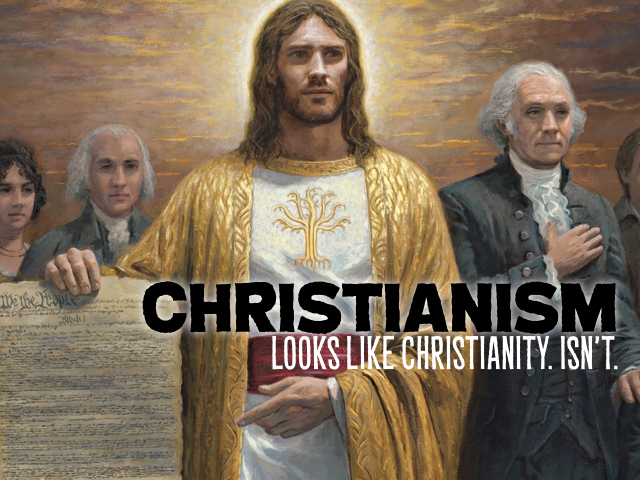
The header image for my Christianism essays is taken from Mormon artist Jon McNaughton’s painting “One Nation Under God.” It shows us one really common example of Christianism in the United States: Civic idolatry, in which we confuse our nation and its ideals with God’s kingdom. Much as we’d like to imagine the United States is an outpost of the kingdom, it’s not, y’know. Jesus is gonna overthrow it, same as every other nation, when he returns. And a lot of Americans have never even considered this idea. We’re a Christian nation, they insist. He’d never. But he totally will.

If you’re a civic idolater, you’re gonna be hugely offended that I used this image, or call it Christianist. Cease-and-desist order forthcoming.

But imagine McNaughton was from Mexico. Imagine he painted something with all Mexico’s founding leaders in the painting. reverently calling the nation to turn to Jesus, with Jesus holding up Mexico’s constitution, and separating the sheep from the goats by how good they were as Mexican citizens. Wouldn’t it bug you just a little?

How about if NcNaughton were Russian? Saudi? North Korean? Civic idolaters unthinkingly assume these other countries aren’t God’s chosen people in the same way Americans are. Jesus’ll definitely overthrow those countries when he returns. But not ours. Never America.