02 July 2026

Ancient heretic theories about Jesus.

The New Testament never clearly, bluntly spells out, “Here’s precisely what Christ Jesus did and how he works.” Systematic theologians and legalists would love it if the apostles did precisely that, but they didn’t, and so if we want to know those details, we gotta dig around the bible and find them.

Here’s the thing: Most of those details are not all that hard to find! Anybody with a decent bible translation and basic reading comprehension skills can get at ’em. The problem is people don’t always like what they find.

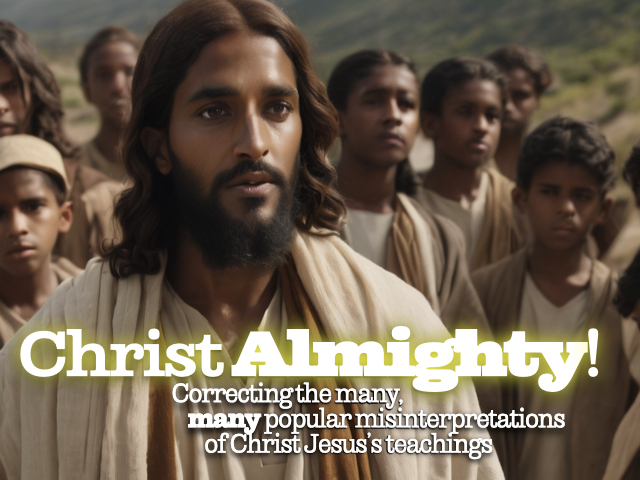
Fr’instance the people who want to know what Jesus looked like. And a basic description is actually in the bible! Right here:

Revelation 1.14-15 KJV
14His head and his hairs were white like wool, as white as snow; and his eyes were as a flame of fire; 15and his feet like unto fine brass, as if they burned in a furnace; and his voice as the sound of many waters.

White hair, bronze skin. Sound like any of the White Jesus paintings, statues, and crucifixes you’ve seen? Of course not; because plenty of people want Jesus to be white like them, and insist he is, and this passage of Revelation mustn’t be taken literally. Amusingly, these are often the same people who take every apocalypse in Revelation literally. That’s their trick: Cherry-pick when and where you want the bible to be literal, based on personal preference. Which is bad theology, but in these cases they’re happy with bad theology.

And we gotta watch out lest we do the very same thing. We all have our biases. We come to the scriptures with an idea already in mind, and wanna find proof texts to back us up. Sometimes the scriptures just won’t do that! And that’s okay; we’re wrong, and the scriptures are meant to correct us when we’re wrong. 2Ti 3.16 But too often we refuse to accept we’re wrong; too often we convince ourselves our clever ideas are really God-ideas, and the scriptures gotta prove us right! If being right is more important than being scrupulous (and for too many people, it absolutely is), we’ll subtly tweak the scriptures this way and that till they do “prove us right”—and that’s how we get heresies.

The ancient Christians ran up against a whole lot of heresies, ’cause for the longest time the Roman Empire practiced freedom of religion. No, seriously. As far as the Romans were concerned, so long that it didn’t interfere with keeping the peace, you could worship any god you pleased. Yes they persecuted Jews and Christians, and that’s because they were told these religions did interfere with keeping the peace. Peace was all they cared about, and like the comic book character Peacemaker, they’d kill as many people as it took to get peace.

Otherwise the Romans let you worship just about any god. You could even introduce new gods and build temples, and start synagogues and teach newbies about your god. A number of gnostics did precisely that, and taught all kinds of heretic weirdness. Some of these gnostics claimed to be Christian, taught their bizarre interpretations of Jesus, and some of those ideas leaked into Christian churches and led ’em astray.

In our day we also have freedom of religion. And, yep, gnostics who teach weird heretic things about Jesus, and start churches and sell books. They make good money at it. They get fans, which feed their pride and make ’em think they’re all the more clever and inspired. And their ideas also leak into Christian churches—and threaten to lead people away from God, his grace, and his kingdom. These aren’t little errors. They’ll trick people into rejecting God.

Of course these heretics already refer to us orthodox Christians as “heretics”—they’re entirely sure they’re right and we’re not. And to be fair, we’re all wrong in one way or another. But these folks are so wrong, they’re rightly called heretic: Their beliefs stand a really good chance of leading people away from God. They prefer their ideas over what God actually reveals about himself. They figure either God’s revelations are wrong, or misinterpreted—whereas they got it right, and how clever of them to see what others don’t. How wise of them; how inspired; what special favorites of God’s they must be. And all the other delusions pride can trick us into.

Heretic theories tend to fall into one of five categories:

  1. JESUS IS ANOTHER GOD. Most heretics figure Jesus isn’t the God, but a god. Another god. The God created Jesus as another god under him, like his vice-God, or prince of all the angels, or demiurge who does all the work while he sits back and rules. Jesus is some powerful being who’s not the very same One True God.
  2. JESUS ISN’T REALLY GOD. Jesus gets called “the son of God,” but that’s just a title the Hebrews gave their messiahs, their ancient kings, to indicate how these guys weren’t gods, but only worked for God. And same as all we other humans are daughters and sons of God. Like us, Jesus is another one of God’s creations. He’s still Messiah, a great teacher and prophet; he’s gonna rule the world; he’s the best human God ever made. But not God.
  3. JESUS ISN’T REALLY HUMAN. Jesus is in fact God; he’s definitely God. But he couldn’t fully give up his divinity to become human (and why would he?) so his humanity was only pretense. He appeared to be human, lest he freak people out too much. But he’s fully divine, wearing what appeared to be a human form.
  4. JESUS IS A DEMIGOD. In pagan religions, gods and humans bred and made demigods, half-and-half hybrids who were either supermen or lesser gods, like Herakles and Perseus and Aeneas. Demigod heresies describe Jesus these ways—part-God instead of entirely God, part-human instead of fully human.
  5. JESUS IS GOD—AND YOU CAN BE GOD TOO! A number of pantheists have wormed this idea into Christianity: Every human being has a divine spark in us, and Jesus fanned his own spark into full-on divinity. Now he’s teaching us to do the same thing. Follow Jesus, and you can become God too.

Whereas, to answer these theories, orthodox Christians aver:

  1. Jesus is the same God, Pp 2.6 and God is One. Dt 6.4 There isn’t another God.
  2. Jesus is as God as God can be. Jn 1.1-2
  3. He’s human; Jn 1.14 more human than humans are, ’cause we sin, which dings us quite a lot.
  4. True, to become human, Jesus was depowered, Pp 2.7 and had to perform miracles through the Holy Spirit’s power. Ac 10.38 But godlike power doesn’t make you God; it’s like saying arms and legs make you human. Divine nature does, and Jesus absolutely has that. He 1.3
  5. There’s only one God, and we’re not him… and Jesus is.

01 July 2026

Trust in the Lᴏʀᴅ. [Pr 3.5-7]

Proverbs 3.5-7 KJV
5Trust in the LORD with all thine heart;
and lean not unto thine own understanding.
6In all thy ways acknowledge him,
and he shall direct thy paths.
7Be not wise in thine own eyes:
fear the LORD, and depart from evil.


Too often this passage is interpreted to mean, “Turn off your brain, and just trust God.”

Which is entirely wrong. These verses are found in Proverbs, in the Old Testament’s wisdom literature, and the whole point of wisdom literature is to remind us to turn on our brains. To make wise, thoughtful, informed decisions instead of instinctive, emotion-driven, gut-level, stupid ones. Stop following your impulses and start using your head.

Part of the problem is that word “heart” in verse 5, and what people think it means, versus what it actually means. The ancients believed humans think with our hearts. Not feel; that’s a medieval idea, and the ancients believed we felt with our guts. But because people nowadays assume “What does your heart tell you?” means what do your emotions tell you, we read that idea back into the bible—where it doesn’t belong!—and think “trusting in the LORD with all my heart” means all our feelings. Not our minds. Not our intellect. Just the feels.

And yep, this is how we fall right back into instinctive, emotion-driven, gut-level, stupid decisions. We go right back to not being wise. But God wants us to be wise. He didn’t make your brain solely so you could memorize pop lyrics, remember who was angry at whom in what reality show, and the multiplication tables you never use anymore because now you can ask Siri what 20 percent off $19.95 is. Use your head to follow him better.

30 June 2026

Hearing God. But doubting you do.

When I became Pentecostal, I suddenly found myself among Christians who regularly said, “Oh, God told me [ENCOURAGING WORD],” or “God showed me [DIRECTION TO GO].”

It’s not that I hadn’t met such Christians before—even in a cessationist church, where they preached he didn’t do that sort of thing anymore! Most Christians are continuationist, same as Pentecostals: God never turned off the miracles, never went away nor hid himself. He can and does talk to his kids whenever he wants. Where we disagree is how often he talks. Pentecostals, myself included, find he talks to his kids all the time. Other Christians think it’s more rare; supposedly God saves his statements for special and important occasions, and doesn’t just chat with us like a loving Father would with his children. Kinda reveals more about how their prayer life isn’t conversational. But I digress.

But yeah, I was surrounded by plenty of Christians who claimed God told ’em this or that. And as I learned how to hear God, I gradually became one of them: “God told me [SUCH-AND-SO].” Not as prophecies for others. I wasn’t trying to pull any Moses-style “Thus saith the LORD” declarations or commands. I only talked about what he told me personally.

Here’s the funny thing. Every so often, somebody publishes a book about how to hear God. And these very same Christians who act as if they know God told ’em stuff… scramble to buy these books.

There’s a preacher of my acquaintance who once said, “Y’know, every time I tell people there really needs to be a book about how to hear God, they get all excited: ‘I would love such a book.’ But these are the same people who claim they already do hear God. So… do they? Do they really?”

Fair question. I would suspect they really do. But here’s why they’d would love to read a book about hearing God’s voice: They have doubts. And rather than deal with those doubts like the Holy Spirit wants ’em to, they don’t. It’s easier not to.

Y’see, when we hear from God, in order to make sure we heard from God, we gotta test those messages. We gotta confirm them! Just as the scriptures instruct. Whether it’s somebody else claiming they got a message from God, or we ourselves believing we just got a message from God, we’re always meant to double-check.

But here’s what humans typically do: Believe it if you like it, disbelieve it if you don’t.

Nope, no further checking. No confirmation. Nothing more with any of the things which get dropped into our spirit; we never bother to confirm it’s God. Or, just as bad, never double-check in case it’s us talking to ourselves, or an evil spirit trying to mess with us.

You really don’t have to buy a book about how to hear God better. You just have to start confirming what you think he’s told you. Find a fellow Christian who also hears God. (Ideally your spouse, or some other trustworthy family member.) Make yourselves accountability partners. Make this prayer request to God: “If you’re ever gonna tell me something, please tell my partner the very same thing.” Then watch him do it. There, was that so hard?

But for too many Christians, this is so hard. They’re terrified if they do this, they’ll find out absolutely nothing God ever “tells them,” is actually God. That it’s entirely in their own head; that they’ve been psyching themselves into thinking God speaks to them, or anyone.

Yep, they’re letting their doubts paralyze them. And stop ’em from legitimately hearing God.

29 June 2026

Raising Lazarus.

John 11.38-44.

At the time Jesus raised Lazarus of Bethany from the dead, he had raised people from the dead before: His synagogue president’s daughter, and some unnamed widow’s son. Raising the girl had happened privately, but raising the boy was right out there in public. So this wasn’t a new miracle… except Lazarus had been in the ground four days. The others might’ve been just dead or recently dead, but Lazarus was dead-dead.

That, and the other raisings had happened in the Galilee. But now they were down south in Judea, a few kilometers from Jerusalem. A number of Jerusalemites were there to grieve with Lazarus’s sisters. From their point of view, the stories about Jesus raising the dead were just that—stories. Raising kids who probably weren’t quite dead, and after the story passed through a number of gossips it got exaggerated into him raising the dead. Myths.

Whether they believed those stories or not, here they saw Jesus do the impossible for themselves.

John 11.38-44 KWL
38So Jesus—again, outraged within himself—
goes to the sepulcher,
which is a cave,
and a rock is lying against it.
39Jesus says, “Take the rock away.”
Martha, the sister of the dead man, tells him, “Sir,
he stinks by now,
for it’s the fourth day.”
40Jesus tells Martha,ᴾ “Didn’t I tell you¹
that when you¹ trust me,
you’ll¹ see God’s glory?”
41So they take away the rock
{which is at the place the dead lay},
and Jesus lifts up his eyes to the sky and says,
“Father, I give you¹ thanks that you¹ hear me.
42I knew you¹ always hear me,
but I say this because of the crowd around,
so they might believe you¹ send me.”
43This said, Jesus shouts in a loud voice:
“Lazarus! Come out!”
44The dead man comes out
his feet and hands bound in linen strips,
and his face wrapped in a sudra.
Jesus tells them, “Loose him
and let him go.”

I kinda got into why Jesus was outraged in the previous passage: His empathy meant he felt the crowd’s anger, and you see some of that anger come out in the previous verse, “Wasn’t this Jesus, who opened the eyes of the blind man, able to do something so that this Lazarus might not die?” Jn 11.37 KWL They were frustrated with him, and he felt some of that frustration.

But now was not the time to vent at their lack of faith; it was time to get Lazarus out of that sepulcher and return him to his family. So for their sake, he prayed the “Lazarus prayer,” in which he reminded them his Father hears him; then ordered Lazarus to come out. Because Lazarus was alive already.

23 June 2026

Jesus prays for the Father’s protection.

John 17.11-12.

Part of the reason for Jesus’s John 17 prayer is the protection of his followers—who would now include us. The world, Jesus says in the next verses, hates ’em because they’re not of the world any more than he is. Jn 17.14 So they’re gonna need protection. Thus far Jesus had been personally protecting them, but he was returning to his Father; now it was on the Father to protect them. ’Cause thus far, Jesus hadn’t lost any of the people the Father gave him… well, except Judas Iscariot.

It’d be better to put all that in Jesus’s words:

John 17.11-19 KWL
11“I’m no longer in the world.
They’re in the world, and I come to you.¹
Holy Father, guard them in your¹ name which you¹ gave me
so they might be one like we are.
12When I’m with them,
I’m guarding them in your¹ name which you¹ gave me.
I’m guarding them
and none of them are being destroyed
—except the son of destruction,
so the scripture can be fulfilled.”

This prayer is not a rote prayer which we can just repeat, and pray as if it’s all our own words. But we can adapt parts of it and include ’em in our own prayers. We can repeat Jesus’s request that the Father guard us, and help us become one like he and the Son are. Jn 17.11

22 June 2026

Jesus weeps for Lazarus.

John 11.28-37.

One of the answers to the popular trivia question, “What’s the shortest verse in the bible?” is found in today’s passage. The shortest verse in the King James Version is the 9-letter “Jesus wept,” Jn 11.35 which I translate “Jesus weeps”—one letter longer—because aorist verbs aren’t always past tense.

Thing is, in the original texts, the 16-letter sentence ἐδάκρυσεν ὁ Ἰησοῦς/edákrusen o Yisús, is not the shortest verse. That’d be the 9-letter עֵ֥בֶר פֶּ֖לֶג רְעֽוּ/Evér, Pelég, Rev in 1 Chronicles 1.25; three of Abraham’s ancestors. And in the New Testament it’d be the 12-letter καὶ ὁ δεύτερος/ke o dévteros, “and the second.” Lk 20.30 Thing is, the Textus Receptus added seven words to this verse, so it’s not all that short in that particular NT. But there’s still a verse in the NT shorter than edákrusen o Yisús, and it’s the 14-letter πάντοτε χαίρετε/pántote hérete, “rejoice always.” 1Th 5.16

Enough bible trivia. Everybody remembers Jesus wept, but now let’s get to why. Because it tends to dumbfound people. Why’s he crying? Why’s he mourning the death of Lazarus? Didn’t he go to Bethany specifically to “awaken” Lazarus from the dead? Jn 11.11 Why’s he grieving a death that he’s about to undo within the next 15 minutes?

I’ve got a ridiculously simple answer to that question, and it’d occur to you immediately if you share that trait. Unfortunately too many Christians don’t, don’t care to cultivate it, and even consider it an undesirable weakness. And it’s not; it’s a fruit of the Spirit. It’s empathy, the knowledge of what others are feeling—and feeling it too. The people were mourning—and kinda angry because they felt Jesus could’ve prevented Lazarus’s death. So Jesus was mourning—and, believe it or not, also kinda angry.

It’s all right there in the text:

John 11.28-37 KWL
28Martha, after saying this,
goes and secretly calls her sister Mary,
saying, “The Teacher is here and calls for you.¹”
29When she hears this,
this Maryᴾ quickly rises up
and is going to Jesus.ᴾ
30Jesus hadn’t yet come into the village,
but is still in the place where Martha met him.
31So the Judeans who are with Maryᴾ in the house,
comforting her,
seeing how Mary quickly rises up and goes out,
follow her,
thinking she goes out to the sepulcher
so she might weep there.
32So when Mary comes to where Jesus is,
on seeing him, she falls to his feet,
telling him, “Master, if you¹ were here,
my brother would never have died.”
33So when Jesus sees Maryᴾ weeping,
and those Judeans who came with her weeping,
he’s outraged in spirit
and stirred up within himself.
34Jesus says, “Where did you² put Lazarus?ᴾ”
They tell him, “Master, come and see.”
35Jesus weeps,
36so the Judeans are saying,
“Look how he loves Lazarus.ᴾ”
37And some say back to them, “Wasn’t this Jesus,ᴾ
who opened the eyes of the blind man,
able to do something
so that this Lazarusᴾ might not die?”

As it says in verse 33, when Jesus sees Mary and the crowd, he ἐνεβριμήσατο/enevrimísato, “snorts with anger.” The KJV has “groaned”; the translators skipped why he groaned, but they knew from their Latin bibles it was because Jesus fremuit spiritu, “raged in spirit.”

Why was Jesus angry? Like I said, empathy: The crowd of Judeans wanted to know why Jesus could cure the blind, but couldn’t’ve cured Lazarus. Jn 11.37 So, some of them were frustrated with him. And Jesus felt that, in his spirit. Not in his guts, which is where the ancients believed emotion came from; he spiritually knew there was anger in the crowd. They wanted to know why he hadn’t done anything. They expected he’d better do something now.

As for why he wept: Mary was weeping. So he wept with her. Because Jesus isn’t a compassionless, unfeeling dick. He’s a human being with the very same emotions we have, but he’s in full control of them and doesn’t use them as an excuse to sin. He rejoices with us; he mourns with us. And because he’s our example, we should do likewise.

19 June 2026

Who wrote the bible’s books?

Recently I saw a meme which listed all the books of the bible, and who wrote ’em. And whoever wrote it got so many wrong. It’s a combination of unprovable traditions—Moses did not write “the five books of Moses,” no matter how often people claim he did—and oversimplifications, like “David” writing the psalms and not David plus other psalmists; or “Paul” wrote all his letters but skipping his cowriters.

Anyway here’s the actual list of who wrote what—as best we know, anyway. I’m listing the books in King James Version order; your bible might have ’em in a different order.

18 June 2026

Talking snakes.

In the past, when I’ve spoken with nontheists about why they don’t believe in God, Christianity, the bible, or Jesus, often the reasons they gave was they weren’t raised Christian, and weren’t raised to take it seriously as a belief system.

Which is fair! It’s the very same reason I’m not Muslim. I was raised Christian, not Muslim, and was raised to favor Christianity. So if someone ever told me in my teens and early twenties, “Have you considered Islam?” I’d’ve honestly said no, I never have. And wasn’t interested in giving it a shot. If I were to give any religion a shot, it’d be my own. Eventually I did exactly that.

Nontheists do the very same thing. When they’re young, they don’t often think about why they don‘t believe in God; they simply don’t. Their parents don’t, and they mimic their unbelieving parents. They know this.

Now, if you encounter them when they’re older, when they’ve been studying atheism for a bit, and now they wanna debate Christians about the merits of religion, now they’re not gonna tell you, “I’m atheist because I was raised that way, and never considered religion a viable option.” No; now they’re definitely in the anti-religion camp, and that explanation—though true—sounds pathetic to them. Now they’re gonna say the reason they’re atheist is because [CURRENT POPULAR REASON]—whatever their favorite atheist authors are currently denouncing the hardest. Sometimes that’s ill-behaved Christians. Sometimes theodicy—“If God exists and is good, evil wouldn’t happen, but it does, so he doesn’t or isn’t.”

And sometimes they don’t believe because they find God, and popular Christian ideas about God, silly. The idea of a old bearded man in the sky, shaking his finger at us or hurling lightning bolts because we sin or don’t believe in him? Ridiculous.

In the second creation story, there’s a נָחַשׁ/nakháš, usually translated “serpent.” In Genesis 3 it has a conversation with the first woman. Seriously: A snake. Talking to a human. And the human talks back. And this isn’t fiction, like Harry Potter, where Harry talks to a snake too; this is a story Christians (and Jews, and Muslims) are meant to take seriously as an explanation for why God didn’t just make the world a paradise for us to live forever in: He totally did do that, but we sinned and ruined everything.

Skeptics simply can’t get past the talking snake. Heck, I’ve known Christians who struggle with it. I used to be one of them. I’m now of the opinion—same as many Christians, whether they admit it or not—this isn’t a literal snake. It’s the devil. Rv 12.9 Christians will pitch different theories about how this story took place—the devil transmogrified itself into a serpent, or somehow possessed an actual serpent—but I think in this context nakháš doesn’t even mean “serpent”; it’s means “devil.” But plenty of Christians have plenty of other theories.

Of course, skeptics find the idea of the devil silly too. Really?—a red man with horns, hooves, tail, and pitchfork, running amok, writing rock music, tempting Christians to not come to a full and complete stop at a stop sign? Ludicrous.

Now you can, and I have, wasted a whole bunch of time trying to explain the pop-culture depictions of God, the devil, the second creation story, and Christianity are filled to the brim with rubbish. These skeptics aren’t remotely interested in who God really is; they already don’t believe. In the very same way you don’t take Zeus seriously.

So shake the dust from your feet and move along.

17 June 2026

The fall of humanity.

Genesis 3.1-8.

There’s a bit of wordplay in the first verse of Genesis 3. The last verse of chapter 2 describes Adam and Eve as עֲרוּמִּ֔ים/arummím, the plural of “naked.” The first verse of chapter 3 describes the נָחָשׁ/nakháš, KJV “serpent,” which in this passage I’m gonna translate “devil,” as עָר֔וּם/arom. Really similar word. Same letters, but one different vowel sound, which is what makes the difference. Otherwise you’d think the devil was the most naked being in the wild.

Why’m I translating nakháš as “devil” instead of “serpent”? Because this is not a literal serpent. This is Satan, as the apostle John later identifies it:

Revelation 12.9 KWL
And the great dragon was cast out, that old serpent, called the Devil, and Satan, which deceiveth the whole world: he was cast out into the earth, and his angels were cast out with him.

The ancients used the word’s verb-form, נָחַשׁ/nakháš—pronounced the same way—to mean “murmur an incantation,” or “practice divination,” or “foretell.” In general it had to do with superstition, and someone which dabbled in superstition would also be a nakháš, used as a noun. Whether the ancients were calling such people serpents, or whether these were originally two different words which later got mixed up, we don’t know. Either way, Genesis 3 isn’t about a literal serpent. Sure looks like it is, considering the LORD’s later curse upon that nakháš that “upon thy belly thou shalt go.” Ge 3.14 But we mustn’t take that curse literally either. I’ll explain when I get there.

Some will object to my using Revelation to interpret a Genesis passage. They figure since John wrote 15 centuries later, what does he know about the historical context of this story? Heck, did the author of Genesis even know the historical context of something which happened millennia before he wrote the book?

But I figure John wrote down what Jesus showed him, and Jesus knows exactly what this story means. So I’m still going with “devil.” If you’d rather read a translation which sticks to “serpent,” feel free.

Genesis 3.1-8 KWL
1The devil was intelligent—
more than every wild living creature
which the god YHWH made.
It said to the woman, “Did God really say,
‘Don’t you² eat from any of the garden’s trees’?”
2The woman told the devil,
“We eat of the garden’s trees’ fruit.
3Of the fruit of the tree in the middle of the garden,
God said, ‘Don’t eat from it;
don’t touch it, lest you² die.’ ”
4The devil told the woman, “You² don’t die-die.
5For God knows on the day you² eat from it,
your² eyes will open,
and you² become like gods,
knowing good and bad.”
6The woman saw the tree was good for food,
that it was desirable to the eyes,
and that it was desirable for wisdom.
She took from its fruit and ate.
She also gave it to her man with her,
and he ate.
7The eyes of the two of them were opened—
and they knew they were naked.
They sewed together fig leaves,
and made themselves loincloths.
8They heard the sound of the god YHWH
going through the garden
in the wind that day.
The human and his woman hid themselves
from the face of the god YHWH
in the middle of the garden’s trees.

As if anyone can hide from God. But Adam and Eve were young and dumb, and knew they’d massively messed things up.

16 June 2026

Jesus’s Lazarus prayer.

John 11.41-42.

I’m going through the Lazarus story, and just before Jesus raises Lazarus from the dead, he prays. It’s an odd little prayer, and from it we can learn a bit about both Jesus and prayer. Goes like so.

John 11.41-42 KWL
41So they take away the rock
{which is at the place the dead lay},
and Jesus lifts up his eyes to the sky and says,
“Father, I give you¹ thanks that you¹ hear me.
42I knew you¹ always hear me,
but I say this because of the crowd around,
so they might believe you¹ send me.”

It’s odd because y’notice Jesus doesn’t make a prayer request. Usually when a Christian’s about to try to cure someone, or even raise the dead, they ask the Holy Spirit, “Can I do this? Can you make me able to do this? Would you cure this person? Is this your will that they be cured? Please do this.” There’s a whole lot of requesting going on. Some begging. Sometimes even some deal-making.

And Jesus does none of that. It’s only, “Thank you, Father, for hearing me. Yeah, I know you already hear me; I’m just saying this for their sake.” Gotta be honest! But in this prayer, he doesn’t ask the Father for anything. It’s solely acknowledgement the Father is here with Jesus—and the Father sent Jesus.

And then Jesus raised Lazarus.

Why doesn’t Jesus beg the Father to empower him to pull off this miracle? Because he doesn’t need to. We already know from other scriptures Jesus prayed a lot. He was all prayed up. When he tells his students elsewhere, right after he threw an evil spirit out of a boy, “This kind can come forth by nothing, but by prayer and fasting,” Mk 9.29 you notice Jesus couldn’t just start fasting right then; he had to already have a lifestyle of fasting. Same with the prayer: Jesus could start praying his head off right at that moment, but what good is that when you don’t already have a conversational relationship with your Father? And Jesus undoubtedly had that already.

So when it came time to cure Lazarus of death, Jesus didn’t need to stand before the sepulcher, lift his hands to heaven, pray for three hours, and maybe Lazarus might come forth. Jesus spent his entire life patterning every action after the Father’s will. Today was no different. And Jesus spent his entire life praying, almost constantly, often intensely, to his Father. He’d been all prayed up since childhood.

If we’re all prayed up, and we step into a situation where someone needs to be cured of illness, we don’t need to drop to our knees and beg God for hours to grant our request. We’ve already been talking to him. We already know what he wants us to do. We already know whether he’ll empower us to cure this illness or not—and if not, we don’t give the poor person false hope that God’ll cure them immediately. We just remind ’em to keep praying, like the widow in Jesus’s Persistent Widow Story.

But if so, we don’t need to pray any more than Jesus did in this situation: “Hey, Father? Thank you so much for hearing me. You always do.” Then, “In Jesus’s name, I order this illness to go away.” And it will.

15 June 2026

Jesus is resurrection and life.

John 11.17-27.

Lazarus’s sisters Martha and Mary come up elsewhere in the gospels. It’s in a story where Mary sits at Jesus’s feet during a lesson, which was not appropriate for women in their sexist culture, and Martha tells Jesus to shoo her away and make Mary help her. But Jesus tells Martha to leave her be; that’s exactly where Mary belongs. Lk 10.38-42 As a result Christians have preached many a sermon where Martha’s the bad example, and Mary’s the good.

Although they don’t always realize why Mary’s the good. Often these sermons only talk about Mary worshiping at Jesus’s feet—as if Mary was only fangirling over Jesus while he was at the serious business of training apostles. That’s not how rabbinic lessons worked. The rabbi makes a statement; the students challenge the statement based on their bible knowledge; the rabbi defends his statement based on his bible knowledge. Those at the rabbi’s feet actively participated in this. Meaning Mary was challenging Jesus, quoting bible, and showing an intellectual capacity that impressed Jesus so much he wanted her there. Valued her there.

Generally the lessons go: Martha frets about so many things which are ultimately irrelevant, but Mary sits at Jesus’s feet. Let’s all be like Mary. Martha bad, Mary good. But no, Martha wasn’t bad—she just didn’t realize she likewise had the right to sit at the Lord’s feet, same as Mary, and learn from Jesus, instead of doing busywork like her culture expected her to.

Anyway, by the time Lazarus died, Martha apparently had learned from Jesus, ’cause she makes some of the more profound faith statements in the bible. Her faith didn’t go heave-ho after her brother died, like we see in so many people; it was strong as ever. When she met with Jesus, she didn’t scream at him about not being there to save Lazarus, as some of the lousier Jesus movies depict her. She still trusts him. She knows the Father listens to him; she still believes he can do something. She still calls him Christ, God’s son.

John 11.17-27 KWL
17So, on arriving, Jesus finds Lazarus
is already four days in the sepulcher.
18Bethany is near Jerusalem;
like 15 stadia. [2⅓ km]
19Many of the Judeans came to Martha and Mary
so they might comfort them about their brother.
20So Martha, once she hears Jesus arrives, meets him.
Mary is sitting in the house.
21So Martha says to Jesus, “Master, if you¹ were here,
my brother never would have died.
22{But} I now know whatever you¹ ask God,
God will give you.¹”
23Jesus tells her, “Your brother will rise again.”
24Martha tells him, “I know he’ll rise—
in the resurrection, on the last day.”
25Jesus tells her, I’m the resurrection.
I’m life.
One who trusts in me, if they¹ die, will live.
26And everyone who lives and trusts in me
ought never, ever die in the age to come.
Do you¹ believe this?”
27Marthaᴾ tells him, “Yes, Master.
I’ve believed you’re¹ the Christ,
God’s son coming into the world.”

Other Christians despair at their great losses, yet Martha still totally trusts Jesus. That’s huge. Let’s all be like Martha.