04 January 2024

It’s 4 January. It’s still Christmas. Does this annoy you?

Back in 2016 my church decided it was time to begin our 21-day Daniel fast… on the very first Sunday of the month. Specifically this was Sunday, 3 January 2016. Welcome back from the holidays, folks; no doughnut for you.

“Really not appropriate to schedule a fast for a feast day,” I pointed out to one of my fellow church attendees.

SHE. “Feast day? This is a feast day?”
ME. “It’s still Christmas.”
SHE. “Christmas was two Fridays ago.”
ME. “Christmas began two Fridays ago. And ends tomorrow. It lasts 12 days, remember?
SHE.What lasts 12 days?”
ME. “Christmas. Remember the song? ‘On the first day of Christmas, my true love gave to me…’ and each day the singer just kept getting more and more birds? ’Cause Christmas has 12 days.”
SHE. “Who celebrates it for 12 days?”
ME.I celebrate it for 12 days. I’m still eating cookies.”
SHE. “Well, you can do that if you like. I took the tree down the day after Christmas.”
ME. “You mean the second day of Christmas.”
SHE. [irritated scoff]

Tell many a Christian today’s the 11th day of Christmas, and this is the response you’ll get: The irritated scoff. To their minds, Christmas ended last month, and good riddance. They were so done with the holiday once Christmas dinner was over. And if they weren’t, the hassle of returning their Christmas gifts—or the credit card bill—did it for ’em.

Like I said back in my advent article, a lot of Evangelicals have adopted the mindset our popular culture foists upon us. To them, the Christmas season begins Black Friday, ends 25 December, and the rest is just aftermath and cleanup. Put the decorations away as soon as possible, ’cause it’s time to concentrate on the new year. And the stores are already selling Valentine’s Day items. (“Already? Are you kidding me?”)

But if you’ve burnt out on Christmas, it’s because you’ve not really been celebrating Christmas. You’ve been celebrating the awful Mammonist substitute the stores, secular television, and government grade schools peddle. Our churches unwittingly help ’em do it. All of us perpetuate the idea of a one-day holiday, a frenzy of gifts and toys and events, and a slapped-on veneer of “Remember the reason for the season!”

In fact Christmas is primarily about how Christ the savior is born. If you’re doing Christmas correctly, and someone brings up the word “Christmas” after the 25th, that’s the mental image which should’ve immediately popped into your mind. Not decorations, toys, and obligations. Jesus has come.

If your first response was to scoff… you did it wrong.

03 January 2024

What does your church believe?—and no, I don’t mean the pastors.

A few years ago a pastor friend of mine posted on social media, “One of the core values at our church is…” something. I don’t remember specifically what. Some virtuous practice, like generosity or frequent potlucks. Every church should have frequent potlucks.

But all I remember is immediately thinking, “No it’s not.”

Because it’s not.

I’ve no doubt it’s one of his core values. But he’s a pastor. He’s not the church.

I’ve no doubt he wants his church to have this value. Probably preaches it in his sermons, includes it in his vision statements, sticks it on the church website. Likely practices it in his personal life. But as I keep reminding Christians (and pastors!) the church is not its leadership. The church is people.

Our pastors might declare our churches and denominations hold to certain faith statements, certain official doctrines, certain core values, certain biblical principles… but unless they’ve taken a poll of the people to find out what we really believe, all they’re really stating is what they think ought to be our churches’ central convictions.

The actual central convictions? Bit messier.

Centuries ago, our Lord Jesus had his apostle John write messages to seven churches located in the eastern Roman Empire. If you read it, you’ll notice Jesus didn’t even bother to state ’em to the church leadership—who were probably following him just fine! Instead he bypassed the church supervisors and spoke straight to the angel over each church—the spirit whom he put in charge of spiritually defending his churches. (Who isn’t actually in charge of the church, ’cause angels help, not lead; ignore anything people claim to the contrary). Addressing the angel was Jesus’s way of addressing the people, not the leaders.

Here’s what he had to say to the people of the church of Ephesus:

Revelation 2.1-7 CSB
1 “Write to the angel of the church in Ephesus: Thus says the one who holds the seven stars in his right hand and who walks among the seven golden lampstands: 2 I know your works, your labor, and your endurance, and that you cannot tolerate evil people. You have tested those who call themselves apostles and are not, and you have found them to be liars. 3 I know that you have persevered and endured hardships for the sake of my name, and you have not grown weary. 4 But I have this against you: You have abandoned the love you had at first. 5 Remember then how far you have fallen; repent, and do the works you did at first. Otherwise, I will come to you and remove your lampstand from its place, unless you repent. 6 Yet you do have this: You hate the practices of the Nicolaitans, which I also hate.
7 “Let anyone who has ears to hear listen to what the Spirit says to the churches. To the one who conquers, I will give the right to eat from the tree of life, which is in the paradise of God.”

In this part of Revelation, lampstands represent the individual churches, Rv 1.20 and Jesus was threatening to end this church if they didn’t bother to follow him. They didn’t, so he eventually did.

And like I said earlier, the leadership of this church was probably following Jesus just fine! Sharing the gospel, serving the needy, loving their neighbors; all the stuff Christians oughta do. But they only made up maybe 20 percent of the church at best. The other 80 percent? They were the ones Jesus was critiquing for abandoning their first love, and slacking on good deeds. They did hate what certain heretics in their city were up to; Jesus hated that too; but it takes very little effort to hate stuff. It’s not that positive a thing to say about ’em.

Anyway back to my point: The leadership of our churches usually takes charge of presenting the public face of our churches. They put together the websites, publish the faith statements, show photos of the 20 percent of the church which actually participates in outreach and charity… but the great majority of the church? It’s embarrassing to say so, but they’re irreligious and fleshly, and have zero interest in following Jesus any better than they already barely do.

They’re why our supposedly “Christian” country doesn’t act it. They’re why our supposedly “Christian” churches don’t follow Christ all that much. Why the people of those churches can so easily be swayed by politicians and scam artists of low character, and think they’re right with God because they hate particular sins. But do they do anything Jesus teaches? Meh; when the mood strikes.

02 January 2024

Jesus wants us Christians to be fruity.

Yes, I know what “fruity” tends to mean in our culture. No, I don’t care. I’m taking the word back. Fruity fruity fruity.

Fruit is a metaphor we see all over the New Testament for behavior. The way Christ Jesus describes it, if you’re a good tree, you produce good fruit, and a rotten tree produces bad fruit. I’ll quote him:

Luke 6.43-45 NRSVue
43 “No good tree bears bad fruit, nor again does a bad tree bear good fruit; 44 for each tree is known by its own fruit. For people do not gather figs from thorns, nor do they pick grapes from a bramble bush. 45 The good person out of the good treasure of the heart produces good, and the evil person out of evil treasure produces evil, for it is out of the abundance of the heart that the mouth speaks.”

His apostle Paul didn’t care to even call bad behavior “fruit,” preferring to call ’em “works of the flesh.” Ga 5.19 But the scriptures’ general idea is there’s good fruit and bad. People are fruity in one way or the other.

And if we’re truly following Jesus, we should see the good stuff. Right?

John 15.1-8 NRSVue
1 “I am the true vine, and my Father is the vinegrower. 2 He removes every branch in me that bears no fruit. Every branch that bears fruit he prunes to make it bear more fruit. 3 You have already been cleansed by the word that I have spoken to you. 4 Abide in me as I abide in you. Just as the branch cannot bear fruit by itself unless it abides in the vine, neither can you unless you abide in me. 5 I am the vine; you are the branches. Those who abide in me and I in them bear much fruit, because apart from me you can do nothing. 6 Whoever does not abide in me is thrown away like a branch and withers; such branches are gathered, thrown into the fire, and burned. 7 If you abide in me and my words abide in you, ask for whatever you wish, and it will be done for you. 8 My Father is glorified by this, that you bear much fruit and become my disciples.”

In the quote above, it sounds like it’s possible to produce no fruit, good or bad. Which isn’t better. Jesus tells another story about a fruitless tree:

Luke 13.6-9 NRSVue
6 Then he told this parable: “A man had a fig tree planted in his vineyard, and he came looking for fruit on it and found none. 7 So he said to the man working the vineyard, ‘See here! For three years I have come looking for fruit on this fig tree, and still I find none. Cut it down! Why should it be wasting the soil?’ 8 He replied, ‘Sir, let it alone for one more year, until I dig around it and put manure on it. 9 If it bears fruit next year, well and good, but if not, you can cut it down.’ ”

Those who produce no fruit—nothing God can use, anyway—are getting disposed of. “Gathered, thrown into the fire, and burned,” is how Jesus put it. Jn 15.6 Being fruitless is functionally the same as producing bad fruit. God wants fruit!

So if we truly follow Jesus, we oughta be super fruity. Our lifestyles should be filled with christlike behavior. Filled with proof of God’s influence on our lives: We should share his character traits, which Paul called “fruit of the Spirit.” Ga 5.22

And yeah, to some degree we should also see some supernatural stuff. Like miracles, prophecy, healing, and so forth, ’cause God’s kingdom isn’t all about philosophy and talk, but God’s power. 1Co 4.19 Stuff happens when God’s among us. But when he’s not—’cause we won’t include him and never bother to follow him—stuff doesn’t happen, and fruit isn’t visible.

So when a person claims to be Christian, claims to follow Jesus, yet their lifestyle is no different than any pagan who has no relationship with God at all—worse, if they’re jerks, or downright evil, and try to justify their dark behavior and beliefs with Christian-sounding excuses—we’re dealing with hypocrites at best, antichrists at worst. Fakes either way.

01 January 2024

Religious. Not “spiritual.”

Happy new year, happy 8th day of Christmas, and happy Feast of the Circumcision (’cause if Jesus was circumcised on the eighth day, that’d be today, right?). At the beginning of each year I figure it’s a good idea to remind readers of the point of TXAB, i.e. the Christ Almighty Blog. And remind myself too: I’ve seen many a blog which began as one thing, evolved into another, and it wasn’t an improvement.

This blog is about following Jesus the Nazarene, our God-anointed king and Messiah, or Christ. The first of his followers became known as Χριστιανούς/Hristianús, “Christ-followers,” or Christians, because that’s what we’re meant to do: We follow Jesus. We teach what he taught, believe what he tells us, do as he says, and grow good fruit.

Except some Christians don’t follow Jesus. Yet claim the title anyway.

You see them everywhere in my homeland of the United States. We claim to be Christian, but we’re not Christ-followers; we’re fans. We really like him! We claim to love him—or at least love him as we’ve re-imagined him, usually to suit our prejudices, politics, and all the sins we’re hoping to get away with. We surround ourselves with other like-minded hypocrites who claim they know Jesus and really don’t, and thereby become Christianist. As revealed by the fact all their fruit is “fleshly.”

There are so many of these misbehaving “Christians,” it’s no wonder various Christians insist, “No, don’t call me Christian; I’m a Christ-follower. Call me that.” They want it very clear they’re legitimately, honestly trying to follow Jesus. They’re not just in it because “Jesus” hates what they hate, and justifies their various hatreds.

And the Christianists claim they’re totally following Jesus too! (Certainly they’ll claim it whenever somebody does something they consider sinful.) But y’know, whenever you drop an authentic God-encounter on ’em, either they immediately recognize their errors and repent… or they lose their minds in horror and offense, and insist this has to be some kind of devilish trick. Yep, given the opportunity they’ll commit straight-up blasphemy of the Holy Spirit, which is why God doesn’t drop that on them as often as he could; why push ’em into sin? But we needn’t even bring up their near-blasphemies. Fleshly works prove ’em as frauds quite effectively.

Well. Once we quit following the crowd and follow Jesus whithersoever he leads, we call this being religious.

04 December 2023

Scriptures for advent.

Each advent season I focus on scriptures which are related to advent topics. Namely Jesus’s first coming, and his second. So expect to see some such articles… but if you can’t wait that long, here’s some stuff I’ve written already.

Nativity stories.

Jesus’s genealogy, in Matthew. Mt 1.1-17 In which Jesus’s messianic credentials are established.
One heck of a birth announcement. Lk 1.5-25 Gabriel’s announcement to the father of John the baptist.
How Mary became Jesus’s mother. Lk 1.26-38 What sort of person God selected as his mother.
Mary’s visit to Elizabeth. Lk 1.39-56 When Jesus’s mother and John’s mother both prophesied about his coming.
The birth of John the baptist. Lk 1.57-80 And his father’s prophecy about just what sort of man he’d be.
How Joseph became Jesus’s father. Mt 1.18-25 Not foster father; adoptive father. God commissioned Joseph to raise his Son.
Joseph, father of Jesus, prophet. Mt 1.18-21 God didn’t just choose anyone to raise his son; he chose someone who actively listened to him.
Christ the Savior is born. Lk 2.1-7 The political circumstances at the time Jesus was born in Bethlehem.
The sheep-herders’ vision of the angels. Lk 2.8-20 Jesus came to save everyone. Here, some of the everyone hear the good news.
The prophets who recognized Jesus. Lk 2.21-40 In temple, two prophets confirm who Jesus is to his parents.
The magi show up. Mt 2.1-3 How Zoroastrian priests used astrology to find Jesus. (And no, this doesn’t mean we‘re to do that.)
Pinpointing Messiah’s birthplace. Mt 2.3-6 Why on earth did the priests tell their murderous king where Messiah would be born?

Messianic prophecies. (Or not.)

The first prophecy of a savior. Ge 3.14-15 After humanity messed up the universe, God indicated he has a plan to fix it.
The star coming out of Jacob. Nu 24.17 Centuries before Israel had a king, Balám predicted one.
The prophet like Moses. Dt 18.15-19. Moses spoke of prophets in general, but this particularly applies to Jesus.
The heir to David’s throne. 2Sa 7.1-17 The LORD told David his throne would last forever. In Jesus, it does.
Not allowed to rot. Ps 16.10 Jesus wasn’t in the grave long enough to rot… which resembles a line in a psalm.
Messiah and Melchizedek. Ps 110.4 How God’s chosen king is like this obscure ancient gentile king.
Jesus, our Immanuel. Is 7.14 How Jesus is like a prophecy about an oddly-named little boy.
The Son who was given us. Is 9.6-7 As disaster drew near to 8th-century BC Israel, Isaiah foretold a Messiah who’d set everything right.
One who brings justice to the gentiles. Is 42.1-4, Mt 12.14-20 A passage Jesus fulfilled—which is about Israel, but Jesus actually does it.
Plucking Jesus’s beard. Or not. Is 50.6 In stories of Jesus’s passion, we regularly hear of people tearing out his beard. It’s not in the gospels; it’s in Isaiah—and he’s speaking of himself.
Our suffering servant. Is 53 ’Cause usually people try to conquer the world by defeating others, not by suffering.
Rachel weeping for her children. Jr 31.15-17 The destruction of Ramáh is a lot like when Herod massacred Bethlehem’s children.
The Son of Man. Da 7.13-14 Jesus’s favorite description of himself comes from a Danielic vision.
“Out of Egypt I called my Son.” Ho 11.1 How fulfillment isn’t the same as a prediction coming to pass.
Christ is born in Bethlehem. Mc 5.1-4 Why the scholars figured Messiah came from that little town.
Is there a prophecy of Jesus’s hometown? Mt 2.23 No; it’s wordplay. But wordplay can be a type of fulfillment.

On the first advent.

When the fullness of time came, God sent his Son. Ga 4.1-5 God had good reason for delaying the first coming till that time.
The Carmen Christi: When Jesus made himself nothing. Pp 2.5-11 An early hymn about how God became human.
The ikon of the invisible God. Cl 1.15-20 Y’know how the LORD forbade graven images? It’s because he reserved that for himself.
Foreknown before the world was founded. 1Pe 1.17-21 The coming of Christ Jesus was always the plan. Not the backup plan.
The living word. Whom the apostles have seen. 1Jn 1.1-4 These guys weren’t writing hypothetically about God; they knew Jesus personally.

On the second advent.

The Son of Man’s returning. And everyone will see it. Mt 24.23-28 It won’t be any secret rapture; it won’t happen quitely in some obscure corner of the world; it won’t be something only Christians can see.
Jesus describes his second coming. Mk 13.24-27 After Jesus describes the great tribulation, he talks about his return.
When is Jesus returning? Mk 13.32-37 Jesus didn’t say. So watch out for his return.
The Five Stupid Teenagers Story. Mt 25.1-15 Don’t get tricked into missing the second coming.
The Lambs and Kids Story. Mt 25.31-46 Those who are headed for the kingdom are already acting as if they’re in it.
The Talents Story. Mt 25.13-30 What’re we doing with our king’s investments in our lives?
The Wheat and Darnel Story. Mt 13.24-30, 13.36-43 Till the second coming, we gotta put up with the weeds.
When Jesus got raptured. Ac 1.6-11 What goes up must come down.
Apostasy before the second coming. 2Th 2.1-12 Before Jesus returns, there’ll be a lawbreaker running amok.
Set your hearts for Jesus’s return. Jm 5.7-8 The End takes place on Jesus’s timetable, not ours.
No, seriously: When’s Jesus returning? He’s taking forever! 2Pe 3.1-9 I know; it’s been 20 centuries. Don’t give up hope.

There’s a nice pile of reading material there. More to come.

27 November 2023

Happy holidays!

In the United States it’s the holiday season. As soon as Halloween is over, out come the Christmas sales, and people start putting mint in everything. You know what we’re ramping up towards.

Javascript isn’t working this Christmas!

Some elf overdid it on the sugar.

I get why the holidays bug people. It’s the commercialism. The merchandising. The obligatory traditions which hold no more meaning for you. The mandatory functions which aren’t any fun, like the Christmas pageants where you gotta watch kids and earnest church members, who have no business singing in public, charitably permitted to nonetheless sing in public. Or the naked, unadulterated greed which sucks the soul out of this time of year.

It’s why I advise Christians to redirect our attention to Advent, the four weeks before Jesus’s nativity. Eastern churches start it even earlier, 40 days before Christmas, and make a fast of it, like Lent. Which you could do, if you’re into fasting; I’m not. But Advent’s purpose isn’t to deprive ourselves so Christmas seems way better by comparison. Nor is it to ramp up the pressure to make ready for a super-blowout Christmas Day. Properly it’s the time to set our eyes on Jesus. He came once before… and he’s coming back again.

21 November 2023

#Blessed.

I have certain people whom I follow on social media, who love love love the hashtag #blessed. They have a nice meal, or get a nice view of the sunset, so they post photos of it on Instagram, tagged #blessed. They find a sweet parking spot in front of their building, so they xeet about it and tag it #blessed. The kids achieve something at school, or make ’em a craft, or otherwise give ’em a fun day instead of screaming their head off because Dad won’t give ’em Froot Loops for dinner; it’s on Facebook, tagged #blessed.

Every time they feel blessed, they gotta post and tag it. Even for little minor stupid stuff. “Drove to work; nothing but green lights all the way! #blessed

I know what brought this on for one of ’em… ’cause she said so. A few months ago her pastor challenged the people of her church to notice all the blessings God sent their way. He blesses us a lot, y’know. And a lot of us first-worlders are mighty big ingrates about it. We presume a smooth and easy life is the way things naturally oughta go. As if our ancestors didn’t struggle mighty hard (and take advantage of lot of other, weaker people) so we descendants could enjoy peace and prosperity and comfort. Anyway, the pastor told ’em to be mindful of their blessings. So she’s trying. She looks for them. No surprise, they’re everywhere. And she’s trying to be grateful to God for them.

Thing is, some months ago she took her husband to this really fancy restaurant for his birthday. She posted a photo on Instagram wearing a nice dress, with a nice plate of shrimp in front of her, nice wine, nice view of the ocean behind her, and the tag #blessed. (I’ll just point out her husband, whose day and life they were celebrating, isn’t even in the photo. Likely he took it.)

Okay: God didn’t grant her this experience. Her husband didn’t surprise her with it. She planned it; she paid for it. I hope she could afford it, and doesn’t have to pay off credit cards for the next several months, but even so: Is this a blessing?

Some would say yes, others no. One could argue the blessing comes from being able to have such experiences: She has a job which can fund these activities, grant the free time, and a kind husband whose life she’d like to celebrate. Although one doesn’t have to celebrate it in that particular way. Nor post a selfie on Instagram.

I can speculate about her motives, but for pagans it’s way more obvious: They’re totally showing off. “Lookit how #blessed I am.” They get to eat the fanciest food, hang out with the coolest people, smoke the finest weed, enjoy the priciest hotels. They’ll even take selfies and tag ’em #blessed even though there’s nothing in them but themselves—because they’re showing off their “blessing” of being attractive. It’s not about gratitude; it’s about ostentatious wealth.

Since pagans have a deficient relationship with God (as even Christians will when we get irreligious, or take God and our salvation for granted, but mostly I’m talking about their distorted beliefs about God), when they tag themselves #blessed, it’s not any acknowledgement of the Father of lights who grants us every good and perfect gift. Jm 1.17 Most of the time they’re thanking the universe—the impersonal cosmos, which they imagine is granting ’em good karma in exchange for… what, all the good vibes they put out there? Assuming they even put any good vibes out there other than happy Instagram photos.

Are these people blessed? Did God grant ’em these blessings? Or did they really just bless themselves?

17 November 2023

Trusting God… versus trusting doctrine.

I’ve posted before about the “doctrines of grace,” as Calvinists call ’em—the things they believe about God and how he saves us. The doctrine they focus on most is God’s sovereignty, which they believe is so absolute, it overrides everything else: Everything in the universe happens because God decreed it.

Not merely allowed it to happen, even though he could totally intervene if he wants, ’cause he’s almighty and unlimited. Determined it would happen. Everything happens because God has a singular plan for the universe, meticulously decided what’d happen and what wouldn’t, and it’s playing out right now. It’s all part of the plan. Trust the plan. Trust God.

Calvinists call this “the doctrine of sovereignty”—doctrine being one of Christianity’s formal fixed beliefs. It’s something they insist Christians must believe. Not should believe; not can believe, ’cause it’s optional. To them, it’s not. You must believe it, if you call yourself Christian. If you don’t—if in fact you teach otherwise—you’ve gone wrong. You’re heretic. Or worse, you’re not even Christian.

So since I dare to say the “doctrine of sovereignty” is fatalistic rubbish which comes more from Platonism than the scriptures, certain Calvinists are convinced I’m heretic. Or, again, not even Christian.

One of ’em put it to me thisaway recently: “I trust God. You don’t.”

No, you trust your doctrine. Which isn’t God. Although you might not recognize the difference. There is one, y’know.

14 November 2023

The word became flesh.

John 1.14-18.

Historically we Christians have had the darnedest time translating and explaining this passage. While it’s written in really simple Greek, it’s deep. It’s profound. It tells us the word of the LORD, the Son of the Father, God of God, God from the Father’s womb (usually translated “bosom” like the KJV, because human fathers don’t have wombs, and any language which gives God feminine qualities tends to creep out certain preachers), the one-who-comes-after-me who’s really the one-who-came-before-me, grace and truth personified, the visible image of the invisible God Cl 1.15became flesh.

Flesh. Meat. Blood and bone and muscle and tissue and nerves and fluids. An animal. Yet God.

People still find this idea alarming. Even blasphemous. I keep coming across pagans who insist God cannot be mortal. God can’t bleed. God can’t die. God can’t suffer from the same limitations as humans; he’s gotta be mightier, if not almighty, or he’s not really God. Or no longer God; he got banished from heaven like Thor from Asgard in his first movie, and lost his powers till he gets ’em back with good karma. (Wait, didn’t Satan get banished from heaven? Meh; nevermind.)

It’s why heresies keep cropping up to claim Jesus isn’t really flesh. He only appeared to be human, but peel off his human mask (eww) and you’ll find a God under it. He only looked like meat and bone, but he’s really an immortal spirit. He only looked real and physical, but he’s really a mass hallucination which confused the whole world, or at least his parents, siblings, those 12 guys who kept following him around, the Romans who killed him, and the senators who put him in a tomb. He only looked like a man, but was a superman, demigod, alien, hybrid, or new superior species. You know, the usual new-agey bulls--t.

But nope, he’s human. Fully, permanently human. And God.

John 1.14-18 KWL
14The word becomes flesh and encamps with us,
and we get a good look at his significance—
significance like we’d see in the only begotten son of a father,
full of grace and truth.
15John witnesses about the word,
and has called out, saying,
“This is the one of whom I say,
The one coming after me has got in front of me,’
because he’s before me.”
16For all of us receive things out of the word’s fullness.
Grace after grace:
17The Law, which Moses gave;
grace and truth, which Christ Jesus comes to be.
18Nobody’s ever seen God.
The only Son, God who’s in the Father’s womb
this one explains God.

13 November 2023

Once we accept the light.

John 1.9-13.

The apostle John described Jesus as the light of life, and says in 1.9 that he’s coming into the world. Not everybody accepts him—even his own people, the Israelis, don’t—but in today’s passage he states those who do accept him, Israelis included, become God’s children.

John 1.9-13 KWL
9The actual light, who lights up every person,
is coming into the world.
10He’s in the world,
and the world comes to be through him,
and the world doesn’t know him.
11 He comes to his own people,
and his own people don’t accept him.
12Whichever of them do accept him,
he gives to them, to those who believe in his name,
the power to become God’s children.
13These people aren’t children by blood,
nor by carnal desire, nor by a man’s desire,
but are begotten by God.

Which was a mind-blowing idea for Pharisees of the first century, who figured they already were God’s children. They figured God had made them his children by befriending Abraham, rescuing Israel from Egypt, giving them his Law, shepherding them through history… Israelis still think they’re God’s children just because they defied the odds and established the state of Israel 75 years ago.

But nope; John states it here pretty clearly. Everybody has the potential to become God’s children; Jews and gentiles alike. But only those who trust the light—trust Jesus, in case you forgot who this “light” metaphor represents—are granted the power to truly become God’s children.

Because we’re not automatically his children just because we’re human. That’s a common idea which plenty of pagans will insist upon: God’s the creator and we’re the creation, so God’s our father and we’re his daughters and sons. Automatically. We automatically have a relationship with him; we’ll automatically go to heaven because of it. Even if we spend our entire lives wanting nothing to do with him, refusing to believe in him, worshiping any and every other god there is, inventing our own gods for fun and profit, even deliberately defying him and being as evil as we can just to show off our autonomy. Pagans might make an exception for truly evil people… but then again they might not, because they believe so very strongly that God’ll save everybody, regardless.

Nope. God wants to save everybody, 1Ti 2.4 but like John the apostle said, it’s whichever of us who do accept the light—again Jesus.

And lemme reiterate: Light, in this passage, means Jesus. Yes, elsewhere in the bible light means other things. Like truth and wisdom. And yes, Jesus is truth, Jn 14.6 and Jesus is wisdom. 1Co 1.24 But don’t mix the metaphors. In accepting the light, we accept Jesus.

Yes, we oughta accept truth and wisdom too, ’cause there are way too many brain-dead Christians out there who believe all the dirty lies and stupid beliefs their favorite preachers and pundits tell them, and won’t even practice basic discernment because they think they’re saved by orthodoxy, not God’s grace. They think they’re saved by trusting all the proper beliefs about Jesus, instead of trusting Jesus. They think all that other stuff is the light because they’ve mixed their metaphors. And y’notice, in so doing, they stop trusting Jesus, and trust their own wisdom, and made-up “truths,” instead. You can tell by their fruits; they get bad because they lose sight of whom they’re meant to be following. That’d be Jesus.

Not for nothing does John point out Jesus’s own people didn’t accept him. Because they figured they had truth and wisdom already; because they figured they were God’s children already. Christians today tend to get the very same attitude. We think, like first-century Judeans, we have the light; we know so much, and we said the sinner’s prayer and were baptized, and we’ve memorized tons of bible verses and Christian pop songs, and “once saved always saved.” We trust all that crap—’cause without Jesus, it’s all crap. We leave the Sermon on the Mount undone, because we trust that crap instead of Jesus.

Pretty dark stuff.

08 November 2023

When Abraham didn’t yet know God’s name. (Or did he?)

Genesis 12.8, Exodus 6.2-3.

Here’s a bible difficulty which tends to stymie a number of biblical literalists. Not all of ’em; most of them realize there’s a really simple solution to it. But some of ’em are in serious denial.

Genesis 12.8 ESV
From there [Avram] moved to the hill country on the east of Bethel and pitched his tent, with Bethel on the west and Ai on the east. And there he built an altar to the LORD and called upon the name of the LORD.
 
Exodus 6.2-3 ESV
2 God spoke to Moses and said to him, “I am the LORD. 3 I appeared to Abraham, to Isaac, and to Jacob, as God Almighty, but by my name the LORD I did not make myself known to them.”

God, the Creator, is identified as the LORD in the very second chapter of the bible—

Genesis 2.4 ESV
These are the generations
of the heavens and the earth when they were created,
in the day that the LORD God made the earth and the heavens.

Throughout that book, the author of Genesis calls God “the LORD” or “the LORD God,” because he’s identifying which god he means. It’s not just אֵ֣ל/El, the generic Canaanite word for “god”; it’s not the Hebrew plural form of that word, אֱלֹהִ֑ים/Elohíym, which usually means the God, although of course it can sometimes mean “gods,” plural. The author is indicating this is the specific God who identified himself as יְהוָ֥ה/YHWH to Moses ben Amram—the God who rescued Israel from Egypt, who’s also the God who called their ancestor Avram ben Terah out of Sumer and renamed him Abraham, who’s also the God who created the sky and land. He’s not just one of the chief gods of a pagan pantheon; he’s the God, the only god they worship, ’cause he’s the only one who actually actively does stuff. He’s the living God.

But in Exodus, this specific God tells Moses that Abraham, and all the Hebrews since, didn’t know him by that name YHWH, which we traditionally translate “the LORD.” They knew him as אֵ֣ל שַׁדָּ֑י/El Šaddáy. Properly it means “Sovereign God,” but for the longest time people didn’t wholly know what šaddáy means (and it didn’t help that the Septuagint regularly translated it ὁ θεός μου/o Theós mu, “my God,” or ὁ θεός σου/o Theós su, “your God”). Most figured it means “high” or “mountainous.” Since sovereignty implies almightiness, “almighty” is fine; we needn’t nitpick the traditional translation. Anywho, God says they knew him as El Šaddáy, not YHWH.

Despite all the many, many instances of YHWH in Genesis—128 times in my copy of the Biblia Hebraica. That’s a lot of times they identify God by a name he’s not yet revealed!

But biblical literalists insist, on the contrary, it was revealed. It’s in Genesis, after all. People called the LORD by name!

Genesis 4.26 ESV
To Seth also a son was born, and he called his name Enosh. At that time people began to call upon the name of the LORD.

Seth was the son of Adam, the very first human; so all the way back then it looks like people identified the name of their Creator as YHWH, the LORD, and were using that name to invoke him. So… we got a difficulty here. What’s the way out of it?

Yes of course literalists have an answer. It’s that the LORD doesn’t really mean to say his name was unknown to the people before Moses.

07 November 2023

Light.

John 1.4-9.

Back when I wrote on John 1, I brought up the apostle John’s use of “word,” and of course the other metaphor he uses a whole bunch in this passage is light.

John 1.4-9 KWL
4What came to be through the word, is life.
Life’s the light of humanity.
5Light shines in darkness,
and darkness can’t get hold of it.
6A person came who’d been sent by God;
his name is John.
7This person came as a witness,
so he might witness about the light,
so through him, everyone might believe.
8This person isn’t the light,
but he came so he might witness about the light.
9The actual light, who lights up every person,
is coming into the world.

The word of God—i.e. the second person of the trinity, whom we know as Jesus of Nazareth, the Christ—created life in verse 4, and John immediately started calling this life “light.” Then said Jesus is the actual light coming into the world in verse 9. As Jesus himself claimed later in this gospel, twice: “I’m the light of the world.” Jn 8.12, 9.5 He comes to give us life. Abundant life in this age; eternal life in the next.

Now lemme remind you the bible is not a series of codes for clever Christians to crack. “Light” is a metaphor for life in this passage. It doesn’t mean life in every passage. When other writers of the bible refer to light, they mean other things. Even when the apostle John refers to light in his first letter, and says God is light, 1Jn 1.5 he’s not using this metaphor anymore. He’s using a different one; in that passage light means truth. And yet various Christians will insist the “truth” of 1 John isn’t simply a metaphor; it’s a definition of the secret bible codeword φῶς/fos, “light”—and so is “life,” so let’s blend the two concepts together to create some freakish gnostic chimera and claim it’s bible knowledge. And turn the light into darkness.

06 November 2023

Word!

John 1.1-5.

I’ve written previously about when God became human. Now let’s look at God before he became human. Beginning with the beginning of the Gospel of John.

John 1.1-5 KWL
1In the beginning is the word.
The word’s with God,
and the word is God.
2This word is in the beginning with God.
3Everything comes to be through the word,
and not one thing, nothing, comes to be without him.
4What came to be though the word, is life.
Life’s the light of humanity.
5Light shines in darkness,
and darkness can’t get hold of it.

“The word” which the author of John wrote of, exists at the beginning of creation. Is with God. Is God. And is the means by which everything is created.

And round 7BC, this word became a human we know as Jesus of Nazareth. Christians recognize him as the Christ.

Why’d the author of John (and for convenience we’ll just assume he’s John bar Zebedee; he probably is) use “word” to describe the pre-incarnate Jesus? You realize this passage is the reason so many Christians are hugely fascinated by the word “word” (and its Greek equivalent λόγος/lóyos, which they mistransliterate logos and pronounce all sorts of ways; and sometimes its Syriac equivalent ܡܐܡܪܐ/memrá), and have written endless things about the Word of God. Some of it is extremely profound and useful… and some of it is sour horsepiss. I grew up hearing a lot of both.

This John passage tends to get translated in past tense. The KJV famously renders it, “In the beginning was the Word, and the Word was with God, and the Word was God.” Which is fine; the beginning of time and creation of the cosmos did happen in our past. But most of this passage was written in the aorist tense, a verb tense which is neither past, present, nor future. It has no time connected to it. You have to figure its time from other verbs in the passage, or from context. Well, there is a verb in this passage with a time-based tense; the present-tense ἦν/in from καὶ θεὸς ἦν ὁ λόγος/ke Theós in o lóyos, “and the word is God.” He is God, present tense. God at creation, and never stopped being God.

Okay, now to the concept of λόγος/lóyos. It literally means “word.” Why’d John use it?

For centuries, Christians presumed lóyos comes from ancient Greek philosophy. Blame ancient gentile Christians. As non-Jews, they had no idea what Pharisees taught about the lóyos of God—or as the Syriac-speaking Pharisees called it in Jesus’s day, the memrá of God. They usually figured whatever the Pharisees taught was wrong, hypocritical, and heresy, so they ignored it altogether.

Instead they interpreted bible through the lens of their own culture. Which was wrong then, and is wrong now. Yet Christians still do it. But that’s a whole other rant; let’s get back to criticizing ancient Christian gentiles.

Ancient Greek philosophers had written a whole bunch of navel-gazing gibberish about the word lóyos. ’Cause they were exploring the nature of truth: What is it, how do we find it, how do we prove it, how do we recognize logical fallacies, and what’s the deal with words which can mean more than one thing? For that matter, what’s a “word” anyway? Is it just a label for a thing, or is it a substantial thing on its own? Maybe that’s why God can create things by merely saying a word. Ge 1.3 And so on.

Follow the Greek philosophers’ intellectual rabbit trails, and you’ll go all sorts of weird, gnostic directions. Which is exactly what gentile Christians did.

Now let’s practice some actual logic. John wasn’t a gentile; he was a Galilean Jew who grew up attending, and getting the equivalent of a middle-school education in, Pharisee synagogues. So let’s look at that culture: What’d Pharisees teach about what a memrá is and means?

Turns out Pharisees had a lot of interesting ideas attached to it.

02 November 2023

Day of the Dead. Or “All Souls Day,” for traditionalists.

Once you become Christian you receive the Holy Spirit: He comes to live within you, to confirm your salvation, and lead and teach you, and hopefully grow good fruit in you. Many Christians confuse this with being baptized in the Spirit, but that’s a different thing. Regardless, he lives in you, and makes you holy. You’re a saint now.

Yes, you are.

Yes, an actual saint, same as all the other famous Christian saints. Same as the first apostles and Jesus’s parents. Same as St. Augustine, St. Francis, St. Nicholas, St. Joan of Arc, St. Teresa of Calcutta, St. John Paul; same as those non-Orthodox and non-Catholic saints who don’t always go by the title, like Jonathan Edwards and D.L. Moody and C.S. Lewis and Billy Graham. The only difference between your sainthood and theirs, is degree. They did more for Jesus, or at least had better publicists. That’s not to say you can’t do just as much for Jesus—because you too have the very same Holy Spirit in you as they did.

I know; not every Christian believes this. Many believe you’re not a saint till you’re definitely in heaven. Till then, you’re on earth, or dead and in purgatory. You may yet become a saint, but not yet.

For those people there’s All Souls Day, which in the west is observed on 2 November. In the United States it’s usually called the Day of the Dead—or if you speak Spanish, Dia de los Muertos.

Day of the Dead is huge in Mexico, where Roman Catholic customs have largely been ditched, ’cause Mexicans way prefer partying to mourning. A lot of Aztec and indigenous customs got mixed in, much like Halloween swiped British and German folklore, and evolved in the United States into something which doesn’t look at all like All Saints Day. But no, Day of the Dead isn’t Mexican Halloween; the holidays don’t practice the very same things. Fr’instance if you’re dressing up, or eating candy, you’re always gonna go with a skull motif. Skulls everywhere. (Hey, everybody has one.)

The reason you don’t see Evangelicals bother with All Souls Day, is because Evangelicals generally believe the same as I do: Every Christian is a saint. If we’re gonna remember our fellow Christians, it’s gonna be on their particular memorial day, or All Saints Day. We don’t need a second holiday to remember the Christian who aren’t saints; there is no such creature.

Still, if you wanna remember departed loved ones, and All Saints Day is a little too solemn for what you have in mind, the Day of the Dead is way less formal. And has tamales and candy! Every holiday should have tamales and candy.

31 October 2023

Reformation Day.

31 October isn’t just Halloween. For Protestants, many of us observe the day as Reformation Day.

On 31 October 1517, bible professor Dr. Martin Luther of the University of Wittenberg, Saxony, Holy Roman Empire (now Germany), nailed to the chapel door, which served as his school’s bulletin board, 95 propositions he planned to discuss with his students. Specifically, about certain church practices to which he objected.

Technically Luther’s 31 October doesn’t line up with our 31 October. Y’see, in 1517 Europeans were still using the Julian calendar, and it was out of sync with the vernal equinox by 11 days. That’s why the Catholics updated it with the Gregorian calendar in 1582. Once we correct for that, this really took place on 10 November. But whatever. Reformation Day!

Luther didn’t realize what he’d done was a big deal. Certainly not the huge deal it later became. It’s dramatically described as if Dr. Luther, enraged as if he just found out about these problems in his church, nailed a defiant manifesto on the Castle Church door. Really this was just a class he was teaching, and he may not have personally thumbtacked ’em to the door at all; he could’ve had a teaching assistant do it.


Joseph Fiennes playing Martin Luther, tacking up the theses. From the 2004 film Luther—not to be confused with the Idris Elba cop show Luther, which is… actually much better. Okay, I’m gonna watch that now.

Luther posted his propositions (or theses, as we tend to call ’em), then sent a copy to his bishop and archbishop, ’cause he still did answer to them you know. But in January 1518, Luther’s friends translated them from Latin to German and printed copies for the general public. Now they got controversial. Because instead of a controlled classroom discussion about whether Luther had a point, now you had people in pubs throughout the Holy Roman Empire (which I’m just gonna shorten to HRE) raging about how the Roman Catholic Church had no biblical basis for what they were up to. Now it wasn’t just an internal debate among clergy-in-training. It was everywhere. It was a firestorm.

30 October 2023

Miracles and the laws of nature.

Lemme start by pointing out the “laws of nature,” as scientists call them, aren’t actually laws. That’s just what we call them. Because, all things being equal, they’re how nature works.

  • Newton’s first law of motion is that a body remains at rest, or at a constant speed in a straight line, unless acted upon by some force.
  • The second law of thermodynamics is that heat spontaneously flows from hotter to colder regions of matter.
  • The law of conservation of energy, is that matter can neither be created nor destroyed; only turned into a different form, like energy.

There are dozens more. They describe how scientists observe the universe working; they’re how it’s always worked, and there’s no reason to assume they’ll stop working this way in future. They don’t work this way because they must, but because they just do. Laws of nature are very important to the way our daily life functions. Imagine how chaotic things would be if the gravity switched off!

Thing is, in the bible we have miracles which appear to ignore these laws. God creates something out of nothing. God makes things which shouldn’t float, float. God stops the earth from turning and moon from orbiting. Stuff which, by the laws of nature, doesn’t happen. Can’t happen.

Theologians simply have to ask the question: How attached is God to these laws? Since he created the universe—and the laws of nature appear to be the rules he’s built into his universe—are they there because they’re how he insists things must be? When he performs a miracle, does he respect the laws of nature, because they’re his laws? Or does he violate them because he only created them for our convenience?

Since God’s almighty, just how obligated is he to follow the laws of nature? Or does his almightiness mean he just plows right through them?

23 October 2023

Zechariah’s prophecy “about the Israel-Hamas War.”

Zechariah 12.

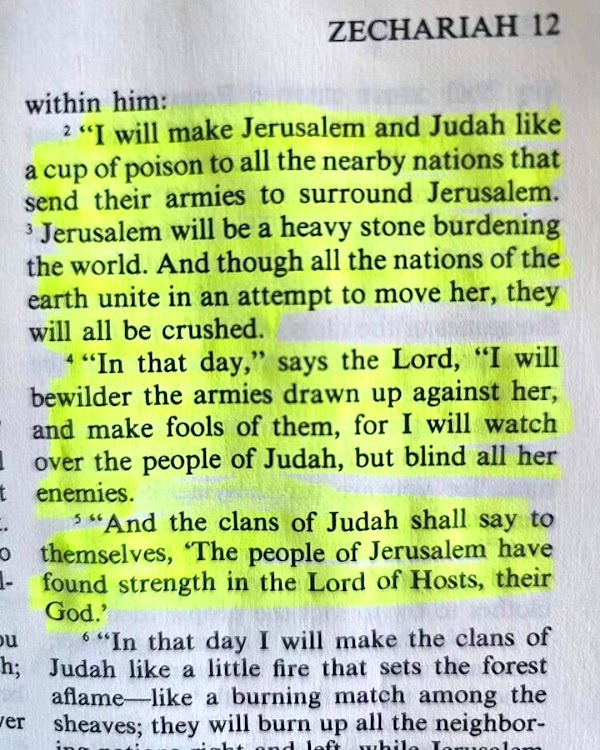
After the Israel-Hamas War began on 7 October 2023, this highlighted bit of Zechariah started making the rounds on social media, usually captioned, “This is going to happen very soon. Watch.”

Zechariah 12.2-5, Living Bible.
From the 1971 edition of The Living Bible.

Memes like this are very popular with people who worry about the End Times, who want to know when it’s time to start buying the food buckets and guns for their bunkers.

The way Darbyist “prophecy scholars” interpret the End Times, every time they come across a passage of scripture which appears to be about anything in their End Times Timeline, they immediately declare that’s precisely what it is. God said it, and his prophets recorded it, not for the people of their day; not for the ancient Israelis of millennia ago. Oh they might’ve thought it was for them, but they were just illiterate foreigners who lived in mud huts without electricity and science, and didn’t even speak English—it’s for us, for the people of our day, for God’s actual chosen people.

The actual context of the scripture doesn’t matter. It only means what we want it to mean. It shall accomplish that which we please, and it shall prosper in the thing whereto we sent it. As for what God meant by it?… well surely he thinks like we do.

Yeah, it’s pretty darned arrogant of these interpreters. But they’re so desperate to find End Times puzzle pieces in the bible which fit into their timelines—however awkwardly—they’re often not even aware what they’re doing. It’s like a child who’s so intent on drawing the perfect picture of a unicorn… she doesn’t realize she’s using permanent markers on the penboard. Or, really, care. Rebuke her for it, and she’ll wonder what all the fuss is about—it’s such a good picture! Why should you want to erase it?

So, Zechariah 12. What’s it historically about? Glad you asked. Let’s take a look at it.

19 October 2023

Those accused of heresy for their End Times views.

That’d include me.

My view of the End Times is preterist—meaning most of the prophecies in Daniel, Revelation, and the Olivet Discourse were fulfilled by the second century of the Christian Era. Obviously Jesus has yet to return, the millennium hasn’t yet started, and New Heaven and New Earth have not yet replaced the current heavens and earth. So not everything has been fulfilled; duh. But just about everything else has.

And when I tell certain Christians this, they’re horrified. Horrified. It’s like I sprouted horns and a tail right in front of ’em, and suddenly I have a pitchfork in my hand, and the flames of hell burst forth behind me as I laugh evilly.

’Cause somehow it got in their heads that if you believe any differently than they about the End Times—or believe any variant other than “premillennial dispensationalism”—generally meaning the various Darbyist End Times timelines proposed by Hal Lindsey, Tim LaHaye, John Hagee, or your favorite prognosticating TV and internet preachers—you don’t believe the bible. Because all their beliefs come from bible. True, they had to massage, finesse, tweak, ditch the historical context, overlay a whole new context, bend, fold, spindle, and mutilate it till it finally means what their favorite “prophecy scholars” insist it means.

Interpreting it in its actual interpretive context, like I do… well their “prophecy scholars” have regularly told them any systems of interpretation other than theirs, are flat-out wrong. They’ve never even heard of “apocalyptic literature,” or think “apocalypse” only means “the very End.” And if they haven’t heard of it, surely it must be wrong. Surely I must be wrong.

And if I’m teaching people wrongly about the End Times… well that’s just extra wrong, in their minds. Why, I might convince people to not watch out for evil. To ignore all the signs of the times. To dismiss the Beast when he finally appears; maybe even convince people to follow him! To not look for Jesus’s second coming, like we’re supposed to.

In short, they think I’m heretic. Worse—that I’m deliberately interpreting bible wrong, deliberately leading people astray, deliberately working for the devil. They think I’m going to hell. When I tell ’em I’m preterist, some of them physically back away, as if at any second the fire and sulfur will fall from heaven to consume me, and maybe scorch them a little if they’re too close.

Their favorite “prophecy scholars” don’t discourage this attitude and behavior at all. They kinda share it. They’re entirely sure they’re right and every non-Darbyist is wrong; they’re helping lead people to Jesus, and every non-Darbyist is hindering, and that’s as good as following Satan.

Okay. Lemme first of all remind you heretic is simply the opposite of “orthodox.” There are certain non-negotiable things every Christian oughta believe. We oughta believe in God; we oughta follow Jesus; we oughta believe he’s alive not dead; we oughta believe he’s returning. These basics are spelled out in the creeds. Some churches add to the creeds, but no churches should be taking doctrines away from them. And the creeds expect us to only believe the following five things about the End:

  • Jesus is coming again in glory.
  • There’s a bodily resurrection of the dead.
  • Jesus will judge the living and the dead.
  • There’s eternal life in the world to come.
  • Jesus’s kingdom will have no end.

Those are non-negotiable. Everything else is negotiable.

But, like I said, plenty of Darbyists are entirely sure their beliefs are just as non-negotiable as the creedal, orthodox stuff. And if you don’t believe as they do, you’re not Christian, and going to hell.

Yep, they think I’m going to hell. And if I convince you Darbyism is all wet, they think I’m dragging you to hell with me.

18 October 2023

Other English-language bibles in the 1600s and 1700s.

No doubt you’ve heard of the King James Version. But KJV fans and worshipers tend to be oblivious to the fact there were other English-language translations of the bible in that day. The KJV was one of many.

The KJV came out ahead of the pack, not because it was better than the rest—it was just as good as the rest—but because James Stuart, king of Scotland and England, suppressed the other existing translations… for political reasons. Y’see the Geneva Bible—the most popular translation of the day, the bible of William Shakespeare and the Pilgrims of Plymouth Rock—flat-out said in its notes Christians should resist tyrants. Unwelcome words to Stuart, who grew up in France and kinda coveted the French kings’ absolute dictatorships. Stuart’s son Charles was later overthrown and beheaded by Parliament for trying to create that kind of monarchy.

The KJV is debatably an improvement on its predecessors—the Tyndale Bible, Matthew’s Bible, the Bishops Bible, and the Geneva Bible among them. But KJV fans take it as a given these were inferior bibles, and haven’t a clue how good and valuable a bible the Geneva Bible was in its day. Usually because they’ve never even heard of it. Many KJV fans like Jack T. Chick like to pretend it never existed. The KJV fans never looked into its history, never took a peek at the previous English translations, and just assumed newer must mean better… until we start talking about present-day translations, and then suddenly newer isn’t better.

Naturally KJV fans know nothing about the KJV’s English-language successors. At least not till the 1881 Revised Version (adapted for the United States as the 1901 American Standard Version), which again, fans dismiss as irrelevant because it doesn’t base the New Testament on the Textus Receptus; as if the KJV translators bothered to look at the Textus most of the time; and as if they actually know why the Textus would be better than current Greek bibles. (It’s not, though.)

Usually they also don’t know about the KJV’s own revisions. They all know it was published in 1611; they don’t know the translators made more than 300 corrections to the text before its second printing in 1613. And that doesn’t even count the spelling. Spelling wasn’t standardized yet, so anyone could spell anything any which way, so long that people understood what they meant. So silent letters got dropped (“owne” became “own,” or “diddest” became “didst,” or “goe” became “go”) and minor grammatical and verbal changes were made (“you” became “ye” 82 times, “lift” became “lifted” 51 times, and so forth; “cheweth cud” became “cheweth the cud,” Lv 11.3 or “reign therefore” became “therefore reign.” Ro 6.12).

Minor changes, but lots of people felt free to make minor changes thereafter. Noah Webster produced an edition of the KJV in 1833 which Americanized the spelling. C.I. Scofield’s 1909 reference bible replaces hundreds of words from the KJV with what Scofield felt were much better translations.

These changes kinda let us in on the biggest problem with the KJV: It’s written in old-timey English. Not just old-timey English from our point of view; it was old-timey for 1611. The KJV’s translators—as they say in their preface!—didn’t actually want to create a whole new translation; they only wanted to fix existing ones. They considered themselves part of the translation tradition which extended all the way back to William Tyndale in 1522. But they hadn’t adjusted for the way language evolved over that century. Only poets and Quakers were referring to one another as “thee” and “thou” anymore, yet the KJV is full of these out-of-date pronouns. Vocabulary and styles were changing. Bibles always need to be translated to fit the way people currently speak—not demand people first learn how people used to speak. That may be fine for literature classes, but sucks in evangelism.

The other issue back then was the discovery of new ancient manuscripts. The Textus Receptus, the Greek New Testament the early English translations were based on, is full of errors. (That’s on purpose. Its editors wanted to include every word found in every available Greek manuscript. So of course that’d include any errors which crept into any bibles over the past 15 centuries.) But in 1627, King Charles Stuart 1 was given the Codex Alexandrinus by St. Cyril Lucaris, patriarch of Alexandria—a near-complete parchment copy of the Septuagint and New Testament, dating from the 400s, although some traditions claim it was copied earlier. It went to the British Museum; it’s been there ever since; English and Scottish scholars had full access to it. Totally could fix all the errors the Textus had put in the KJV.

So when the Puritans under Oliver Cromwell took over England in 1649, Parliament eventually created a commission to work on updating the bible. Unfortunately nothing ever came of it. Why not? Cromwell expelled them in 1653 for not holding new elections. New bibles had to wait.

In the meanwhile, Puritans created paraphrases—bibles and New Testaments where they translated the KJV into present-day English. (With big long book titles, which is what people did back then.) Like John Dale’s Bible Explained in 1652. Or Henry Hammond’s A Paraphrase and Annotations upon All the Books of the New Testament, Briefly Explaining All the Difficult Places Thereof in 1675. Or Richard Baxter’s New Testament with Paraphrase and Notes in 1685. Or Daniel Whitby’s A Paraphrase and Commentary upon All the Epistles of the New Testament in 1700. Or the volumes of John Guyse’s The Practical Expositor, or an Exposition of the New Testament, in the Form of a Paraphrase, with Occasional Notes in 1739-52—which John Wesley later used for his 1755 Explanatory Notes on the New Testament.

I should point out these paraphrases aren’t like the Living Bible or The Voice, in which the writers take creative license with the text; nor like the 2015 Amplified Bible, in which they try to shoehorn popular Evangelical doctrines and beliefs into it. They weren’t really trying to create new bible versions. They were trying to interpret it for their readers. Like when an expositor is analyzing a new bible verse, and briefly puts it in her own words: She’s just trying to make it more understandable.

16 October 2023

Does God have the right to judge anyone?

Throughout the bible it’s taken for granted that God has every right to judge humanity for sin. He created us, created this planet for us to take care of, and set the terms and conditions for us to live by. Either we trust him, follow them, and be blessed by his aid and comfort… or we don’t, won’t, and fall subject to every natural disaster there is.

For that matter, as spelled out in God’s TOS, he also reserves the right to sic some of those disasters on us—triggering recessions, causing droughts, provoking invaders, starting fires, dropping meteors, blotting out the sun. And that’s not just Old Testament behavior either. Revelation tells of him doing that stuff during the Christian Era as well.

And pagans and nontheists find the very idea of this behavior really offensive. God judging humanity? God condemning humanity? God punishing humanity? How dare he?

To pagans, that’s not the behavior of a loving God. A loving God would never. He’d bail us out of all our problems and clean up all our messes. He’d never send a giant flood to wipe out sinners; he’d never dump burning sulfur on Sodom to destroy its rapists; he’d never kill all the firstborn Egyptians to convince their pharaoh to free Israel; he’d never task Israel with genocidally wiping out the Amorites to take their land; he’d never task Assyria and Babylon and Rome with near-genocidally wiping out the Israelis who’d gone pagan. A loving God would at the very most mitigate evil, or make it very very hard for humans to commit it. But he would never stop it cold in its tracks by smiting the evildoers.

Or he would… but they’d have to really be evildoers. Like murderous dictators and their soldiers. He’d strategically smite them. But the “collateral damage,” as our militaries call it, of civilians who lived near by, or innocent family members who somehow weren’t actively or quietly supporting them in their evildoing: God would somehow spare them. He’s God; he could figure out how to target them precisely, and spare innocents… and then somehow make sure those “innocents” never get radicalized against God and his people for taking away their loved ones.

As for nontheists, they insist there is no God judging humanity or mitigating evil. That’s just people murdering other people same as always, and using God to justify ourselves. The bible is merely a book of myths; Israelis conquered their neighbors, then inserted God into their stories and claimed it was all his idea. Then Jesus showed up centuries later and said no, God is love—which is a nice idea, but Jesus must be talking about a different God than the one his ancestors invented, ’cause that guy is all smitey.

Okay. There are gonna be various pagans and nontheists who come at this issue from other directions, but I think I’ve laid out the general idea here: The scriptures reveal God as someone who represses or stops evil, and doesn’t rule out destruction and death and war as ways of doing so. And the skeptics argue he can’t do it these ways, for that’d make him evil. Captain America can shoot bad guys and remain noble and virtuous and good… but God can’t.

02 October 2023

Are you experienced?

Every so often someone’ll ask me, “How do you know there’s a God?”

This isn’t a rhetorical question. They aren’t looking for Christian apologists’ various proofs for God’s existence, and would in fact be very annoyed if that’s what I gave them: “Well we know there’s a God because the universe works on cause-and-effect, and if we trace all the causes back to a first cause…” Yeah yeah, they’ve heardd the “unmoved mover” idea before. They don’t care about deducing God’s existence through reason.

And if that’s the only basis I have for believing in God, they’ll move on. They’re not looking for a logical argument. They’re looking for God Himself. Have I, me, K.W. Leslie, the guy who talks about God as if he’s met him personally, encountered God Himself?

Yep. Met him personally.

No, really.

No, really. Three decades ago I was attending a largely cessationist church. There were some Christians in that church who were exceptions, who believed God still does stuff; but there weren’t many, and they weren’t in leadership. I had heard God still does stuff through some of their testimonies, and sometimes missionaries would visit, preach, and share their God-experiences; and sometimes people would leave copies of Guideposts Magazine—which is pretty much all about God-experiences. So I knew some Christians had ’em. I just figured I didn’t; not really.

So I told God to either reveal himself, or I was giving up on Christianity. I didn’t give him a deadline; I just figured I’d gradually fade out of church attendance, much like my high school friends had. Maybe I’d try Buddhism or something. Meanwhile I’d pay attention, ’cause you never know; maybe he’d show up!

And he did. And no, that wasn’t the only time. He’s revealed himself in many different ways, many times since, on a frequent basis. No way I’m ever quitting now. I might, and have, quit an individual church if they go bad. But never Jesus.

Whereas the folks in that cessationist church weren’t entirely sure “met him personally” is even a valid option when we’re talking with people who have questions and doubts. Most have been taught the usual God-damned rubbish that God stopped personally intervening in the universe, stopped interacting with his kids once the bible was completed or science was invented; that the only way to encounter God anymore is through a near-death experience. Miracles have ceased, and any “miracles” you hear of today aren’t God-things; they’re Beelzebub-things.

And of course these folks insist they’ve never seen a miracle, and since they presume (sorta arrogantly) they’re the standard for what’s “normal” in our universe: If miracles never happened for them, they never happen for anyone.

So when I tell these unbelieving Christians I met God—and continue to meet God—they figure I have a screw loose. Because deep down that’s really what they believe about God: Believing in him is screwy. He’s a figment. He’s imaginary. He doesn’t interact with the real world, and isn’t remotely “real” in that sense. He’s a platonic ideal or an anthropomorphized abstract. He’s myth.

The very idea God’s substantively real… kinda scares them a little. ’Cause that’d mean they should take God a lot more seriously than they currently do. Right now the idea of an impossibly distant, remote, otherworldly, outside-our-universe and doesn’t-intervene God kinda works for them. They’re comfortable with the arrangement: God expects nothing more of us than that we intellectually accept his existence and Jesus’s kingship, and in exchange he’ll graciously let us into heaven. Done deal. Easy-peasy.

Only problem: That’s not who God is, nor all he expects of us. We know better. He wants us to take much, much bigger steps. But before we ever do that—before we get radical about our Christianity (and hopefully not in crazy legalistic ways), we wanna know our religion isn’t based on wishful thinking. We wanna know there’s a real live God behind it all.

There is. If you’re Christian, he lives inside you. You wanna see him? You wanna silence your doubts about his existence for good and all? Then you gotta put aside that imaginary-God manure and start treating him like he’s real. And you’re gonna discover that all this time, while you weren’t paying attention ’cause you were too busy playing church, God’s been here all along.

27 September 2023

Partisanship is a work of the flesh.

In Paul’s list of works of the flesh in Galatians, one of the words he used is ἐριθεῖαι/epitheíe. The King James Version translates it as “strife;” the ESV went with “rivalries,” and the NIV and NASB with “selfish ambition.” I translate it “partisanship.”

No, I didn’t translate it this way because I wanna rebuke partisanship, and needed a bible verse to back me up. I got it out of Greek dictionaries when I translated this Galatians passage years ago. I’ll quote ’em for you. My Liddell-Scott-Jones lexicon has this:

ἘΡΙ̅ΘΕΊΑ epiθ'eɪ.ɑ noun. Labor for wages. Hesychius, “Lexicography”
2. Canvassing for public office. Intriguing. Aristotle, “Politics.”
3. Selfish or factious ambition. Jm 3.14, Pp 1.17 Intrigues, party squabbles. Ga 5.20

Joseph H. Thayer has this in his lexicon:

eritheias (eritheuō to spin wool, work in wool, Heliodorus 1.5 middle in the same sense; Tb 2.11 used of those who electioneer for office, courting popular applause by trickery and low arts; Aristotle, “Politics” 5.3 the verb is derived from erithos working for hire, a hireling; from the Maced. age down, a spinner or weaver, a worker in wool; Is 38.12 LXX a mean, sordid fellow), electioneering or intriguing for office; Aristotle 5.2-3 hence apparently in the New Testament a courting distinction, a desire to put oneself forward, a partisan and factious spirit which does not disdain low arts; partisanship, factiousness; Jm 3.14, 16, Pp 1.16, 2.3 Ignatius “Philadelphians” 8 equivalent to contending against God. Ro 2.8, 2Co 12.20, Ga 5.20

Lastly a contemporary Greek teacher, William D. Mounce:

the service of a party, party spirit; feud, faction; 2Co 12.20 contentious disposition, selfish ambition; Ga 5.20, Pp 1.17, 2.3, Jm 3.14 by impl. untowardness, disobedience. Ro 2.8, Jm 3.16

The word was originally used to describe weavers. At some point in the past, weavers began to use their guild to influence city politics—and were willing to do anything it took to gain political power. So the word evolved to mean that instead. It means partisanship.

Galatians 5.19-21 KWL
19Fleshly works are obvious in anyone who practices the following:
Promiscuity. Uncleanness. Unethical behavior.
20Idolatry. Addiction. Hatred. Rabble-rousing.
Too much zeal. Anger. Partisanship. Separatism. Heresy.
21Envy. Intoxication. Constant partying.
And other people like these.
I warn you of them just like I warned you before:
Those who do such things won’t inherit God’s kingdom.

Of course partisans are gonna seriously be in denial about this. Which is why they tell me, “It only says partisanship because you made it say that,” and point to other translations they like much better. Translations which imply it’s totally okay for them to be partisan!

Okay… but in those other translations it says “strife,” “rivalries,” and “selfish ambition.” Don’t partisans regularly do that stuff too?

26 September 2023

Wanna feel the Holy Spirit? Crank up the bass.

Wanna feel the Holy Spirit? Crank up the bass.

I joke all the time about this with the people in my church: If you want people to really feel like the Holy Spirit is in the building, get on the soundboard and make sure the bass guitar, the bass drum, and all the lower notes on the keyboard, are cranked all the way up to 11. Conversely if you want ’em to feel like he’s missing, you do the opposite and turn all of ’em off.

It’s one of those jokes which is funny because it’s true. If you actually did this, it’s actually how people would respond. The higher the bass, the more people “felt” the Spirit move. Turn it all the way down and you’ll get, “I don’t know what was wrong this morning, but I wasn’t really feeling the Spirit today.”

’Cause bass causes stuff in the building to vibrate. Including people. Most of us know this already… but we never really think about how else it affects us.

Go to any movie theater and you know they make darned sure there are subwoofers under the floor, and they’re cranked all the way up. They want you to feel every crash, bang, gunshot, and explosion in that movie. Low sound waves shake your innards, and turn a spectacle into an experience.

Same with dance clubs. Same with concerts. People weep at concerts. Same as they’ll weep at worship services. It doesn’t always register how this is the physical effect of soundwaves, and how our brains have connected the sensation to our emotions, so it triggers us. All we know is we feel.

So when people don’t know there’s a difference between spirit and emotion (or even when we’re totally aware of this fact, but we’ve never bothered to discern which is which), we’ll assume the feelings are the Spirit at work. Especially when it feels really good.

Conversely, when “my spirit is downcast,” we’re still talking about emotions and sensations. Not anything the Spirit is actually doing—and he’s usually doing quite a lot! But because we don’t feel something positive, we presume he must be absent.

This isn’t a uniquely Christian thing. Most people don’t know the difference between spirit and emotion. Most people don’t think there is any difference. Pagans in particular, but I’ve caught even mature Christians making this mistake as well. I know better, and even I slip up sometimes. I’ve yet to meet a Christian who hasn’t.

13 September 2023

Heavens!

HEAVEN 'hɛ.vən noun. The dwelling place of God, his angels, and debatably good humans after they die. Traditionally depicted as above the sky.
2. A euphemism for God himself. [“Sin displeases heaven.”]
3. The sky, perceived as a vault containing the sun, moon, planets, and stars.
4. A place of bliss. [“This is heaven!”]
5. Short for the kingdom of heaven, i.e. God’s kingdom.
6. The state of being in God’s presence, namely after death.
[Heavenly 'hɛv.ən.li adjective.]

As you can see, there are multiple definitions of our word “heaven.” But when Christians talk about heaven, we mean the dwelling place of God. Right?

Not really. In fact not usually.

In my experience, when Christians talk about heaven, we’re actually talking about the kingdom of heaven. In other words, God’s kingdom. Which is meant to happen here on earth. We Christians are supposed to be already living like it’s here—and when Jesus returns, he’ll fully set it up and run it. But too often Christians act like this kingdom does not happen on earth, and never will: It’ll happen in heaven. In the future. After we die. When we do stuff in heaven, “heaven” is always way later. Or we describe the stuff we’ll be doing in New Jerusalem… which is actually in New Heaven, which is not even the same heaven the scriptures typically mean.

I listed six definitions of heaven. No, I’m not gonna therefore say there are six heavens, like C.S. Lewis did when he wrote about four loves. There are likely more definitions of heaven than even that.

But there are Christians who claim there are multiple heavens. Not just the current heaven, and the New Heaven of Revelation 21. There’s the seven heavens of Dante Alighieri’s Paradisio, the 10 heavens of the Pharisees, and the three heavens which you’ll hear Evangelicals talk about ’cause they’ve neither read Paradisio nor 1 Enoch.

Confused yet? Maybe a little. Hope not. Let’s start with the bible’s descriptions of the heavens.